
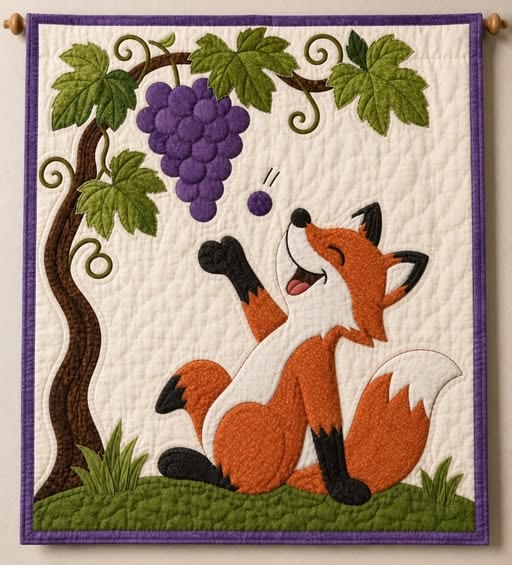
Fox and Grapes Patchwork Panel Pattern is a charming sewing project that combines woodland beauty, playful storytelling, and traditional textile techniques in one decorative piece. Inspired by the image, the design features a cheerful orange fox reaching toward a bunch of purple grapes beneath a leafy vine, while a curved brown tree and green landscape complete the scene. The composition works especially well as a fabric wall hanging, a nursery decoration, a seasonal panel, or a handmade gift for someone who appreciates animals and nature. Although the finished artwork looks detailed, the project can be divided into manageable sections, allowing both confident beginners and experienced quilters to enjoy the creative process. By preparing the templates carefully and assembling the shapes in layers, you can reproduce the visual depth of the original panel without needing advanced drawing skills. The most important qualities are patience, accurate cutting, and a willingness to adjust the arrangement before permanently attaching the appliqué pieces.
This fox patchwork pattern uses a combination of piecing, appliqué, quilting, and decorative stitching. Patchwork traditionally refers to joining pieces of fabric to create a larger textile surface, while appliqué is the technique of placing smaller fabric shapes over a background and sewing them into position. In this design, the cream fabric forms the foundation, while separate shapes create the fox, grapes, tree trunk, leaves, grass, vines, and other details. The quilted texture visible across the background gives the panel softness and character, while the contrasting purple border frames the artwork and connects visually with the grapes. Each material contributes to the overall result, so choosing fabrics with suitable colors, textures, and values is just as important as following the construction steps. You do not need to copy every color exactly, but maintaining a clear contrast between the background and the appliqué pieces will help the main elements remain easy to recognize.
Before beginning the Fox and Grapes Patchwork Panel Pattern, decide how large you want the finished panel to be. A medium wall hanging is convenient because the animal and leaf details remain large enough to cut and sew comfortably, while the complete project is still easy to handle on a domestic sewing machine. You can enlarge or reduce the templates, provided that every piece is resized by the same percentage. It is also helpful to make a full-size paper layout before cutting your chosen fabrics, because the paper version allows you to study the proportions, test the placement, and correct any awkward spaces. The original composition has a strong visual balance: the tree and grapes occupy the upper-left area, the fox becomes the central focal point, and the green ground anchors the design along the bottom. Recreating this balance will make the finished patchwork panel pattern look polished, expressive, and suitable for display.
Materials and Preparation for the Patchwork Panel
Begin by selecting a light cream or warm white cotton for the main background. A slightly textured fabric can give the panel a handmade appearance, but avoid a print that is too busy because it may compete with the appliqué. Cut the background several inches larger than your intended finished measurement so there is room for quilting, trimming, and attaching the border.
DISCOVER MORE FREE PATTERNS HERE!
For the fox, choose a medium or deep orange cotton, along with white or ivory fabric for the chest, muzzle, face, and tail tip. You will also need black or very dark charcoal fabric for the paws, ears, nose, and leg markings. These contrasting fabrics are essential because they define the recognizable features of the fox appliqué pattern.
The grapes can be made from multiple purple circles or oval shapes. Using two or three purple shades adds dimension, although a single purple fabric will also work. A small piece of matching purple fabric can be used for the grape that appears to be tossed above the fox, creating the playful movement seen in the reference design.
Prepare several green fabrics for the leaves, grass, hills, and ground. A variety of olive, moss, forest, and fresh green tones will keep the vegetation from appearing flat. The leaves should be darker than the background, while the lower landscape can include medium and dark greens to create visual depth.
You will also need brown fabric for the tree trunk and branches, plus a narrow strip of purple fabric for the inner border. Additional supplies include lightweight fusible web, coordinating thread, batting, backing fabric, fabric scissors, pins, an iron, a sewing machine, and a removable fabric-marking tool. A pressing cloth is useful when working with fusible adhesive.
Wash and press the fabrics before cutting, particularly when using different brands or fabric types. Prewashing reduces the risk of uneven shrinkage after the completed panel is cleaned. Press every fabric smoothly, label the colors, and organize the pieces by design section so that the assembly of the Fox and Grapes Patchwork Panel Pattern remains orderly.
Creating the Templates and Appliqué Elements
Start by drawing or tracing the principal shapes onto paper. Separate the illustration into simple components: tree trunk, branches, grape circles, leaves, vine curls, fox body, head, ears, legs, paws, chest, muzzle, tail, and grass. Complicated shapes become easier when divided into overlapping layers rather than cut as one large piece.
Remember that templates traced onto the paper side of fusible web may need to be reversed. This is especially important for the fox, because its direction and posture contribute greatly to the composition. Trace each template clearly, leave a small space between the shapes, and write the fabric color or placement name inside every outline.
Fuse the adhesive pieces to the wrong sides of the chosen fabrics according to the manufacturer’s directions. Avoid overheating the adhesive, since excessive heat may make the fabric stiff or cause the glue to spread. After the fabric has cooled, carefully cut each shape along its traced line using sharp scissors.
Create the grape cluster by cutting several rounded shapes of slightly different sizes. Overlap the grapes so the cluster resembles a natural bunch rather than a group of evenly spaced circles. Place the darker grapes around the lower or shaded areas and reserve lighter purple pieces for sections that should appear closer to the viewer.
For the leaves, cut broad shapes with pointed edges and slightly irregular outlines. You can add vein lines later with free-motion quilting, straight stitching, or hand embroidery. The curling vine sections may be cut from narrow brown or green fabric strips, or created with dense satin stitching if cutting such thin shapes feels difficult.
Arrange all the prepared pieces on a full-size paper guide before transferring them to the fabric background. Check that the fox can reach visually toward the grapes, that the tree does not overpower the animal, and that enough open space remains around the shapes. This planning stage is fundamental to a successful appliqué quilt panel.
Assembling and Sewing the Fox and Grapes Design
Place the cream background fabric on a flat pressing surface and lightly mark the finished boundaries. Begin the arrangement with the largest structural pieces, usually the tree trunk, lower green landscape, fox body, and tail. Do not remove every paper backing immediately; position the major shapes first so you can make corrections.
Add the fox’s white chest and face sections over the orange body. Next, place the dark paws, legs, ear interiors, and nose. The overlap order should imitate natural anatomy, with rear sections positioned first and foreground pieces placed last. This layering gives the fox patchwork design depth and prevents distracting gaps.
Position the tree branches, grape cluster, leaves, and curling vines across the upper area. The leaves may overlap the branches, while some branches can disappear behind the grapes. Place the single purple grape above the fox’s nose and add two small stitched motion marks later to suggest that the fruit is moving.
Once you are satisfied with the complete composition, follow the fusible web instructions to press the pieces onto the background. Work section by section rather than trying to fuse the entire panel at once. Allow each area to cool before moving the fabric so the appliqué edges remain securely attached.
Stitch around each shape using a narrow zigzag, blanket stitch, satin stitch, or small straight stitch. Dark brown thread works well around the tree, green thread blends into the leaves, and matching orange, purple, black, and white threads create neat edges on the fox and grapes. Contrasting thread may be used when you want a stronger outlined appearance.
Add expressive details after the major appliqué sections are secured. Stitch the fox’s closed eye, smiling mouth, tongue, leaf veins, grape contours, bark lines, and grass blades. These small additions give personality to the Fox and Grapes Patchwork Panel Pattern and transform basic fabric shapes into a lively illustrated scene.
Quilting, Borders, Finishing, and Display
Create a quilt sandwich by placing the backing fabric wrong side up, positioning the batting over it, and laying the appliquéd top right side up. Smooth each layer carefully and baste them together with pins, temporary adhesive, or long hand stitches. Proper basting prevents shifting and unwanted folds during quilting.
Quilt the cream background with gentle curves, loose waves, stippling, or another free-motion design. Keep the quilting lines close enough to control the fabric but not so dense that the panel becomes stiff. Quilting around the appliqué shapes also helps them stand slightly forward from the background.
Add extra quilting inside selected pieces to enhance their texture. Curved lines can suggest the roundness of the grapes, irregular vertical stitching can resemble tree bark, and delicate veins can define the leaves. The green hills may be quilted with horizontal curves that echo the shape of the ground.
Trim the panel carefully so the sides are straight and the corners are square. Attach a narrow purple border to reflect the grape color and frame the central image. A second neutral or coordinating border may be added when you want a larger finished wall hanging, but the design also looks attractive with one strong purple frame.
Finish the edges with traditional quilt binding, facing, or a decorative fabric border. For a wall hanging, sew a fabric sleeve across the upper back before closing the binding. Insert a wooden dowel through the sleeve so the panel can hang evenly without placing stress on the quilted top.
Give the completed Fox and Grapes Patchwork Panel Pattern a final light press from the back, protecting dimensional stitches and appliqué details. Display it away from excessive moisture or continuous direct sunlight. The panel can decorate a sewing room, reading corner, nursery, classroom, or any space that benefits from a warm handmade accent.
Frequently Asked Questions About the Fox and Grapes Patchwork Panel Pattern
What is the Fox and Grapes Patchwork Panel Pattern?
The Fox and Grapes Patchwork Panel Pattern is a decorative textile project featuring a fox, grapes, leaves, vines, a tree, and a grassy landscape. The image is created mainly through appliqué, with additional quilting and embroidery used to add detail and texture.
Is this project suitable for beginners?
A patient beginner can complete the project, especially by using fusible appliqué. The pattern contains several small pieces, so it is wise to begin with larger templates and simplified details. Practicing the chosen appliqué stitch on fabric scraps will also improve confidence.
What type of fabric is best for the panel?
Quilting cotton is generally the easiest material to use because it is stable, easy to cut, and available in many colors. Batiks can also work well for leaves, tree bark, and grass because their subtle variations create natural texture without requiring complicated piecing.
Can the pattern be sewn without fusible web?
Yes. The shapes may be attached with needle-turn appliqué, raw-edge appliqué, freezer-paper appliqué, or turned-edge machine appliqué. Fusible web is simply a convenient option because it holds the pieces in place while they are stitched.
How can I resize the patchwork panel?
Resize every template by the same percentage using a printer or copy machine. Keep in mind that very small reductions may make the paws, vines, facial features, and leaf points difficult to sew. Enlarging the pattern is often easier than reducing it.
Should the appliqué be completed before quilting?
In most cases, the appliqué pieces should be positioned and secured before the quilt sandwich is assembled. Decorative outlining can be completed during the appliqué stage or through all three layers, depending on the amount of texture you want in the final project.
Which stitch is best for raw-edge appliqué?
A narrow zigzag provides dependable edge coverage, while a blanket stitch offers a traditional decorative finish. A small straight stitch creates a softer raw-edge look. Test the stitch width and length on a sample before working on the final fox appliqué panel.
How do I prevent the background from puckering?
Use lightweight fusible web, avoid stretching the background, and press instead of sliding the iron. During stitching, allow the machine to feed the fabric naturally. When quilting, begin near the center and gradually work toward the outer edges.
Can I use leftover fabric scraps?
Yes. This project is an excellent way to use orange, purple, brown, green, white, and black scraps. The pieces do not need to come from the same fabric collection. Coordinating their color values is more important than matching the prints perfectly.
Can the design be turned into another sewing project?
The Fox and Grapes Patchwork Panel Pattern can become a cushion front, tote bag panel, table mat, quilt block, fabric book cover, or centerpiece for a larger quilt. Adjust the template size and quilting density according to the intended use.
How should the finished panel be cleaned?
Remove loose dust gently with a soft brush or low-suction vacuum attachment protected by a clean screen. When washing is necessary, use cool water, mild detergent, and careful handling. Dry the panel flat to preserve its shape and prevent distortion.
How can I make the fox look more expressive?
Small details make a significant difference. Adjust the curve of the stitched eye, the angle of the mouth, the position of the tongue, and the tilt of the ears. The raised paw and floating grape should also align naturally to reinforce the playful action.
Conclusion
The Fox and Grapes Patchwork Panel Pattern brings together fabric selection, template preparation, layered appliqué, decorative stitching, quilting, and careful finishing. By beginning with a full-size layout and working from the largest background elements toward the smallest details, you can reproduce the lively woodland scene in an organized and enjoyable way. The contrasting orange fox, purple grapes, green foliage, brown tree, and cream background make the composition visually clear, while the quilted texture adds warmth and dimension.
EASILY FIND THE PDF FOR THIS PATTERN HERE!
This project can be customized through different fabrics, border colors, stitching methods, and finished sizes. Whether it becomes a wall hanging, cushion, bag panel, or quilt centerpiece, the design offers many opportunities for creative interpretation. Leave your sincere opinion about the project and share your suggestions, preferred colors, or ideas for adapting this Fox and Grapes Patchwork Panel Pattern into another handmade creation.