
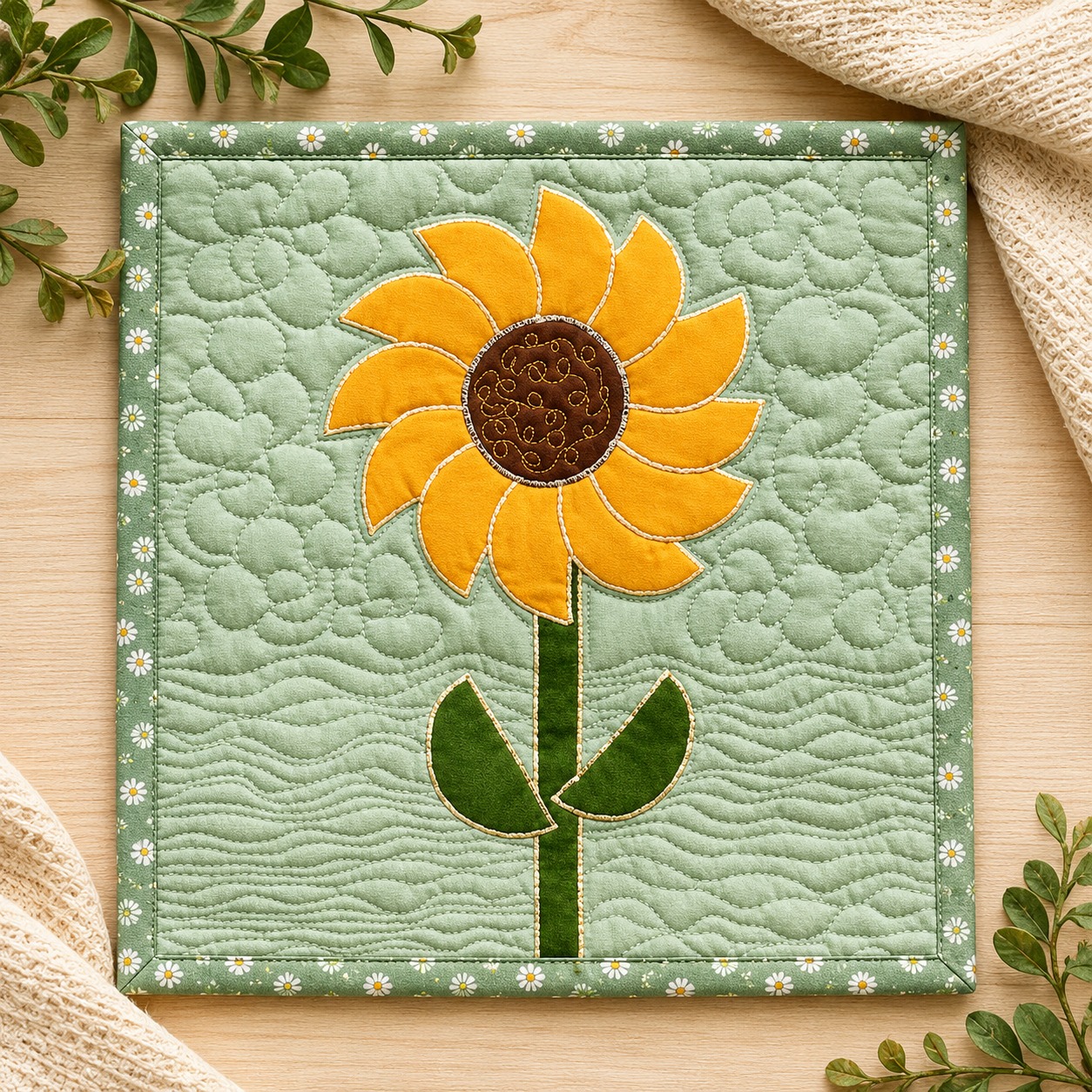
The Sunflower Quilt Panel Pattern is a cheerful fabric project that combines appliqué, quilting, simple piecing, and decorative stitching in one beautiful handmade panel. Inspired by the photograph, the design features a large golden sunflower with curved petals, a rich brown center, a long green stem, and two leaves, all placed over a softly quilted green background. A coordinating floral border frames the composition and gives the piece a polished finish. This type of project is especially appealing because it can be adapted into wall décor, a table mat, a mini quilt, a cushion front, or seasonal farmhouse decoration. Even though the finished piece looks detailed, the individual construction stages are approachable when they are completed in the correct order. The key is to prepare accurate templates, choose fabrics with enough contrast, and quilt the background before or after the appliqué according to your preferred method.
When working with a Sunflower Quilt Panel Pattern, fabric selection has a major influence on the finished appearance. The photograph uses a soft sage-green background that allows the warm sunflower petals to become the visual focus. Golden yellow or mustard fabric works especially well for the petals, while a chocolate or dark brown fabric creates the recognizable sunflower center. Dark green fabric is ideal for the stem and leaves, and a small floral print can be used for the outer border to give the panel a gentle country-inspired personality. Cotton quilting fabric is usually the easiest choice because it presses well, holds its shape, and accepts decorative stitches beautifully. You can also mix subtle prints and solids, provided the fabrics remain balanced enough that the sunflower does not disappear into an overly busy background.
One of the most attractive characteristics of this Sunflower Quilt Panel Pattern is the relationship between the simple appliqué shapes and the textured quilting surrounding them. The background in the reference image contains free-motion floral and flowing line quilting, creating depth without competing with the central motif. Decorative stitching around the petals, leaves, stem, and flower center also gives the appliqué a defined handmade finish. Beginners can simplify these details by using a regular straight stitch, blanket stitch, or narrow zigzag stitch, while more experienced quilters can experiment with free-motion quilting and contrasting thread. The following tutorial explains the entire process from fabric preparation to the final binding, allowing you to recreate the general look of the photographed project while adjusting the measurements and colors for your own creative style.
Materials and Preparation for the Sunflower Quilt Panel Pattern
Start by choosing the approximate finished size of your Sunflower Quilt Panel Pattern. A practical size for a decorative panel is around 40 cm x 45 cm, although you can enlarge or reduce it depending on where you plan to display the project. Cut the background fabric slightly larger than the desired finished measurement so you have extra material available for trimming after quilting. For example, you could cut a piece measuring approximately 44 cm x 49 cm. This extra allowance makes it easier to keep the edges straight after the quilting process.
DISCOVER MORE FREE PATTERNS HERE!
For the quilt sandwich, prepare one piece of cotton batting and one backing fabric piece approximately the same size as the oversized background. The batting gives the project its soft raised texture and makes the quilting stitches more visible. A lightweight or medium-weight batting is usually suitable for a decorative wall panel. Avoid extremely thick batting because it may make the small appliqué details harder to stitch neatly.
Prepare several scraps of golden yellow fabric for the sunflower petals. You will also need dark brown fabric for the center, deep green fabric for the leaves and stem, and coordinating printed fabric for the outer border. A green print containing small white or yellow flowers can reproduce the charming look seen in the photo, but almost any subtle botanical print can work. The important SEO keyword concept here, Sunflower Quilt Panel Pattern, refers to a quilted decorative panel in which sunflower-shaped fabric pieces are arranged and stitched onto a prepared background.
Create paper templates for the appliqué before cutting the fabric. The sunflower can be divided into three main template groups: petals, circular center, and greenery. Make one curved petal template approximately 9 to 11 cm long, then use that template repeatedly while slightly rotating the petals around the center. For greater visual interest, prepare two slightly different petal shapes instead of making every petal identical.
The circular center can measure approximately 9 to 11 cm in diameter, depending on the size of the complete flower. Cut a stem approximately 3 to 4 cm wide and long enough to extend from the flower to the lower border. The leaves can be drawn as simple elongated oval or pointed shapes measuring approximately 10 to 13 cm long. Remember that handmade appliqué does not need mathematical perfection; slight differences between the petals can actually give your sunflower more personality.
Before assembling anything, wash and press the fabric if you normally prewash quilting cotton. Iron every piece carefully because wrinkles can distort small appliqué shapes. Keep a rotary cutter, quilting ruler, fabric scissors, pins or clips, removable fabric marker, sewing machine, coordinating thread, appliqué thread, batting, and iron nearby. Good preparation makes every later stage of the Sunflower Quilt Panel Pattern easier and helps produce cleaner, more accurate results.
Creating and Arranging the Sunflower Appliqué
Begin by tracing the petal templates onto the chosen yellow fabric. If you are using fusible web for raw-edge appliqué, trace the shapes onto the paper side of the fusible material first. Follow the manufacturer’s basic heat-setting directions for the product you already use, then cut the shapes carefully. Fusible appliqué is particularly useful for this project because it keeps numerous curved petals from shifting while they are being stitched.
Arrange the petals on the quilt background before permanently attaching anything. Place the flower center roughly in the upper half of the panel and organize the petals around it in a circular arrangement. The photographed sunflower has a lively rotating appearance, with the petals pointing in slightly different directions rather than forming a perfectly symmetrical ring. This gentle movement is one of the details that gives the Sunflower Quilt Panel Pattern its handmade charm.
After you are satisfied with the petal arrangement, carefully lift the brown center away and secure the yellow petals first. Work gradually so the arrangement does not shift. Once the petals are fixed in place, position the brown center over their inner ends. The center should cover any slightly uneven petal edges, creating a clean circular focal point and making the construction look professionally planned.
Next, position the long green stem beneath the sunflower. Keep it relatively straight but do not worry if it has a slight handmade irregularity. Place two leaves on opposite sides of the stem, angling them upward toward the flower. In the reference project, the leaves are simple and bold, which keeps the composition easy to recognize even from a distance.
Secure the stem and leaves using your preferred appliqué technique. A narrow zigzag stitch, blanket stitch, satin-like edge stitch, or simple straight stitch can all produce attractive results. Decorative light-colored or golden thread can be especially effective around yellow petals because it emphasizes their shapes. If you prefer a subtle look, choose thread that closely matches each appliqué fabric.
Finish the flower center with decorative quilting or free-motion stitching. You can create loops, curls, small circles, spirals, or irregular seed-like motifs across the brown fabric. These stitched details suggest the dense texture of real sunflower seeds without requiring hundreds of tiny fabric pieces. This decorative center is an excellent example of how quilting stitches can become part of the design rather than simply serving a structural purpose.
Quilting the Background and Adding Texture
Once the appliqué is secure, layer the quilt top, batting, and backing fabric. Smooth each layer carefully to eliminate wrinkles, then baste everything together with pins, temporary basting spray, or long hand stitches. Begin quilting near the center and gradually move toward the outside edges. This method helps distribute the fabric evenly and reduces the risk of puckering.
The upper portion of the photographed Sunflower Quilt Panel Pattern uses flowing floral-style quilting that blends naturally with the botanical theme. You can recreate this effect with free-motion loops, petals, leaves, spirals, and rounded shapes. Do not attempt to make every quilting motif identical. Organic quilting usually looks more natural when the curves vary slightly in size and direction.
If free-motion quilting feels intimidating, use simpler alternatives. Gentle wavy lines, evenly spaced curves, or diagonal quilting can provide excellent texture while being easier to control. You could even use the decorative stitches already available on your sewing machine. The goal is not to copy every stitch from the photograph but to create enough quilting to secure the three layers and provide attractive surface texture.
The lower area can be quilted with flowing horizontal lines that resemble gentle waves. Begin at one side and stitch slowly toward the opposite side, changing direction occasionally so the lines remain natural rather than perfectly straight. Continue adding parallel lines approximately 0.5 to 1 cm apart. This technique contrasts nicely with the rounded quilting motifs used near the flower.
When quilting near the sunflower appliqué, avoid stitching directly across the petals unless that effect is intentionally part of your design. Stitching around each shape, sometimes called outline quilting or echo quilting, can make the flower appear slightly raised. One or two lines following the contours of the petals are usually enough. The batting will naturally create a gentle dimensional effect around the appliqué.
After the quilting is completed, place the panel on a cutting mat and square all four sides. Use a long ruler to make sure the corners are approximately 90 degrees. Trim away excess batting and backing carefully. This step is important because accurate edges make the final border or binding much easier to attach and give the completed Sunflower Quilt Panel Pattern a neat rectangular appearance.
Finishing the Border and Displaying the Quilt Panel
The border shown in the photograph is a narrow green floral frame containing tiny daisy-like flowers. To reproduce a similar appearance, cut four fabric strips approximately 4 to 5 cm wide. Attach the side strips first, press them outward, and then attach the top and bottom strips. Depending on the construction method you prefer, this decorative border can be added before the quilt sandwich is assembled or incorporated as a binding-style finishing frame after quilting.
If you want the border to function as traditional quilt binding, cut strips on the straight grain and join them end to end. Fold the long strip in half lengthwise and press it. Sew the raw edges of the binding to the front perimeter of the quilt, fold the binding around to the back, and secure it by hand or machine. Carefully formed corners will make the finished panel appear much cleaner.
For a look closer to the reference image, choose a border fabric containing colors already found in the appliqué. Sage green connects beautifully with the background and leaves, while small yellow and white flowers visually relate to the sunflower. Repeating colors is an easy design technique that makes a quilt feel coordinated even when several prints are being used.
Give the finished Sunflower Quilt Panel Pattern a final gentle press, being careful not to flatten the quilting texture excessively. Inspect the appliqué edges and trim any loose threads. If a section appears slightly uneven, decorative stitching can often be added to improve the finish. Handmade quilting naturally contains small variations, and these details are often part of what gives a fabric project its character.
To turn the panel into wall décor, add a hanging sleeve to the back before completing the final hand stitching on the binding. Another option is to display the quilt on a small wooden quilt hanger. Because the design is relatively compact, it can work well in a kitchen, craft room, entryway, breakfast area, or seasonal decorating arrangement.
The same Sunflower Quilt Panel Pattern can also become the starting point for many other projects. Reduce the design to create a mug rug or potholder, enlarge it for a wall hanging, turn it into a cushion cover, or repeat several sunflowers across a table runner. Once you understand how the petals, center, stem, leaves, quilting, and border work together, it becomes easy to customize the idea with different fabrics and colors.
FAQ About the Sunflower Quilt Panel Pattern
What is a Sunflower Quilt Panel Pattern?
A Sunflower Quilt Panel Pattern is a quilting design that uses a sunflower as the main decorative feature of a fabric panel. The sunflower may be created with traditional piecing, appliqué, raw-edge appliqué, or a combination of techniques. The panel is normally layered with batting and backing, quilted for texture, and finished with binding or a decorative border.
Is this sunflower quilt project suitable for beginners?
Yes. Beginners can make a simplified version by using fusible appliqué and basic machine quilting. Instead of complicated free-motion designs, use straight lines, soft curves, or a simple decorative machine stitch. Working slowly and arranging all pieces before sewing helps make the project much easier.
What fabric is best for a sunflower quilt panel?
High-quality quilting cotton is one of the easiest fabrics to use because it cuts accurately, presses smoothly, and is available in many colors and prints. Cotton blends can also work, but beginners usually find standard quilting cotton more predictable.
How many sunflower petals should I make?
There is no strict number. A medium sunflower can look attractive with approximately 10 to 14 petals, depending on their width and the size of the center. The photographed project has overlapping curved petals, so the exact quantity is less important than achieving an evenly balanced circular arrangement.
Should I quilt before or after adding the appliqué?
Both methods are possible. Quilting after the appliqué allows you to outline the flower and integrate it naturally with the background quilting. Quilting the background first can make the appliqué stand out more prominently. For a project resembling the reference image, assembling the appliqué before completing most of the decorative quilting is a practical approach.
Can I sew the appliqué without fusible web?
Yes. You can use traditional turned-edge appliqué, needle-turn appliqué, freezer-paper templates, glue-basting, or carefully pinned raw-edge appliqué. Fusible web simply makes placement easier, especially when the design contains many petals.
What stitch should I use around sunflower petals?
A blanket stitch, narrow zigzag stitch, satin-style stitch, or straight raw-edge appliqué stitch can all work. Select the technique according to the finish you prefer. Contrasting thread creates strong visual outlines, while matching thread makes the appliqué edges more subtle.
How can I make the sunflower center look textured?
Use free-motion loops, spirals, circles, curls, or irregular seed-like patterns. You can also quilt crossing curved lines to create a subtle seed texture. Dark brown fabric combined with lighter decorative thread makes these details particularly visible.
Can I use different colors instead of yellow and green?
Absolutely. Traditional sunflower colors produce a familiar natural look, but quilting allows plenty of creative freedom. Rust, mustard, gold, burgundy, cream, orange, teal, or even blue could create a more modern interpretation of the Sunflower Quilt Panel Pattern.
What can I make with the finished sunflower panel?
The completed design can be used as a mini quilt, wall hanging, table topper, cushion front, placemat, tote bag panel, seasonal decoration, or centerpiece for a larger quilt. Changing the dimensions of the templates makes it easy to adapt the same concept to many sewing projects.
How do I keep the appliqué pieces from moving while sewing?
Fusible web is one of the simplest solutions. You can also use fabric glue designed for temporary basting, appliqué pins, or careful hand-basting. Always secure the pieces before beginning decorative edge stitching, especially around narrow leaf tips and curved petals.
How do I achieve the raised quilted appearance seen in the photo?
The dimensional look comes from combining batting, dense background quilting, and outline stitching around the appliqué. Areas containing less quilting naturally appear slightly higher than densely stitched sections. Medium-weight batting can help make this contrast more noticeable without making the panel excessively bulky.
Conclusion
The Sunflower Quilt Panel Pattern is a rewarding project for anyone who enjoys combining appliqué, quilting, decorative stitching, and colorful fabric design. Throughout this tutorial, you learned how to prepare the fabric, create sunflower templates, arrange the petals, attach the flower center, add the stem and leaves, build a quilt sandwich, quilt decorative background textures, square the panel, and finish everything with a coordinating border.
The most important part of creating this design is not making every petal or quilting line perfectly identical. A handmade sunflower gains much of its beauty from small variations in the shapes, stitches, and fabric textures. By choosing a strong yellow for the petals, rich brown for the center, natural green for the foliage, and a soft contrasting background, you can create a Sunflower Quilt Panel Pattern that immediately becomes the focal point of a room.
EASILY FIND THE FREE PDF FOR THIS PATTERN HERE!
You can also use this project as a foundation for your own variations. Try different floral borders, experiment with golden decorative stitches, enlarge the appliqué, create multiple flowers, or transform the design into a pillow, runner, or larger quilt. Once the basic construction method is understood, there are many possibilities for making the pattern uniquely yours. If you decide to make this Sunflower Quilt Panel Pattern, leave your sincere opinion about the project and share your suggestions. It would be wonderful to know which colors, quilting stitches, borders, or creative variations you would choose for your own sunflower panel.