
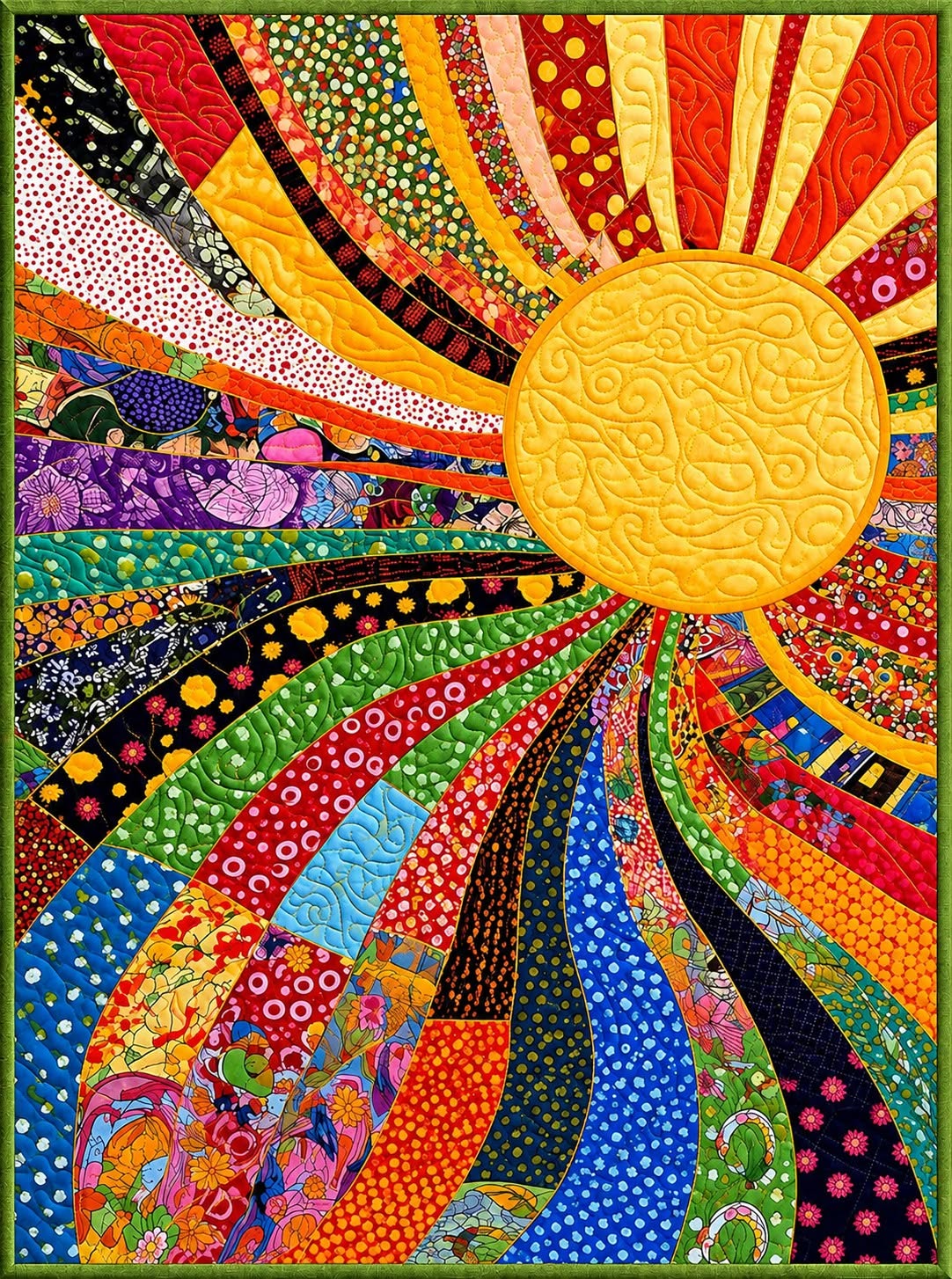
The Radiant Sunburst Bedspread Fabric Pattern is a joyful quilting project that transforms colorful fabric scraps into a dramatic circular composition inspired by the rays of the sun. The design shown in the reference image combines curved fabric strips, vivid prints, contrasting colors, and a large golden center to create a striking visual movement across the entire quilt surface.
What makes this design especially appealing is the way each fabric section seems to radiate outward from the center while still maintaining an organic, handmade personality.
Instead of relying on perfectly identical strips, the quilt gains character through variations in width, print, direction, and color.
This makes the project an excellent opportunity to use leftover quilting cotton, treasured fabric scraps, or coordinated fat quarters from previous sewing projects.
The curved sunburst arrangement also creates a sense of energy that works beautifully on a bedspread, wall quilt, decorative throw, or oversized textile panel.
For quilters who enjoy combining precision with creative freedom, this pattern offers both structure and plenty of room for personal interpretation.
Creating a Radiant Sunburst Bedspread Fabric Pattern is also a wonderful way to explore several important quilting techniques in one project. You will work with fabric selection, curved piecing, strip construction, appliqué-style layering, quilting, pressing, and finishing techniques.
Although the finished design looks complex, it can be approached gradually by dividing the sunburst into manageable sections.
The most important element is not perfect symmetry but visual balance, because the beauty of the project comes from the interaction between colors, curves, and printed fabrics.
Bright reds, oranges, yellows, blues, greens, purples, and floral patterns can all coexist successfully when they are distributed thoughtfully throughout the design.
The central golden circle acts as a visual anchor, giving the eye a calm resting point surrounded by the energetic movement of the fabric rays.
With careful preparation and patient assembly, even an ambitious-looking quilt like this becomes achievable through a logical step-by-step process.
Another advantage of the Radiant Sunburst Bedspread Fabric Pattern is its flexibility. You can make a large quilt for a bed, reduce the pattern for a wall hanging, or create smaller versions for pillows and decorative panels.
The same basic construction principles remain useful regardless of the final size.
Because every ray can be made from a different fabric, this project is particularly suitable for scrap quilting and sustainable sewing practices that make good use of fabric already available in your sewing room.
The image also demonstrates how effective contrast can be: dark navy and black prints are positioned beside bright yellow, orange, green, and red sections, making every curve easier to distinguish.
Small floral motifs, dots, geometric prints, and novelty fabrics add another layer of visual interest without overwhelming the design.
The result is a quilt that feels spontaneous and artistic while still being grounded in traditional patchwork construction.
Choosing Fabrics and Preparing the Sunburst Design
The first step in making a Radiant Sunburst Bedspread Fabric Pattern is selecting a generous range of quilting fabrics. Choose approximately 25 to 40 different prints if you want the rich, scrappy appearance seen in the reference design. You can certainly use fewer fabrics, but a larger variety will help create the lively patchwork effect that gives this project its distinctive personality.
DISCOVER MORE FREE PATTERNS HERE!
Start by sorting your fabrics into broad color families such as yellow, orange, red, blue, green, purple, and dark neutrals. This does not mean every color must appear in equal quantities. Instead, think about how the colors will travel around the quilt and how light and dark fabrics can alternate to create strong contrast between neighboring rays.
The term Radiant Sunburst Bedspread Fabric Pattern refers to the radiating arrangement of fabric pieces that extend outward from a circular center. In this type of quilt, the eye naturally follows the curves and lines moving away from the center, creating an impression of sunlight, spinning motion, or flowing ribbons. Understanding this visual principle will help you plan the placement of your fabrics.
Wash and press your fabrics before cutting if you normally prewash quilting cotton. Pressing is especially important because curved pieces are much easier to cut and sew accurately when the fabric lies completely flat. Avoid stretching the fabric aggressively with the iron, particularly when working with curved edges or pieces cut near the bias.
Create a full-size paper template or several reusable templates for your curved rays. Some rays can be wide, while others can be narrow. Adding subtle differences in shape will help reproduce the free-flowing appearance of the original project. Remember to include a seam allowance of approximately 0.6 cm around every piece if it is not already incorporated into your template.
Before sewing anything permanently, arrange several fabric pieces on a large table, bed, or design wall. Step away from the layout occasionally and look at the entire composition. If two similar colors are touching too frequently, replace one with a contrasting print. This simple planning stage can dramatically improve the final appearance of your Radiant Sunburst Bedspread Fabric Pattern.
Cutting and Sewing the Curved Fabric Rays
Begin cutting the rays using your prepared templates. A rotary cutter and cutting mat are helpful, but scissors can also work well when cutting complex curves. Label pieces when necessary so you remember the intended order, especially if you have already planned specific color combinations for different areas of the quilt.
For a highly scrappy design, construct some rays from multiple smaller fabric pieces instead of using one continuous strip. Sew short sections together first, press the seams, and then cut the completed patchwork strip into the required curved shape. This creates the interesting mixture of florals, dots, checks, and geometric patterns visible throughout the inspiration image.
Curved piecing becomes easier when you work slowly. Place two neighboring pieces right sides together and match the beginning, middle, and end of the curves. Use several pins or clips to distribute the fabric evenly. Sew with a consistent seam allowance and avoid pulling the fabric as it passes under the presser foot.
After sewing each curved seam, carefully press it before adding another piece. Pressing toward the darker fabric is often practical, although the direction may need to change when several seams meet. For very curved seams, make small clips in the seam allowance without cutting through the stitching. These clips allow the seam to relax and lie flatter.
Continue building larger sections of connected rays rather than attempting to assemble the entire quilt at once. For example, you might create four or six large sunburst sections and then join those sections together. Working in manageable units makes it easier to control distortion and allows you to check the overall color distribution during construction.
As the rays grow, place them on your design surface frequently. Look for a balanced mixture of bright quilting fabrics, darker accents, large prints, small prints, and solid-looking textures. The goal is not mathematical perfection. The charm of the Radiant Sunburst Bedspread Fabric Pattern comes from its energetic combination of irregular shapes and thoughtfully distributed colors.
Creating the Golden Center and Assembling the Quilt Top
The large golden circle is the visual heart of the design. Choose a warm yellow, golden orange, or softly textured fabric that contrasts clearly with the surrounding rays. A solid or tone-on-tone print works particularly well because it gives the eye a quiet place to rest among the many colorful patterns.
Cut the center circle slightly larger than the opening where the rays meet. This allows the circle to cover any minor irregularities at the center of the pieced sunburst. Depending on your preferred quilting technique, you can attach the circle using traditional appliqué, raw-edge appliqué, turned-edge appliqué, or another secure sewing method.
For a clean appliqué finish, press the seam allowance of the circle toward the back using a circular template as a guide. Position the circle carefully over the assembled rays, making sure it appears balanced. Pin or baste it securely before sewing around the edge with a small straight stitch, blind stitch, or decorative machine stitch.
If you prefer raw-edge appliqué, apply a lightweight fusible web to the back of the golden fabric before cutting the circle. Fuse it to the quilt top according to the product instructions and stitch around the edge. A narrow zigzag, blanket stitch, or straight stitch can all provide attractive results depending on the look you want.
Once the center has been attached, inspect the entire quilt top for puckers, uneven seams, or areas that need reinforcement. Press the completed top carefully from the reverse side. Avoid dragging the iron across the curved seams because excessive sideways movement can distort the circular arrangement.
At this point, the characteristic look of the Radiant Sunburst Bedspread Fabric Pattern should be clearly visible. The golden circle should appear surrounded by sweeping rays that move outward across the surface. Before moving on to quilting, measure the quilt top and trim the outer edges only if necessary to create the final rectangular or square dimensions you want.
Quilting, Finishing, and Personalizing the Bedspread
Prepare your quilt sandwich by placing the backing fabric wrong side up, adding batting, and positioning the finished quilt top right side up. Smooth every layer carefully so there are no wrinkles. Baste the layers together with safety pins, basting spray, or long hand-basting stitches according to your usual quilting method.
The reference image uses dense quilting that adds texture without distracting from the colorful fabric composition. Free-motion quilting is an excellent choice for this style. Swirls, loops, leaves, pebbles, abstract lines, or meandering patterns can travel across individual rays and emphasize the handmade appearance of the quilt.
The golden sun center is a perfect place for more detailed quilting. You might stitch spirals, feathers, floral shapes, leaves, or flowing lines inside the circle. Because the center fabric is relatively simple compared with the surrounding prints, the quilting stitches will be more visible and can become a decorative feature.
When quilting the rays, you can either follow the curved seams or quilt freely across them. Stitching parallel to the seams emphasizes the sunburst movement, while free-motion quilting creates a softer and more organic surface. Both approaches work well for the Radiant Sunburst Bedspread Fabric Pattern, so choose the technique that matches your experience level.
After quilting is complete, trim the batting and backing evenly with the quilt top. Prepare binding strips in a coordinating color. A dark binding can frame the many bright fabrics effectively, while yellow, orange, red, or multicolored binding can continue the cheerful personality of the design. Attach the binding securely around all four edges.
Your finished Radiant Sunburst Bedspread Fabric Pattern can be personalized even further with embroidered details, decorative stitching, a fabric label, or meaningful scraps from previous projects. These small touches can transform a beautiful quilt into a personal textile story. Because every fabric combination will produce a different result, no two versions of this pattern need to look exactly alike.
FAQ – Frequently Asked Questions About the Radiant Sunburst Bedspread Fabric Pattern
Is the Radiant Sunburst Bedspread Fabric Pattern suitable for beginners?
A confident beginner can attempt this project, especially if basic straight seams and simple quilting techniques are already familiar. The curved piecing requires patience, but working slowly and assembling the quilt in smaller sections makes the process much more manageable.
What type of fabric should I use?
Quilting cotton is generally the easiest choice because it is stable, easy to cut, and available in countless colors and prints. Cotton scraps from previous quilting projects are also ideal for creating the highly varied appearance of the design.
How many different fabrics are needed?
There is no strict requirement. You can use around 15 fabrics for a more controlled palette or 30 to 40 fabrics for a highly scrappy appearance. The reference style benefits from variety, especially when different scales of prints are mixed together.
Can I make the sunburst with fabric scraps?
Yes. In fact, scrap fabric is one of the best choices for this project. Smaller pieces can be joined together to create longer patchwork rays, allowing you to use fabrics that might otherwise remain unused.
How large should the center circle be?
The circle size depends on the overall quilt dimensions. It should be large enough to cover the central meeting point of the rays while remaining proportional to the design. Creating a paper circle first and testing it over the quilt top is a simple way to determine the most attractive size.
Do all the rays need to have the same width?
No. Different widths create a more dynamic and artistic design. Mixing narrow, medium, and wide rays can help reproduce the natural flowing appearance that makes this sunburst pattern so visually interesting.
How can I prevent curved seams from puckering?
Pin the curves carefully, sew slowly, and avoid stretching the fabric. Small clips in the seam allowance can also help curved seams lie flat after stitching. Gentle pressing is more effective than forcing the fabric into position with a hot iron.
Can this design be made without curved piecing?
Yes. A simplified interpretation can use straighter wedge-shaped pieces arranged around the center circle. The final design will look more geometric, but it will still preserve the recognizable radiating sunburst effect.
What batting works best for this bedspread?
Cotton or cotton-blend batting provides a comfortable weight and highlights quilting texture nicely. Polyester batting can create more loft, while thinner batting may be preferable if the bedspread will be used in warmer weather.
What quilting design is best for the golden center?
Free-motion spirals, floral motifs, feathers, loops, leaves, and abstract meandering designs all work beautifully. The center is an excellent place to showcase more visible quilting because the relatively simple fabric allows the stitching to stand out.
Can I resize the Radiant Sunburst Bedspread Fabric Pattern?
Absolutely. The pattern concept can be adapted for king-size or queen-size bedspreads, smaller throws, wall hangings, table toppers, and cushion covers. Templates simply need to be enlarged or reduced while keeping the proportions visually balanced.
How should I choose colors for a balanced result?
Combine warm colors such as red, orange, and yellow with cooler shades such as blue, green, and purple. Include a few dark fabrics to provide contrast and prevent the brighter sections from blending together. Repeating colors in different locations also helps create visual unity.
Conclusion
The Radiant Sunburst Bedspread Fabric Pattern is a vibrant quilting project that combines traditional patchwork techniques with a playful, artistic arrangement of curved fabric rays. By beginning with a thoughtful fabric selection, preparing accurate templates, sewing the curved sections gradually, and using a bold golden circle as the central focal point, you can recreate the energetic character of the design while still making the quilt completely your own.
Throughout the project, color balance and contrast are just as important as accurate stitching. Mixing florals, dots, geometric prints, novelty fabrics, and solid-looking textures gives the bedspread depth and personality, while careful pressing and gradual assembly help maintain the sweeping curves of the sunburst. The quilting stage offers another opportunity for creativity. Dense free-motion stitching, curved lines, spirals, floral motifs, or simple meandering designs can add wonderful texture and emphasize the movement created by the colorful rays. With binding added around the outer edge, the finished piece becomes a durable and eye-catching quilt suitable for a bedroom, decorative display, or meaningful handmade gift.
EASILY FIND THE PDF FOR THIS PATTERN HERE!
Most importantly, the Radiant Sunburst Bedspread Fabric Pattern encourages you to experiment with the fabrics you already love. Every selection of scraps, every variation in the shape of a ray, and every quilting line contributes to the individuality of the finished project. If you create your own version, leave your sincere opinion about the project and share any suggestions, fabric combinations, or quilting ideas you would like to try. Your experience may inspire another quilter to create a completely new interpretation of this colorful sunburst design.