
The Denim Table Runner with Daisies Fabric Pattern is a charming sewing project that combines the casual beauty of denim with the fresh, cheerful look of white daisies.
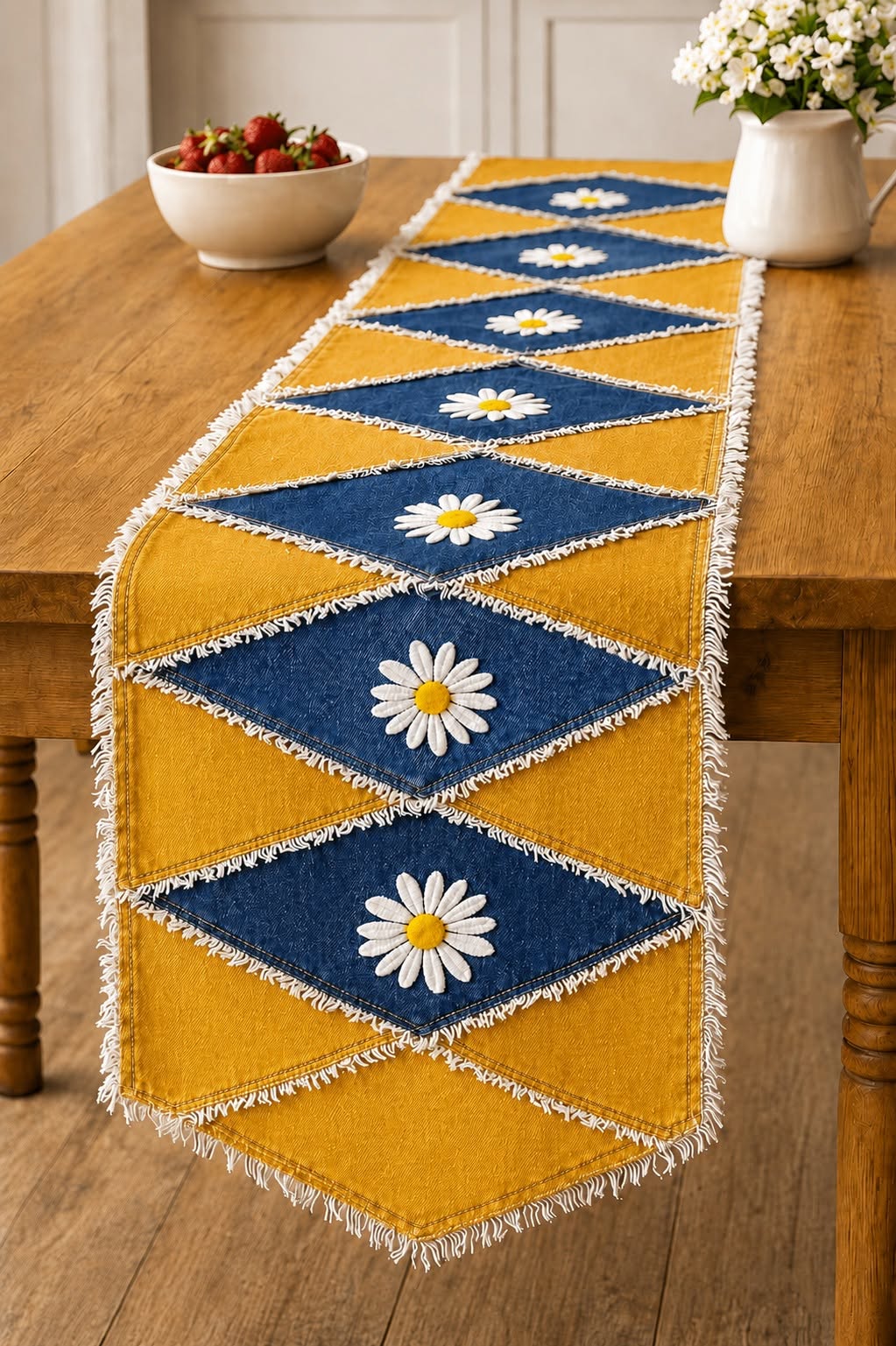
Inspired by the table runner shown in the photo, this design uses overlapping denim sections, visible stitching, softly frayed edges, and dimensional floral appliqués to create a handmade piece full of texture.
It is an excellent way to transform leftover jeans or denim fabric into practical home décor while practicing basic sewing and appliqué techniques.
The contrast between deep blue denim, white petals, and golden-yellow flower centers gives the runner a clean farmhouse appearance that works beautifully on wooden tables.
Because the design is based on repeated geometric sections, the finished runner can easily be adjusted to suit a small dining table, a console table, or a longer farmhouse-style table.
In this tutorial, you will learn how to plan, cut, assemble, decorate, and finish a Denim Table Runner with Daisies Fabric Pattern from beginning to end.
One of the most interesting details of this project is the deliberate use of raw denim edges as a decorative element instead of hiding every seam inside the fabric.
When denim edges are stitched securely and then gently frayed, they develop the soft white fringe visible throughout the photographed runner.
The overlapping diagonal panels also create a beautiful rhythm along the length of the piece, giving the impression of individual envelope-shaped or diamond-inspired sections.
Rather than requiring complicated quilting blocks, this design depends on accurate cutting, thoughtful placement, and consistent topstitching.
The daisies add a softer element to the strong denim texture, making the runner suitable for spring decorating, rustic kitchens, casual dining rooms, and handmade gifts.
Even if you are still building your sewing confidence, the Denim Table Runner with Daisies Fabric Pattern can be completed successfully by working slowly and checking the placement of every piece before stitching.
Another advantage of this denim sewing project is its flexibility because no two finished runners need to look exactly alike.
You can combine several shades of recycled jeans for a patchwork appearance or use one consistent denim shade for a cleaner and more coordinated result.
The daisy appliqués may be made from cotton, felt, lightweight denim, or another fabric that holds its shape well enough for decorative stitching.
The project can also be customized by changing the length, width, number of floral motifs, or amount of visible fraying around the individual sections.
What makes the original inspiration especially appealing is the balance between rustic construction and careful finishing: the edges appear relaxed, while the flowers and topstitching remain neat and intentional.
Following that same principle will help your handmade Denim Table Runner with Daisies Fabric Pattern look polished without losing its warm, handcrafted personality.
Materials, Measurements, and Preparing the Denim Pieces
Before cutting anything, gather your denim fabric, sewing machine, denim needle, strong coordinating thread, fabric scissors, rotary cutter if available, ruler, fabric marker, pins or clips, white fabric for the petals, yellow or golden fabric for the flower centers, and fusible web if you prefer stabilized appliqué. Choose denim that is sturdy but not excessively thick, especially where several layers will overlap.
DISCOVER MORE FREE PATTERNS HERE!
For a medium table runner, a practical finished size is approximately 35 to 40 cm wide and 140 to 180 cm long. These measurements can be changed according to the table. Measure the table first and decide whether you want the runner to stop near the edges or hang over both ends as shown in the inspiration photo.
The decorative surface can be constructed from repeated denim rectangles or elongated polygon-shaped panels. A convenient starting measurement is approximately 35 cm wide by 25 to 30 cm long for each section. Add extra fabric where pieces overlap so that the runner remains stable after all sections are assembled.
Wash and dry recycled denim before cutting it. Prewashing removes residual shrinkage and also encourages the natural fibers along the cut edges to soften. Press the fabric thoroughly afterward because flat denim is much easier to measure accurately. If using old jeans, avoid very stretched knee areas unless you want deliberate variation in texture.
Cut enough denim panels to create the complete runner length. Lay them on a large flat surface and experiment with their arrangement before sewing. To recreate the visual style of the photograph, position sections so that diagonal edges overlap and create repeated V-shaped or diamond-like lines. Alternate denim shades slightly if you want more patchwork character.
Once satisfied with the layout, mark a stitching line approximately 1 to 1.5 cm from each exposed raw edge. This space between the seam and the cut edge becomes the frayed decorative border. Accurate marking is important because consistent seam placement makes the Denim Table Runner with Daisies Fabric Pattern appear intentional rather than randomly assembled.
Building the Layered Runner and Creating the Frayed Denim Effect
Begin assembling the runner from one end and work toward the opposite end. Place the first denim panel flat, then overlap the next section according to your planned diagonal arrangement. Secure it with sewing clips or strong pins so that the fabric cannot shift. Denim is heavier than quilting cotton, so careful positioning makes stitching much easier.
Topstitch along the marked line using a denim needle and a medium-length straight stitch. A stitch length around 3 mm often works well for visible construction seams. Test your machine on scrap denim first, particularly if you are sewing through several overlapping layers, and adjust the tension if necessary.
Continue adding panels one at a time, checking the overall width after every few sections. Maintaining a consistent width is more important than making every diagonal exactly identical. Small variations can actually enhance the handmade character of a rustic denim table runner, as long as the piece remains balanced and lies flat.
After the main sections are connected, stitch around the long outer edges of the runner approximately 1 to 1.5 cm from the cut edge. Do the same around the pointed or shaped ends if your design includes them. This line of stitching acts as a barrier so that controlled fraying does not continue into the body of the runner.
To create the characteristic frayed denim edges, gently pull loose horizontal threads away from the exposed seam allowances. A blunt needle, seam ripper, or small brush can help separate the fibers without cutting through the structural stitching. Work gradually because aggressive pulling can make the fringe uneven or damage the seam.
When all edges have been partially frayed, shake the runner outdoors or remove loose fibers with a lint roller. Additional washing later can soften the fringe further, but you do not need extreme fraying immediately. The goal is a soft white border around each overlapping denim section similar to the textured finish that makes the Denim Table Runner with Daisies Fabric Pattern visually distinctive.
Making and Attaching the Fabric Daisy Appliqués
The daisies provide the focal points of this design, so take time to create evenly shaped flowers. Start by drawing a simple petal template approximately 4 to 6 cm long, depending on the flower size you want. Cut multiple petals from white fabric. For a dimensional flower, prepare approximately 10 to 14 petals for each daisy.
If your white fabric frays easily, apply lightweight fusible interfacing to the back before cutting. Another option is to use felt or a tightly woven cotton that maintains clean edges. The fabric daisy appliqué should be soft enough to complement the denim while remaining strong enough to withstand gentle washing.
Arrange the petals in a circle, overlapping their bases slightly. Stitch the petal bases together by machine or hand so they remain in position. For extra dimension like the flowers in the inspiration image, avoid attaching every petal completely flat. Allow the outer portions to lift slightly from the denim surface.
Cut a small circular piece of yellow or golden fabric for the flower center. A diameter of approximately 2.5 to 4 cm works for most daisies. Place it over the joined petal bases and secure it with a dense zigzag stitch, decorative stitch, or careful hand stitching. A slightly padded center can create additional dimension.
Before attaching the flowers permanently, position all daisies along the finished runner. The photographed design uses one flower as a focal point on many of the individual denim sections, creating a consistent visual path from one end to the other. Space yours evenly without making the arrangement appear too rigid.
Secure each finished daisy to the denim table runner. You can machine stitch through the center and inner portions of the petals or hand stitch from the back for a less visible attachment. Check that every flower is firmly secured while preserving some three-dimensional texture. This contrast between rugged denim and delicate daisies gives the project its recognizable personality.
Finishing, Care, Styling, and Customizing Your Table Runner
After attaching all the flowers, inspect every seam from both sides. Trim unnecessary thread tails and reinforce any areas where several denim pieces intersect. Thick intersections receive more stress during washing and handling, so a short additional line of stitching can prevent separation and increase the life of your Denim Table Runner with Daisies Fabric Pattern.
Place the runner flat on a table and check whether the layers are lying smoothly. If necessary, press the denim from the reverse side using an appropriate iron temperature. Avoid pressing dimensional appliqués directly because excessive heat or pressure may flatten the petals. A pressing cloth can protect delicate decorative areas.
For cleaning, gentle washing is usually preferable, especially when the runner contains raw-edge construction. A washing cycle can increase the frayed effect, so expect some additional loose threads during the first few washes. Trim unusually long threads instead of pulling them aggressively. Allowing the denim to soften naturally will improve its comfortable handmade appearance.
The completed Denim Table Runner with Daisies Fabric Pattern works especially well with wooden furniture because the warm wood grain contrasts beautifully with blue denim. White dishes, simple pottery, wildflowers, strawberries, or small farmhouse-style accessories can complement the runner without overwhelming its decorative details.
Customization is also easy. Replace dark indigo denim with faded blue jeans for a softer vintage effect, mix several washes for a true recycled denim patchwork appearance, or enlarge the daisies for stronger floral accents. You can also shorten the design into placemats or create coordinating denim coasters using the same raw-edge and daisy techniques.
Most importantly, allow the project to retain some natural irregularity. Recycled fabric will have changes in color, grain, fading, and thickness, and those variations are part of its appeal. A successful Denim Table Runner with Daisies Fabric Pattern does not need factory-perfect symmetry; it needs secure stitching, balanced proportions, thoughtful flower placement, and a finish that feels intentionally handcrafted.
Frequently Asked Questions About the Denim Table Runner with Daisies Fabric Pattern
What type of denim is best for a table runner?
Medium-weight denim is generally the easiest choice. It provides enough structure to stay flat on the table but remains manageable when several layers overlap. Very heavy jeans denim can become difficult for a domestic sewing machine, while extremely lightweight stretch denim may not maintain the geometric shape as effectively.
Can I make this project from old jeans?
Yes. Recycled jeans are excellent for this project and can add authentic differences in color and texture. Open the jeans along the seams and cut the largest usable flat sections. Avoid areas containing thick pockets or bulky seams unless they are intentionally incorporated as decorative details.
How do I keep denim from fraying too much?
The key is to stitch a secure line approximately 1 to 1.5 cm inside the raw edge. The material outside that seam can fray, while the stitching helps stop the fringe from progressing farther into the fabric. Trim excessively long loose threads after washing.
Do I need a special sewing machine for denim?
A standard home sewing machine can often handle medium-weight denim if it is equipped with a proper denim or jeans needle. Sew slowly through thick intersections and avoid forcing the fabric. Using a longer stitch and strong quality thread can also improve the results.
How long should a denim table runner be?
There is no single required length. Measure your table and decide whether the runner should remain entirely on the tabletop or extend beyond both ends. For many dining tables, approximately 140 to 180 cm is useful, but your furniture dimensions should guide the final measurement.
How wide should the runner be?
A width between approximately 30 and 40 cm usually works well for many tables. The Denim Table Runner with Daisies Fabric Pattern shown in the inspiration uses a substantial width that allows the geometric seams and flowers to remain clearly visible.
Can the daisies be sewn completely by machine?
Yes. The petals can be prepared, layered, and secured with machine stitching. The flower centers can also be attached using straight stitch, zigzag stitch, satin stitch, or another decorative stitch. Hand stitching is optional and is especially useful when you want more control over three-dimensional petals.
Can I use felt for the daisy petals?
Felt can work very well because its edges do not fray easily. However, choose a relatively thin felt so the flowers do not become excessively bulky. Cotton and other tightly woven fabrics are also suitable, especially when backed with lightweight fusible interfacing.
How can I make the daisy appliqués look dimensional?
Attach the bases and inner portions of the petals while leaving much of each petal slightly free. You can also layer two circles of petals or lightly shape the petals before attaching them. Avoid pressing them flat after sewing.
Should I add backing fabric to the runner?
Backing is optional. If the overlapping denim pieces provide enough stability, you may leave the underside visible for a deliberately rustic construction. If you prefer a cleaner reverse side, add a lightweight cotton backing after assembling the decorative top.
Can this pattern be made without frayed edges?
Absolutely. For a cleaner look, finish the edges with narrow hems, binding, enclosed seams, or carefully turned edges. However, the raw-edge denim technique is one of the features that gives this particular runner its distinctive farmhouse and recycled-fabric appearance.
How do I prevent the runner from becoming too bulky?
Use medium or lightweight denim, avoid unnecessary layers, and trim hidden seam allowances where appropriate. When sewing through intersections, flatten thick areas carefully before stitching. A hump-jumper or folded scrap of fabric placed behind the presser foot can sometimes help the machine cross bulky seams smoothly.
Can I change the flowers to another design?
Yes. Although daisies define the look of the Denim Table Runner with Daisies Fabric Pattern, the same construction could be decorated with sunflowers, hearts, leaves, stars, butterflies, or other appliqué shapes. Keeping one repeated motif throughout the runner helps maintain visual unity.
Is this a good project for beginners?
It can be. The construction relies mostly on straight stitching, simple shapes, raw-edge finishing, and basic appliqué. Beginners should practice sewing through multiple denim layers on scraps before working on the final runner and should complete one section at a time instead of rushing the assembly.
How can I make the finished project look more professional?
Consistent measurements, straight topstitching, evenly controlled fraying, and balanced flower spacing make the biggest difference. Pressing the denim during construction and testing stitch settings before beginning will also improve the final appearance.
Conclusion
Creating a Denim Table Runner with Daisies Fabric Pattern is a rewarding way to combine recycling, practical sewing, decorative appliqué, and farmhouse-inspired home décor in a single project. Starting with carefully prepared denim panels, you can build the runner through overlapping geometric sections, secure them with visible topstitching, and develop the characteristic frayed denim edges that give the design so much texture.
The next stage introduces the delicate contrast of handmade daisies. By cutting white petals, adding golden centers, and placing the flowers evenly throughout the runner, a simple denim foundation becomes an eye-catching decorative piece. The technique can be customized for almost any table size and adapted to the fabric scraps you already have available. You have also learned how to choose suitable denim, establish practical measurements, control raw-edge fraying, sew through layered fabric, construct dimensional daisy appliqués, finish the runner securely, care for it after completion, and personalize the project through different denim shades and decorative details. These techniques can later be reused for placemats, cushions, bags, wall hangings, and many other creative sewing projects.
EASILY FIND THE PDF FOR THIS PATTERN HERE!
The most appealing feature of this design is the way it celebrates handmade texture rather than trying to hide it. Visible seams, softly frayed fibers, slight changes in denim color, and dimensional flowers all contribute to the personality of the finished piece. With patience and careful construction, your Denim Table Runner with Daisies Fabric Pattern can become a beautiful centerpiece that adds warmth, color, and craftsmanship to an everyday dining space. If you make this project, leave your sincere opinion about the finished design and share any suggestions or creative changes you would make. Your ideas for different denim shades, flower styles, measurements, or decorative finishes can inspire new variations of this Denim Table Runner with Daisies Fabric Pattern and help other sewing enthusiasts discover fresh ways to personalize the project.