
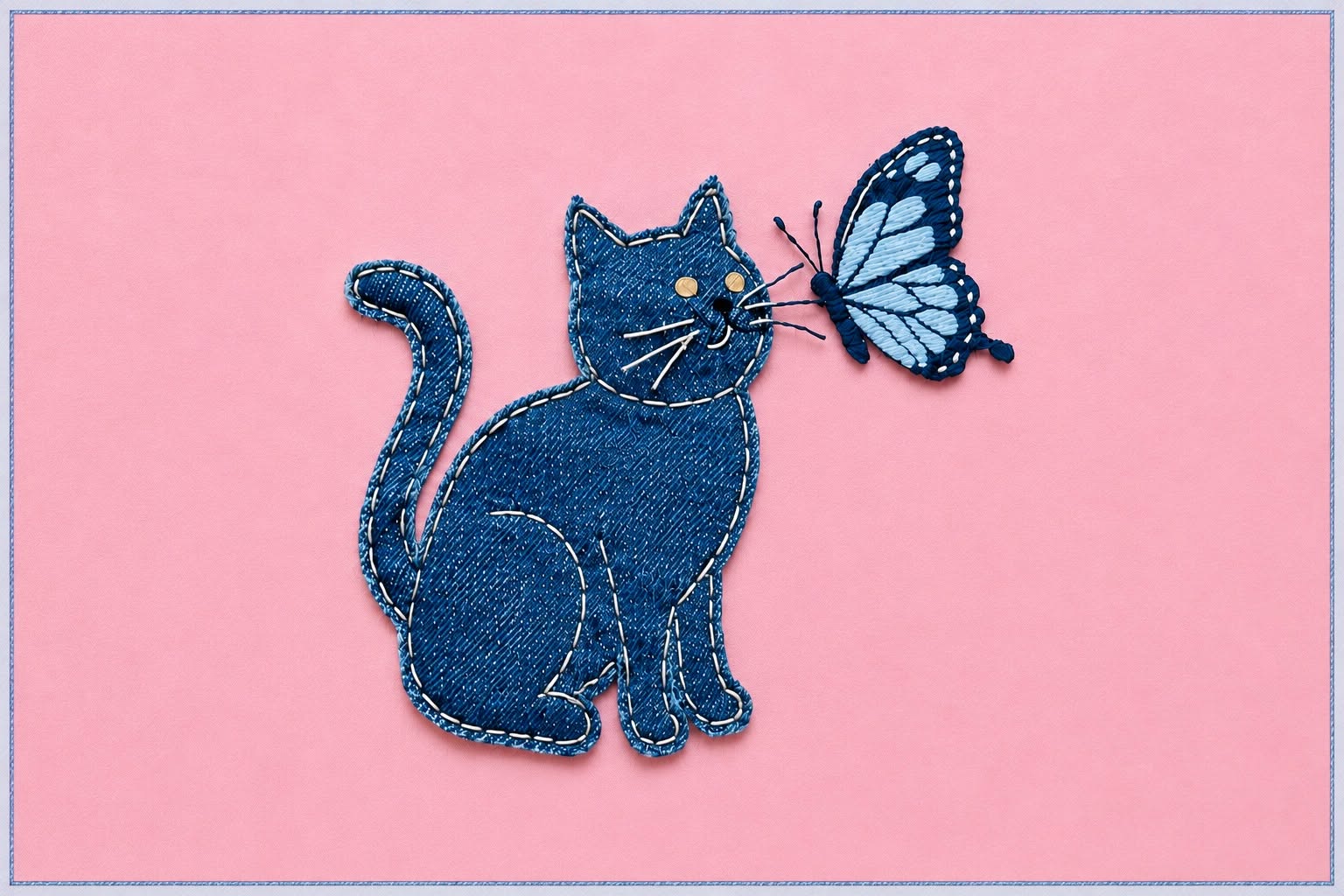
Cat and Butterfly Appliqué on Denim quilt Pattern is a charming sewing project that combines the rustic beauty of denim with the delicate personality of appliqué art. Inspired by the image of a seated denim cat looking toward a graceful butterfly, this project is an excellent way to transform simple fabric pieces into a decorative quilt block, wall hanging, pillow panel, or handmade gift. The strong texture of denim gives the cat a distinctive appearance, while contrasting embroidery stitches make every outline visible and expressive. This design can also be created with recycled jeans, making it an appealing project for sewists who enjoy giving fabric a second life. The butterfly adds softness and movement to the composition, balancing the heavier appearance of the denim cat. With careful cutting, positioning, stitching, and finishing, even a relatively simple silhouette can become an eye-catching piece of textile art.
One of the greatest advantages of the Cat and Butterfly Appliqué on Denim quilt Pattern is that it does not require an extremely complicated collection of quilting tools. Most of the work can be completed with fabric scraps, a stable background, basic embroidery thread, fusible web or another appliqué stabilizer, sharp scissors, and a sewing machine or hand-sewing needle. The cat shape can be simplified into several recognizable sections, including the body, head, ears, front legs, back leg, and tail. Small embroidered details such as the whiskers, eyes, nose, and mouth give the animal personality without requiring tiny fabric pieces. The butterfly can be created from patterned fabric, printed cotton, light denim, or a contrasting fabric that clearly stands apart from the cat. This combination of appliqué and decorative stitching makes the finished project look detailed while keeping the actual construction process manageable for patient beginners and enjoyable for experienced quilters.
When working on this denim quilt Pattern, the most important idea is to build the design in layers rather than trying to create everything at once. Begin by preparing the background and tracing the main appliqué shapes, then cut and position the cat before adding its stitched details. After the cat is secure, create the butterfly and arrange it so that the two figures appear visually connected, just as they do in the reference image. Decorative stitches can then be added around the silhouettes to emphasize their shapes and create the handmade appearance that makes this project so attractive. A light-colored background works especially well because it produces strong contrast against dark denim. The project can remain as a single decorative block or become part of a larger quilt after completion. By following a logical sequence and testing stitches on scraps first, you can create a polished Cat and Butterfly Appliqué on Denim quilt Pattern with clean edges, balanced proportions, and plenty of handmade character.
Materials and Fabric Preparation for the Denim Appliqué
For the main cat, choose medium-weight denim that is flexible enough to stitch but still firm enough to hold its shape. Old jeans are ideal for this type of denim appliqué, especially areas that are not excessively stretched or worn. Wash and dry recycled denim before cutting so that any remaining shrinkage happens before construction. Press the fabric thoroughly using an appropriate iron setting. Flat fabric makes tracing and cutting much more accurate. If the denim feels extremely thick, select a lighter section so the finished block does not become unnecessarily bulky.
For the background, use a stable cotton or cotton-blend fabric in white, cream, pale gray, beige, or another light neutral shade. A lighter background helps the dark blue cat appliqué remain visually dominant. Cut the background several centimeters larger than the intended finished block because appliqué and embroidery can occasionally cause slight distortion. For example, if you want a finished block around 30 × 30 cm, begin with approximately 34 × 34 cm of background fabric. This extra space can be trimmed after all stitching is completed.
You will also need a small piece of contrasting fabric for the butterfly. Pale blue fabric with dark printed details can closely resemble the look of the reference design, although floral cotton, batik, or scrap fabric can also work beautifully. For a harmonious appearance, select colors that complement rather than compete with the denim. The butterfly should remain clearly visible against the background. A small amount of black, navy, or charcoal fabric can be used for the butterfly body if desired.
A fusible appliqué web is useful for holding each shape securely before stitching. This material is placed between the appliqué fabric and background, then activated with an iron according to the manufacturer’s general heat requirements. If you prefer not to use fusible material, temporary fabric adhesive, appliqué pins, or hand basting can also hold the pieces in position. The goal is simply to stop the shapes from shifting while the edges are stitched. Accurate placement becomes especially important around narrow areas such as the tail and front legs.
Choose strong embroidery thread or quilting thread for the visible outline stitching. White or cream thread creates the striking contrast seen around the denim cat, while dark navy or black thread works well for the butterfly. You may use embroidery floss for hand sewing or heavier decorative thread if your sewing machine can handle it correctly. Always test decorative thread on a denim scrap first. Different combinations of needle size, tension, and thread thickness can create noticeably different results.
Other useful supplies include fabric scissors, small embroidery scissors, a removable fabric marker, tracing paper, an iron, a pressing cloth, pins, needles, and a sewing machine if you prefer machine appliqué. For denim, a denim or jeans needle is usually more reliable than a fine universal needle because it is designed to penetrate heavier woven material. Keeping your tools organized before beginning makes the entire Cat and Butterfly Appliqué on Denim quilt Pattern easier and more enjoyable to assemble.
Step-by-Step Cat and Butterfly Appliqué Construction
Begin by drawing or tracing the cat silhouette on paper. The finished cat can be approximately 20 to 24 cm tall for a medium decorative block, although you can resize the design according to your project. The silhouette should include two pointed ears, a rounded head, curved back, large lower body, two front legs, one visible rear leg, and a long curved tail. Keep the shapes smooth and avoid unnecessary tiny curves. Simple shapes are easier to cut from denim and usually produce cleaner stitched edges.
Transfer the pattern to the paper side of fusible web and roughly cut around it, leaving a small border. Fuse the web to the wrong side of the denim, allow it to cool, and then cut precisely along the drawn outline. If your pattern includes separate leg or body sections, prepare each section individually. Some quilters prefer one large cat silhouette, while others create overlapping pieces to imitate the layered appearance of the example. Both methods can produce excellent results when the proportions remain balanced.
Place the denim cat on the background before permanently attaching anything. Position it slightly below the center so there is enough open space above and to one side for the butterfly. Once you like the placement, follow the fusible web instructions to secure the cat. Press rather than sliding the iron across the fabric because excessive movement can distort narrow appliqué sections. Allow the block to cool on a flat surface before beginning the decorative stitching.
Stitch around the cat using a visible running stitch, blanket stitch, or narrow decorative stitch. A hand-sewn running stitch in contrasting white or cream thread creates a charming folk-art effect similar to the reference image. Keep each stitch reasonably consistent, approximately 3 to 5 mm long depending on the scale of the design. Do not worry about making every stitch mechanically perfect. Slight variation can enhance the handmade appearance of the denim quilt Pattern, provided the overall stitching remains neat.
Next, add the cat’s facial details. Small circular stitches or tiny fabric dots can create the eyes, while a small dark nose gives the face a focal point. Add a short mouth line and several long whiskers using embroidery thread. The whiskers should extend outward naturally rather than forming perfectly identical lines. You can also sew a curved line near the shoulder and another around the rear leg to suggest the cat’s anatomy. These simple embroidered lines give dimension to an otherwise flat appliqué shape.
Finally, prepare the butterfly. Create two symmetrical upper wings and two smaller lower wing sections or use a single butterfly-shaped fabric piece. Position the butterfly a short distance in front of the cat’s face so that the composition suggests interaction between the two figures. Add a narrow dark body, antennae, and optional decorative wing stitching. Secure the butterfly with small stitches around its perimeter. At this stage, the central scene of the Cat and Butterfly Appliqué on Denim quilt Pattern is complete and ready for quilting and finishing.
Quilting, Finishing, and Creative Design Options
After the appliqué is finished, inspect all edges carefully. Denim can fray naturally, and a slight amount of fraying may actually contribute to the rustic look of the project. However, loose threads that extend too far should be trimmed. If you want perfectly controlled edges, use a close blanket stitch or narrow zigzag around the silhouette. For a more relaxed handmade look, allow approximately 1 to 2 mm of raw edge to remain visible beyond the stitching.
To transform the appliqué into a quilted block, layer the finished top with batting and backing fabric. Smooth each layer carefully and secure them using quilting pins or temporary basting. You can quilt around the cat and butterfly to make them appear slightly raised from the background. This technique is sometimes called outline quilting or echo quilting. Additional gentle lines can be stitched through the empty background area without distracting attention from the main design.
If you want to create a wall hanging, add one or more fabric borders around the finished block. Dark denim borders can connect visually with the cat, while pale blue or navy printed cotton can repeat the butterfly colors. A narrow inner border followed by a wider outer border often creates a professional frame-like appearance. Keep the border design relatively simple because the Cat and Butterfly Appliqué on Denim quilt Pattern should remain the visual center of the project.
The same design can easily become a decorative pillow. Once the quilted front panel is finished, trim it to the desired dimensions and attach a simple envelope-style or zippered backing. A cushion measuring approximately 40 × 40 cm provides enough space for the appliqué while remaining suitable for many chairs, beds, and sofas. For a softer pillow, use lightweight denim rather than thick jeans fabric. Heavy denim combined with dense batting can make the cover overly stiff.
Scrap fabrics can also personalize the project. Instead of using only traditional dark blue denim, consider mixing several shades of recycled jeans. The body could use deep indigo, while the legs, tail, or ear sections use faded blue pieces. This creates subtle patchwork variation without changing the recognizable cat silhouette. The butterfly could then introduce a brighter accent such as turquoise, lavender, soft yellow, or dusty pink.
Before completing the project, press the block gently from the back whenever possible. Protect embroidery and dimensional stitching with a pressing cloth. Square the finished block using a quilting ruler and trim away the extra background fabric that was left earlier. Once the edges are straight and the block has the correct dimensions, it can be bound as a miniature quilt, sewn into a cushion, incorporated into a tote bag, or joined with additional appliqué blocks to create a larger denim quilt.
Frequently Asked Questions About the Cat and Butterfly Appliqué on Denim quilt Pattern
What is the best denim for this appliqué project? Medium or lightweight denim is usually easier to cut and stitch than very heavy workwear denim. Recycled jeans are an excellent option as long as the fabric is clean, stable, and not excessively stretched. Slightly faded denim can add natural texture and visual interest. If your sewing machine struggles with multiple layers, choose thinner denim and avoid placing bulky seams inside the appliqué shapes.
Do I need a sewing machine to make this design? No. The Cat and Butterfly Appliqué on Denim quilt Pattern can be created entirely by hand. In fact, visible hand stitching can add considerable charm to the finished piece. A running stitch, blanket stitch, or whip stitch can secure the appliqué edges. Machine stitching is faster, but hand sewing provides greater control around small curves such as ears, paws, and butterfly wings.
How do I stop denim appliqué from fraying too much? Fusible web helps stabilize the fabric, while close edge stitching prevents excessive unraveling. You can also apply a narrow zigzag or satin stitch if you want a very clean edge. Some makers intentionally allow slight fraying because it creates a relaxed, rustic appearance. The important point is to keep the fraying controlled so that it does not interfere with the cat’s silhouette.
Can beginners make this denim quilt Pattern? Yes. A beginner can successfully complete this project by simplifying the shapes and working slowly. The basic techniques include tracing, cutting, positioning, fusing, and stitching. Practicing the outline stitch on spare denim before working on the actual cat is very helpful. Beginners may also want to enlarge the design because larger curves and pieces are generally easier to sew accurately.
What size should the appliqué be? There is no mandatory size. A cat approximately 20 to 24 cm tall works nicely on a 30 cm or larger quilt block. For a pillow, you can enlarge the cat to approximately 25 to 30 cm. Smaller versions can be used for tote bags, fabric organizers, or mini quilts. Always resize both the cat and butterfly proportionally so the relationship between the two figures remains natural.
Can I use cotton fabric instead of denim? Absolutely. Although denim gives this particular design its distinctive character, the same cat appliqué Pattern works with quilting cotton, linen, felt, chambray, or other stable fabrics. Cotton is easier to sew and may be preferable for lightweight quilts. You can also mix materials, using denim for the cat and patterned quilting cotton for the butterfly.
Should the appliqué edges be turned under? Either raw-edge or turned-edge appliqué can be used. Raw-edge appliqué is faster and suits the casual appearance of denim particularly well. Turned-edge appliqué produces a cleaner traditional finish but can be more difficult with thick denim. For the style shown in this project, visible raw edges combined with contrasting stitching create an attractive handcrafted effect.
How can I make the butterfly look more detailed? Use printed fabric for the wings and add small embroidered lines that follow the wing sections. A dark stitched border provides definition, while a narrow embroidered body and delicate antennae complete the shape. You can also combine two shades of blue or use tiny fabric pieces inside the wings. Keep the butterfly relatively delicate so it does not overpower the larger cat.
Can this appliqué be washed? Yes, provided all fabrics are washable and the appliqué pieces have been securely stitched. Prewashing recycled denim and cotton is helpful because it reduces later shrinkage. Use secure edge stitching if the finished project will be washed frequently. Decorative wall hangings generally experience less wear, so more delicate hand stitching can be appropriate for them.
What other projects can be made with this pattern? The design can decorate pillows, tote bags, mini quilts, wall hangings, denim jackets, fabric baskets, table mats, sewing machine covers, or larger patchwork quilts. You can also create several cats in different denim shades and combine them into a themed quilt. Changing the butterfly to a flower, bird, heart, or leaf is another easy way to adapt the basic composition.
Conclusion
The Cat and Butterfly Appliqué on Denim quilt Pattern demonstrates how a small collection of simple materials can become a warm and expressive textile project. By selecting suitable denim, preparing a stable background, creating an easy-to-cut cat silhouette, carefully attaching each appliqué piece, and adding contrasting embroidery, you can reproduce the distinctive handmade appearance of the design. The butterfly provides an elegant focal point and creates a visual story, making the finished block feel more lively than a single isolated motif. Throughout this tutorial, you learned how to prepare recycled denim, trace and cut appliqué pieces, position the cat and butterfly, stabilize the fabrics, sew decorative outlines, embroider facial details, add batting and backing, quilt the background, and adapt the finished design for several practical projects. These techniques are useful far beyond this single denim quilt Pattern because the same process can be applied to animals, flowers, houses, seasonal motifs, and many other appliqué designs.
EASILY FIND THE PDF FOR THIS PATTERN HERE!
Most importantly, allow your finished project to reflect your own creative style. You can change the denim shades, enlarge the butterfly, add floral details, experiment with colorful embroidery, or incorporate the block into a much larger quilt. Handmade appliqué does not need to look identical from one project to another; those small differences are part of what makes textile art special. If you try this Cat and Butterfly Appliqué on Denim quilt Pattern, leave your sincere opinion about the project and share your suggestions for future designs. Your ideas about colors, fabrics, stitching styles, and possible variations can inspire new creative versions of this charming denim cat and butterfly theme.