
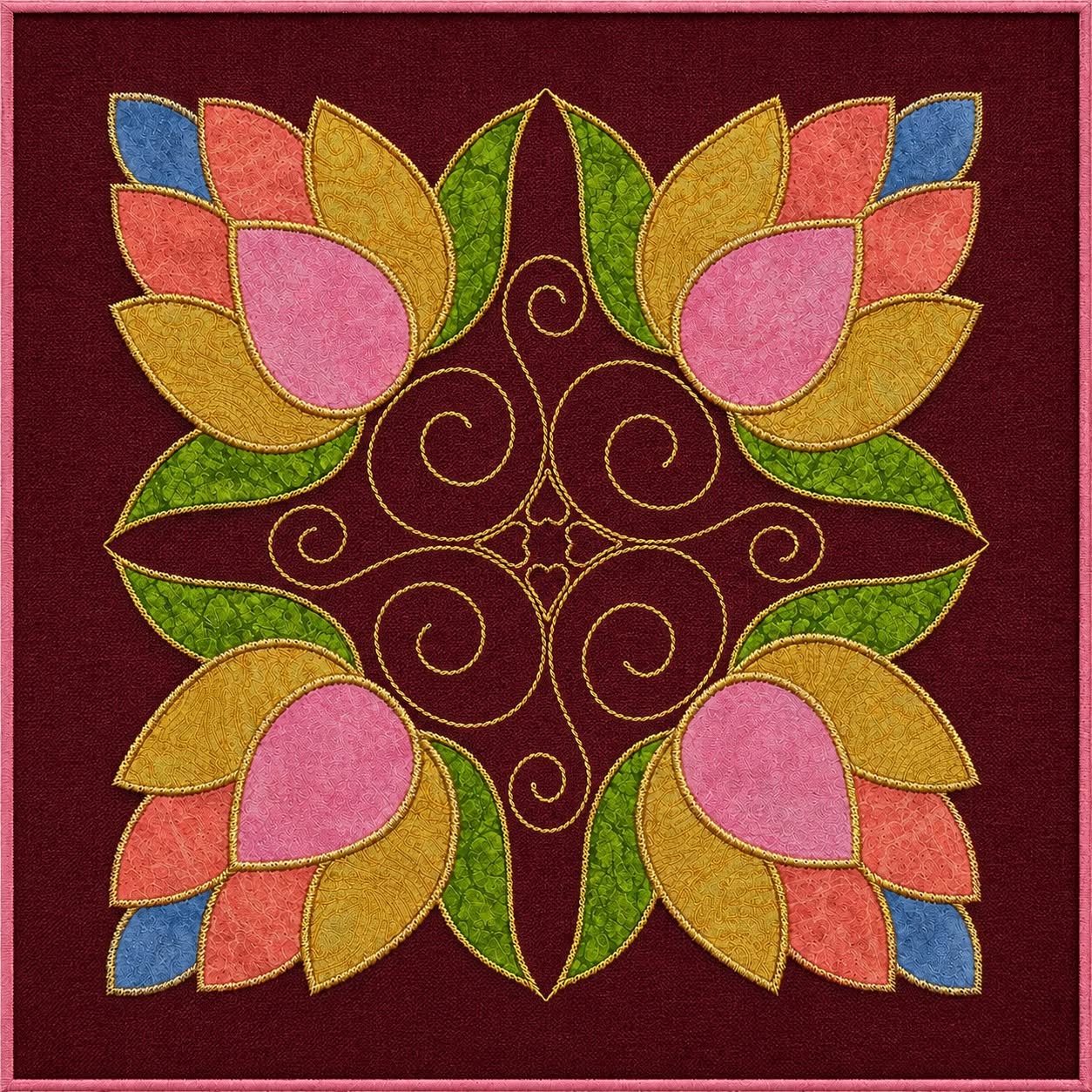
The Lotus Flower Appliqué Quilt Block Pattern is a beautiful fabric-art project that combines floral appliqué, symmetrical quilting, decorative stitching, and bold color contrast in a single quilt block. Inspired by the image shown above, this design features four stylized lotus flowers positioned around a central ornamental motif, creating a balanced composition that immediately draws attention. The dark background allows the pink, coral, yellow, green, and blue fabrics to stand out, while the decorative golden stitching gives the entire block an elegant finished appearance. Although the result looks detailed, the project becomes much easier when it is divided into individual shapes and completed one section at a time. Quilters can use the finished block for wall hangings, decorative pillows, table toppers, bags, or as part of a larger quilt.
Creating a Lotus Flower Appliqué Quilt Block Pattern is also an excellent opportunity to practice several important quilting techniques. The word appliqué refers to the process of placing smaller pieces of fabric onto a larger background fabric and securing them with stitching. A quilt block is an individual fabric unit that may be displayed independently or joined with additional blocks to create a larger quilt. In this particular project, appliqué shapes form the flowers and leaves, while free-motion or decorative stitching adds texture and swirling details to the central area. The combination of simple fabric shapes and expressive stitching makes the project suitable for adventurous beginners as well as experienced quilters looking for a decorative floral design.
One of the strongest visual features of this Lotus Flower Appliqué Quilt Block Pattern is symmetry. Four similar flowers surround a central decorative area, giving the block a harmonious appearance from every direction. You do not need to reproduce every stitch from the reference image exactly. Instead, focus on preserving the main structure: four lotus flowers, layered petals, surrounding green leaves, a contrasting background, and graceful curved stitching toward the center. Small variations can make your handmade version more personal. Choosing fabrics with subtle texture or tonal prints can also add depth without making the pattern look overly busy.
Materials, Fabric Selection, and Preparing the Lotus Appliqué Pieces
Begin by selecting a strong background fabric for your Lotus Flower Appliqué Quilt Block Pattern. Black provides dramatic contrast similar to the reference project, but navy blue, charcoal gray, deep burgundy, or dark green can also work beautifully. A quilting cotton with a tight weave is usually easier to handle because it remains stable while you position and stitch the appliqué pieces. Before cutting, press the background fabric carefully so there are no folds that could interfere with accurate placement.
DISCOVER MORE FREE PATTERNS HERE!
For the lotus flowers, prepare several complementary fabric colors. The reference design uses soft pink for the large inner petals, coral or salmon for intermediate petals, golden yellow for outer petals, and small blue accents near the outer corners. These colors are only a starting point. You could make a purple lotus, a blue-and-white version, or even a monochromatic block using several shades of the same color. The most important consideration is maintaining enough contrast between neighboring pieces so each petal remains clearly visible.
Green fabric is needed for the leaves surrounding the floral arrangement. Using two or three green tones can give the foliage more dimension. Light green can be placed beside darker olive or forest-green pieces, while decorative stitching can imitate leaf veins. This approach creates visual interest without requiring highly complicated fabric piecing. Small-scale prints, batiks, and tone-on-tone quilting cottons work especially well because they add texture while preserving the recognizable shapes of the leaves.
To create your appliqué templates, study the image as a collection of basic shapes instead of one complicated picture. Each lotus flower consists mainly of elongated pointed petals and larger rounded teardrop-shaped petals. Trace these shapes onto paper or template plastic. Since the block is symmetrical, you can create one set of templates and flip them when making flowers on opposite sides. Label every pattern piece before cutting so you know where it belongs during assembly.
If you prefer fusible appliqué, trace the template pieces onto the paper side of fusible web. Remember that the finished shape will usually appear reversed after fusing, so orientation matters when working with asymmetrical pieces. Rough-cut the fusible material around each shape, fuse it to the wrong side of the appropriate fabric according to the product instructions, and then cut precisely along the traced line. This method helps prevent shifting while the shapes are stitched to the background.
Before permanently attaching anything, arrange all pieces on the background fabric. Start with the large flowers and then position the green leaves around them. Stand several feet away from the arrangement and inspect the balance. Check that the flowers are approximately the same distance from the center and from the outer edges. Photographing the layout before stitching can also be useful because you will have a visual reference if any pieces become mixed up during construction.
Step-by-Step Assembly of the Lotus Flower Appliqué Quilt Block Pattern
Start construction by finding the exact center of your background fabric. Fold the fabric gently in half horizontally and vertically and press only enough to create temporary reference creases, or mark the center using a removable fabric-marking tool. These guidelines will help you position the four flowers evenly. Accurate placement at this stage is important because the central symmetry is one of the defining characteristics of the Lotus Flower Appliqué Quilt Block Pattern.
Place the first lotus flower near one corner of the central area. Begin with the pieces that visually sit behind the others. The smaller outer petals generally go down first, followed by larger golden or coral petals, and finally the prominent pink center petal. Slight overlapping creates the layered appearance associated with lotus blossoms. Repeat the arrangement for the other three flowers while rotating each flower toward the center of the block.
Next, position the green leaves around and between the lotus flowers. Several leaves should point outward while others guide the eye toward the center. In the reference design, the foliage helps connect all four floral motifs without making them look like isolated decorations. Avoid crowding the pieces. Leaving controlled areas of dark background visible between leaves creates strong negative space and makes the colorful appliqué easier to appreciate.
Once you are satisfied with the layout, secure the pieces. With fusible appliqué, press each piece according to the fusible manufacturer’s recommended temperature and duration. Work gradually instead of trying to fuse the entire block at once. If you prefer traditional needle-turn appliqué, add the required seam allowance when preparing the pieces, pin or baste them in position, and turn the raw edges under as you stitch. Both techniques can produce an attractive result, although fusible appliqué is often faster.
Stitch around every appliqué shape to permanently secure it. A narrow zigzag, satin stitch, blanket stitch, or decorative machine stitch can all be used. A light-colored or metallic-looking thread creates an outlined appearance similar to the photograph. Alternatively, matching thread creates softer transitions between fabrics. Try your selected stitch settings on scrap fabric first so you can adjust stitch width, length, and tension before working on the actual quilt block.
Continue around the block systematically instead of jumping randomly between pieces. Complete one flower, move to its surrounding leaves, and then continue to the next section. This keeps the fabric easier to manage and helps maintain consistent stitching. Periodically check the back of the block to make sure the thread tension is balanced and no unwanted loops have formed. When all four flowers and the surrounding foliage are secured, press the block gently from the back to prepare it for decorative quilting.
Decorative Stitching, Quilting, and Finishing the Floral Block
The center of this Lotus Flower Appliqué Quilt Block Pattern is created largely through decorative stitching rather than additional fabric pieces. Use a removable marking pen or chalk pencil to sketch several spiral shapes before sewing. Begin with four larger spirals arranged symmetrically around the center. Then add smaller curls between the flowers and leaves. These flowing lines contrast beautifully with the pointed petals and help unite all areas of the design.
If you are comfortable with free-motion quilting, lower or cover the feed dogs and use a free-motion quilting foot. Practice drawing spirals with a pencil before attempting them with the sewing machine. Smooth curves are more important than perfect circles. Handmade quilting naturally contains small variations, and these differences can add character. Move the fabric slowly while maintaining a steady machine speed to create even stitches around each curve.
Decorative thread can dramatically change the appearance of the finished block. Gold, cream, pale yellow, or metallic thread produces an ornamental outline similar to the reference image. If metallic thread proves difficult to manage, a high-quality polyester or rayon thread with a golden tone can provide a similar visual effect. Use a compatible needle and test your thread combination before sewing long decorative sections.
Additional quilting can be added inside the fabric pieces to give them more texture. Stitch gentle curved lines inside the yellow petals, simple vein patterns inside the green leaves, and subtle contour lines inside the coral pieces. Avoid overfilling the large pink petals if you want them to remain visually dominant. The goal is to create enough texture to enhance the fabric while preserving a clear distinction between every component of the lotus flowers.
After the decorative work is complete, layer the quilt block with batting and backing fabric if it will become a mini quilt or wall hanging. Smooth all three layers carefully and secure them with pins, clips, or temporary basting. Quilt around the appliqué shapes and through selected background areas. Quilting close to the edges of the flowers can make the appliqué appear slightly raised, producing a dimensional effect that works particularly well with floral designs.
Finally, square the block using a quilting ruler and rotary cutter. Check that all sides are straight and all corners form 90-degree angles before adding binding or joining the block to other quilt sections. A narrow binding in black can preserve the dramatic background, while gold, green, pink, or coral binding can coordinate with the appliqué. Once finished, the Lotus Flower Appliqué Quilt Block Pattern becomes a versatile decorative piece that combines traditional textile techniques with a highly graphic contemporary look.
FAQ About the Lotus Flower Appliqué Quilt Block Pattern
What is a Lotus Flower Appliqué Quilt Block Pattern? A Lotus Flower Appliqué Quilt Block Pattern is a quilting design in which fabric pieces shaped like lotus petals, leaves, and related decorative elements are attached to a background fabric. The word pattern refers to the templates and arrangement used to reproduce the design. Unlike traditional pieced blocks constructed primarily from geometric fabric sections, appliqué blocks allow curved and organic shapes to be placed freely on the background.
Is this project suitable for beginners? A motivated beginner can make this project successfully, especially when using fusible appliqué. The floral design may look complex because it contains many individual pieces, but most components are simple leaf or teardrop shapes. Beginners should work slowly, organize pieces before sewing, and practice decorative stitches on scraps. Making one lotus flower first is also a useful way to understand the layering process before completing the entire block.
What is the best fabric for appliqué quilting? Quilting cotton is one of the most convenient fabrics because it is stable, widely available, easy to cut, and easy to stitch. Batik fabrics are another excellent choice for a Lotus Flower Appliqué Quilt Block Pattern because their rich colors and subtle variations add visual texture. Very stretchy or slippery fabrics can be more difficult to control and may require additional stabilizer, especially for machine appliqué.
Should I use fusible appliqué or needle-turn appliqué? Either method can work. Fusible appliqué is generally faster and helps keep small shapes firmly positioned while you stitch, making it particularly useful for blocks containing many petals and leaves. Needle-turn appliqué creates beautifully finished folded edges and is popular among quilters who enjoy traditional hand sewing. Your choice should depend on the finish you prefer and the amount of time you want to devote to the project.
How can I make all four lotus flowers symmetrical? Create templates from one finished flower layout and reuse the same pieces for every corner. Mark vertical and horizontal center lines on the background before positioning the appliqué. Measuring the distance between each flower and the center can also improve consistency. Exact duplication is not essential, but careful placement helps achieve the balanced appearance that gives the Lotus Flower Appliqué Quilt Block Pattern its distinctive visual impact.
What can I make with the finished quilt block? The finished design can become much more than one section of a quilt. You can turn it into a wall hanging, cushion cover, table centerpiece, tote bag panel, decorative runner, framed textile artwork, or the focal block of a larger bed quilt. Multiple blocks can also be repeated with different fabric combinations, allowing each lotus flower arrangement to have its own personality while maintaining the same overall pattern.
Conclusion
The Lotus Flower Appliqué Quilt Block Pattern is a rewarding project that brings together color selection, fabric layering, appliqué quilting, decorative stitching, symmetry, and creative finishing. By breaking the design into individual flowers, petals, and leaves, even a visually elaborate pattern becomes manageable. The process begins with choosing a strong contrasting background, continues through template preparation and careful appliqué placement, and finishes with decorative spirals, quilting, and binding. Throughout this tutorial, you learned how to plan the four lotus arrangements, prepare the appliqué pieces, position the leaves, secure the fabrics, outline each shape, and create the characteristic ornamental stitching in the center. You also learned how fabric selection and thread choice can change the personality of the finished block. Pink and gold can create a warm traditional appearance, while blue, violet, turquoise, or monochromatic fabrics can transform the same Lotus Flower Appliqué Quilt Block Pattern into something completely different.
EASILY FIND THE PDF FOR THIS PATTERN HERE!
The most important part of this project is allowing the design to develop gradually. Arrange the pieces before sewing, evaluate the symmetry, and adjust individual petals until the composition feels balanced. Decorative stitching should enhance the appliqué rather than compete with it. With patience and a little experimentation, this pattern can become an impressive handmade textile piece while also helping you develop valuable quilting and appliqué skills. If you create your own version of this Lotus Flower Appliqué Quilt Block Pattern, leave your sincere opinion about the project and share your suggestions for colors, fabrics, stitches, or alternative ways to use the finished block. Creative feedback can inspire new interpretations of the pattern and help other quilting enthusiasts discover fresh ideas for their own projects. A useful next step would be to prepare a printable English template with individual lotus petals, leaves, placement guides, and seam allowance based on this design.