
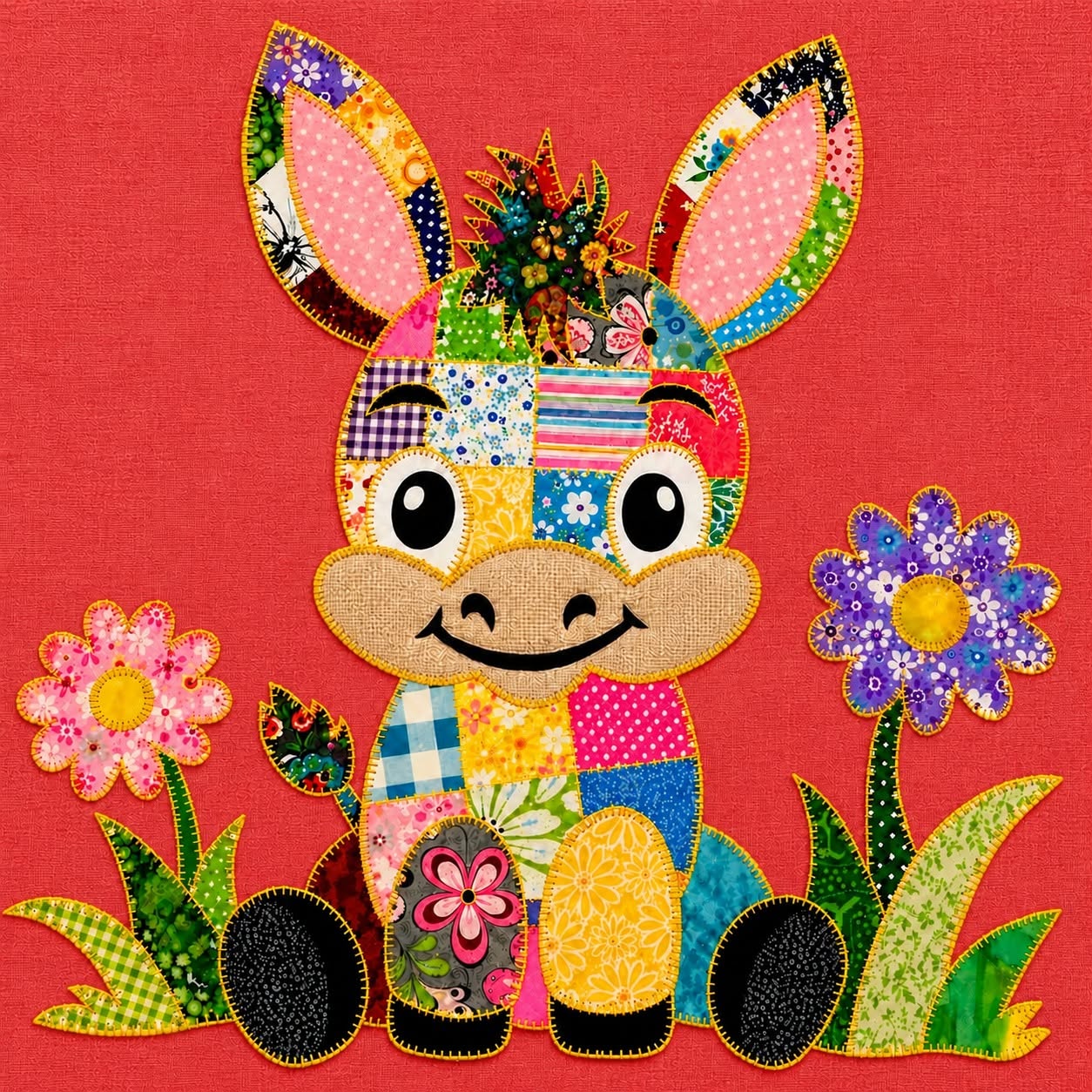
The Colorful Patchwork Donkey Appliqué Fabric Pattern is a cheerful sewing project that combines traditional appliqué, patchwork, decorative stitching, and playful fabric selection in one charming design. Inspired by the image, the finished piece features a friendly donkey made from many small pieces of patterned cotton, surrounded by colorful flowers, leaves, and grass. The variety of prints gives the animal a handmade personality while allowing you to use small fabric scraps that might otherwise remain unused. This type of project works beautifully as a quilt block, nursery wall hanging, decorative fabric panel, cushion front, tote bag centerpiece, or framed textile artwork. Although the number of individual pieces may make the design look complicated at first, the construction becomes much easier when the project is divided into simple sections. By preparing the templates carefully and building the donkey gradually, even an intermediate beginner can create an attractive result without complicated sewing equipment.
One of the most enjoyable aspects of a Colorful Patchwork Donkey Appliqué Fabric Pattern is the freedom it offers when choosing colors and prints. The example uses pink, yellow, blue, green, purple, red, black, white, and floral fabrics, creating a lively patchwork effect rather than trying to imitate the natural coloring of a donkey. Small-scale florals, dots, checks, stripes, geometric prints, and solid fabrics can all be combined in the same project. In sewing terminology, patchwork means joining or visually combining pieces of different fabrics to form a larger decorative surface, while appliqué refers to attaching shaped fabric pieces onto a background fabric. This design brings both techniques together. The donkey is constructed from individual appliqué shapes, but many of those shapes can themselves be divided into smaller colorful sections, producing the distinctive patchwork appearance seen in the photograph.
Before beginning the Colorful Patchwork Donkey Appliqué Fabric Pattern, it is worth planning the project carefully because good preparation makes the sewing process much smoother. Choose a light neutral cotton for the background so the colorful donkey and flowers remain visually prominent. Gather several coordinating cotton scraps, fusible web suitable for appliqué, paper for templates, fabric scissors, small sharp scissors, an iron, matching or contrasting sewing thread, pins, a fabric marking pencil, and a sewing machine if you prefer machine appliqué. Hand stitching is also possible and can create a charming folk-art finish. For a wall panel, a background measuring approximately 45 x 45 cm offers comfortable working space, although the design can be enlarged or reduced. Always remember that dimensions are adjustable, and test your appliqué method on a spare piece of fabric before working on the final panel.
Choosing Fabrics and Preparing the Donkey Appliqué Templates
Start by studying the major shapes in the Colorful Patchwork Donkey Appliqué Fabric Pattern. The donkey can be separated into several basic components: two large ears, the rounded head, muzzle, two eyes, body, four dark hooves, tail, and the decorative mane or floral feature between the ears. The surrounding scene includes two flowers, several leaves, grass shapes, and small decorative details. Breaking the image into these recognizable sections prevents the pattern from becoming overwhelming. Sketch each component separately on paper before transferring it to fabric.
DISCOVER MORE FREE PATTERNS HERE!
For a panel approximately 45 x 45 cm, the donkey itself can measure around 28 to 32 cm high, depending on how much space you want for the flowers. Make paper templates for every large component. A practical starting size is approximately 13 to 15 cm for the head width, 9 to 11 cm for each ear, 14 to 16 cm for the body width, and 4 to 6 cm for each hoof. These dimensions are guides rather than strict rules. Maintain consistent proportions so the face remains balanced and friendly.
The ears are especially important because they give the donkey its recognizable silhouette. Draw a long tapered ear with a softly rounded point, then create a smaller inner-ear template. In the photograph, the ears contain several pieces of patterned fabric surrounding a pink central section. You can reproduce this effect by dividing the outer ear template into curved sections. Sew the small sections together first or arrange them as individual fused appliqué pieces. The inner pink section should remain clearly visible.
Next, prepare templates for the face. Draw a rounded head shape with slightly wider cheeks and a separate cream-colored muzzle. The muzzle should overlap the lower part of the head, creating the light area around the nose and smile. Create two oval eye templates plus smaller black pupils and tiny white highlights. Simple shapes are preferable because accurate cutting will produce a cleaner finished appliqué. The expressive face is one of the strongest visual elements of this fabric pattern.
The body can be drawn as a wide oval or gently tapered shape. Divide it into several irregular rectangular and curved sections to imitate the patchwork arrangement visible in the inspiration image. Avoid making every section identical. A combination of small checks, florals, polka dots, stripes, and solid-looking prints creates greater movement. The objective is controlled variety: colorful enough to feel playful but coordinated enough that the donkey remains easy to recognize.
Finally, prepare the flower and foliage templates. Each flower can consist of a circular center surrounded by rounded petals. Make leaves in several lengths, approximately 4 to 9 cm, and include both narrow and broad shapes. Small variations create a natural garden effect. Label every paper piece before cutting the fabric. This simple organization step becomes extremely useful once dozens of colorful appliqué components are spread across your workspace.
Building the Colorful Patchwork Donkey Step by Step
Begin construction with the ears and head because these sections establish the visual style of the entire Colorful Patchwork Donkey Appliqué Fabric Pattern. If you are creating pieced patchwork ears, join the fabric sections with approximately a 0.6 cm seam allowance, press the seams carefully, and then trim the completed patchwork unit using the ear template. Alternatively, fuse each smaller fabric section directly to the background within the ear outline. Both methods work well, although fused appliqué is usually easier for beginners.
Create the head in a similar way. Arrange colorful fabric rectangles and irregular shapes so they cover the complete head template. A useful technique is to place contrasting fabrics next to one another. For example, combine a yellow print beside blue, pink beside green, and striped fabric beside floral fabric. This contrast allows individual sections of the patchwork donkey to remain visible. Press every section gently before proceeding because wrinkles become difficult to correct after appliqué stitching.
Position the cream muzzle over the lower face and check its placement before fusing or sewing. The top edge should overlap part of the colorful head and extend slightly beyond the cheeks, giving the donkey its soft rounded expression. Add two small black nostrils and create the curved smile using embroidery, narrow fabric strips, fabric-safe permanent detailing, or dense machine stitching. Embroidery generally produces the most durable handcrafted appearance.
Prepare the eyes separately before permanently attaching them to the face. Place white or cream eye shapes first, followed by large black pupils and tiny white highlights. The highlights are small but extremely effective because they make the eyes appear bright and expressive. Keep both eyes similar in size and align them horizontally. Slight handmade differences are acceptable and often add personality, but large differences can make the facial proportions appear accidental rather than intentionally whimsical.
Once the face is complete, work on the body. Arrange the patchwork sections before sewing anything permanently. Include several strong colors while distributing similar colors across different areas rather than clustering all blues or pinks together. The central body in the inspiration contains a mixture of turquoise checks, yellow floral prints, hot pink fabric, green motifs, and darker accent pieces. This balanced color distribution is an important characteristic of the Colorful Patchwork Donkey Appliqué Fabric Pattern.
Add the four dark hooves at the bottom of the body. Black or charcoal textured fabric provides strong contrast and visually anchors the colorful animal. Slightly overlap the hooves with the body so there are no visible gaps in the background. The back legs can appear partially behind the body while the front hooves remain more prominent. When all the sections look balanced, press the entire donkey carefully following the instructions for your fusible web.
Sewing the Appliqué and Creating the Flower Garden
After arranging the donkey, secure the appliqué edges with your preferred stitch. A narrow zigzag stitch, blanket stitch, or satin-style edge stitch can work well. Blanket stitch is particularly popular for folk-inspired appliqué because it creates a visible handmade outline without covering too much fabric. Choose thread that coordinates with each piece or use one neutral thread for a unified appearance. Test stitch width and tension on scrap fabric before sewing the project.
Work from pieces positioned underneath toward pieces that overlap them. This is sometimes called establishing the appliqué layering order. For example, stitch the body before the front hooves if the hooves overlap its lower edge. Stitch the head before adding the muzzle, and secure the outer ears before completing the inner-ear details. Following this order keeps overlapping edges neat and helps the project look intentionally assembled instead of crowded.
The flowers create an attractive frame around the donkey. In the image, a pink flower appears on one side and a purple flower on the other. Cut rounded petals from patterned fabrics and choose contrasting yellow centers. Position the flowers approximately level with the donkey’s lower face or shoulders. Their different colors provide balance while avoiding perfect symmetry. Secure the petals first and place the circular centers over their inner edges, which hides small alignment imperfections.
Create flower stems from narrow strips of green fabric or appliqué bias strips. Curved stems can be easier to form with flexible bias-cut fabric. Arrange green leaves around the stems and along the bottom edge of the panel. Use several shades and prints of green to maintain the same patchwork character used in the donkey. Dark green leaves provide depth, while yellow-green and bright green pieces brighten the foreground.
Add small grass shapes along the base to visually connect the animal and flowers. Instead of making the grass perfectly uniform, vary the height and direction of the pointed shapes. Some blades can overlap the donkey’s legs slightly while others extend toward the edges of the design. Layering different greens creates an illusion of dimension without requiring complicated quilting. This is a simple way to make the entire fabric appliqué pattern feel more complete.
The small floral feature between the donkey’s ears can be simplified or made highly detailed depending on your experience. Cut tiny red, yellow, pink, and green shapes representing flowers and foliage and arrange them like a miniature bouquet. Because these pieces are small, fusible appliqué is especially convenient. If very tiny fabric components feel difficult to sew, embroidered leaves and flowers can replace some pieces while preserving the colorful decorative effect.
Finishing, Quilting, and Displaying the Fabric Pattern
When every appliqué section has been stitched, inspect the entire Colorful Patchwork Donkey Appliqué Fabric Pattern for loose edges or skipped areas. Secure any sections that lift from the background. Trim stray threads from both sides and press the panel gently from the back using a pressing cloth if necessary. Avoid applying excessive heat to decorative threads or synthetic materials. A careful final press helps the project lie flat before quilting.
If you want to turn the appliqué into a small quilted wall hanging, create a quilt sandwich using the finished top, thin batting, and backing fabric. Cut the batting and backing slightly larger than the appliqué panel. Smooth all three layers and secure them using temporary basting spray, safety pins, or traditional thread basting. Quilting prevents the layers from shifting and gives the finished piece additional texture and structure.
Quilt around the donkey, flowers, and leaves using an outline quilting technique. Stitch approximately 2 to 4 mm outside important appliqué edges. This produces subtle definition and makes the colorful shapes stand out from the neutral background. The remaining background can be quilted with gentle curves, loops, or simple straight lines. Avoid overly dense quilting if you want the appliqué to remain soft and visually dominant.
For a clean edge, add quilt binding. Cut fabric strips approximately 6 to 7 cm wide, join them end to end, fold the long strip in half, and press. Sew the binding around the front perimeter of the quilt and wrap it toward the back. Finish the reverse side by hand for a traditional appearance or machine stitch it for a faster result. A coordinating green, pink, blue, or multicolored binding complements the playful project particularly well.
You can also adapt the Colorful Patchwork Donkey Appliqué Fabric Pattern for many projects besides wall art. Reduce the pattern for a tote bag, children’s backpack pocket, placemat, or fabric organizer. A medium version makes an appealing cushion front, while a larger version can become the centerpiece of a children’s quilt. When adapting the dimensions, enlarge or reduce all components by the same percentage to preserve their proportions.
Most importantly, allow the fabric selection to reflect your own style. The project does not require the exact prints shown in the image. Scraps from previous sewing projects can create a meaningful memory quilt effect, while fabrics from a coordinated collection can create a more polished palette. Whether you choose bright rainbow colors, soft pastels, country prints, florals, or modern geometric fabrics, the basic Colorful Patchwork Donkey Appliqué Fabric Pattern construction method remains the same.
Frequently Asked Questions About the Colorful Patchwork Donkey Appliqué Fabric Pattern
What is a Colorful Patchwork Donkey Appliqué Fabric Pattern?
A Colorful Patchwork Donkey Appliqué Fabric Pattern is a textile design in which fabric shapes are arranged and stitched to create a donkey illustration. Multiple colors and printed fabrics give individual parts of the animal a patchwork appearance. The technique combines decorative appliqué with scrap-friendly patchwork and can be incorporated into quilts, cushions, bags, and wall panels.
Is this project suitable for beginners?
Yes, especially when fusible appliqué is used. Beginners can simplify the smaller decorative pieces and concentrate on the main ears, head, muzzle, body, legs, and flowers. More experienced sewists can divide the shapes into additional patchwork sections, add detailed embroidery, and use decorative machine stitching.
What fabric is best for patchwork appliqué?
Quilting-weight cotton is one of the easiest materials to work with because it cuts cleanly, presses well, and is available in many prints. Cotton scraps are particularly useful for this design. Avoid very stretchy fabrics when making your first version because they may distort during cutting and stitching.
Do I need fusible web for appliqué?
Fusible web is not mandatory, but it makes positioning much easier. It temporarily or permanently bonds the appliqué pieces to the background before stitching, reducing movement under the presser foot. Traditional needle-turn appliqué can also be used if you prefer a hand-sewn method.
Should appliqué pieces include seam allowance?
That depends on the technique. Raw-edge fusible appliqué normally does not need traditional seam allowance because the shape is cut to its final outline and the raw edge is secured with stitching. Needle-turn appliqué usually requires an additional turning allowance around the template.
Which stitch works best around appliqué pieces?
Blanket stitch and narrow zigzag stitch are two popular choices. A short straight stitch close to the edge can also work when a deliberately raw-edge appearance is desired. The best option depends on the final style and how often the finished item will be washed.
How can I prevent the background fabric from puckering?
Use proper stabilizing materials when necessary, avoid overly tight thread tension, and do not stretch the background while stitching. Press the fabric before assembly and sew at a comfortable speed. A lightweight tear-away stabilizer behind detailed areas may help when using dense decorative stitches.
Can I make the donkey using only fabric scraps?
Absolutely. This project is particularly suitable for scraps because many components are small. Save pieces large enough for the head and background, but most patchwork sections, petals, leaves, ear details, and body sections can be cut from relatively small remnants.
How can I enlarge or reduce the pattern?
Change all template pieces using the same percentage. For example, enlarging every piece to 125% maintains the original proportions. Remember to enlarge the surrounding flowers, leaves, and other decorative components as well so they remain visually balanced with the donkey.
Can the project be washed?
Yes, provided all fabrics, threads, adhesives, and embellishments are washable. Prewashing cotton fabric can help reduce unexpected shrinkage or color transfer. If the piece is intended purely as wall décor, frequent washing will normally be unnecessary.
How do I create the patchwork effect without sewing dozens of seams?
Use individual fused pieces directly on top of a larger base shape. For example, cut the full head from a lightweight foundation fabric and cover it with smaller colorful sections. Fuse each section in place and secure visible edges with decorative stitching. This creates the visual impression of traditional patchwork with simpler construction.
What other projects can use this appliqué design?
The donkey motif can decorate children’s quilts, nursery wall hangings, cushion covers, fabric baskets, tote bags, table runners, personalized gifts, and seasonal textile decorations. Changing the background and surrounding motifs makes it easy to adapt the same pattern to different themes.
Conclusion
Creating a Colorful Patchwork Donkey Appliqué Fabric Pattern is an enjoyable way to combine colorful fabric scraps, basic patchwork principles, appliqué, decorative stitching, and simple quilting techniques. The process begins with separating the design into manageable templates, selecting contrasting cotton fabrics, and building the ears, head, expressive face, body, hooves, flowers, leaves, and grass one component at a time. Careful layering and accurate placement are more important than complicated sewing techniques.
The strongest feature of this project is its flexibility. You can closely reproduce the bright combination shown in the inspiration image or completely personalize the donkey with fabrics already available in your sewing collection. Floral prints create a traditional handmade atmosphere, geometric patterns offer a modern appearance, and pastel fabrics can transform the same design into soft nursery décor. Every variation can remain recognizable while still being unique.
EASILY FIND THE PDF FOR THIS PATTERN HERE!
Once the appliqué is complete, optional quilting, backing, and binding can turn the design into a durable decorative panel. The same Colorful Patchwork Donkey Appliqué Fabric Pattern can also be resized and adapted to cushions, bags, quilts, and many other sewing projects. By understanding the basic construction method rather than relying on one exact fabric combination, you gain a versatile technique that can be reused for future appliqué designs. If you make your own version of this colorful patchwork donkey, leave your honest opinion about the project and share any suggestions for colors, fabrics, appliqué techniques, or decorative details you would like to try. Your creative choices can make the pattern completely different while keeping the playful spirit of the original design. A useful next step would be to create a printable English template with seam allowance, separating the donkey, ears, muzzle, body, flowers, leaves, and hooves into ready-to-cut pattern pieces.