
Patchwork Floral Stool Cover Fabric Pattern is a charming sewing project that transforms an ordinary wooden stool into a colorful and comfortable decorative piece.
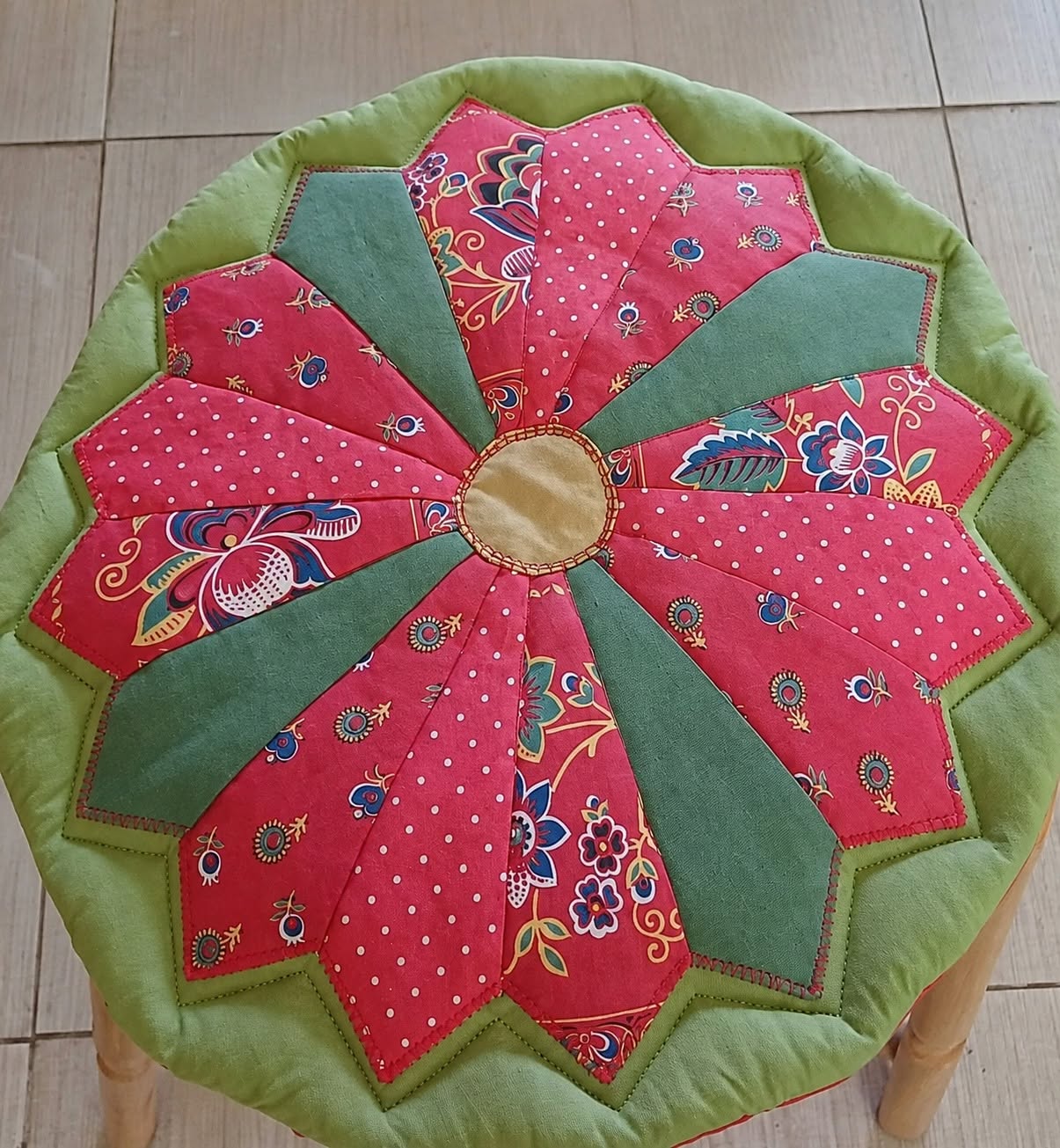
The design shown in the photo combines flower-inspired patchwork, appliqué techniques, soft padding, decorative stitching, and a neatly finished circular border.
Each elongated fabric petal points toward a round center, creating the appearance of a large blooming flower across the stool seat.
By mixing solid fabrics with floral, checked, and polka-dot prints, the finished cover gains depth, personality, and a handmade country-style appearance.
This project is suitable for sewists who enjoy using fabric scraps creatively while making something practical for the home.
With careful measuring and patient assembly, the same basic method can be adapted to stools of many different sizes.
The term Patchwork Floral Stool Cover Fabric Pattern describes both the visual design and the construction process used to make the piece.
“Patchwork” refers to combining separate fabric sections into a unified composition, while “floral” describes the arrangement of those sections as petals around a center.
A “stool cover” is the padded fabric layer fitted over the stool seat, offering decoration, softness, and some surface protection.
The “fabric pattern” includes the printable or hand-drafted templates needed to cut the petals, center circle, background, border, and backing accurately.
Although the cover looks detailed, its construction becomes manageable when the work is divided into measuring, cutting, arranging, stitching, padding, and finishing stages.
The most important factor is consistency, especially when tracing and cutting repeated petal shapes.
One of the best features of this fabric stool cover pattern is the freedom it gives you when selecting colors and prints.
You may reproduce the green and red palette seen in the photograph or create a completely different combination that matches your room.
Scrap fabrics work especially well because each petal can display a different pattern without making the design feel disorganized.
A repeated background color, such as soft green, helps connect the various prints and keeps the finished flower visually balanced.
The project is also a useful opportunity to practice fabric appliqué, curved sewing, decorative edge stitching, layering, and basic upholstery-style finishing.
Before starting, wash and press all cotton fabrics so they are less likely to shrink or distort after the cover has been completed.
Materials, Measurements, and Fabric Preparation
Begin by measuring the diameter of the stool seat from one outer edge to the opposite edge. Add approximately 3 to 5 inches to this measurement so the cover can extend over the sides and accommodate padding. For example, a stool seat measuring 14 inches across may require an outer fabric circle between 17 and 19 inches, depending on how much side coverage you prefer.
DISCOVER MORE FREE PATTERNS HERE!
For the main materials, prepare quilting cotton in several coordinating colors, a larger piece of background fabric, backing fabric, batting or foam, matching sewing thread, and a small amount of bias binding or piping. You will also need paper for drafting the templates, fabric scissors, paper scissors, pins or fabric clips, a ruler, a marking pencil, and a sewing machine.
The flower shown in the reference image is formed with long pointed petals arranged in a circular pattern. To create your patchwork floral pattern, draw one petal on paper with a narrow lower end and a wider pointed outer end. The petal must be long enough to reach from the center circle toward the edge of the stool cover.
Fold the paper petal vertically before cutting it out. This simple step ensures that the left and right sides are symmetrical. Add a ¼-inch seam allowance around the template when the petals will be pieced traditionally. When using raw-edge appliqué, you may cut directly on the final outline, although a fusible web layer is recommended to stabilize the pieces.
The number of petals depends on their width and on the look you want to achieve. A design containing between 12 and 16 petals usually creates a full, balanced flower. Before cutting all the pieces, make one test petal from inexpensive fabric and place it on the paper circle to check its size and angle.
Press every fabric before tracing the templates. Position the pattern carefully so the grain of the fabric runs vertically along each petal whenever possible. Accurate grain placement helps prevent stretching, especially around the pointed tips. Trace and cut the required number of petals, alternating solid colors and printed fabrics to create a lively floral patchwork design.
Creating and Arranging the Floral Patchwork
Cut the background fabric into a circle using the stool measurement plus the selected allowance. To make a clean paper guide, fold a square sheet of paper into quarters, measure the radius from the folded corner, mark several points, and connect them with a smooth curve. Unfold the paper to reveal a balanced circular template.
Mark the exact center of the background circle with a removable fabric pencil. Next, draw a light vertical line and a horizontal line through the center. These guidelines divide the circle into four equal sections and make it easier to distribute the petals evenly without allowing the flower to shift to one side.
Place the first four petals on the vertical and horizontal guidelines. Their narrow ends should meet near the center, while their pointed tips should face the outer edge. Add the remaining petals between these first four pieces, maintaining equal spacing and checking that the colors alternate attractively.
Experiment with the fabric arrangement before pinning anything permanently. Place bold floral prints beside quieter solids, and avoid grouping too many similar prints in one area. In the photographed design, red patterned petals are balanced by green pieces, creating a strong contrast while preserving a coordinated handmade appearance.
Once the arrangement looks balanced, secure the petals with pins, temporary fabric adhesive, or fusible web. Start securing them near the center and work outward. Smooth each section carefully so there are no wrinkles underneath. The petal points should form a relatively even ring around the outer portion of the background.
Cut a circular center from a neutral fabric such as beige, cream, pale yellow, or soft gold. The center circle hides the narrow ends of the petals and becomes the focal point of the design. Make it large enough to cover all raw intersections while remaining proportional to the petals and the overall Patchwork Floral Stool Cover Fabric Pattern.
Sewing, Decorative Stitching, and Adding Padding
Choose an appliqué stitch suitable for your fabric and sewing machine. A narrow zigzag stitch provides a secure finish, while a blanket stitch creates a more decorative, handcrafted edge. Test the stitch length and width on fabric scraps before working on the actual cover, particularly when using contrasting thread.
Sew around each petal slowly, beginning near the narrow center end and following the outline toward the pointed tip. Stop with the needle down whenever you need to pivot. Raise the presser foot, rotate the fabric slightly, lower the foot, and continue sewing. This technique produces cleaner points and smoother corners.
After all petals are attached, position the center circle over their inner ends. Pin or fuse it securely, then stitch around the circumference. A decorative blanket stitch works beautifully around the center because it visually connects with the stitching used around the petals. Press the finished appliqué from the reverse side using moderate heat.
Place the completed top over a layer of batting. For a softer stool, use two layers of quilt batting or a piece of thin upholstery foam. Cut the padding slightly larger than the finished circle so it reaches fully across the seat and gently wraps around the sides without creating empty areas.
Baste the top and padding together around the outer edge. You can also add light quilting to keep the layers stable. Stitching around the center circle, between selected petals, or close to the appliqué edges will prevent the padding from shifting while still allowing the floral design to remain soft and slightly raised.
At this stage, test the layered piece on the stool. Check that the flower is centered and that the padded outer border falls evenly around the seat. If one area appears longer, trim cautiously. Avoid removing too much fabric because the final seam, binding, or casing will reduce the overall diameter slightly.
Finishing and Fitting the Stool Cover
Cut the backing fabric to match the outer circle of the padded top. Depending on how you want the cover to attach, the backing may be a simple full circle, a fitted casing, or a gathered lower panel. A removable cover is usually more practical because it can be taken off for gentle cleaning.
For a gathered fit, cut a fabric strip long enough to travel around the circumference of the cover, adding extra length for seams and fullness. Sew the short ends together to form a loop. Attach one long edge of the loop to the circular cover, distributing the fabric evenly and clipping curves when necessary.
Fold the lower edge of the side strip inward twice to create an elastic casing. Stitch around the casing while leaving a small opening. Insert elastic with a safety pin, pull it until the cover fits securely under the stool seat, join the elastic ends, and close the opening with a short line of stitching.
Another option is to finish the cover with bias binding and add fabric ties underneath. Bias binding follows curves more easily than straight-grain fabric. Pin it around the outer edge, stitch it slowly, fold it over the raw layers, and topstitch it in place. Add four strong ties positioned at equal intervals.
To imitate the appearance of the photographed stools, consider adding piping around the lower edge. A contrasting red, coral, or dark green piping cord gives the cover a more defined outline. Sew the piping to the top layer before attaching the backing or side section, keeping the cord close to the stitching line.
Place the completed Patchwork Floral Stool Cover Fabric Pattern on the stool and adjust the sides until the flower sits directly in the center. Smooth the padded border with your hands and check that the attachment method is secure. The finished piece should feel comfortable, remain stable during normal use, and display an even circular silhouette.
Frequently Asked Questions
What fabric works best for a Patchwork Floral Stool Cover Fabric Pattern?
Medium-weight cotton is usually the easiest choice because it cuts cleanly, presses well, and supports appliqué stitching. Quilting cotton offers an excellent variety of solids and prints. For a heavier-use stool, canvas or cotton-linen fabric may be used for the backing and side sections.
Can I make this stool cover using fabric scraps?
Yes. This is an excellent fabric scrap project because each petal requires only a relatively small piece of material. Try to select scraps with similar weights so that the flower remains smooth. Very thin and very heavy fabrics may react differently during stitching and washing.
How many petals should the floral design contain?
Most circular stool covers look balanced with 12 to 16 petals. Wide petals require fewer pieces, while narrow petals allow a fuller design. The ideal number depends on the seat diameter and the dimensions of your template. Always test the paper pieces on a full-size circle before cutting fabric.
Should I use fusible web for the appliqué?
Fusible web is helpful, especially for beginners or for raw-edge appliqué. It keeps the petals from moving while they are stitched and reduces fraying. Select a lightweight fusible product so the final seat does not become overly stiff. Follow the manufacturer’s heat recommendations when pressing.
Can this project be sewn by hand?
The project can be completed by hand, although it will require more time. Use small blanket stitches or slip stitches to secure the appliqué pieces. Strong hand-quilting thread may be used for the decorative edges, while durable polyester thread is suitable for assembling the cover and its attachment system.
How thick should the padding be?
For decorative use, one or two layers of cotton or polyester batting may be sufficient. For regular seating, thin upholstery foam provides more support. Avoid extremely thick foam unless the side panel has been measured to accommodate it, as excessive bulk can make the cover difficult to fit securely.
How do I resize the pattern for a larger stool?
Measure the new stool diameter and enlarge the background circle accordingly. Increase the petal length so the flower reaches toward the outer edge, but keep the center circle proportional. A photocopier can enlarge a paper template, or you can redraw the petal using a ruler and curved lines.
How can I prevent the fabric from puckering around the appliqué?
Use a stabilizer behind the background fabric, select the correct needle, and avoid pulling the material while sewing. A slightly longer stitch may work better on thicker layers. Press the work gently after stitching, but do not stretch the circular background while it is warm.
Is the finished stool cover washable?
A removable cotton cover can usually be washed gently, but the correct method depends on the batting, foam, thread, and embellishments used. Prewash all cotton fabrics before construction. When foam is removable, take it out before washing. Air-drying helps preserve the shape and decorative stitching.
What color combinations work well for this design?
Red and green create a cheerful country-inspired look similar to the photographed project. Blue and white produce a fresh coastal style, while beige, brown, and rust create a warm farmhouse appearance. Pastel pink, mint, lavender, and cream are suitable for a softer cottage-style design.
Can I use the floral pattern for something other than a stool cover?
Yes. The same patchwork flower pattern may be adapted for cushions, table toppers, wall hangings, chair pads, placemats, or quilt blocks. Adjust the petal and background dimensions according to the intended project, and choose the appropriate amount of padding for its function.
How do I keep the stool cover from sliding?
Use elastic, fabric ties, a fitted side panel, or a nonslip backing material. The cover should fit snugly without being stretched excessively. For stools used frequently, elastic combined with a textured backing offers additional stability and allows the cover to be removed when cleaning is necessary.
Conclusion
The Patchwork Floral Stool Cover Fabric Pattern combines practical sewing with the beauty of a large fabric flower. Throughout this tutorial, you learned how to measure the stool, create a circular base, draft an accurate petal template, select coordinating fabrics, arrange the floral composition, secure the appliqué pieces, add decorative stitching, insert padding, and finish the cover with elastic, ties, binding, or piping. Careful preparation is the key to achieving a balanced result. Testing paper templates before cutting fabric prevents sizing problems, while marking the center and dividing the background into equal sections keeps the flower symmetrical. The use of contrasting prints, repeated colors, and a neutral center circle helps turn individual scraps into a cohesive floral fabric pattern.
EASILY FIND THE PDF FOR THIS PATTERN HERE!
This project can be customized for almost any decorative style, from farmhouse and country sewing to modern, vintage, cottage, or colorful scrap quilting. Once you understand the construction method, you can resize the flower, change the number of petals, experiment with different stitches, or adapt the design for cushions and other home accessories. Please leave your sincere opinion about this Patchwork Floral Stool Cover Fabric Pattern and share any suggestions that could make the project even more creative, practical, or enjoyable for other sewing enthusiasts.