
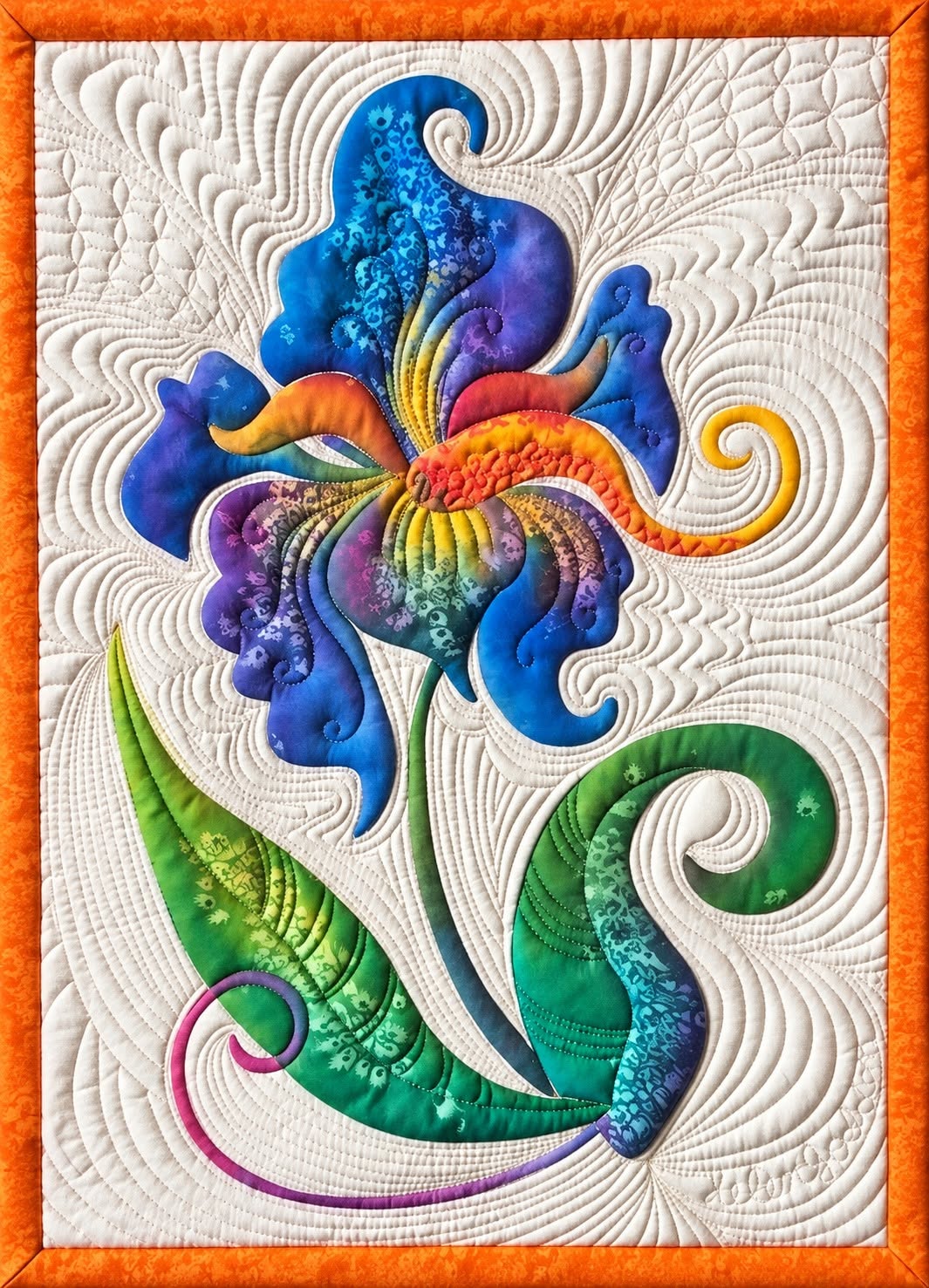
The Panel with Iris Appliqué and Free Motion Quilting Pattern is a striking textile project that combines expressive floral appliqué with dense, flowing quilting to create a dimensional piece of fiber art.<br>
Inspired by the image, the design features a large iris as the focal point, surrounded by elegant leaves, curved stems, and a richly quilted neutral background.<br>
The contrast between the colorful flower and the light quilted surface helps every petal, curve, and stitched detail stand out without making the composition feel crowded.<br>
This type of project is especially appealing to quilters who want to move beyond traditional blocks and explore a more artistic approach to appliqué quilting, free motion quilting, and decorative textile panels.<br>
Although the finished piece appears intricate, it can be created gradually by separating the work into manageable stages: planning the motif, preparing the appliqué pieces, assembling the quilt sandwich, stitching the design, and completing the background quilting.<br>
The result can be displayed as a wall hanging, framed textile panel, decorative centerpiece, or simply kept as a beautiful example of creative quilting practice.
One of the most important characteristics of the Panel with Iris Appliqué and Free Motion Quilting Pattern is the relationship between color and texture.<br>
The iris in the reference design contains shades of blue, violet, purple, orange, green, yellow, and turquoise, creating the appearance of painted fabric while still preserving the handcrafted quality of quilting.<br>
The surrounding white or cream area works almost like negative space in a painting, but instead of remaining completely empty, it is filled with sweeping stitched curves, echoes, feathers, spirals, waves, and organic motifs.<br>
These quilting lines create movement around the flower and visually connect the central appliqué with the edges of the panel.<br>
For a similar project, you do not need to reproduce every color or quilting line exactly; what matters most is preserving the balance between a dramatic iris appliqué, a quiet background, and detailed free motion quilting.<br>
Choosing harmonious fabrics and repeating a few colors throughout the petals and leaves will make the finished panel look intentional and professionally coordinated.
This project can be adapted to different skill levels because the same basic construction method works whether you use simple cotton prints or sophisticated hand-dyed fabrics.<br>
A confident beginner can simplify the iris into larger appliqué shapes and use basic curves or meandering stitches in the background, while an experienced quilter can divide the petals into multiple sections and add micro-quilting, echo lines, feathers, and decorative fills.<br>
For the strongest visual effect, select a high-quality neutral cotton for the background, colorful fabrics for the flower and leaves, batting that provides moderate loft, backing fabric, coordinating threads, fusible web if desired, and a sturdy binding fabric.<br>
A sewing machine capable of lowering or covering the feed dogs is useful for free motion quilting, although the exact setup depends on your machine.<br>
Before quilting the final panel, practicing the major motifs on a small quilt sandwich can help you become comfortable with hand movement, stitching speed, and changes in direction.<br>
With patience and careful planning, the Panel with Iris Appliqué and Free Motion Quilting Pattern becomes an enjoyable way to combine fabric selection, appliqué, thread work, and creative quilting in one unified design.
Preparing the Iris Appliqué Pattern and Choosing Fabrics
Begin by deciding the final dimensions of your Panel with Iris Appliqué and Free Motion Quilting Pattern. A medium wall panel is often easier to manage than a very large quilt because you can rotate it comfortably while appliquéing and quilting. Cut your neutral background several centimeters larger than the desired finished size so you have room for trimming after the quilting is complete. Press the fabric carefully before beginning because wrinkles can distort the appliqué placement.
DISCOVER MORE FREE PATTERNS HERE!
Next, study the iris as a collection of separate shapes rather than one complicated flower. The design can be divided into upper petals, side petals, central petals, lower petals, the flower throat, stem, large leaves, and decorative curled extensions. Draw these shapes on paper or tracing material, simplifying extremely small details when necessary. Creating a full-size paper layout first makes it easier to adjust proportions before cutting valuable fabric.
For the iris appliqué, choose several fabrics instead of relying on one solid color. Blues and purples can form the dominant petals, while orange, coral, gold, lavender, and turquoise pieces add contrast near the center. Fabrics with subtle mottling, watercolor effects, batik textures, or tonal patterns are particularly effective because they create natural variation without requiring complicated piecing. Keep the strongest contrasts near the focal areas of the flower.
The leaves should complement the flower while remaining visually distinct. Use different shades of green, such as emerald, olive, lime, teal-green, or deep forest green. In the reference-inspired composition, the leaves contain broad curves and tapered ends, making them important secondary design elements rather than simple background foliage. A slightly darker fabric along one edge can suggest shadow, while a brighter green area creates the impression of reflected light.
Transfer each pattern shape to fusible web if you prefer raw-edge fusible appliqué. Remember to reverse directional shapes when tracing them onto the paper side of the fusible material. Fuse the pieces to the wrong side of the selected fabrics according to the product instructions, allow them to cool, and then cut accurately along the traced lines. If you prefer turned-edge appliqué, add an appropriate seam allowance around every template instead.
Once all pieces are cut, arrange the entire iris on the neutral background before permanently attaching anything. Begin with the shapes that visually sit behind the others, followed by overlapping petals, central sections, stems, and foreground leaves. Step away from the work occasionally and look at the composition from a distance. This simple habit makes it much easier to notice a petal that appears too large, a curve that feels awkward, or a color that needs better balance.
Building the Appliqué and Creating Dimension with Stitching
After you are satisfied with the arrangement, secure the pieces to the background using your chosen appliqué method. When working with fusible appliqué, fuse only after confirming the final placement. Avoid excessive heat because too much adhesive or prolonged pressing can make the fabric stiff. A pressing sheet can help protect both your iron and the exposed edges of the fusible material.
Stitch around each appliqué shape to secure the edges. A narrow zigzag, blanket stitch, satin stitch, or small straight stitch can all work well depending on the style you want. For an artistic Panel with Iris Appliqué and Free Motion Quilting Pattern, a fine straight stitch placed close to the raw edge often creates a softer, more painterly appearance. Matching thread makes the stitching subtle, while contrasting or variegated thread emphasizes the outlines.
Add internal stitched details to the petals after the main shapes are secured. These lines can follow the natural direction of an iris petal, beginning near the center and flowing outward. Curved stitching, small veins, gentle echoes, and selective decorative fills can make flat appliqué fabric appear sculpted. Avoid filling every area with the same density because differences in stitch spacing help create visual depth.
The central portion of the flower deserves special attention because it naturally becomes the visual focal point. Use slightly denser stitching, warmer colors, or carefully placed thread accents near the throat of the iris. Orange, gold, coral, or yellow threads can be particularly effective against blue and purple fabrics. If you are using variegated thread, test it first to ensure the color changes enhance rather than distract from the fabric.
Stitch the leaves in a similar way, following their long sweeping curves. Quilted veins can extend from the base toward the tapered ends, while curved parallel lines can emphasize the curled sections. A few textured fills in selected areas create additional interest. The objective is not to cover every inch of the appliqué with thread but to use quilting lines strategically to suggest movement, folds, shadows, and changes in direction.
When the appliqué stitching is finished, inspect the entire panel before creating the quilt sandwich. Trim loose threads and make sure every edge is securely attached. Place the backing wrong side up, center the batting over it, and position the appliquéd top right side up. Baste the three layers with your preferred method, keeping the surface smooth. Proper basting is essential because the dense free motion quilting used later can amplify even small wrinkles.
Free Motion Quilting the Background and Finishing the Panel
Before beginning the background, practice your chosen free motion quilting motifs on a scrap sandwich made from similar fabric and batting. Adjust the machine tension as needed and find a comfortable relationship between machine speed and hand movement. For many quilters, smooth medium-speed stitching produces more consistent curves than trying to move either extremely slowly or extremely quickly.
Start by quilting close to the outline of the iris and leaves. This technique, often called outlining or stitching in the ditch depending on placement, helps define the appliqué and makes it rise visually above the background. Add one or two echo lines around selected parts of the flower. Echo quilting is especially effective around dramatic curved petals because it repeats their silhouette and extends their movement into the surrounding white space.
Divide the remaining background mentally into several sections. Instead of attempting to quilt the entire area with one continuous motif, allow different textures to flow around the iris. You might use curved parallel lines beside one petal, feather-inspired forms near another, gentle waves near the leaves, and small spirals in open corners. Repeating a few motifs throughout the panel keeps the design cohesive.
Pay attention to quilting density. Dense quilting around the appliqué compresses the background and allows the flower to appear more dimensional. However, extremely dense stitching across the entire surface can make the panel stiff. Leave occasional areas with slightly wider spacing so the eye has places to rest. Consistency is less important than creating intentional transitions between heavily and lightly quilted areas.
As you work toward the outer edges, use the background stitching to guide the viewer’s eye back toward the iris. Long sweeping curves can point inward, while feathers and spirals can echo the natural shapes of petals and leaves. The objective of free motion quilting is not simply to fill empty fabric; it should strengthen the composition. Rotate the panel when necessary and pause regularly to check how different sections relate to one another.
After the quilting is complete, lay the panel on a flat surface and square it carefully. Trim the excess batting and backing, maintaining equal margins around the central composition. Finish the perimeter with a fabric binding that complements the appliqué. A warm rust, copper, brown, gold, deep green, or blue binding can frame the neutral background beautifully. Add a hanging sleeve to the back if the finished Panel with Iris Appliqué and Free Motion Quilting Pattern will be displayed on a wall.
Frequently Asked Questions About the Panel with Iris Appliqué and Free Motion Quilting Pattern
What is the best fabric for an iris appliqué quilt panel? High-quality quilting cotton is an excellent choice because it is stable, easy to cut, and available in many colors and textures. Batiks and tonal fabrics work particularly well for a floral art quilt because their subtle variations can create depth inside the petals. A neutral cotton background provides strong contrast and makes the colorful iris appliqué easier to appreciate.
Do I need an expensive sewing machine for free motion quilting? No. Many domestic sewing machines can be used for free motion quilting as long as you can use an appropriate quilting or darning foot and manage the feed dogs according to your machine’s instructions. Good lighting, comfortable positioning, practice, and consistent hand movement are often more important than having a specialized machine.
What type of batting works well for this project? A batting with moderate loft is usually a practical choice for a decorative panel. Cotton batting creates a relatively flat traditional appearance, while blends can provide slightly more definition depending on their composition. The most important factor is selecting batting that behaves well with the amount of quilting you plan to add and testing it before committing to the final piece.
Can a beginner make the Panel with Iris Appliqué and Free Motion Quilting Pattern? Yes, but simplifying the design is helpful. Beginners can create larger petals with fewer overlaps, use raw-edge fusible appliqué, and replace complicated quilting motifs with basic loops, waves, echoes, or gentle meandering. The project can become more elaborate as confidence develops, making it suitable for gradual skill building.
How can I prevent puckering during dense free motion quilting? Start with a well-basted quilt sandwich, check thread tension on a sample, and quilt gradually across the surface instead of completely finishing one tiny area before moving to another. Smooth the panel periodically without stretching it. Maintaining reasonably balanced quilting density throughout the background also reduces distortion.
Can I change the colors of the original iris design? Absolutely. The Panel with Iris Appliqué and Free Motion Quilting Pattern can be interpreted in many palettes. Purple and blue create a classic iris appearance, while pink, burgundy, turquoise, yellow, orange, or even monochromatic fabrics can produce a more contemporary result. Keep enough contrast between neighboring pieces so the petal shapes remain easy to distinguish.
Conclusion
Creating a Panel with Iris Appliqué and Free Motion Quilting Pattern is an opportunity to combine several important quilting techniques in one decorative project. The process begins by breaking the iris into manageable appliqué shapes, selecting fabrics with strong but harmonious colors, and arranging the pieces carefully on a neutral background. Accurate placement provides the foundation for the entire composition.
After the appliqué pieces are secured, decorative stitching can transform simple fabric shapes into dimensional petals and leaves. Following the natural direction of the flower with curved lines, veins, echoes, and small textured areas creates depth without requiring complicated painting techniques. Thread effectively becomes another artistic material alongside the fabric.
The free motion quilting is what brings the background to life. Echoes, waves, feathers, spirals, curved lines, and organic fills can surround the iris while emphasizing its movement. Varying the quilting density helps the appliqué stand forward visually and prevents the light background from appearing empty.
Finally, careful trimming and a coordinating fabric binding give the panel a polished finish. Whether you follow the colors of the reference image or create your own interpretation, the most important idea is to maintain a balance between iris appliqué, color, texture, negative space, and free motion quilting.
EASILY FIND THE FREE PDF FOR THIS PATTERN HERE!
This project can also be an excellent practice piece for developing greater confidence with artistic quilting because every section provides an opportunity to experiment with fabric placement, thread selection, curves, decorative fills, and dimensional effects. There is no need for every stitch to be identical; small variations are part of the character of handmade textile art. If you create your own Panel with Iris Appliqué and Free Motion Quilting Pattern, leave your sincere opinion about the project and share your suggestions. Which part would you change, which colors would you choose for your iris, and what free motion quilting motifs would you use in the background? Your ideas can inspire new interpretations and make this beautiful quilting technique even more creative.