
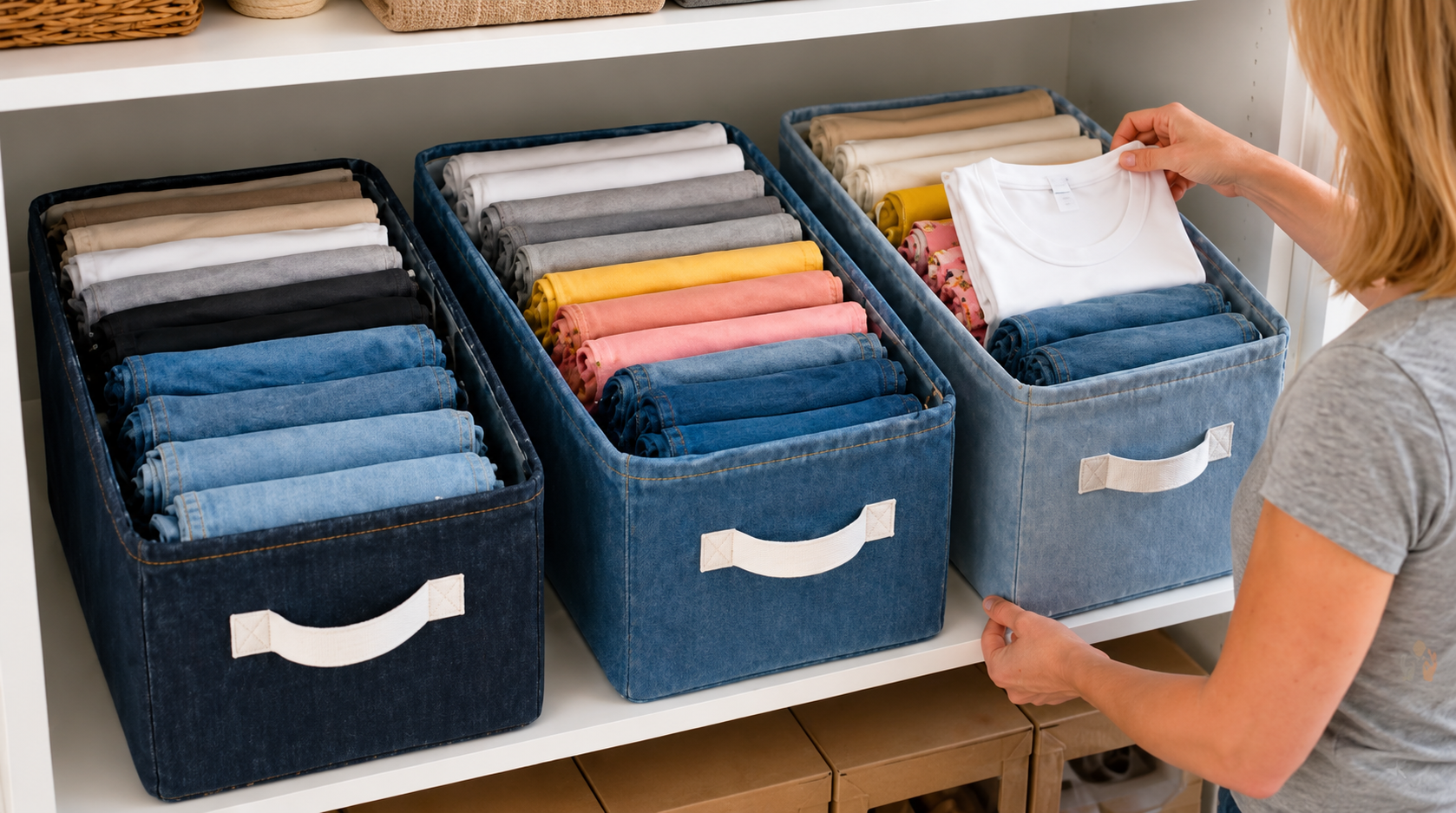
DIY large storage box made from old jeans Pattern is a practical sewing project that transforms worn denim into a useful, attractive, and sturdy organizer for the home. Instead of leaving old jeans forgotten in a closet, you can reuse their strongest sections to create spacious fabric boxes similar to the denim storage containers shown in the reference image. The finished organizers are ideal for folded clothing, towels, sewing supplies, toys, craft materials, accessories, or seasonal items. Because denim naturally has more body than many lightweight fabrics, it is an excellent material for a box that needs to keep its shape while still looking soft and handmade. This project is also flexible because you can make one large box or create several coordinating boxes in different shades of blue denim.
One of the best features of this DIY denim storage box is that you do not need perfectly matching jeans. In fact, mixing dark, medium, and light washes can give the finished project a charming handmade appearance. The box can be kept simple with large uninterrupted denim panels, or it can be constructed from several smaller pieces if your jeans do not provide enough fabric for a single panel. Strong interfacing or stabilizer is added between the outer denim and the lining to give the organizer the structured rectangular appearance seen in the photo. A fabric handle on the front makes the container easier to pull from a shelf, while neat topstitching gives the project a polished finish.
Making a large storage box from old jeans is also a useful way to practice practical sewing techniques such as working with heavy fabric, adding interfacing, sewing boxed corners, inserting a lining, and attaching reinforced handles. The project can be adapted to many sizes, but for a roomy closet organizer, a finished measurement of approximately 40 cm wide, 30 cm deep, and 30 cm high works especially well. You can adjust these dimensions according to your shelving space. The following DIY large storage box made from old jeans Pattern explains the complete process from preparing your recycled denim to shaping, lining, reinforcing, and finishing the storage box.
Materials, Measurements, and Preparing the Old Jeans
Begin by collecting two or three pairs of old jeans, depending on their size and how large you want the organizer to be. For the clean rectangular style shown in the image, choose denim areas without excessive stretching, holes, or very thin worn sections. Legs usually provide the largest usable pieces. You may also save pockets and seams for another recycling project rather than discarding them.
DISCOVER MORE FREE PATTERNS HERE!
For a finished box measuring approximately 40 cm wide × 30 cm deep × 30 cm high, prepare denim panels for the front, back, two sides, and bottom. Add approximately 1.5 cm seam allowance around each piece. Your front and back panels can therefore measure about 43 cm × 33 cm, while the side panels can measure approximately 33 cm × 33 cm. Cut the bottom approximately 43 cm × 33 cm.
You will also need medium- or heavy-weight interfacing, fusible fleece, foam stabilizer, or another bag-making stabilizer. This material is important because denim alone may collapse when the box is empty. Cut stabilizer pieces slightly smaller than the denim panels so bulky material does not become trapped inside every seam allowance.
For the lining, choose cotton canvas, quilting cotton reinforced with interfacing, or another washable fabric. Cut lining pieces using the same dimensions as the denim pieces. A lighter lining can make the inside easier to see, especially if the box will hold clothing, craft supplies, or small household objects.
The front handle can be made from cotton webbing, recycled denim, or sturdy canvas. A handle approximately 20 to 24 cm long works well for a large organizer. If making the handle from denim, cut a strip about 26 cm long and 8 cm wide, fold the raw edges inward, fold the strip in half, and topstitch both long edges.
Before cutting anything, wash and dry the jeans. Prewashing is especially important for recycled denim because different jeans may shrink differently. Press the fabric thoroughly after washing. Carefully remove thick waistbands, metal rivets, zippers, and excessively bulky seams so the usable denim lies flat during cutting.
Cutting, Reinforcing, and Sewing the Denim Box
Lay the prepared denim on a large cutting surface and position your pattern pieces carefully. If one pair of jeans is not wide enough for a full panel, sew smaller pieces together first. Press the joining seams open and topstitch them if desired. Patchwork construction can become an intentional design feature of your old jeans storage box.
Attach stabilizer to the wrong side of each denim panel according to the manufacturer’s instructions. If you are using fusible interfacing, test the iron temperature on a scrap of denim first. Some old jeans contain stretch fibers that can react differently to high heat. Apply the stabilizer evenly so the panels remain smooth.
Next, mark the handle placement on the front panel. Center the handle horizontally and position it approximately 8 to 10 cm below the top edge. Fold approximately 2 cm of each handle end underneath before sewing. This hides the raw edges and produces a cleaner finish.
Stitch each end of the handle securely using a square with a diagonal X through the center. This reinforcement method distributes stress over a larger area and is commonly used for bag handles. Sew slowly through the multiple fabric layers and use a denim needle if necessary.
Now place the front panel and one side panel right sides together. Sew along the vertical edge using approximately a 1.5 cm seam allowance. Continue by attaching the back panel, second side panel, and finally closing the remaining side seam. You should now have a rectangular denim tube.
Pin or clip the denim bottom panel to the lower edge of the box. Match every corner precisely before sewing. Stitch one side at a time, stopping with the needle down whenever you need to pivot at a corner. Trim excessive bulk from the seam allowances if necessary, but do not cut too close to the stitching.
Creating the Lining and Giving the Storage Box Its Shape
Construct the lining in almost the same way as the denim exterior. Sew the front, side, back, and remaining side panels together with right sides facing. Keep your seam allowances consistent because even a small difference can affect how smoothly the lining fits inside the outer box.
Attach the lining bottom carefully, matching the four corners. Leave an opening approximately 15 to 18 cm long along one bottom or side seam. This opening will later allow you to turn the entire organizer right side out after the exterior and lining have been joined.
Press the lining seams where possible. Good pressing can dramatically improve the appearance of a handmade storage box. Although some stabilizers should not be pressed aggressively, the lining seams can usually be flattened with a regular iron using the appropriate temperature for the fabric.
Turn the denim exterior right side out and gently push out the corners. At this stage you should begin to see the final rectangular form of the DIY large storage box made from old jeans Pattern. If the sides feel too flexible, you can insert additional pieces of foam stabilizer or plastic canvas between the exterior and lining before finishing.
Place the denim box inside the lining so the right sides of the fabrics face each other. Match the side seams and upper edges. Clip around the entire opening rather than relying only on pins, especially if your denim and stabilizer create thick layers.
Sew around the upper opening with a consistent seam allowance. After stitching, carefully turn the entire project right side out through the opening left in the lining. Push the denim exterior into shape, place the lining inside the box, and close the lining opening with a neat machine stitch or invisible hand stitch.
Finishing Details, Topstitching, and Using the Denim Storage Box
Once the lining is inside the box, roll the upper seam gently between your fingers so the lining sits just below the denim edge. Press carefully if your stabilizer allows it. Clip around the top to prevent the layers from shifting before topstitching.
Sew one or two rows of topstitching around the upper edge. A slightly longer stitch length, such as 3 to 3.5 mm, often looks attractive on denim. Gold, tan, cream, or contrasting thread can create the classic jeans-inspired appearance visible in the reference project.
Check the handle again after the organizer is completed. It should lie flat against the front when not being used but allow enough room for your fingers when pulling the box from a shelf. If you plan to store heavier objects, reinforce the handle attachment with a second row of stitching.
To improve the rectangular shape even further, cut removable bottom support from plastic canvas, thin corrugated plastic, or another lightweight washable material. Cover the insert with leftover lining fabric before placing it inside the bottom. This creates a flatter base and helps distribute the weight of stored items.
Your completed recycled denim storage box can now be used for folded jeans, shirts, towels, yarn, fabric, toys, magazines, or general household organization. Creating several boxes in different denim washes can produce an attractive coordinated storage system. Dark jeans can become one box, medium denim another, and faded jeans a third.
The same DIY large storage box made from old jeans Pattern can easily be resized. For smaller shelves, reduce the width and depth while keeping the construction method unchanged. For very large storage bins, increase the strength of the stabilizer and consider using two layers of denim or canvas reinforcement around the bottom.
FAQ About the DIY Large Storage Box Made From Old Jeans Pattern
How many pairs of jeans are needed to make one large storage box?
For a box measuring approximately 40 × 30 × 30 cm, two to three adult-size pairs of jeans are usually enough. The exact amount depends on the jeans size, the number of worn areas, and whether you use complete panels or patch together smaller denim pieces.
Can stretch jeans be used for this project?
Yes, although non-stretch denim is easier to stabilize. Stretch denim should be reinforced with a strong interfacing so the sides do not become distorted. Avoid extremely thin or heavily worn stretch sections.
What is the best stabilizer for a denim storage box?
Firm fusible interfacing, foam stabilizer, heavyweight nonwoven stabilizer, or bag-making foam can all work well. The best choice depends on how rigid you want the box to be. A large organizer generally needs more support than a small fabric basket.
Can I make the box without interfacing?
You can, but the finished container will probably be softer and may collapse when empty. If you want the structured appearance shown in the reference image, some type of internal reinforcement is strongly recommended.
What sewing machine needle should I use for old jeans?
A denim or jeans needle is usually the most suitable choice. Sizes such as 90/14 or 100/16 work for many denim projects, although the ideal needle depends on the thickness of your fabric and the number of layers being sewn.
Can the storage box be washed?
A fabric-only version can generally be gently washed, provided all materials used are washable. However, removable plastic or cardboard supports should be taken out first. If the box contains very firm specialty stabilizer, follow the care instructions for that material.
How do I prevent bulky corners?
Trim excess seam allowance carefully after sewing, particularly around the bottom corners. Avoid cutting through the stitches. Grading the seam allowances can also reduce bulk where several layers meet.
Can I use jeans pockets on the outside?
Absolutely. Recycled pockets can become useful exterior compartments for labels, scissors, measuring tapes, small toys, or other lightweight items. Stitch them to the denim panel before assembling the main box.
How can I make the box stand more upright?
Use firmer stabilizer and add a removable rigid bottom. You can also insert thin stabilizer panels between the lining and exterior on all four sides. These additions help the denim organizer maintain clean rectangular walls.
Can different denim colors be combined?
Yes. Combining several denim washes is one of the most appealing aspects of working with recycled jeans. You can create patchwork panels, alternating sides, contrasting handles, or coordinated boxes in dark, medium, and light blue.
Is this project suitable for beginners?
A confident beginner can complete it with patience. The construction uses mostly straight seams, although sewing thick denim layers and aligning the bottom corners requires careful handling. Practicing on scrap denim before sewing the final pieces can be helpful.
What can I store inside a large denim box?
These organizers are excellent for clothing, towels, fabric, yarn, lightweight toys, blankets, accessories, magazines, and general closet organization. Very heavy objects should be avoided unless the bottom and handles are specially reinforced.
Conclusion
The DIY large storage box made from old jeans Pattern is a creative way to combine sewing, recycling, and practical home organization in one useful project. By preparing old denim, cutting structured panels, adding stabilizer, sewing a lining, attaching a reinforced handle, and carefully topstitching the upper edge, you can transform unwanted jeans into an attractive organizer that looks polished enough for an open closet or shelving unit.
The most important lessons are to choose strong sections of denim, reinforce every large panel, keep the measurements consistent, strengthen the handle attachment, and take your time when sewing bulky corners. Once you understand these techniques, the same basic old jeans storage box pattern can be adapted into smaller baskets, deeper closet bins, craft organizers, or coordinated storage sets.
This project also shows how useful recycled fabric can become when it is given a thoughtful new purpose. Instead of treating worn jeans as waste, you can use their durability, texture, and familiar blue tones to create something functional for everyday life. Whether you make one large organizer or several matching containers, each finished box can have its own unique combination of denim shades and stitching details. If you try this DIY large storage box made from old jeans Pattern, leave your sincere opinion about the project and share any suggestions you would use to customize it. Your ideas about different denim combinations, handles, linings, dimensions, or decorative details can inspire even more creative versions of this practical recycled sewing project.