
The Crochet Heart, Butterflies, and Circles Pattern is a charming handmade project that combines three simple decorative motifs into one colorful crochet composition. Hearts bring a soft romantic touch, butterflies create movement and personality, and crocheted circles provide a practical foundation that can be transformed into coasters, appliqués, table decorations, garlands, or small handmade gifts. One of the advantages of this project is that you can work with several yarn colors without needing complicated construction techniques. The pattern is especially suitable for crocheters who already understand basic stitches but want to practice shaping and joining smaller motifs. Throughout this tutorial, the instructions use standard US crochet terminology so that the abbreviations remain consistent and easy to follow. By the end, you will understand how to crochet each component and combine them into your own version of the Crochet Heart, Butterflies, and Circles Pattern.
Another appealing feature of the Crochet Heart, Butterflies, and Circles Pattern is its flexibility. You can make tiny hearts for decorative accents, medium butterflies for embellishments, or larger circles to serve as cup mats and decorative table pieces. Cotton yarn is particularly useful because it produces defined stitches and creates pieces that hold their shape well, although acrylic yarn can also be used for purely decorative versions. The colors can be coordinated to match a kitchen, craft room, nursery, seasonal display, or special celebration. Pastel shades such as lavender, peach, cream, and light blue create a delicate look, while stronger contrasting colors produce a more playful result. Because every motif is made separately, this crochet project is also a convenient way to use small amounts of leftover yarn from previous projects.
Before beginning, remember that handmade crochet naturally varies depending on yarn weight, hook size, and individual tension. The stitch counts provided in this Crochet Heart, Butterflies, and Circles Pattern are designed as a practical starting point rather than a rigid commercial specification. If your circle begins to curl, additional increases may be needed, while a wavy circle may require fewer increases. Similarly, the size of the heart and butterfly can easily be adjusted by changing yarn thickness or hook size. Working carefully through each round and counting your stitches will produce more consistent results. Blocking the finished motifs can also improve their shape considerably. Most importantly, enjoy the creative process and experiment with color combinations that make the finished crochet pieces feel personal.
Materials, Crochet Abbreviations, and Essential Techniques
For this Crochet Heart, Butterflies, and Circles Pattern, choose a smooth DK or light worsted cotton yarn if you want firm, clearly defined motifs. A hook between approximately 3.0 mm and 4.0 mm works well for many yarns in this range, but always check the yarn label and adjust according to your tension. You will also need scissors, a yarn needle, stitch markers, and optional sewing pins for blocking. Multiple colors are useful for creating contrasting butterfly wings and decorative hearts. A neutral cream or white shade works beautifully for the circular bases.
DISCOVER MORE FREE PATTERNS HERE!
The main US crochet abbreviations used in the pattern are ch = chain, sl st = slip stitch, sc = single crochet, hdc = half double crochet, dc = double crochet, tr = treble crochet, st = stitch, sts = stitches, sp = space, and rep = repeat. You may also see MR, meaning magic ring. When the instructions say “2 dc in the next st,” work two double crochets into the same stitch. This is an increase and helps create rounded shapes.
The magic ring is extremely useful for the circle and butterfly motifs because it creates a neat center without leaving a large hole. Form a loop with the yarn, insert the hook into the loop, pull up a working loop, and crochet the required stitches around the ring. Once the first round is complete, gently pull the yarn tail to close the center. If you prefer not to use an MR, ch 4 and sl st into the first ch to create a small starting ring. Both techniques can work successfully.
Good crochet tension is important when making small motifs. If your stitches are extremely tight, inserting the hook into later rounds can become difficult and your heart may lose its soft curves. If the stitches are too loose, the motifs may look uneven and fail to hold their shape. Try to maintain relaxed, consistent loops as you crochet. When changing colors, complete the final yarn-over of the previous stitch using the new color for a cleaner transition.
Another technique used throughout the Crochet Heart, Butterflies, and Circles Pattern is working several stitches into one space. This method creates the rounded lobes of a heart and the curved wings of a butterfly. For example, a combination such as tr, 2 dc, hdc moves gradually from a tall stitch toward a shorter stitch, creating a natural curve. Reversing that sequence builds the opposite side. Understanding stitch height makes shaping much easier.
Finally, prepare your yarn before beginning by winding each color neatly and leaving enough space to work comfortably. Because the motifs are small, it is easy to crochet several hearts or butterflies in one sitting. Weave in loose ends after completing each component rather than leaving every end until the end of the project. This keeps your workspace organized and makes final assembly faster. Once the basic techniques are comfortable, you are ready to create the main crochet circles and hearts.
How to Crochet the Circles and Heart Motifs Step by Step
Begin the circular base with an MR. Work ch 2, which does not count as a stitch, followed by 12 dc into the ring. Pull the ring closed and join with a sl st to the first dc. For Round 2, ch 2 and work 2 dc in each stitch around, giving you 24 dc. Join again with a slip stitch. This basic increasing structure creates a flat crochet circle and forms the foundation for a coaster-sized piece.
For Round 3, ch 2, 1 dc in the next st, 2 dc in the following st, then repeat this sequence around. You should finish with approximately 36 stitches. For Round 4, work 1 dc in each of the next 2 sts, 2 dc in the following st, repeating around. If you want a larger circle, continue adding one additional regular stitch between increases on each new round. This gradual increase keeps the crochet circle relatively flat.
To give the circular base a more textured handmade appearance, you can finish with a round of single crochet. Ch 1 and work 1 sc in each stitch around, making increases only if the edge begins pulling inward. Join with a sl st and fasten off. For a decorative edge, try repeating sc, ch 2, sc in selected stitches around the circle. Small picot-like details can also complement the heart decorations used later in the pattern.
To make a small crochet heart, begin with an MR. Into the ring work ch 2, 3 tr, 3 dc, ch 1, 1 tr, ch 1, 3 dc, 3 tr, ch 2, sl st into the ring. Pull the magic ring gently until the center closes. The tall treble stitches naturally form the two upper curves, while the central treble stitch creates the lower point. Adjust the stitches with your fingers before fastening off.
For a slightly larger heart, crochet the small heart first and add an edging round. Attach the same color or a contrasting yarn near the bottom point. Work sc evenly around the first side, using 2 sc in selected curve stitches where additional space is necessary. Around each upper lobe, increase gradually so the fabric does not tighten. At the center indentation, use a sl st to emphasize the heart shape before continuing around the second lobe.
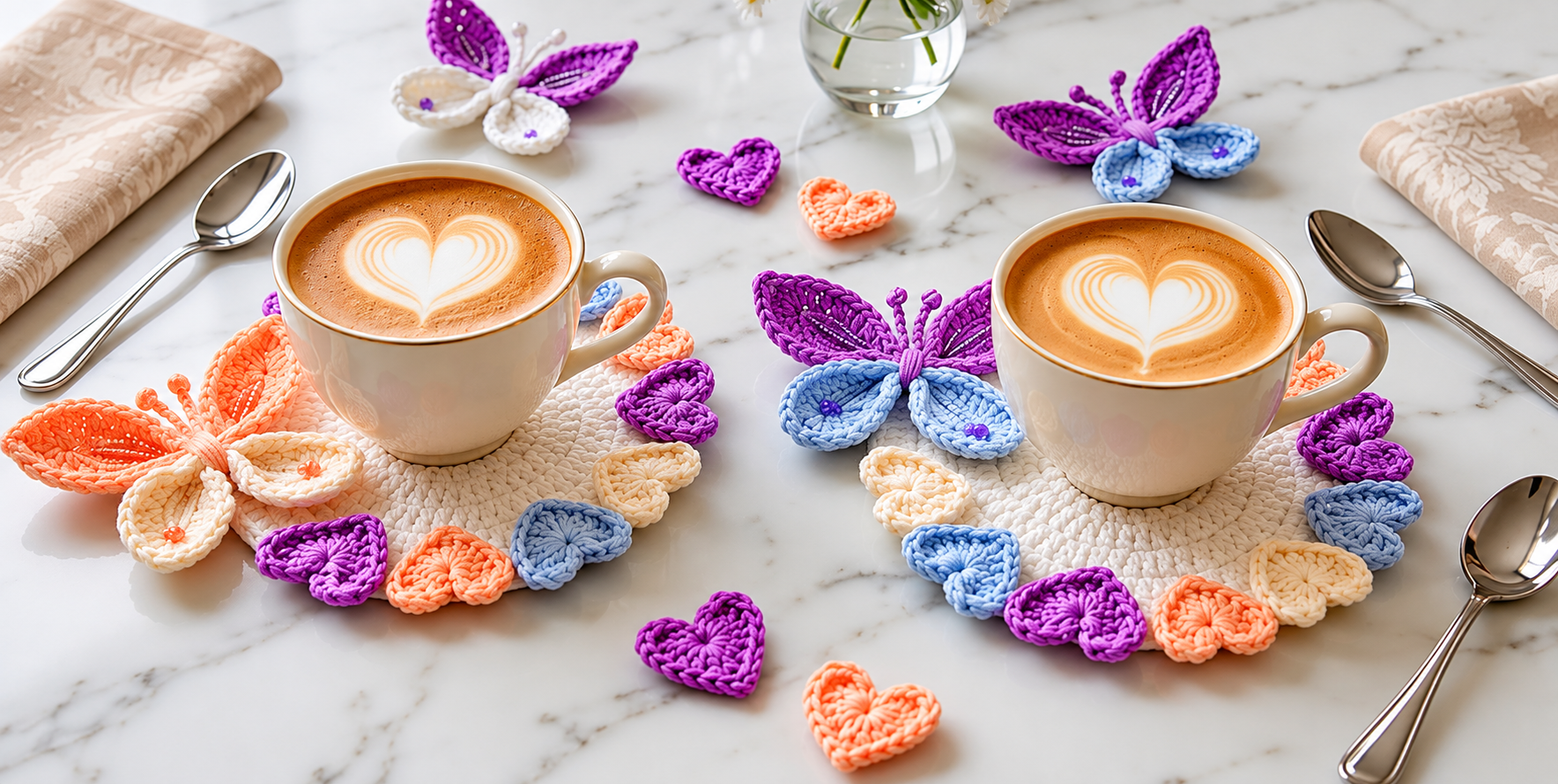
The hearts can now be positioned around the finished circles. Arrange them evenly before sewing so you can evaluate the spacing. Using a yarn needle and matching yarn, stitch through the back loops of each heart and the outer stitches of the circle. Avoid pulling too tightly, as this can distort the circular base. Alternating peach, purple, blue, cream, or other complementary shades gives the Crochet Heart, Butterflies, and Circles Pattern a cheerful handmade appearance.
Crochet Butterfly Pattern, Assembly, and Finishing Details
The butterfly is the most decorative element in the Crochet Heart, Butterflies, and Circles Pattern, but its construction can still be kept beginner-friendly. Start with an MR and work ch 3, 3 tr, ch 3, sl st into the ring to create the first large upper wing. Repeat the same sequence for the second upper wing. Keep the magic ring slightly loose while working so there is enough room for all four wing sections.
For the smaller lower wings, continue inside the same ring with ch 2, 3 dc, ch 2, sl st into the ring. Repeat once more for the opposite lower wing. Pull the magic ring closed carefully. You should now have four distinct wing sections: two larger upper wings and two smaller lower wings. Fasten off and weave the yarn tail toward the back of the butterfly.
To create a contrasting butterfly similar to a colorful appliqué, crochet the upper wings in one shade and add surface details in another. A simple option is to embroider chain stitches or running stitches through the wing surface after crocheting. Another method is to work a second small wing motif and stitch it partially over the first. Keep decorative additions lightweight so the butterfly remains flexible and does not become overly bulky.
Create the butterfly body by attaching a contrasting yarn at the bottom center. Ch 6, then work sl st back along the chain to create a narrow cord. Position this cord vertically over the center of the wings and sew it securely. For the antennae, attach yarn at the top of the body, ch 4, fasten off, and repeat on the other side. Small knots at the ends can give the antennae a finished appearance.
When assembling your crochet butterfly, hearts, and circle, place the butterfly slightly overlapping the outer edge of the circular base. Secure the body first, then add a few small stitches to the lower portions of the wings. Leaving parts of the upper wings unattached creates a gentle three-dimensional appearance. The heart motifs can then be distributed around the remaining edge, forming a colorful border without overcrowding the main butterfly.
Finish by gently blocking the crochet motifs. Lightly dampen them with clean water, shape them on a flat surface, and pin the curves into position if necessary. Allow everything to dry completely before removing the pins. Trim any visible loose ends only after they have been woven securely into several stitches. The completed Crochet Heart, Butterflies, and Circles Pattern can be used for decorative coasters, appliqués, table accents, handmade ornaments, or creative gift embellishments.
Frequently Asked Questions About the Crochet Heart, Butterflies, and Circles Pattern
Is the Crochet Heart, Butterflies, and Circles Pattern suitable for beginners? Yes, especially for beginners who already know chain, slip stitch, single crochet, double crochet, and treble crochet. The individual components are relatively small, making them excellent practice pieces. Beginners should concentrate on counting stitches and keeping their tension consistent. The butterfly may require slightly more shaping, but it becomes straightforward once the four wings are understood.
What yarn is best for crochet hearts and butterflies? Cotton yarn is one of the best choices because it gives small motifs clear definition and good structure. Cotton is particularly appropriate when the circular base will be used as a coaster. Acrylic can also be used for ornaments, garlands, appliqués, and other decorative projects. Whatever yarn you choose, using similar yarn weights for all motifs will make assembly easier.
Why is my crochet circle becoming wavy? A wavy circle often means there are too many increases for your personal stitch tension. Try working fewer increases or changing to a slightly smaller hook. If the circle curls upward instead, it may need additional increases or a slightly larger hook. Because crochet tension varies between people, minor adjustments are normal when creating a flat crochet circle pattern.
Can I make the crochet hearts larger? Absolutely. The simplest solution is to use thicker yarn and a larger hook, but you can also add additional rounds around the original heart. When creating extra rounds, place increases around the curved upper sections and carefully maintain the pointed bottom. The same method can be used to resize butterflies, although thicker yarn is generally the easiest option for maintaining the original proportions.
How can I use the finished motifs? The Crochet Heart, Butterflies, and Circles Pattern can be adapted into many handmade projects. Individual hearts can decorate bags, blankets, greeting-card crafts, cushions, or garlands. Butterflies can become appliqués for accessories or home decorations. Circular pieces can function as coasters, decorative mats, or bases for larger arrangements. You can also join several circles to create a colorful table runner or wall decoration.
How do I keep the butterfly wings from curling? First check whether your stitches are too tight. Then gently shape each wing by hand and use blocking to improve the final appearance. Cotton motifs respond particularly well to light wet blocking. Avoid stretching the piece aggressively; the goal is simply to encourage each wing into a symmetrical shape. Small securing stitches during assembly can also help the butterfly remain positioned correctly.
Conclusion
The Crochet Heart, Butterflies, and Circles Pattern combines simple crochet techniques with plenty of creative possibilities. You learned the essential US crochet abbreviations, how to make a flat circular base, how to form a small crochet heart, how to construct a four-wing crochet butterfly, and how to assemble and block the finished motifs. By adjusting yarn colors, hook sizes, border details, and motif placement, you can create many different versions from the same basic pattern.
This project is also a practical way to practice important skills such as magic rings, increases, stitch height, shaping, color changes, sewing appliqués, and blocking. Once you become familiar with the basic construction, try making several hearts and butterflies in different combinations. Small changes in color and placement can completely transform the final design while keeping the crochet instructions familiar. If you make your own Crochet Heart, Butterflies, and Circles Pattern, leave your sincere opinion about the tutorial and share your suggestions. Which color combination would you choose for your hearts and butterflies? Your ideas can inspire new variations and help make future crochet projects even more creative.