
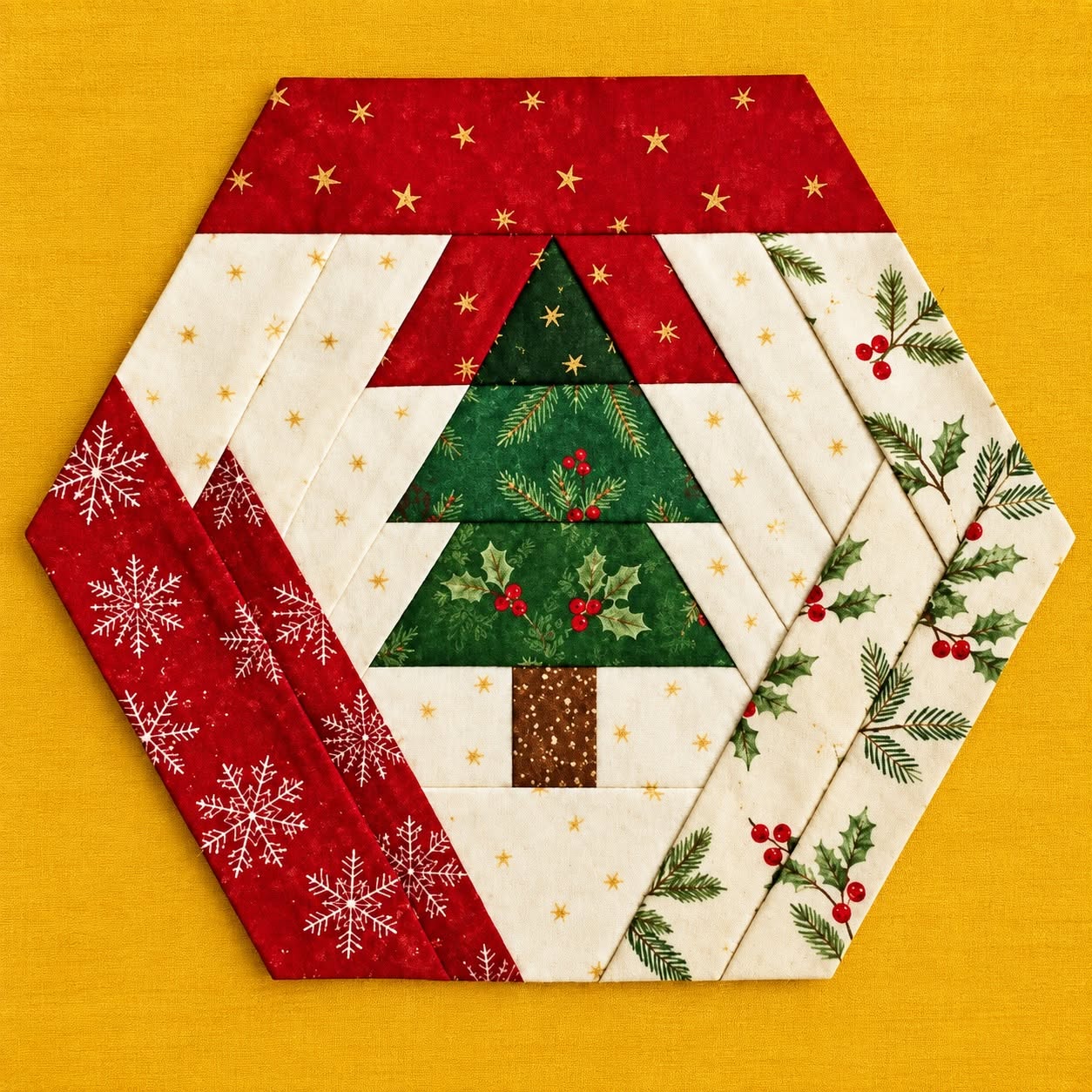
The Hexagonal Patchwork Block with Christmas Tree Motif Pattern is a charming seasonal sewing project that combines traditional patchwork construction with the warm colors and familiar imagery of Christmas. The design centers on a green fabric tree with a small brown trunk, while angled strips of cream and red fabric create the surrounding geometric structure. The finished hexagonal shape makes the block especially attractive because it feels different from a standard square quilt block while still relying on approachable cutting, piecing, pressing, and trimming techniques. With careful preparation, this project can become a beautiful handmade accent for the holiday season.
One of the most appealing features of this Christmas patchwork pattern is the opportunity to combine several festive fabrics without making the design feel overly busy. Deep red fabric provides strong framing areas, cream prints create visual breathing room, and different shades of green establish the Christmas tree as the focal point. Small seasonal prints such as snowflakes, stars, holly leaves, berries, pine branches, or subtle metallic motifs can add personality. The important idea is to maintain enough contrast between neighboring pieces so the geometry of the hexagonal patchwork block remains easy to recognize after everything is sewn together.
Although the finished block looks detailed, the construction can be approached as a sequence of smaller sewing tasks. Rather than trying to assemble the entire hexagon at once, you will build the tree, add the surrounding background sections, create the decorative side strips, and finally trim the complete unit into its characteristic six-sided shape. Accurate seams and careful pressing make a noticeable difference, but the project does not require complicated equipment. A regular sewing machine, rotary-cutting tools, quilting cotton, an iron, and basic sewing supplies are enough to create your own Hexagonal Patchwork Block with Christmas Tree Motif Pattern from beginning to end.
Materials, Fabric Selection, and Preparing the Christmas Patchwork Pieces
Begin by selecting fabrics that clearly separate the tree from the background. For a block inspired by the photograph, choose several green quilting cottons for the tree, a brown print for the trunk, cream or ivory fabric for the snowy background, and two or more coordinating red prints for the outer sections. Holiday fabrics containing stars, snowflakes, holly, berries, or evergreen branches work particularly well. You do not need every fabric to have a Christmas print; combining festive prints with quieter tonal fabrics often produces a more balanced result.
DISCOVER MORE FREE PATTERNS HERE!
A practical finished size for this project is approximately 30 to 35 cm (12 to 14 inches) across, although you can scale the pattern up or down. Because the design depends more on proportion than on one mandatory finished measurement, it is helpful to make a paper sketch of the hexagon before cutting valuable fabric. Draw the outer shape first, position a centered triangular tree inside it, and then divide the remaining space into the angled strips visible around the tree. Add your preferred seam allowance to every individual pattern piece.
For the tree, prepare three or four horizontal green sections that gradually increase in width toward the bottom. The top section should form the pointed tip, while each following section becomes progressively wider. Using different green prints creates the layered appearance seen in the original project. Cut a narrow brown fabric rectangle for the trunk. Before sewing, arrange these pieces on your work surface to confirm that the tree has a recognizable triangular silhouette.
Next, prepare the cream background pieces. These sections fill the negative space around the tree and help establish the angled patchwork construction. Instead of thinking of them as random strips, consider them part of the structure of the block. The cream pieces on the left and right should follow similar angles so the central motif appears balanced. A subtle cream print containing tiny gold stars or another low-volume motif is especially effective because it adds texture without competing with the tree.
Cut red strips for the top and left portions of the hexagon, plus cream or printed strips for the right side. In the photographed design, the red area includes different Christmas prints, while the lighter side contains botanical holiday motifs. This asymmetry gives the Christmas quilt block a handmade, scrappy character. You can reproduce that effect or use matching fabrics on both sides for a more symmetrical appearance.
Before beginning construction, label the pieces or keep them arranged in sewing order. Patchwork designs containing multiple angled pieces can become confusing once they are moved from the cutting table to the sewing machine. Use a consistent seam allowance throughout the project, such as 6 mm (1/4 inch), which is standard for many quilting projects. Check the first few seams with a ruler because even small inconsistencies can accumulate across several strips and affect the final hexagonal shape.
Sewing the Christmas Tree Motif and Building the Central Section
Start the Christmas tree motif with the green sections. Arrange the green pieces from smallest to largest, keeping the pointed section at the top. If your pattern divides the tree into horizontal bands, sew the bands together one at a time. Align the raw edges carefully and use the same seam allowance for every seam. After stitching each section, press the seam before attaching the next piece. Pressing as you work keeps the tree flat and prevents small distortions from becoming larger problems later.
The tree can be constructed with straight horizontal seams or slightly angled sections, depending on the look you want to reproduce. For the layered appearance shown in the inspiration image, use green fabrics with different prints while keeping them within a similar color family. A dark green near the top, a medium evergreen shade through the center, and another botanical green toward the base can create attractive depth without requiring appliqué.
Once the green tree body is assembled, add the brown trunk underneath. Center the trunk carefully so it aligns visually with the point of the tree. Small cream rectangles can be sewn to both sides of the trunk, creating a wider background unit beneath the tree. Press these seams flat, then join this lower unit to the base of the green triangle. Check that the trunk remains vertical before pressing the completed seam.
Now begin adding the cream background around the tree. The pieces immediately beside the tree should follow its diagonal edges. Sew one side at a time rather than attempting to attach several pieces simultaneously. After each seam, open the fabric and press it before proceeding. This method is slower than chain-piecing everything at once, but it gives you much better control over the angles of the patchwork Christmas tree block.
Continue outward by attaching additional cream and red sections. The central tree should remain visually dominant, so periodically place the block flat on the table and check its alignment. If one side begins to extend noticeably farther than the other, verify your seam allowances and fabric placement before continuing. Small differences can usually be corrected during trimming, but major alignment problems are easier to fix before all the outer strips have been attached.
When the central section is complete, give it a careful press from both sides. Avoid aggressively sliding the iron across the fabric because diagonal edges can stretch. Instead, lower and lift the iron while pressing. A flat central unit provides a reliable foundation for the outer strips and makes the final hexagonal quilt block much easier to trim accurately.
Adding the Angled Strips and Shaping the Hexagonal Patchwork Block
The outer construction gives this pattern much of its distinctive appearance. Begin with the top red section, which forms a broad horizontal band above the tree. Depending on how you drafted your pattern, this may be one piece or several joined strips. Center it over the tree and sew it to the upper background section. Press the seam carefully so the top remains straight and does not pull the tree out of alignment.
Move to the left side and add the red snowflake patchwork strips. The photograph uses diagonal sections that create movement around the central motif. Attach the strip closest to the tree first and work outward. If your strips extend beyond the planned perimeter, leave them slightly oversized rather than trimming too early. Oversized outer pieces provide a little flexibility when establishing the final hexagonal outline.
Repeat the process on the right with cream holiday fabric. Botanical prints featuring holly, berries, or pine branches work beautifully here because they introduce recognizable Christmas imagery without overwhelming the central tree. Try to orient directional prints intentionally. A pine branch pointing naturally toward the center usually looks more deliberate than a motif that appears unexpectedly upside down after trimming.
As you add each new strip, inspect the intersections between seams. The goal is not necessarily to make every printed motif line up, but the structural lines should look intentional. Pinning or using sewing clips can help prevent long angled pieces from shifting. Sew slowly when crossing previous seams, particularly where several layers meet. Consistent construction is more valuable than sewing quickly when creating a geometric Christmas sewing pattern.
After all surrounding pieces are attached, press the entire block and prepare to establish the final hexagon. A transparent quilting ruler is extremely useful for this stage. Locate the vertical centerline through the tree and mark the approximate midpoint of the block. Trim the top and bottom edges first, then establish the four diagonal sides. Work gradually and measure opposite sides as you go rather than cutting the complete shape freehand.
The finished hexagonal patchwork block should have six clean sides with the Christmas tree visually centered inside the composition. Do not worry if the tree is not mathematically centered to the millimeter; handcrafted patchwork often benefits from slight visual variation. What matters most is that the finished block looks balanced, the tree remains upright, and enough fabric remains around the perimeter for whatever finishing method you choose.
Finishing, Quilting, and Creative Uses for the Christmas Tree Block
Once the pieced top is finished, you can use the Hexagonal Patchwork Block with Christmas Tree Motif Pattern in several ways. For a quilted table mat, layer the patchwork top with batting and backing fabric. Cut the batting and backing slightly larger than the hexagonal top. Smooth all three layers carefully and secure them with pins, temporary basting, or your preferred quilting method.
Simple quilting works especially well because the fabrics already provide plenty of decorative detail. Consider stitching approximately 6 mm (1/4 inch) away from major seam lines. This technique, often called echo quilting or stitching beside the seam, emphasizes the geometric construction. You can also quilt horizontal lines through the tree sections, outline the triangular tree, or add gentle decorative stitching in the cream background.
After quilting, trim the batting and backing to match the hexagonal top. You can finish the perimeter with quilt binding, a facing, or a turned construction method depending on the intended use. Binding is particularly suitable for a table mat because it protects the raw edges. Bias binding can be helpful around unusual angles, although carefully prepared straight-grain binding can also work when each corner is handled individually.
If you want to turn the block into a potholder or hot pad, choose appropriate heat-resistant materials and construct the project specifically for that purpose. For purely decorative applications, regular quilt batting is sufficient. The block can also become the front of a Christmas cushion, a wall hanging, a centerpiece, or part of a larger holiday quilt. Several hexagons joined together can create an especially interesting geometric arrangement.
Fabric scraps are excellent for this pattern. The individual tree bands, trunk, and surrounding strips do not require large pieces of fabric, making this an effective scrap fabric Christmas project. Save coordinated leftovers from previous holiday projects and arrange them by color. Even fabrics that look unrelated on their own can work together when unified by a consistent red, green, cream, and brown palette.
Finally, press the completed project gently and inspect the seams, corners, and perimeter. Trim loose threads and make sure all finishing stitches are secure. Handmade patchwork does not need to look factory-produced to be beautiful. Slight variations are part of the character of the craft. With thoughtful fabric selection and careful construction, the Hexagonal Patchwork Block with Christmas Tree Motif Pattern becomes a festive project that can return to your holiday décor year after year.
FAQ About the Hexagonal Patchwork Block with Christmas Tree Motif Pattern
What is a Hexagonal Patchwork Block with Christmas Tree Motif Pattern?
It is a six-sided patchwork design featuring a Christmas tree as its central motif. Different fabric pieces are sewn around the tree to form a decorative hexagonal composition. The combination of geometric piecing and seasonal fabrics makes it suitable for holiday quilting and sewing projects.
Is this Christmas patchwork project suitable for beginners?
A confident beginner can make this project, especially after practicing a consistent 1/4-inch seam allowance. The most important skills are accurate cutting, straight stitching, pressing, and trimming. Angled pieces require a little more attention than ordinary squares and rectangles, but constructing the project section by section makes the process manageable.
What fabrics work best for this pattern?
Good-quality quilting cotton is an excellent choice because it is stable, easy to cut, and easy to sew. Green prints are ideal for the tree, brown works naturally for the trunk, cream provides contrast, and red gives the block a traditional Christmas appearance. Snowflakes, holly, berries, stars, and evergreen prints can reinforce the seasonal theme.
How large should the finished hexagon be?
There is no single required size. A block measuring approximately 30–35 cm (12–14 inches) across works well for a decorative table piece or small wall project. You can enlarge or reduce the design as long as all components are scaled proportionally and seam allowances are added correctly.
Why are my angled patchwork pieces becoming distorted?
Some angled edges expose more of the fabric’s bias, which stretches more easily than straight-grain edges. Handle these pieces gently, avoid pulling them while sewing, and press with an up-and-down motion instead of moving the iron aggressively from side to side.
Should I press the seams open or to one side?
Either method can work depending on the construction. Pressing seams to one side is common in quilting and can help nested intersections align. Pressing open can reduce bulk where several angled pieces meet. Choose the method that keeps your particular block as flat as possible.
Can I make the Christmas tree from fabric scraps?
Yes. In fact, the tree is particularly attractive when made from several coordinated green fabric scraps. Different shades and prints create the appearance of separate branches or layers while still reading visually as one Christmas tree.
Can I change the traditional red and green colors?
Absolutely. The same construction can be made with burgundy, sage, ivory, gold, blue, silver, or other seasonal palettes. The most important consideration is contrast. The tree should remain clearly distinguishable from the fabrics surrounding it.
How do I keep the Christmas tree centered?
Mark the center of your developing block and repeatedly check the tree against that reference as you add surrounding pieces. Sew opposite sections in a controlled sequence and avoid trimming the final hexagonal perimeter until all major pieces have been attached and pressed.
What can I make with the finished block?
The finished block can become a Christmas table mat, decorative wall hanging, cushion front, mini quilt, centerpiece, or component in a larger patchwork design. Multiple hexagonal blocks can also be joined to produce a larger holiday quilt arrangement.
Do I need a special sewing machine?
No. A standard domestic sewing machine capable of producing a reliable straight stitch is sufficient. A 1/4-inch quilting foot is useful but not mandatory. A rotary cutter, cutting mat, transparent ruler, iron, and accurate measuring tools will usually have a greater impact on precision than specialized machinery.
How can I make the finished block look more professional?
Accuracy begins before sewing. Cut carefully, maintain a consistent seam allowance, press after each major seam, and wait until the complete patchwork unit is assembled before performing the final precision trimming. These simple habits help the seams lie flatter and make the six sides of the hexagon appear cleaner and more balanced.
Can this pattern be used for other seasons?
Yes. The hexagonal construction can serve as a foundation for many variations. Changing the central motif and fabrics can transform the concept for autumn, spring, birthdays, or everyday décor. For the Christmas version, however, the combination of a green tree, snowy cream background, rich red strips, and seasonal botanical prints creates its recognizable holiday character.
How should I wash a finished quilted version?
Follow the care recommendations for the fabrics, batting, thread, and any other materials used in your project. Prewashing fabric is optional in many quilting projects, but remember that untreated cotton may shrink slightly. If the finished piece will be washed regularly, using compatible materials throughout the project helps provide more predictable results.
What is the most important step when making this block?
Maintaining accurate proportions throughout construction is particularly important. The individual seams may look simple, but small measurement differences can accumulate as additional angled strips are attached. Measure regularly, press carefully, and perform the final trimming only after the full block has been assembled.
Conclusion: Creating Your Own Christmas Hexagonal Patchwork Block
The Hexagonal Patchwork Block with Christmas Tree Motif Pattern brings together several enjoyable quilting techniques in one festive project. You begin by choosing coordinated Christmas quilting fabrics, build the green tree and brown trunk, surround the motif with contrasting cream sections, add decorative red and botanical strips, and finally trim the complete patchwork into a balanced hexagonal shape.
Throughout the process, the most useful habits are accurate cutting, a consistent seam allowance, careful pressing, and regular alignment checks. These basic techniques help control the angled pieces and keep the central Christmas tree motif visually balanced. Once the piecing is complete, quilting and edge finishing transform the block into a durable handmade decoration.
The pattern is also easy to personalize. You can experiment with traditional red and green, softer farmhouse colors, elegant metallic prints, or fabrics already available in your scrap collection. Whether you turn the finished block into a table mat, wall hanging, cushion, or part of a larger quilt, it offers plenty of room for individual creativity while retaining its distinctive Christmas character.
EASILY FIND THE FREE PDF FOR THIS PATTERN HERE!
Most importantly, enjoy the process of building the design one piece at a time. Handmade holiday projects often become meaningful decorations precisely because every fabric choice and stitch reflects the maker’s personal style. If you make your own Hexagonal Patchwork Block with Christmas Tree Motif Pattern, leave your sincere opinion about the project and share any suggestions or creative variations you would add. Your ideas may inspire an entirely new version of this festive patchwork design.