
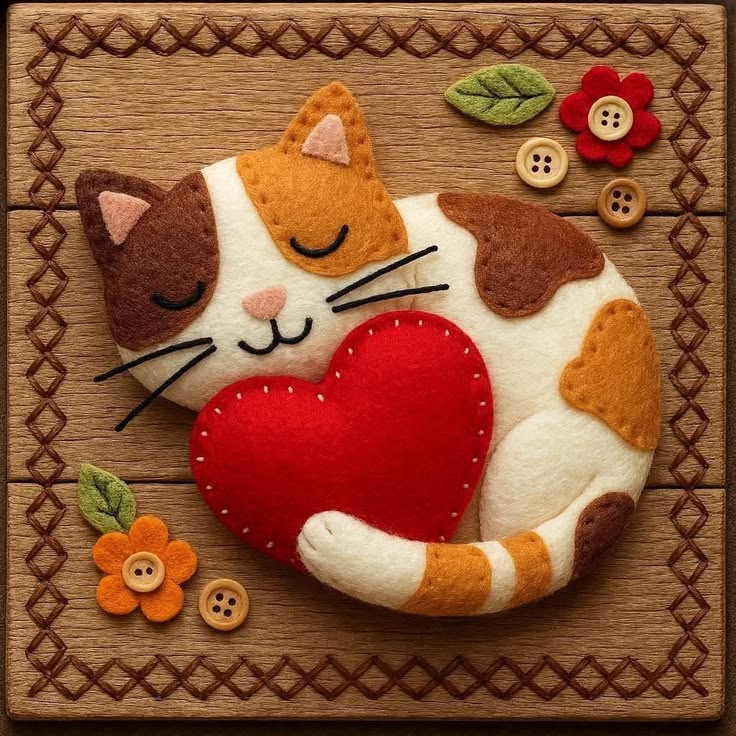
The Sleeping Cat with Heart Felt Wall Panel Pattern is a charming handmade project that combines soft felt, simple appliqué, decorative stitching, and a warm cat-inspired design. The finished piece features a peaceful sleeping cat curled around a bright red heart, creating a cozy composition that works beautifully as handmade wall décor. Small details such as the embroidered whiskers, closed eyes, felt flowers, leaves, and decorative buttons give the panel personality without making the construction unnecessarily complicated. Because most shapes are created individually before assembly, this project is also approachable for crafters who are still developing their confidence with felt sewing and appliqué techniques.
One of the most attractive qualities of this felt cat wall panel is the way different colors and textures create depth. The cat has a creamy main body with brown and golden-orange patches, while the oversized red heart immediately becomes the focal point. Instead of relying on complicated quilting or advanced embroidery, the design uses recognizable shapes and visible hand stitching to produce its handmade character. The wooden-look background shown in the inspiration can be recreated with a fabric-covered panel, a lightweight wood panel, or another firm craft backing. The goal is to create a stable base that supports the felt pieces while maintaining the warm, rustic appearance of the original design.
Making your own Sleeping Cat with Heart Felt Wall Panel Pattern also gives you plenty of opportunities for customization. The cat can be enlarged or reduced, the patches can be changed to match a favorite pet, and the heart can be made in practically any color. You can also replace the flowers with stars, leaves, paw prints, or other simple felt motifs. Beginners can keep the construction straightforward with basic running stitches and backstitches, while experienced makers can add blanket stitching, embroidery, layered felt, or subtle padding. The following tutorial explains the complete process from preparing the pattern pieces to assembling and displaying the finished panel.
Materials, Pattern Pieces, and Preparation
Begin by gathering the materials for your Sleeping Cat with Heart Felt Wall Panel Pattern. You will need felt in cream or ivory, medium brown, golden orange, bright red, soft pink, green, and a few flower colors. You will also need embroidery floss or strong sewing thread, a hand-sewing needle, fabric scissors, paper for templates, removable fabric marking tools, and a firm backing panel. Decorative wooden buttons are optional, but they help reproduce the playful handcrafted appearance seen in the inspiration.
DISCOVER MORE FREE PATTERNS HERE!
For a comfortable wall decoration, consider making the finished backing approximately 30 x 30 cm to 35 x 35 cm. These measurements are flexible rather than mandatory because the proportions of the cat matter more than the exact panel size. Leave enough open space around the animal for the floral embellishments and decorative border. Before cutting any felt, sketch the entire composition on ordinary paper. This full-size drawing becomes your master pattern and helps prevent proportion problems later.
Separate the cat drawing into individual felt appliqué pattern pieces. You will need a large rounded body, a head, two ears, a curved tail, facial patches, body patches, a small triangular nose, inner ear pieces, and a large heart. The sleeping cat should have a comfortably rounded silhouette rather than sharp geometric edges. Number or label every paper template before cutting it apart so that you can easily reconstruct the original arrangement.
Next, trace each template onto the appropriate felt. Use cream felt for the main cat body and portions of the face and tail. Cut the larger facial and body patches from brown and golden-orange felt. Pink works well for the inner ears and nose, while red creates the central heart. When cutting, use long, controlled scissor movements wherever possible. Smooth edges are especially important on the large heart because its strong color naturally attracts attention.
Prepare the decorative components separately. Cut several simple felt flowers using rounded petals and create small green leaves with slightly pointed ends. Buttons can form the flower centers or can be positioned independently around the panel. Avoid attaching them immediately. Lay everything on the backing first and adjust the spacing until the smaller decorations balance the much larger cat-and-heart composition.
Finally, prepare the backing. A fabric-covered board creates a softer finish, while a wooden or wood-look surface produces a rustic effect similar to the inspiration. If you use fabric, stretch it evenly over a firm board so there are no wrinkles underneath the appliqué. Lightly mark the approximate location of the cat with a removable marking tool. These preparation steps make final assembly considerably easier.
Building and Sewing the Sleeping Felt Cat
Start assembling the sleeping felt cat before permanently attaching it to the wall panel. Position the colored patches over the cream body and head pieces. The inspiration uses asymmetrical patches, which makes the cat look lively and handmade. Place a dark brown patch around one side of the face, golden orange over the upper head, and additional brown and orange shapes across the body. Slight irregularity is completely acceptable and can actually enhance the handcrafted style.
Secure each colored patch using small running stitches or a neat blanket stitch around its perimeter. Choose matching thread for a subtle finish or contrasting thread if you want the stitches to become part of the decoration. Keep the spacing reasonably consistent. Felt is forgiving because its raw edges generally do not unravel, making it an excellent material for decorative appliqué projects.
Construct the ears by layering the small pink inner-ear triangles over the larger outer ear pieces. Stitch them securely before attaching the ears to the head. Position the ears so they follow the relaxed curve of the cat rather than standing perfectly upright. This slight tilt contributes to the sleepy expression. Once satisfied with the placement, stitch the ears firmly to the head section.
The facial embroidery is one of the most important stages of the Sleeping Cat with Heart Felt Wall Panel Pattern. Use dark embroidery floss to create gently curved closed eyes. Add a small pink nose, a short curved mouth, and long whiskers extending toward both sides. Simple backstitch works particularly well because it creates smooth continuous lines. Test the facial placement with temporary marks before stitching because even small changes can alter the cat’s expression.
Now assemble the body, head, and tail. The tail should curve naturally around the lower portion of the body, helping frame the heart. If you want a slightly dimensional wall hanging, place a thin layer of polyester filling beneath selected felt pieces before closing the seams. Use only a small amount; excessive stuffing can distort the appliqué shapes and make the finished panel difficult to mount evenly.
Before permanently joining all components, place the completed cat on your backing and inspect the overall silhouette. Check whether the head appears balanced against the body and whether the tail follows the outer curve naturally. This is the best moment to make adjustments. Once the main pieces are stitched together, changing their proportions becomes much more difficult.
Creating the Heart, Flowers, and Decorative Details
The large red heart is the visual centerpiece of this felt wall panel pattern. Draw a symmetrical heart on paper first, fold the template through the center, and trim both sides together if necessary. This simple technique produces a balanced shape. Transfer the template to red felt and cut carefully. The heart should be large enough to overlap the cat’s body noticeably while still leaving the face and colored patches visible.
Position the heart across the lower front of the cat, following the arrangement in the inspiration. Use small running stitches around the perimeter, leaving consistent spacing between stitches. Light-colored thread provides a decorative contrast against red felt and emphasizes the handmade construction. If you prefer a cleaner appearance, red thread can make the seam less noticeable. Both methods work well, so choose according to the style you want.
For additional dimension, the heart can be lightly padded. Place a second heart-shaped felt piece behind the first, stitch most of the perimeter, insert a very thin layer of filling, and close the opening. Keep the heart relatively flat so it does not overpower the cat. Another option is to use two layers of felt without filling, which provides extra thickness while maintaining a crisp appliqué appearance.
Create the flowers from simple rounded felt shapes. A five-petal flower is especially easy to cut and works well with a wooden button at its center. Combine red, orange, or other warm colors with green leaves to complement the heart and cat patches. Stitch the button securely through the flower and backing whenever possible. If the wall panel will be displayed where children can reach it, make sure every small embellishment is attached particularly firmly.
Arrange the flowers, leaves, and extra buttons around the main composition without overcrowding it. The sleeping cat and red heart should remain the obvious focal point. One floral grouping can occupy a lower corner while another smaller flower or leaf balances the opposite upper area. This diagonal distribution gives the design movement and prevents all the visual weight from gathering in one section.
The decorative border can be created with embroidery, fabric trim, or painted details depending on your chosen backing. For a sewn version, repeated cross-stitches or diamond-shaped embroidery can frame the composition. Keep the border a short distance from the outside edge and maintain relatively even spacing. A dark brown thread works especially well with a wood-inspired background and coordinates naturally with the brown patches of the cat.
Final Assembly, Finishing, and Display
Once every individual component is prepared, perform a complete dry arrangement before permanent attachment. Place the felt sleeping cat, heart, flowers, leaves, and buttons on the backing exactly where you want them. Step away from the project and view it from a distance. This simple check makes it easier to notice crooked positioning, excessive empty space, or decorations that compete with the main subject.
Attach the cat securely to the backing using hand stitches around strategic areas of the silhouette. You do not necessarily need to sew through every visible edge if the cat has already been fully assembled. Concentrate on the head, body, tail, and other points that could lift away from the panel. Keep attachment stitches hidden whenever possible so the decorative stitches remain visually distinct.
Add the heart after the cat has been anchored. Because the heart overlaps the body, it can help conceal some structural stitches. Make sure its center remains smooth and that both upper curves sit naturally against the cat. Secure the lower point carefully because this section can curl outward if left loose. The result should appear as though the sleeping cat is peacefully curled around or embracing the heart.
Attach the flowers, leaves, and decorative buttons last. This order allows you to reposition the small decorations if the main appliqué ends up slightly different from your original plan. Sew through buttons several times using durable thread and knot securely on the reverse side whenever the backing construction permits. Flatten leaves gently after stitching so their shapes remain clearly visible.
Inspect the entire Sleeping Cat with Heart Felt Wall Panel Pattern for loose threads and uneven stitches. Trim thread ends carefully without cutting knots. If removable fabric markings are still visible, remove them according to the marking tool’s instructions. Gently smooth the felt by hand rather than pressing it aggressively with a hot iron, since some craft felts can react poorly to high temperatures.
Finish by adding an appropriate hanging method for the type and weight of backing you selected. A lightweight fabric-covered panel may work with a sewn hanging loop, while a heavier rigid panel requires hardware suitable for its construction and weight. Once displayed, the finished project becomes a warm handmade decoration for a craft room, bedroom, nursery, hallway, or cozy reading space.
FAQ About the Sleeping Cat with Heart Felt Wall Panel Pattern
Is the Sleeping Cat with Heart Felt Wall Panel Pattern suitable for beginners?
Yes. The project is especially approachable because felt does not normally require traditional raw-edge finishing. Beginners can use simple running stitches, backstitches, and basic appliqué techniques. Creating a full-size paper template before cutting the felt also makes assembly much easier.
What type of felt should I use?
Good-quality craft felt is suitable for decorative projects, while wool-blend felt generally provides a softer texture and durable finish. The most important consideration is choosing felt that cuts cleanly and maintains its shape. Using felt of similar thickness throughout the cat also helps create an even result.
Can I make the cat look like my own pet?
Absolutely. One advantage of a cat appliqué pattern is how easily the markings can be customized. Change the brown and orange patches to gray, black, cream, tabby-inspired colors, or any combination that resembles your cat. You can also modify the tail, ears, and facial markings while keeping the same overall construction method.
How large should the finished panel be?
A size around 30 to 35 cm square provides enough room for a detailed cat, large heart, flowers, and decorative border. However, the design can be scaled up or down. When resizing it, enlarge or reduce all pattern pieces by the same percentage so their proportions remain consistent.
Should the felt pieces be glued or sewn?
Sewing provides the traditional handmade appearance seen in this design and creates attractive decorative edges. Temporary fabric-safe adhesive can sometimes help hold pieces during assembly, but stitching remains useful for long-term security. If you use adhesive, choose one intended for textile crafts and test it on a scrap first.
What stitches work best for this felt wall panel?
Running stitch works beautifully around the heart and many appliqué pieces. Blanket stitch can provide a more defined edge around patches, while backstitch is excellent for the closed eyes, mouth, and whiskers. These basic hand embroidery stitches are enough to complete the entire project.
Can the heart be made three-dimensional?
Yes. Cut two identical heart pieces, sew around most of the perimeter, insert a very small amount of filling, and finish the seam. Keep the padding light so the heart maintains its recognizable shape and does not become disproportionately thick compared with the cat.
Do I need a sewing machine?
No. This project can be completed entirely by hand. In fact, visible hand stitching contributes significantly to the cozy character of the design. A sewing machine may be useful for preparing a fabric backing, but it is not essential for constructing the felt appliqué itself.
How can I keep my stitches evenly spaced?
Practice first on leftover felt and make tiny removable guide marks if necessary. Work slowly and avoid pulling the thread too tightly, since excessive tension can distort the felt. Consistency matters more than perfectly identical stitches, especially in a handmade decorative project.
Can I change the flowers and buttons?
Certainly. The flowers and buttons are decorative accents rather than structural components. You could replace them with felt hearts, stars, butterflies, paw prints, leaves, or other motifs. Keeping the secondary decorations relatively small ensures that the cat and heart remain the visual focus.
What colors work well for this pattern?
The cream, brown, golden orange, and bright red combination creates a warm traditional palette. For a softer version, try ivory, blush pink, sage green, and muted terracotta. A modern version could use gray, white, mustard, and burgundy. Maintaining contrast between the cat, heart, and background helps each shape remain easy to distinguish.
How can I make the project look more polished?
Careful cutting is one of the biggest factors. Use sharp scissors, prepare paper templates, check the arrangement before sewing, and keep your stitches reasonably consistent. Also avoid using too much stuffing. Clean edges and thoughtful spacing often make a bigger difference than complicated decorative techniques.
Can this pattern be used for something other than wall art?
Yes. The same Sleeping Cat with Heart Felt Wall Panel Pattern concept can inspire a cushion front, fabric tote decoration, framed textile artwork, quilt appliqué block, or handmade gift panel. Adjust the backing materials and construction method according to how the finished item will be used.
Conclusion
The Sleeping Cat with Heart Felt Wall Panel Pattern brings together several enjoyable craft techniques in one approachable project. Starting with a full-size paper template helps establish the proportions, while individually cut felt pieces make it possible to build the cat gradually. The cream body, warm brown and orange patches, embroidered sleepy face, curved tail, and oversized red heart work together to create the distinctive composition.
Throughout this tutorial, you learned how to prepare the felt appliqué pieces, assemble the cat, stitch its facial features, create a lightly dimensional heart, make simple flowers and leaves, position decorative buttons, and finish the design with a coordinating border. You can follow the original warm color palette or personalize the markings and embellishments to create a completely different character.
EASILY FIND THE FREE PDF FOR THIS PATTERN HERE!
Most importantly, this project does not depend on complicated equipment. Careful cutting, straightforward hand stitches, thoughtful layering, and patient assembly are enough to transform simple pieces of felt into an expressive handmade decoration. Whether you keep the finished panel for your own home or make it as a thoughtful handmade gift, the sleeping cat and heart create a warm and welcoming result. If you make your own version of the Sleeping Cat with Heart Felt Wall Panel Pattern, leave your sincere opinion about the project and share your suggestions. Which colors would you choose for the cat, and what details would you add to make the pattern uniquely yours?