
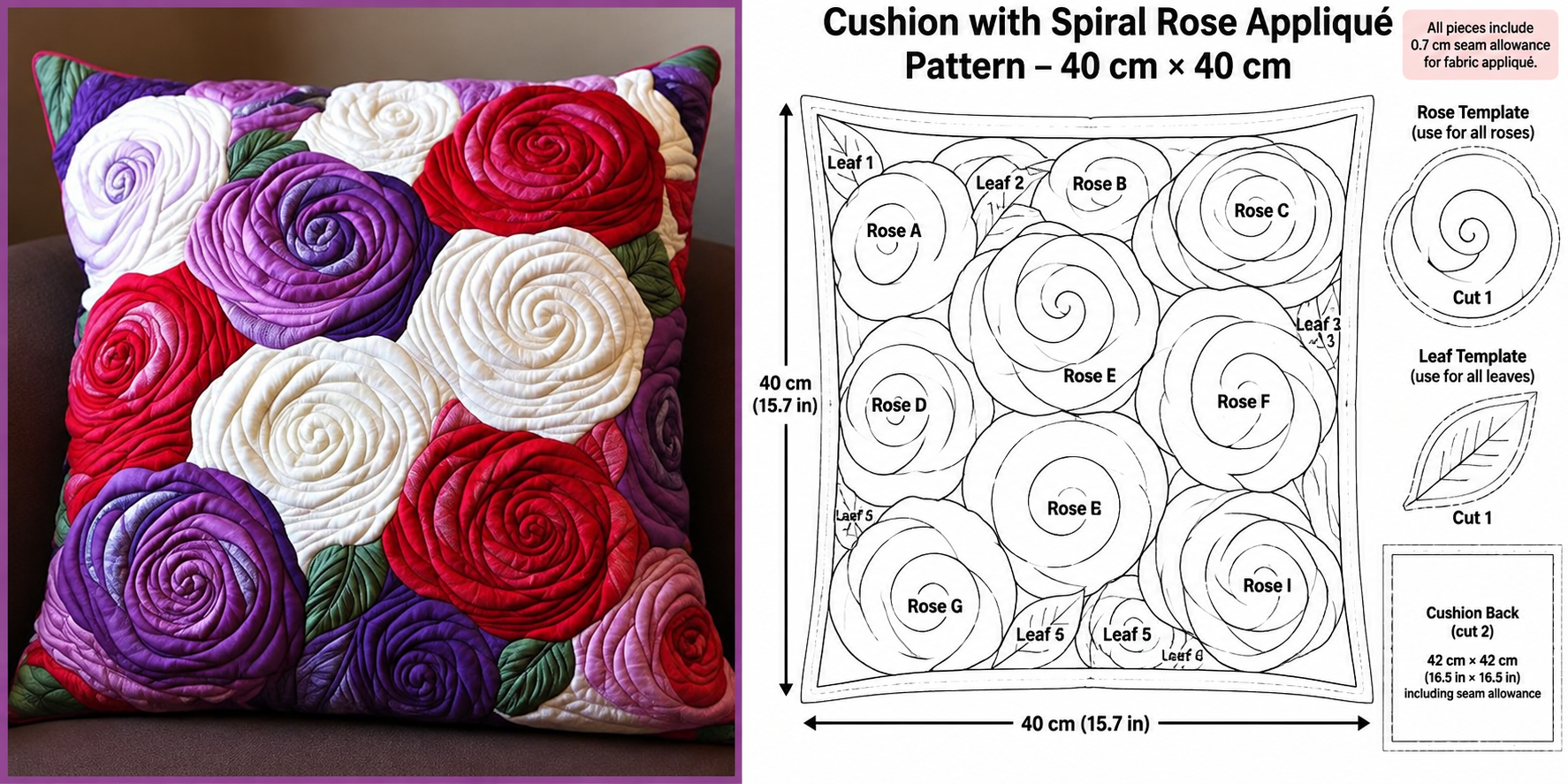
The Cushion with Spiral Rose Appliqué – 40 cm × 40 cm Pattern is a beautiful fabric project that transforms a simple square cushion into a richly textured floral decoration. Inspired by the cushion shown in the reference image, the design is built from overlapping roses in shades of red, purple, pink, cream, and white, with small green leaves appearing between the flowers. What makes the project especially attractive is the spiral construction of each rose. Instead of relying on a highly complicated flower template, the petals can be suggested through curved fabric sections and concentric stitched lines that gradually travel toward the center. The result is dimensional without becoming excessively bulky, making this spiral rose appliqué cushion suitable for a sofa, reading chair, bedroom, or handmade home décor collection.
Although the finished piece looks elaborate, the 40 cm × 40 cm cushion pattern can be approached one flower at a time. The main technique combines fabric appliqué, layered floral shapes, decorative stitching, light quilting, and basic cushion construction. Larger roses establish the visual structure, while medium and smaller flowers fill the remaining spaces. Choosing fabrics is an important part of recreating the appearance: solids, tone-on-tone prints, batiks, and subtle textured cottons can all work beautifully because the stitching remains clearly visible. A balanced combination of deep and light colors also helps separate neighboring flowers and gives the surface the lively, handcrafted character seen in the inspiration.
This project is particularly rewarding for sewists who enjoy turning fabric scraps into decorative pieces. You do not need every rose to be perfectly identical; slight differences in size, curvature, stitching, and fabric tone actually contribute to the handmade appearance. The Cushion with Spiral Rose Appliqué – 40 cm × 40 cm Pattern can therefore be adapted to the materials already available in your sewing room while maintaining its recognizable floral composition. The instructions below explain how to plan the cushion front, construct the spiral roses, arrange the appliqué, add decorative stitching, and assemble the finished cushion cover. Take your time with the arrangement before sewing because the placement of the flowers is what gives this design its abundant garden-like effect.
Materials and Preparation for the 40 cm × 40 cm Rose Cushion
Begin with a square of sturdy cotton fabric measuring approximately 44 cm × 44 cm for the cushion front. The additional fabric provides working room for quilting and trimming. You will later square the panel to the size required for your chosen seam allowance. Neutral cotton is convenient because most of it will disappear underneath the appliqué flowers. You can also use lightweight canvas or another stable woven fabric, provided it remains easy to sew through multiple layers.
For the roses, collect fabrics in several coordinated shades. The reference design combines deep red, burgundy, violet, lavender, blush pink, ivory, cream, and white roses. You do not have to reproduce these colors exactly. The important principle is contrast. Place lighter flowers beside darker ones whenever possible so that individual roses remain visible rather than blending into one large mass of color.
You will also need small pieces of green fabric for the appliqué leaves. Using two or three green tones adds visual depth. The leaves occupy relatively little space, but they are important because they break up the flower colors and reinforce the garden theme. Small scraps are usually sufficient, making this an excellent opportunity to use leftover fabric from previous quilting projects.
For stabilization, prepare a piece of thin batting slightly larger than the cushion front. A backing layer of inexpensive cotton can be placed behind the batting to create a traditional quilt sandwich. This construction makes the decorative spiral stitching more pronounced and gives the completed cushion a softly padded surface. Avoid extremely thick batting because the numerous appliqué layers already contribute texture.
Basic supplies include fabric scissors, pins or fabric clips, sewing thread, marking tools, an iron, a sewing machine, ruler, and rotary cutter if available. Fusible web is optional. It can make the appliqué process easier by temporarily securing flowers and leaves before stitching. If you prefer traditional appliqué, the pieces can instead be basted or carefully pinned.
Before cutting everything, prepare a simple paper plan for the 40 cm × 40 cm floral arrangement. Draw a square and sketch circles of different sizes until the surface looks balanced. Plan several large roses, a group of medium flowers, and smaller roses near corners and narrow spaces. This preliminary step reduces unnecessary fabric cutting and makes final assembly considerably easier.
How to Create the Spiral Rose Appliqué
Start by creating the largest roses, which can measure approximately 12 to 15 cm across. Medium flowers may measure around 8 to 11 cm, while smaller filler roses can range from approximately 5 to 8 cm. These dimensions are flexible. In fact, varying flower sizes is one of the easiest ways to reproduce the natural, layered appearance of the cushion in the photograph.
For a simplified spiral rose appliqué, cut a roughly circular flower base from your chosen fabric. It does not need to be mathematically perfect. Gentle irregularities can help imitate natural petals. Mark a small center and lightly draw a spiral guideline moving outward from that point. This line becomes your reference when adding curved sections and decorative stitching.
To increase the petal effect, cut several curved or crescent-shaped fabric pieces from related shades of the same color family. For example, a purple rose could combine medium violet, lavender, and dark purple. Position these pieces around the base circle with slightly overlapping edges. The curves should generally follow the direction of the spiral rather than forming straight horizontal bands.
Secure the layers using fusible web, temporary fabric adhesive intended for sewing, pins, or hand basting. Work from the outer sections toward the center, checking frequently that the flower remains relatively flat. Too many layers concentrated in the middle can create an unnecessarily hard area, so use smaller pieces as you approach the center of the fabric rose appliqué.
The characteristic spiral becomes much clearer after stitching. Starting near the center, sew a smooth curved line and gradually expand it outward. You can follow the edges of the layered pieces while occasionally adding extra curved lines to suggest individual petals. A standard straight stitch works well, although a narrow decorative stitch can provide additional definition if your machine offers suitable options.
Repeat this method for every flower, changing both color and scale. Some roses can have tightly packed centers, while others can feature broader spirals. This variation prevents the finished Cushion with Spiral Rose Appliqué – 40 cm × 40 cm Pattern from looking overly mechanical. Arrange completed flowers temporarily on the cushion front as you work so you can immediately see which colors and sizes are still needed.
Arranging, Appliquéing, and Quilting the Floral Cushion Front
Once you have prepared enough roses, place the cushion-front fabric on a flat surface and begin arranging the largest flowers first. Avoid positioning every large rose in a straight row. A more organic composition comes from distributing them across different areas of the square. In the inspiration, the flowers seem to flow across the entire cushion rather than following a rigid grid.
Next, add the medium roses. Allow some flowers to overlap visually, but make sure the main spiral centers remain visible. This is where your color planning becomes especially important. A white rose beside a red or purple flower creates immediate definition, while two similarly dark flowers may need a small leaf or contrasting flower between them.
Use the smallest roses to fill corners and narrow openings. It is perfectly acceptable for a flower to appear partially cropped at an edge. In fact, extending some appliqué beyond the apparent boundary of the cushion creates the impression that the floral design continues beyond the panel. Just remember that all important details should remain safely inside the final seam line.
Insert green fabric leaves into selected spaces between roses. Simple pointed oval shapes work well. Fold, fuse, or appliqué the edges according to your preferred technique, and add a stitched center vein if desired. Leaves do not need to appear between every pair of flowers. A few carefully placed green accents are enough to provide contrast without competing with the roses.
After you are satisfied with the arrangement, secure the appliqué pieces permanently. Stitch around exposed edges using a small straight stitch, blanket stitch, zigzag, or another appropriate appliqué stitch. Then complete the spiral and petal quilting within each rose. Working progressively across the panel is usually easier than trying to stitch every outer edge first and returning later for interior details.
When all decorative stitching is finished, press the panel carefully from the back and square it. For a finished cushion measuring approximately 40 cm × 40 cm, the exact cutting size depends on your seam allowance and closure method. For example, when using a 1 cm seam allowance, a cover panel constructed at about 42 cm × 42 cm provides the necessary seam allowance around a nominal 40 cm finished front. Always verify your measurements before trimming because quilting can slightly reduce the dimensions of the original fabric.
Assembling and Finishing the Spiral Rose Cushion Cover
The back of the cushion can be constructed with a simple envelope closure, which is practical because it requires no zipper. Cut two back panels wide enough to match the prepared cushion front while allowing the inner edges to overlap generously. Finish the overlapping edges with a double-fold hem so raw fabric will not be visible when the cover is completed.
Place the finished rose panel right side up. Position the two backing pieces over it with their right sides facing the appliqué. Their hemmed edges should overlap near the center of the cushion. Pin or clip carefully around all four sides, paying special attention to areas where appliqué layers meet the outer seam because those sections may be slightly thicker.
Sew around the complete perimeter using the seam allowance established during your measurement planning. Reinforce the corners and the points where the envelope panels overlap. After sewing, trim excess bulk from the corners without cutting through the stitches. This small detail helps produce cleaner corners after the cushion cover is turned right side out.
Turn the cover through the envelope opening and gently shape each corner. Avoid aggressively pulling the corners with scissors or another sharp object, as that can damage the seam. A blunt turning tool works better. Give the completed cover a light press from the back or use a pressing cloth over the appliqué surface to protect the dimensional stitching.
Insert a 40 cm × 40 cm cushion form and distribute the filling evenly into the corners. Depending on the fullness you prefer and the construction of your insert, you may choose a slightly fuller insert, but always check how your specific fabric and seams respond. The front should appear comfortably filled without putting excessive stress on the appliqué or outer seams.
Finally, examine the entire Cushion with Spiral Rose Appliqué – 40 cm × 40 cm Pattern for loose threads or unsecured appliqué edges. Trim threads neatly and reinforce any area that needs additional stitching. Your finished piece should display a dense arrangement of dimensional spiral roses, contrasting colors, small green leaves, and clearly visible curved quilting that emphasizes the handmade floral texture.
FAQ About the Cushion with Spiral Rose Appliqué – 40 cm × 40 cm Pattern
What is spiral rose appliqué?
Spiral rose appliqué is a decorative fabric technique in which curved fabric shapes and/or stitching are arranged in a spiral formation to resemble the layered petals of a rose. In this cushion, the spiral lines are especially important because they visually guide the eye from the flower center toward the outer petals.
What fabric is best for making the roses?
Quilting cotton is one of the easiest choices because it is stable, widely available, and simple to stitch. Batiks, subtle prints, and tone-on-tone cotton fabrics can also create beautiful results. Fabrics that fray excessively or stretch significantly can be more challenging for beginners.
How many roses do I need for a 40 cm × 40 cm cushion?
There is no mandatory number because the quantity depends on flower size. A successful composition usually combines several large focal roses with medium and small filler flowers. Instead of counting flowers first, arrange paper circles over a 40 cm × 40 cm template and determine how many are needed to cover the surface attractively.
Do I need fusible web for the appliqué?
No. Fusible web is helpful because it keeps the shapes stable during sewing, but traditional pinning, basting, or other appropriate appliqué methods can also be used. Choose the technique that best suits your experience and the fabrics being used.
Can this project be sewn by hand?
Yes. The appliqué and spiral details can be hand stitched, although completing the entire cushion manually will require more time. Hand stitching can produce a charming artisanal texture, especially when the thread is intentionally visible.
Can beginners make this cushion?
A patient beginner with basic sewing knowledge can approach the project successfully. The best strategy is to practice one spiral fabric rose on scrap material before beginning the final cushion. This allows you to experiment with curved stitching, layering, and appliqué edge finishing.
Why should batting be placed behind the cushion front?
Batting gives the floral panel extra body and helps the stitched spiral lines create a quilted appearance. It also makes the front softer and more dimensional. Thin batting is generally sufficient because the overlapping flowers already create additional thickness.
How can I keep the cushion from becoming too bulky?
Avoid stacking too many fabric layers in the centers of the flowers. Use lightweight cotton, thin fusible materials, and moderate batting. Trim unnecessary hidden fabric when appropriate while preserving enough material to keep every appliqué section secure.
Can I change the rose colors?
Absolutely. The red, purple, pink, cream, and white palette is inspired by the pictured cushion, but the Cushion with Spiral Rose Appliqué – 40 cm × 40 cm Pattern can be customized. Blue and white, pastel pink and green, autumn shades, monochromatic neutrals, or scrap-fabric combinations can all produce distinctive results.
How should a handmade appliqué cushion be cleaned?
Follow the care requirements of the specific fabrics, batting, threads, and stabilizers used in your project. Gentle cleaning is generally preferable for heavily appliquéd decorative pieces. Testing fabric for colorfastness before construction is particularly useful when combining intense reds, purples, or other saturated colors with white and cream fabrics.
How do I make the spiral stitching look smooth?
Sew slowly and rotate the fabric gradually rather than making sudden turns. Marking a light spiral guideline before stitching can also help. Practicing curved seams on scraps is an effective way to develop consistent movement before quilting the finished roses.
Can the same pattern be adapted to other projects?
Yes. Individual spiral rose appliqué patterns can be used on tote bags, wall hangings, table decorations, quilt blocks, and other fabric projects. Simply adjust the flower dimensions and overall layout to suit the size and purpose of the new item.
Conclusion
Completing Your Handmade Spiral Rose Cushion
The Cushion with Spiral Rose Appliqué – 40 cm × 40 cm Pattern combines several enjoyable sewing techniques in one colorful home décor project. Starting with a stable cushion base, you learned how to select contrasting fabrics, plan different flower sizes, build layered roses, create their characteristic spiral details, introduce green appliqué leaves, and use quilting to add definition and texture. The project may appear intricate at first glance, but dividing it into individual flowers makes the construction much more manageable.
The most important lesson is that this design does not depend on absolute uniformity. Slightly different rose sizes, spiral shapes, colors, and stitched petals give the cushion its handcrafted personality. Careful placement of large, medium, and small flowers creates balance, while the mixture of red roses, purple roses, white roses, pink roses, and green leaves provides the rich garden-inspired appearance.
EASILY FIND THE FREE PDF FOR THIS PATTERN HERE!
After the decorative front is complete, a straightforward envelope backing turns the appliqué panel into a practical 40 cm × 40 cm cushion cover. With careful pressing, accurate seams, and a final inspection of the appliqué, the result is a decorative piece that highlights both fabric color and sewing texture. Use this Cushion with Spiral Rose Appliqué – 40 cm × 40 cm Pattern as a starting point and personalize it with your favorite fabrics and color combinations. If you make your own version, leave your sincere opinion about the project and share your suggestions. Your ideas about different rose colors, stitching techniques, layouts, or finishing details can inspire even more creative variations of this beautiful floral cushion.