
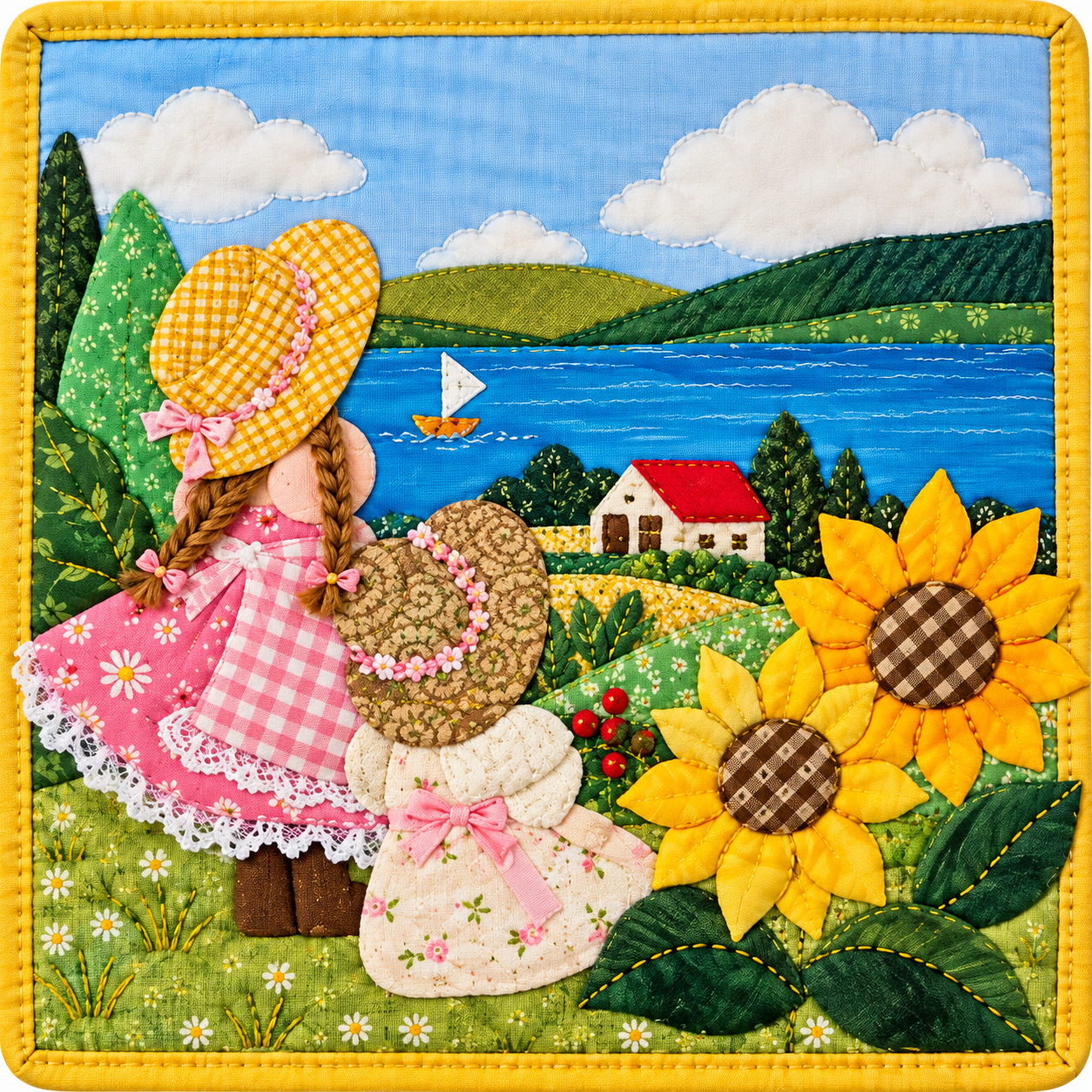
Quilt Panel with Appliqué of Girls by the Lake and Sunflowers Pattern is a charming fabric-art project that combines landscape quilting, dimensional appliqué, hand-stitch details, and country-inspired motifs in one decorative panel. The scene brings together a peaceful blue lake, rolling green hills, clouds, a small cottage, trees, oversized sunflowers, and a girl dressed in a pink country-style outfit. Because many of the elements are constructed separately and layered onto the background, this project offers plenty of opportunities to work with fabric appliqué, layered quilting, dimensional flowers, and decorative stitching. The finished piece can become a wall hanging, decorative panel, or the centerpiece of a larger quilt.
One of the most appealing characteristics of the Quilt Panel with Appliqué of Girls by the Lake and Sunflowers Pattern is its sense of depth. Instead of creating the entire picture on one flat fabric surface, the design can be assembled in visual layers. The blue sky forms the farthest background, followed by clouds and distant hills. The lake and trees occupy the middle ground, while the girl, flowers, foliage, and other dimensional appliqués create the foreground. This layered construction is useful for beginners because the project can be divided into manageable sections rather than completed all at once.
Fabric selection plays an important role in recreating the handmade character shown in the inspiration image. Small floral prints, gingham, textured greens, bright yellow cotton, soft pink fabrics, cream prints, and several shades of blue work especially well. You do not need every fabric to match perfectly. In fact, a varied scrap quilt fabric palette can make the landscape more interesting. The goal is to maintain enough contrast so the main shapes remain easy to recognize while still allowing all of the colors and prints to feel connected as one cheerful countryside scene.
Preparing the Fabric Landscape and Background
Begin by deciding the finished dimensions of your panel. A square format works particularly well for this appliqué quilt pattern, although the design can easily be adapted into a rectangle. Before cutting any detailed shapes, draw a simple full-size layout on paper. Mark the approximate positions of the sky, distant hills, lake, foreground grass, girl, cottage, sunflowers, and large leaves. This drawing does not need to be artistically perfect; it simply becomes your placement guide.
DISCOVER MORE FREE PATTERNS HERE!
For the foundation, cut a piece of backing fabric, batting, and background fabric slightly larger than the intended finished panel. Leaving extra material around the edges gives you room to square the quilt after stitching. Press all cotton fabrics before cutting. If you are using lightweight materials for dimensional pieces, a thin interfacing can provide extra stability without making the appliqués excessively stiff.
Create the sky using a generous section of light blue cotton fabric. The slightly mottled appearance of tonal cotton is ideal because it resembles natural variations in the sky. Cut the distant hills from several shades of green. Give each hill a soft curved upper edge rather than a straight line. Overlap these sections slightly, placing the most distant hills first and darker or more detailed sections closer to the foreground.
Next, add the lake using medium or bright blue fabric. Position it horizontally across the middle of the composition. Gentle rows of stitching can represent movement on the water. Slightly irregular lines are often more convincing than perfectly straight ones because they create the impression of small waves. White or pale blue thread can provide enough contrast to make the water visible without overpowering the rest of the scene.
The foreground grass can be created from green floral cotton. Add darker green sections around the edges to suggest bushes and trees. Individual tree shapes may be cut as simple tapered forms and layered together. A combination of light, medium, and dark greens helps establish perspective. Decorative hand stitches through the centers of the trees can imitate trunks or branches while securing the pieces to the quilt.
Complete the basic landscape with soft white cloud appliqués. Rounded cloud shapes can be prepared using turned-edge appliqué, fusible appliqué, or another method you are comfortable using. Secure the edges with a small blanket stitch, whipstitch, or narrow machine stitch. Once the clouds, hills, lake, and foreground are attached, the foundation of the Quilt Panel with Appliqué of Girls by the Lake and Sunflowers Pattern is ready for its detailed focal elements.
Creating the Girl, Hats, Cottage, and Dimensional Appliqué Details
The girl is one of the most detailed parts of the design, so construct her as several individual components. Start with the legs, body, dress, arms, head, hair, and hat. Arrange the pieces on your paper template before transferring them to fabric. This helps determine which elements must be placed underneath others. In most cases, the legs go down first, followed by the dress, upper body, head, hair, and finally the hat.
For the dress, combine coordinating pink floral fabric and pink gingham fabric. A gently gathered or slightly flared skirt produces the dimensional country-dress effect. Lace trim can be sewn along the lower edge before the skirt is attached to the panel. A second fabric panel over the front of the dress adds another layer and makes the garment look more detailed. Tiny ribbon bows are optional but can provide attractive finishing accents.
The hair can be made from yarn, embroidery thread, or narrow fabric strips. Braided strands create a particularly recognizable country-inspired appearance. Secure the upper ends underneath the hat so the attachment stitches remain hidden. Small bows at the bottom of each braid provide both decoration and additional security. Keep dimensional embellishments firmly stitched if the panel will be handled frequently.
Create the large hat from two or three fabric pieces rather than one flat shape. A crown and brim made from yellow gingham give the hat visible structure. A line of hand stitching around the edges can emphasize its shape, while a narrow decorative trim or small fabric flowers can be placed along the crown. Slight padding behind the brim is another way to introduce 3D fabric appliqué.
The smaller foreground figure can be assembled using the same layered approach. A cream or floral body, textured hat, and pink ribbon help coordinate this character with the main girl. The shapes do not require complicated anatomy because the design relies on recognizable silhouettes. Gentle curves and carefully chosen fabrics are often enough to communicate the figure successfully.
Finally, construct the small cottage in the distance. Use cream fabric for the walls, brown scraps for the door and windows, and red fabric for the roof. Because the cottage represents an object farther away, keep it considerably smaller than the foreground figures and flowers. This deliberate difference in scale strengthens the perspective and makes the entire Quilt Panel with Appliqué of Girls by the Lake and Sunflowers Pattern feel deeper.
Making the Sunflowers, Leaves, Trees, and Decorative Stitching
The oversized sunflowers provide the strongest burst of color in the composition. To make each flower, prepare individual petal shapes from yellow cotton fabric. Petals can be lightly padded, folded, or constructed with a turned seam for additional dimension. Using several petals instead of cutting one flat flower silhouette produces a much more sculptural result and allows every petal to sit at a slightly different angle.
Arrange the petals in a circular formation, overlapping their bases. Secure each petal near the center while allowing the outer portion to remain slightly raised. A few subtle quilting stitches through each petal will help maintain its shape. You can vary the yellow fabrics slightly between petals, using golden yellow, sunflower yellow, or tiny tonal prints to create natural variation.
For each flower center, cut a circle from brown gingham or textured brown fabric. A small amount of batting or fiberfill underneath the circle can produce the raised center seen in dimensional appliqué work. Turn the raw edge underneath, position the circle over the bases of the petals, and stitch securely around the perimeter. The center simultaneously finishes the flower and conceals the petal attachment stitches.
Large leaves can be made from dark green fabrics. Create simple pointed oval shapes and place them around the sunflowers so that some extend behind the blossoms. Stitch a central vein through each leaf using contrasting thread. Additional diagonal stitches can suggest secondary veins. These lines provide decoration while also quilting the leaf securely to the panel.
Use decorative quilting stitches throughout the landscape to create continuity. Yellow stitching looks especially attractive on dark green foliage, while white or pale blue works well across the water. Green or gold thread can define hills, stems, and grasses. The stitches do not all have to be identical. Combining running stitch, backstitch, blanket stitch, and small straight stitches can enhance the handmade character of the panel.
Small details should be added only after the major appliqués are securely positioned. These might include tiny flowers, berries, grass stems, the miniature sailboat, shrubs around the cottage, and additional landscape stitching. Adding them at the end prevents the small pieces from interfering with larger construction steps. They also provide an opportunity to balance empty areas after you can see the entire composition.
Quilting, Binding, Finishing, and Displaying the Completed Panel
Once all appliqué components are attached, examine the panel from a short distance. This is an effective way to identify areas that need additional stitching or visual balance. Check that the girl, sunflowers, cottage, lake, and surrounding landscape remain clearly recognizable. If one area appears too empty, a small leaf, embroidered flower, or line of quilting may be enough to connect it with the rest of the design.
Prepare the final quilt sandwich using the decorative top, batting, and backing. If the pieces were already assembled over batting, add the final backing as required by your chosen construction method. Smooth the layers carefully and baste them using your preferred technique. The dimensional appliqués should remain free from unnecessary compression, especially the flower petals, hats, bows, and other raised details.
Quilt around the principal shapes using outline quilting. Stitching close to the edges of the girl, flowers, cottage, trees, and hills emphasizes their silhouettes and helps separate foreground elements from the background. Additional quilting in open areas prevents the layers from shifting. The sky can receive gentle horizontal or curved lines, while the grassy areas may benefit from short irregular stitches resembling vegetation.
Square the completed panel only after the quilting is finished. Measure carefully from several points and trim the edges so all four sides are straight. Avoid cutting too close to important appliqués. If you planned the original background with extra fabric around its perimeter, this stage should provide enough room to make small corrections without affecting the composition.
Finish the project with a quilt binding that complements the main colors. Bright yellow binding works particularly well because it echoes the sunflower petals and frames the blue-and-green landscape with a cheerful contrast. Prepare continuous binding strips, join them, press them lengthwise, and attach the binding around the perimeter. Carefully formed corners will give the panel a neat, professional appearance.
The completed Quilt Panel with Appliqué of Girls by the Lake and Sunflowers Pattern can be displayed as textile wall art, incorporated into a larger quilt, or adapted into another decorative sewing project. A hanging sleeve can be added to the back if you plan to display it on a wall. Because the design contains dimensional components, storing it flat or loosely rolled is preferable to creating hard folds through the flowers and figures.
Frequently Asked Questions About the Quilt Panel with Appliqué of Girls by the Lake and Sunflowers Pattern
What type of fabric is best for this appliqué quilt?
Quilting cotton is one of the easiest choices because it is stable, widely available, easy to press, and offered in countless colors and prints. Small floral prints, gingham, tonal fabrics, and solid cottons are especially useful for this design.
Can beginners make this quilt panel?
Yes, although completing it gradually is recommended. Beginners can simplify the design by using fewer landscape layers and making flatter appliqués. Start with the background and large shapes before progressing to the girl, flowers, and smaller decorative elements.
What is fabric appliqué?
Fabric appliqué is a sewing technique in which smaller fabric shapes are attached to a larger background to form decorative images or patterns. The pieces may be secured by hand or machine and can have raw, turned, or otherwise finished edges depending on the chosen method.
Do I need a sewing machine?
Not necessarily. Many portions of this project can be sewn by hand, particularly the decorative appliqué and visible stitching. A sewing machine can make background assembly, quilting, and binding faster, but it is not essential for every stage.
How can I make the sunflower petals dimensional?
Create each petal separately using two fabric layers or a folded construction. Light batting can also be inserted for additional volume. Attach the petals primarily near their bases and avoid stitching every outer edge completely flat.
Can fusible web be used for the appliqués?
Yes. Fusible appliqué can simplify positioning, particularly for the hills, cottage, clouds, and small landscape pieces. Follow the instructions supplied with the fusible material and test it on fabric scraps before applying it to the main project.
Should I wash the fabrics before sewing?
Prewashing is optional and depends on your normal quilting practice. If you choose to prewash, treat the primary cotton fabrics consistently. This can reduce the possibility of uneven shrinkage or unexpected color bleeding later.
How do I prevent the panel from becoming too bulky?
Reserve padding and dimensional construction for focal elements such as the sunflowers and hats. Background hills, lake sections, trees, and other supporting elements can remain relatively flat. This contrast actually makes the dimensional details more noticeable.
What thread should I use for decorative stitching?
Cotton quilting thread, embroidery floss, and other suitable sewing threads can all work. Choose thread according to the effect you want. Contrasting yellow stitches stand out against green leaves, while matching thread creates a more subtle finish.
How can I resize the pattern?
Enlarge or reduce all pattern components by the same percentage. Maintaining consistent proportions is important because the relative scale of the girl, cottage, flowers, lake, and landscape contributes significantly to the perspective.
What makes this project different from a traditional pieced quilt?
Traditional piecing generally relies on fabric sections sewn together along seams to create blocks or patterns. This project relies heavily on appliqué quilting, where decorative fabric shapes are layered over a foundation to create a recognizable pictorial scene.
Can leftover fabric scraps be used?
Absolutely. This project is particularly suitable for a scrap fabric quilt approach because many elements require only small amounts of material. Leftover floral prints, gingham pieces, greens, browns, yellows, pinks, and blues can all become useful components.
How should dimensional appliqués be cleaned?
A decorative wall panel generally needs less frequent washing than a bed quilt. Follow the care requirements of every fabric, thread, ribbon, lace, and embellishment used in the project. Delicate dimensional details should always be considered when choosing a cleaning method.
Can I change the colors in the original design?
Yes. The composition can be personalized freely. The pink dress could become blue, purple, red, or yellow, while the landscape can use different shades of green. Maintaining good contrast between neighboring pieces is more important than reproducing every original color.
How do I make the lake look more realistic?
Use several horizontal stitching lines across the blue fabric. Slight variations in length and spacing suggest ripples. Combining blue and white threads can add visual movement while preserving the simple handmade aesthetic of the quilt.
Conclusion
The Quilt Panel with Appliqué of Girls by the Lake and Sunflowers Pattern brings several enjoyable sewing techniques together in one richly detailed project. By building the composition from background to foreground, you can create the blue sky, rolling hills, lake, trees, cottage, figures, dimensional hats, large sunflowers, and leafy vegetation in a logical sequence that keeps the construction manageable.
The most important lesson is to think in layers. Start with broad background shapes, continue with medium-sized landscape features, and reserve the most dimensional fabric appliqué elements for the foreground. Carefully chosen fabrics, strategic contrast, decorative stitching, gentle padding, and thoughtful placement help transform simple pieces of cotton into a countryside scene with noticeable visual depth.
You can also personalize the project through your own fabric collection. Different gingham prints, floral scraps, lace trims, ribbons, embroidery threads, and shades of green can make every version unique. The techniques described here—including layered appliqué, dimensional sunflower appliqué, outline quilting, decorative hand stitching, landscape construction, and quilt binding—can also be adapted to many other pictorial quilting projects.
EASILY FIND THE FREE PDF FOR THIS PATTERN HERE!
Most importantly, enjoy the handmade process rather than worrying about making every element identical. Small variations in stitches, flowers, leaves, clothing, and landscape shapes contribute to the character of textile art. If you create your own version of the Quilt Panel with Appliqué of Girls by the Lake and Sunflowers Pattern, leave your sincere opinion about the project and share your suggestions for colors, fabrics, details, or techniques you would like to try in your next quilt.