
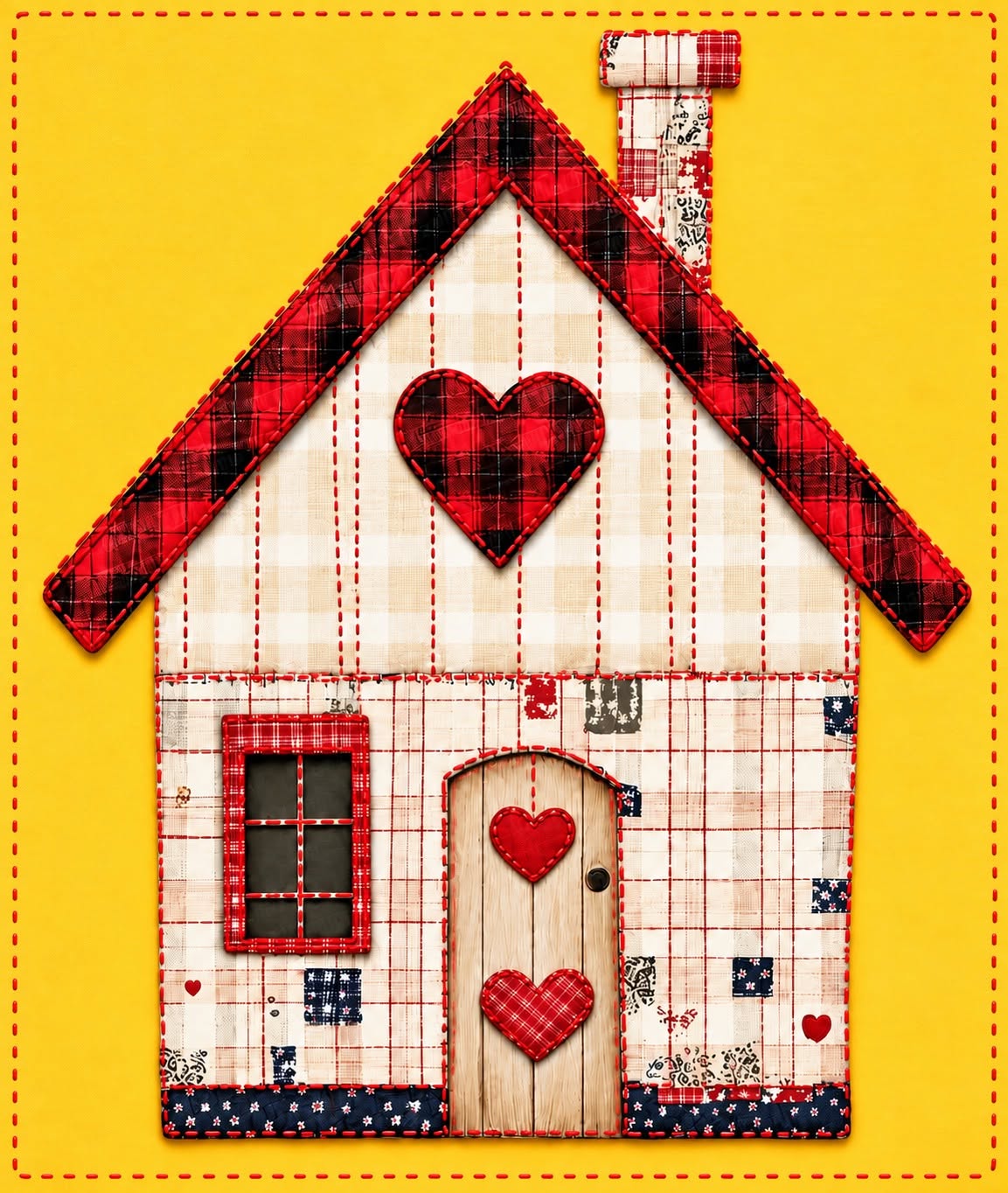
The Fabric Playhouse Panel Pattern is a charming sewing project that transforms simple pieces of fabric into a warm, decorative little house filled with personality. Inspired by the handmade cottage shown in the reference image, this project combines fabric appliqué, patchwork-style construction, decorative stitching, and layered textile details to create a cozy house-shaped panel. The plaid roof, neutral walls, heart decorations, window, wooden-style door, and small chimney work together to give the finished piece a welcoming country appearance. One of the best features of this design is that it can be adapted to many different fabric collections, making it ideal for using coordinated cotton prints or carefully selected scraps left from previous sewing projects. Although the finished panel looks detailed, the individual shapes are simple enough to prepare with basic cutting and sewing techniques. With a little patience, even someone who has never created a fabric house before can follow the process and develop a beautiful handmade decoration.
A Fabric Playhouse Panel Pattern can be used for much more than a single decorative wall panel. The same house design can become the center of a quilt block, a pillow front, a nursery decoration, a seasonal wall hanging, a fabric book page, or even part of a larger village-themed quilt. Because the design is built from separate geometric pieces, every section can be personalized. You might choose classic red and cream plaid fabrics similar to the inspiration image, soft farmhouse neutrals, bright children’s prints, floral cotton, denim accents, or even Christmas fabrics for a festive interpretation. Small details such as hearts, window frames, door handles, and decorative stitching provide excellent opportunities for adding character without making the construction unnecessarily complicated. The goal is not absolute perfection but rather creating a handmade textile piece with visual balance, texture, and charm. Slight differences in stitching or appliqué placement often make a handcrafted house look even more inviting.
Before beginning your Fabric Playhouse Panel Pattern, spend a few minutes planning the colors, proportions, and intended final size. A practical finished size for a decorative panel is approximately 35 cm wide by 45 cm high, although the template can easily be enlarged or reduced. Quilting cotton is generally the easiest material to handle because it presses well, holds its shape, and is available in countless patterns. You will also need lightweight fusible web or another suitable appliqué stabilizer, coordinating thread, batting or interfacing if you want additional structure, a backing fabric, scissors or a rotary cutter, an iron, pins or clips, and a sewing machine. Decorative hand stitching is optional but can add a lovely rustic finish. Preparing everything before sewing makes the process smoother and allows you to concentrate on building the house one attractive layer at a time.
Planning, Fabrics, and Preparing the Fabric Playhouse Panel Pattern
Begin by sketching the basic proportions of your Fabric Playhouse Panel Pattern on paper. The main body can be represented by a rectangle approximately 30 cm wide by 25 cm high, while the upper front section can be shaped like a triangle rising another 15 cm above the walls. These dimensions are only a starting point, so you can adjust them according to your preferred panel size. Add a roof that extends approximately 3 to 4 cm beyond each side of the house to create the attractive overhanging effect visible in the inspiration design. Keeping the first drawing simple makes it much easier to understand how all the pieces will fit together.
DISCOVER MORE FREE PATTERNS HERE!
Next, choose a coordinated fabric palette. For a look similar to the photographed project, select a light cream or beige print for the walls, a stronger red-and-black plaid for the roof, a softer cream-and-red plaid for the lower walls, and darker fabric for the base. The roof should usually contain the strongest color because it visually frames the entire house. The neutral wall fabrics provide contrast and prevent the panel from becoming too busy. Try placing the fabrics beside one another before cutting anything, as this quickly reveals whether the colors and patterns work harmoniously.
Wash and press your fabrics if you normally prewash quilting cotton. Pressing is especially important because even small wrinkles can affect the accuracy of appliqué pieces. Use a dry or lightly steamed iron according to the fabric manufacturer’s care recommendations. Once pressed, place each fabric on a flat cutting surface and straighten the grain before measuring. Accurate preparation at this stage will help the finished Fabric Playhouse Panel Pattern remain symmetrical and neat.
Cut the main house body first. You can use one continuous house-shaped foundation or construct the lower rectangle and triangular upper section separately. If you want the two-section appearance shown in the reference project, use one light fabric for the triangular upper wall and another coordinated print for the rectangular lower section. Add approximately 0.7 cm seam allowance wherever pieces will be sewn together traditionally. Appliqué shapes, however, can usually be cut to their finished dimensions when fusible appliqué is being used.
Prepare the roof from two long fabric strips approximately 7 cm wide, trimming one end of each strip so they meet neatly at the roof peak. The exact length depends on your house dimensions, but each side should extend beyond the wall by several centimeters. A red plaid or dark checked fabric works particularly well because the strong diagonal roof creates an immediate focal point. You can add lightweight interfacing behind the roof pieces if the chosen cotton is very soft and you want a slightly raised appearance.
Finally, prepare the smaller templates: chimney, door, window, hearts, window frame, and base strip. Tracing these components onto lightweight fusible web is an efficient way to keep every shape organized. Remember to reverse any asymmetrical template before tracing because fusible appliqué pieces flip when transferred to fabric. Labeling the paper side of each shape can also prevent confusion later. Once all the components are prepared, arrange them without sewing so you can evaluate the complete composition.
Building the House, Roof, Window, and Door
Start assembling the Fabric Playhouse Panel Pattern by joining the main wall sections. If the triangular top and rectangular bottom are separate, place them right sides together along the horizontal joining edge and stitch using approximately a 0.7 cm seam allowance. Press the seam carefully, usually toward the darker fabric. If you prefer an appliqué construction, you can instead place both sections on a larger foundation fabric and secure them using fusible web. Either method can produce a beautiful result, so choose the technique that feels most comfortable.
Position the roof after the main house shape is stable. The two roof strips should meet at the upper point and extend beyond the walls on both sides. Fuse or pin them carefully before sewing. A narrow zigzag, blanket stitch, or straight stitch placed close to the fabric edge can secure the roof. For a slightly rustic appearance, use contrasting thread and allow the stitching to remain visible. For a cleaner finish, choose thread that blends closely with the plaid fabric.
The chimney adds a whimsical architectural detail and helps make the house silhouette immediately recognizable. Cut a small rectangular chimney approximately 5 cm wide by 10 cm high, depending on your overall scale. A lighter checked print works beautifully when the roof itself is dark. Position the chimney behind the right or left roof slope before permanently attaching the roof if you want it to appear naturally integrated into the structure. A small cap or differently oriented fabric strip at the top can create additional dimension.
Create the window from a dark rectangular fabric approximately 8 cm wide by 11 cm high. Add narrow fabric strips around the outside to imitate a red plaid frame. Inside the dark window, stitch one vertical and one horizontal line or attach very narrow strips to form four panes. This small contrast between the dark interior and light dividing lines gives the window surprising visual depth. Keep the frame reasonably straight, but remember that a handcrafted cottage does not need to look mechanically perfect.
For the door, cut a rounded rectangle approximately 8 cm wide by 15 cm high. A beige, tan, or subtle wood-print fabric works especially well. If you do not have wood-grain fabric, create the impression of boards by stitching several vertical lines with brown or dark beige thread. You can also add subtle irregular lines with washable fabric marker before stitching. Position a small dark circle or stitched French knot near one side to represent the handle.
Before permanently sewing the door and window, place both pieces on the lower wall section and evaluate their spacing. In the inspiration image, the window sits to the left while the taller door occupies the center-right area. This asymmetrical arrangement gives the design personality while remaining visually balanced. Leave enough surrounding fabric visible so the wall print does not disappear behind the decorative elements. Once satisfied, fuse or pin everything securely and stitch around each component.
Adding Hearts, Appliqué Details, and Decorative Stitching
The hearts are essential decorative elements in this Fabric Playhouse Panel Pattern because they introduce warmth and reinforce the handmade cottage theme. Prepare at least three hearts in different sizes. A large heart can be positioned in the triangular upper wall, a medium heart near the lower portion of the door, and a smaller heart near the upper part of the door. Red plaid, deep burgundy, or coordinating patterned fabric creates strong contrast against the neutral house walls. You can also introduce tiny heart accents elsewhere if you want a more playful appearance.
To make the hearts, fold a small paper rectangle in half and draw half of a heart along the folded edge. Cut through both layers and unfold the paper to create a symmetrical template. Trace the shapes onto fusible web, attach the web to the wrong side of your chosen fabric, and cut along the outlines. Remove the paper backing and place each heart in position. Press according to the instructions for your fusible material, protecting delicate fabric when necessary.
Secure the edges with an appliqué stitch. A blanket stitch is especially attractive because it creates the traditional handmade outline commonly associated with folk-art fabric projects. A narrow zigzag works well when durability is important, while straight stitching close to the edge creates a relaxed raw-edge style. Dark brown, black, deep red, or coordinating thread can all produce interesting effects. If you prefer a vintage country appearance, slightly darker stitching around light-colored pieces often enhances their shape.
Decorative stitching can also be added to the main walls. The inspiration design includes subtle dashed vertical lines that contribute texture without distracting from the stronger appliqué pieces. You can reproduce this effect using a sewing machine’s decorative stitch or simple hand running stitches. Keep the spacing irregular enough to feel handmade but consistent enough to look intentional. These lines are optional, yet they can make a simple cream fabric appear much richer.
Add a dark base strip along the bottom of the house to visually ground the composition. A strip approximately 3 to 4 cm high is usually sufficient. Black, charcoal, dark brown, or a tiny floral print can work nicely. Small scraps of patterned fabric placed along this area can imitate flowers, stones, or garden details. This is a wonderful place to use very small remnants that might otherwise be discarded.
At this stage, inspect the entire Fabric Playhouse Panel Pattern from a distance. Look for areas that seem too empty or too crowded. Small appliqué squares, miniature hearts, decorative dots, or short embroidery lines can help distribute color across the lower wall. Avoid filling every available space because some quiet areas are necessary to keep the house readable. The strongest elements should remain the roof, hearts, window, and door, while all additional decoration plays a supporting role.
Finishing, Quilting, and Displaying the Fabric Playhouse Panel Pattern
Once all appliqué pieces are securely attached, decide whether the project will remain a simple fabric panel or become a quilted wall hanging. For quilting, cut batting and backing approximately 3 to 5 cm larger than the house panel on every side. Place the backing wrong side up, add the batting, and position the finished house panel on top. Smooth all three layers carefully and secure them with quilting pins, clips, or temporary basting according to your preferred method.
Quilting does not need to be complex. Simple stitching around the outline of the house, roof, door, window, and hearts will emphasize each shape while stabilizing the layers. This technique is often called outline quilting. You can also quilt several vertical lines through open wall areas. Try to avoid quilting directly across important appliqué details unless that effect is intentional. A moderate stitch length generally produces a clean appearance.
If you want the house itself to stand alone rather than sit on a rectangular background, use interfacing or thin batting inside the house and finish the outer edge carefully. Binding, facing, or a close decorative stitch can be used depending on the intended purpose. A free-standing fabric house panel can be attached to a larger quilt later, incorporated into a bag, or displayed as textile art. The versatility of the Fabric Playhouse Panel Pattern is one of the reasons this style of project is so enjoyable.
For a traditional wall hanging, square the quilted panel after quilting. Trim the edges carefully using a ruler and rotary cutter, checking that opposite sides remain parallel. Prepare binding strips approximately 6 cm wide, join them end to end, fold them lengthwise, and attach the binding around the outer perimeter. Mitered corners provide a professional finish, although simple folded corners are perfectly suitable for beginners. Finish the binding by machine or hand according to your preferred appearance.
A hanging sleeve can be added to the back if you intend to display the finished house on a wall. Cut a fabric strip slightly shorter than the panel width, fold and finish the short ends, then stitch the long edges to form a tube. Attach it near the upper back edge while avoiding stitches that show through the front. A small wooden rod can then slide through the sleeve, allowing the textile panel to hang evenly without stretching.
Your completed Fabric Playhouse Panel Pattern should feel personal rather than identical to any single example. Changing the fabrics, window style, roof color, heart placement, or decorative stitching can completely transform the character of the house. You could create several houses in different palettes and eventually combine them into a fabric village. The most important part of the process is learning how simple fabric shapes can be layered thoughtfully to create a surprisingly detailed textile illustration.
Frequently Asked Questions About the Fabric Playhouse Panel Pattern
What is a Fabric Playhouse Panel Pattern?
A Fabric Playhouse Panel Pattern is a sewing design used to create a decorative house-shaped textile panel using fabric pieces, appliqué, patchwork techniques, and stitching. The project can be displayed independently or incorporated into larger items such as quilts, cushions, wall hangings, bags, and nursery decorations.
Is this project suitable for beginners?
Yes. Beginners can successfully make this project because most of the pieces are based on simple rectangles, triangles, strips, and heart shapes. Using fusible appliqué can make the construction particularly approachable because the pieces can be temporarily secured before stitching. Taking time to arrange and press each component usually produces better results than trying to work quickly.
What fabric is best for a Fabric Playhouse Panel Pattern?
Quilting cotton is one of the most practical choices. It is stable, easy to cut, easy to press, and available in many coordinating patterns. Plaid, gingham, floral, neutral, and small geometric prints work especially well. Fabric scraps can also be mixed successfully, provided their weights are reasonably similar.
Do I need fusible web for the appliqué?
Fusible web is helpful but not absolutely required. It keeps smaller pieces such as hearts and window frames from shifting while they are stitched. Traditional needle-turn appliqué, glue basting, pins, or temporary fabric adhesive are alternatives. Beginners often find lightweight fusible web especially convenient.
Which stitch should I use around the appliqué pieces?
A blanket stitch, narrow zigzag, or straight stitch can all work well. Blanket stitch appliqué creates a decorative country-style finish, while a narrow zigzag offers additional edge protection. Straight stitching is excellent for a deliberately rustic raw-edge appearance.
How large should the finished house panel be?
There is no mandatory size. A panel approximately 35 cm wide by 45 cm high provides enough space for detailed doors, windows, hearts, and roof elements without becoming difficult to manage. Smaller versions can be used for pillows or bags, while larger houses can become central blocks in bed quilts or wall quilts.
Can I make the project without a sewing machine?
Yes. The entire project can be assembled by hand, although it will require more time. Hand blanket stitch works beautifully around appliqué shapes, and simple running stitches can add decorative texture. Hand sewing may actually enhance the folk-art appearance of the finished house.
Can leftover fabric scraps be used?
Absolutely. This project is especially suitable for scraps because many of the decorative pieces are small. Hearts, window frames, chimney sections, base details, and tiny accent patches can all be cut from remnants. Coordinating scrap colors before sewing will help the final design remain visually balanced.
How can I make the panel look more three-dimensional?
Use thin batting behind selected appliqué elements such as the roof, door, or hearts. Additional quilting around these shapes will create subtle raised areas. Darker stitching along certain edges can also create visual depth without adding substantial thickness.
Can the Fabric Playhouse Panel Pattern be customized for different seasons?
Yes. Spring versions can feature floral fabrics and pastel colors, while autumn houses can use rust, brown, mustard, and burgundy fabrics. Christmas versions look beautiful with red, green, cream, and plaid prints. The basic construction remains the same, so changing the fabric selection is usually enough to create an entirely different theme.
How do I prevent appliqué edges from fraying?
Fusible web helps stabilize the fabric, while blanket stitch or zigzag stitching protects the edges further. If you intentionally use raw-edge appliqué, a small amount of fraying can become part of the handmade aesthetic. Choosing tightly woven quilting cotton also reduces excessive fraying.
Can several house panels be combined into one quilt?
Yes. Creating multiple variations of the Fabric Playhouse Panel Pattern is an excellent way to build a village-themed quilt. Each house can have a different roof, door, window, fabric palette, and heart arrangement. Background strips or traditional quilt blocks can then be placed between the houses to connect the overall design.
Conclusion
The Fabric Playhouse Panel Pattern demonstrates how a collection of relatively simple fabric shapes can become a detailed and welcoming textile project. Starting with the main walls and roof, you learned how to plan proportions, coordinate fabrics, construct the house structure, create a window and door, prepare heart appliqués, add decorative stitching, and finish the project as a quilted panel. Techniques such as fabric appliqué, blanket stitching, outline quilting, careful pressing, and thoughtful fabric placement help transform ordinary quilting cotton into a charming handmade cottage.
This project is also an excellent opportunity to experiment with your own creative ideas. You can change the colors, enlarge the house, add flowers, create different windows, introduce seasonal fabrics, or make several houses for a complete fabric village. There is no need for every handmade detail to look identical because individual variations give textile art its special character.
EASILY FIND THE PDF FOR THIS PATTERN HERE!
Most importantly, completing a Fabric Playhouse Panel Pattern provides useful experience with fabric selection, accurate cutting, appliqué placement, decorative stitching, layering, quilting, and finishing techniques that can be applied to many future sewing projects. Whether you use the finished design as wall décor, a quilt block, a cushion front, or part of another handmade creation, the same basic process offers endless opportunities for personalization. If you decide to create your own Fabric Playhouse Panel Pattern, leave your sincere opinion about the project and share your suggestions. Which fabrics, colors, decorative details, or variations would you add to your own little fabric house? Your ideas can inspire new versions and make this charming sewing project even more creative.