
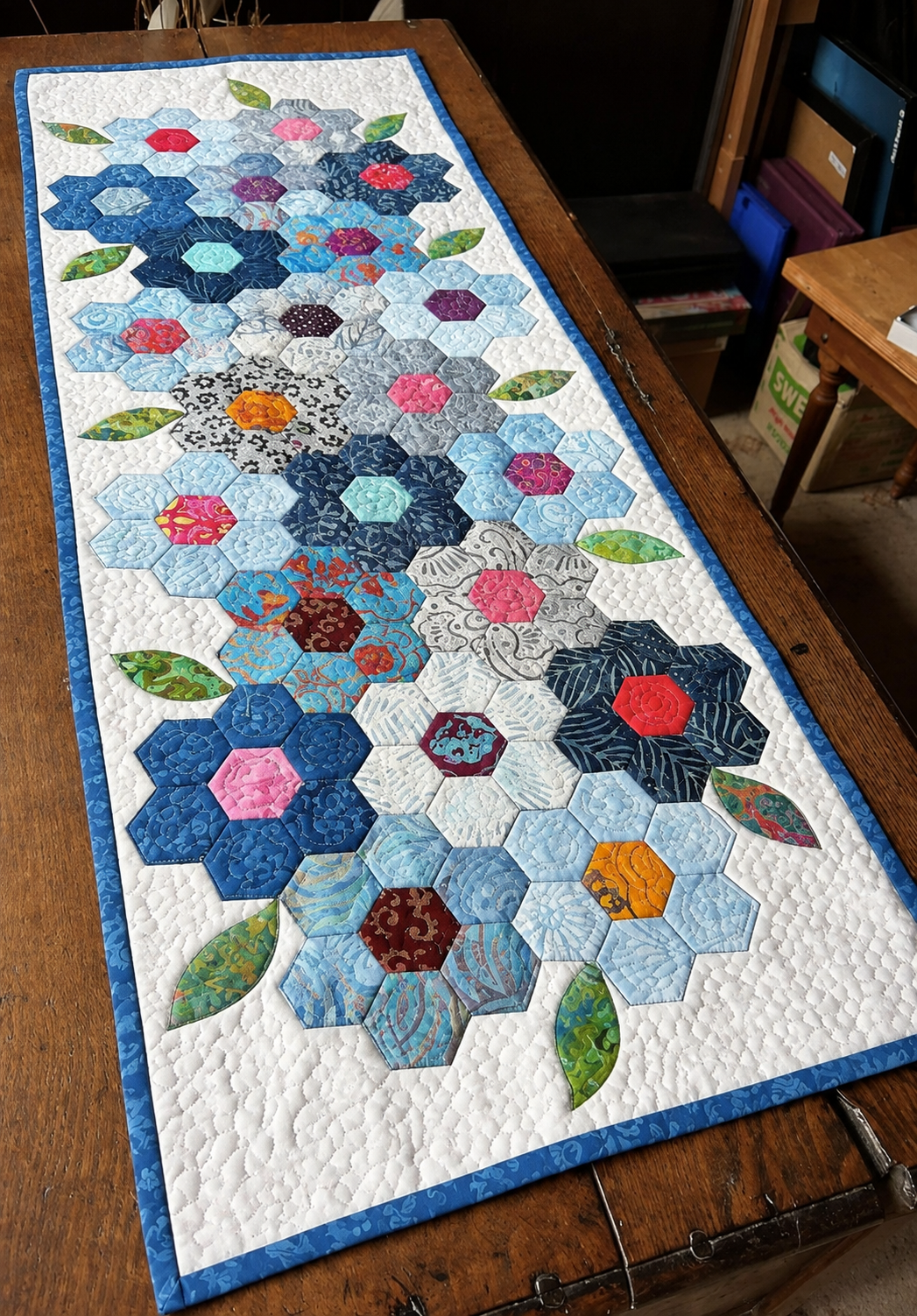
The Hexagon Flower Table Runner Fabric Pattern is a beautiful sewing and quilting project that transforms small pieces of fabric into an elegant floral arrangement for the dining table, sideboard, console, or decorative cabinet. The design is based on hexagon fabric pieces arranged around contrasting centers to create flowers with a charming patchwork appearance. One of the most attractive aspects of this project is the freedom to combine different prints, colors, and textures while maintaining a harmonious overall composition. Soft blues, navy fabrics, floral prints, gray tones, pink accents, and occasional warm colors can create the relaxed handmade effect seen in the reference project. Because the flowers are assembled individually before being positioned on the background, the layout can easily be adapted to a longer or shorter table runner. This makes the Hexagon Flower Table Runner Fabric Pattern an interesting project both for experienced quilters and for beginners who want to practice accurate fabric piecing.
A hexagon flower quilt design is created by combining geometric precision with creative fabric placement. Each flower normally consists of a central hexagon surrounded by six additional hexagons, producing a recognizable seven-piece flower shape. Several flowers can then be connected, overlapped visually, or positioned close together to form a flowing garden across the runner. Fabric leaves placed between some of the flowers soften the geometric appearance and reinforce the botanical theme. A light background is especially useful because it allows darker blues, colorful flower centers, and printed fabrics to stand out clearly. The narrow contrasting border around the outside gives the project a finished appearance and visually frames the patchwork work in the center.
Making a fabric table runner pattern like this is also a practical way to use scraps left from previous sewing projects. Small hexagons do not require large pieces of fabric, so even relatively small remnants can become petals or flower centers. Batiks, cotton prints, subtle florals, tone-on-tone fabrics, and coordinated solids can all work successfully when distributed thoughtfully throughout the design. The key is maintaining enough contrast between neighboring pieces so that each hexagon flower remains visible from a distance. Accurate cutting and consistent seam allowances are equally important because small variations can accumulate when several hexagons are joined together. With careful preparation, the final runner can achieve the detailed handmade appearance of the photographed project while still being completely personalized.
Materials and Fabric Preparation for the Hexagon Flower Table Runner
For this Hexagon Flower Table Runner Fabric Pattern, begin by choosing good-quality quilting cotton. Cotton is easy to cut, press, stitch, and quilt, making it one of the most practical materials for this type of project. Select several coordinated fabrics for the petals and additional contrasting fabrics for the centers. You will also need a light fabric for the background, batting, backing fabric, thread, and fabric for the binding.
The exact dimensions of the runner can be adjusted according to the table where it will be used. A practical starting size is approximately 35 to 45 cm wide and 100 to 140 cm long. Before cutting the main pieces, decide how many hexagon flowers you would like to include. A longer runner can accommodate more flowers, while a smaller runner may look balanced with six to eight flower units.
Choose one hexagon template size and use it consistently throughout the project. A hexagon measuring approximately 5 to 7 cm across can create flowers similar in proportion to the ones shown in the inspiration image. Remember that the measurement must account for your chosen construction technique. When cutting fabric directly for piecing, add the appropriate seam allowance around every side.
Prepare seven hexagons for each complete flower: one for the center and six for the petals. The center can be strongly contrasting, such as pink against blue petals, orange against gray petals, or aqua against navy petals. Repeating some colors across different flowers helps create visual continuity without making every flower identical.
For the leaves, prepare simple pointed leaf shapes from green printed fabrics. These can be made using appliqué methods rather than traditional piecing. Mixing olive green, sage, pale green, and botanical prints will make the leaves appear naturally varied. Keep the leaves relatively small so they complement the patchwork flowers instead of competing with them.
Finally, prewash the fabrics if you normally prewash quilting materials, and press every piece before cutting. A flat fabric surface improves cutting accuracy considerably. Organize the cut hexagons by flower before sewing, placing each group of seven pieces together. This simple preparation step prevents confusion later and allows you to evaluate color combinations before permanently joining the pieces.
How to Sew the Hexagon Flowers Step by Step
Begin the sewing stage of the Hexagon Flower Table Runner Fabric Pattern with one flower at a time. Place the center hexagon in front of you and arrange six petal hexagons around it. Experiment with the orientation of printed fabrics so interesting motifs appear in visible areas. Photographing or numbering the arrangement before stitching can help preserve your chosen layout.
Join the first petal to one side of the center hexagon using a consistent seam allowance. Stop your stitching precisely at the intersection where the seam allowance begins rather than sewing beyond it. This detail is especially helpful when joining additional hexagons because the pieces must pivot naturally around the corners. Press the seam carefully after sewing.
Add the second petal to the next side of the center. Continue around the central hexagon until all six petals have been attached. Depending on the construction method, you may need to sew short seams between neighboring petals as you progress. Accurate corner matching will make the finished hexagon flower block look cleaner and more symmetrical.
Once all six petals surround the center, complete the seams between the petals. Avoid pulling the fabric while stitching because stretching can distort the geometric shape. Press the completed flower from the wrong side first and then gently press from the front. Pressing rather than aggressively sliding the iron helps preserve the original shape of the pieces.
Continue making additional flowers using different fabric combinations. Some flowers can have light petals with dark centers, while others can feature dark petals with colorful centers. In the photographed style, blues and soft neutrals dominate the project, while pink, red, aqua, orange, and patterned centers provide small areas of stronger visual interest.
Place every completed flower on a large flat surface before beginning the final arrangement. At this stage, avoid permanently attaching anything to the background. Move flowers around until their colors feel evenly distributed. The hexagon floral table runner should appear naturally varied rather than arranged in obvious rows, so slightly irregular spacing can produce a more organic garden-like composition.
Arranging the Flowers, Leaves, and Background
Cut the background fabric slightly larger than your desired final table runner dimensions. Having extra fabric around the perimeter provides room for trimming after appliqué and quilting. Press the background thoroughly and position it on a flat work surface. If necessary, lightly mark the approximate finished boundaries with a removable fabric-marking tool.
Arrange the largest or darkest hexagon flowers first. Rather than placing them in a perfectly straight line, distribute them diagonally and alternately from one side of the runner to the other. This creates movement and encourages the eye to travel through the entire design. Leave some visible background between flower groups so the composition does not become overly crowded.
Next, add the medium and lighter flowers. Try to avoid positioning two very similar flowers directly beside one another. A navy flower can sit near a pale blue flower, while a gray floral unit may be balanced with a turquoise or multicolored one. This contrast is one of the visual strengths of the Hexagon Flower Table Runner Fabric Pattern.
Add fabric leaves in the open spaces around the flowers. Some leaves can point toward the outer edge while others can connect two flower areas visually. You do not need to place a leaf beside every flower. Strategic spacing usually produces a more natural result and prevents the design from becoming too busy.
Once you are satisfied with the arrangement, secure the flowers temporarily using your preferred appliqué preparation method. Depending on your sewing style, you may use pins, temporary fabric adhesive, fusible appliqué products, or careful hand basting. Make sure every piece remains flat against the background before beginning permanent stitching.
Stitch around the flowers and leaves using either machine appliqué or hand appliqué. A narrow zigzag, blanket stitch, or discreet straight stitch can work depending on how the pieces were prepared. Keep your stitching consistent throughout the fabric flower table runner because repeated finishing details help unify fabrics with different colors and prints.
Quilting, Binding, and Finishing the Table Runner
After all flowers and leaves have been secured, prepare the quilt sandwich. Place the backing fabric with the wrong side facing upward, add the batting, and position the decorated runner top with the right side facing upward. Make sure both the batting and backing extend beyond the top on every side. Smooth all three layers carefully before securing them.
Baste the layers using safety pins, thread basting, or another quilting method you prefer. Begin near the center and work outward to minimize wrinkles. Because a quilted table runner is relatively narrow, this process is usually easier than preparing a large quilt. Check the back frequently to ensure that no folds have developed.
Quilt around the hexagon flowers to emphasize their geometric outlines. You can also quilt through selected areas inside the petals for additional stability. In the white or light background sections, simple free-motion curves, gentle meandering, or closely spaced lines can add texture without distracting attention from the colorful floral arrangement.
Continue quilting evenly across the entire runner. The goal is not necessarily to create extremely dense quilting but to connect all three layers securely. Areas around appliqué leaves deserve particular attention because quilting around them can help the leaves appear more dimensional. The combination of geometric flowers and softer background quilting creates appealing visual contrast.
When quilting is complete, trim the edges of the runner so they are straight and square. Prepare a quilt binding in a color that coordinates with the flower fabrics. Dark blue is particularly effective with a mostly blue and neutral composition because it frames the pale background while repeating colors found in several flowers.
Attach the binding around all four sides, carefully forming neat corners. Finish it by machine or hand according to your preferred technique. Give the completed Hexagon Flower Table Runner Fabric Pattern a gentle final press, avoiding excessive heat if fusible materials were used. The result should be a decorative handmade runner filled with dimensional-looking hexagon flowers, scattered leaves, and a clean contrasting border.
FAQ – Hexagon Flower Table Runner Fabric Pattern
What is a Hexagon Flower Table Runner Fabric Pattern?
A Hexagon Flower Table Runner Fabric Pattern is a sewing or quilting design that uses hexagonal fabric shapes arranged into flower formations. A typical flower contains one center hexagon surrounded by six petal hexagons. Multiple flowers are then arranged across a rectangular fabric background to create a decorative table runner.
How many hexagons are needed for one fabric flower?
A traditional hexagon flower normally uses seven hexagons. One piece becomes the flower center, and six matching or coordinated hexagons form the petals. If you create ten flowers, for example, you would need approximately 70 hexagons before adding any optional decorative pieces.
What fabric is best for a hexagon table runner?
Quilting cotton is an excellent choice because it is stable, easy to cut, and easy to press. Batiks also work particularly well because their small-scale designs can produce interesting variations inside the relatively small hexagon fabric pieces.
Can I make this project using fabric scraps?
Yes. A scrap fabric table runner is one of the best applications for this design. Because individual hexagons require only small pieces of material, scraps from previous quilts, bags, cushions, and sewing projects can often be incorporated successfully.
Do all the hexagon flowers need to match?
No. In fact, using different fabrics is part of the charm of the pattern. You can make some flowers dark, others light, and several with colorful centers. Repeating a few colors throughout the runner will help connect the different flower combinations visually.
What size should the hexagons be?
There is no mandatory size. Hexagons around 5 to 7 cm can produce attractive medium-sized flowers for a table runner, but smaller pieces create a more detailed design. The most important rule is to use the same template consistently so adjoining pieces align correctly.
Can beginners make a Hexagon Flower Table Runner?
Yes, although patience is important. Beginners should practice joining several scrap hexagons before assembling the main flowers. Consistent seam allowances, accurate cutting, and careful pressing are more important than sewing quickly.
Do I need a special sewing machine?
No. A regular household sewing machine can handle this project. Straight stitching is sufficient for most construction, and a basic zigzag or blanket-style stitch can be useful when attaching appliqué elements.
Can the flowers be sewn by hand?
Absolutely. English Paper Piecing, traditional hand piecing, and hand appliqué are all possible methods for working with hexagons. Hand sewing takes longer, but many quilters enjoy the control it offers when matching small geometric pieces.
How should I choose colors for the table runner?
Begin with a main color family and introduce smaller contrasting accents. For a design inspired by the photo, you could use pale blue, navy, gray, white, and aqua as the primary palette, then introduce pink, burgundy, orange, turquoise, and green in smaller amounts.
Why add leaves between the hexagon flowers?
Leaves reinforce the garden theme and help fill isolated spaces without adding another large flower. They also soften the strong geometric lines created by the hexagon quilt pattern. Different green fabrics can make the arrangement look more natural and dynamic.
How can I make the runner longer?
Simply extend the background fabric and add additional flower groups. Because the design does not depend on a rigid block arrangement, the Hexagon Flower Table Runner Fabric Pattern can be adapted to different table lengths without dramatically changing its visual character.
Should I quilt before or after attaching the flowers?
For this style of project, the flowers are generally attached to the runner top before assembling and quilting the three layers. Quilting afterward secures the batting and backing while adding texture around the completed floral design.
Can this pattern be used for projects other than table runners?
Yes. The same hexagon flower fabric pattern can inspire placemats, wall hangings, cushion covers, bed runners, tote bag panels, and larger quilts. The construction principle remains essentially the same; only the number of flowers and the dimensions of the background need to change.
How do I keep the runner flat after quilting?
Careful basting, balanced quilting, and pressing throughout construction are important. Start quilting near the center and gradually move outward. Avoid pulling the fabric strongly while sewing, because uneven tension can distort the runner or create unwanted waves around the edges.
Conclusion
The Hexagon Flower Table Runner Fabric Pattern combines traditional patchwork geometry with the softer appearance of a floral garden. By preparing coordinated hexagon fabric pieces, assembling them into seven-piece flowers, arranging them across a light background, and adding appliqué leaves, you can create a table runner with depth, movement, and plenty of handmade personality. Careful cutting, consistent seams, thoughtful color distribution, and patient pressing are the foundations of a successful result. You also learned how to prepare the quilt sandwich, secure the three layers, quilt around the decorative elements, trim the runner, and finish everything with a contrasting quilt binding. The pattern is especially useful for using fabric scraps, experimenting with color combinations, and adapting one basic geometric shape into a project that looks detailed and sophisticated.
EASILY FIND THE PDF FOR THIS PATTERN HERE!
Most importantly, your Hexagon Flower Table Runner Fabric Pattern does not need to be an exact copy of another project. Changing the fabrics, number of flowers, arrangement of the leaves, runner dimensions, or quilting style can make every version unique. Use the techniques explained here as a foundation and allow your own fabric collection to guide the final appearance. If you make this project, leave your sincere opinion about the pattern and share your suggestions for future variations. Your ideas about colors, flower arrangements, quilting styles, and finishing details c