
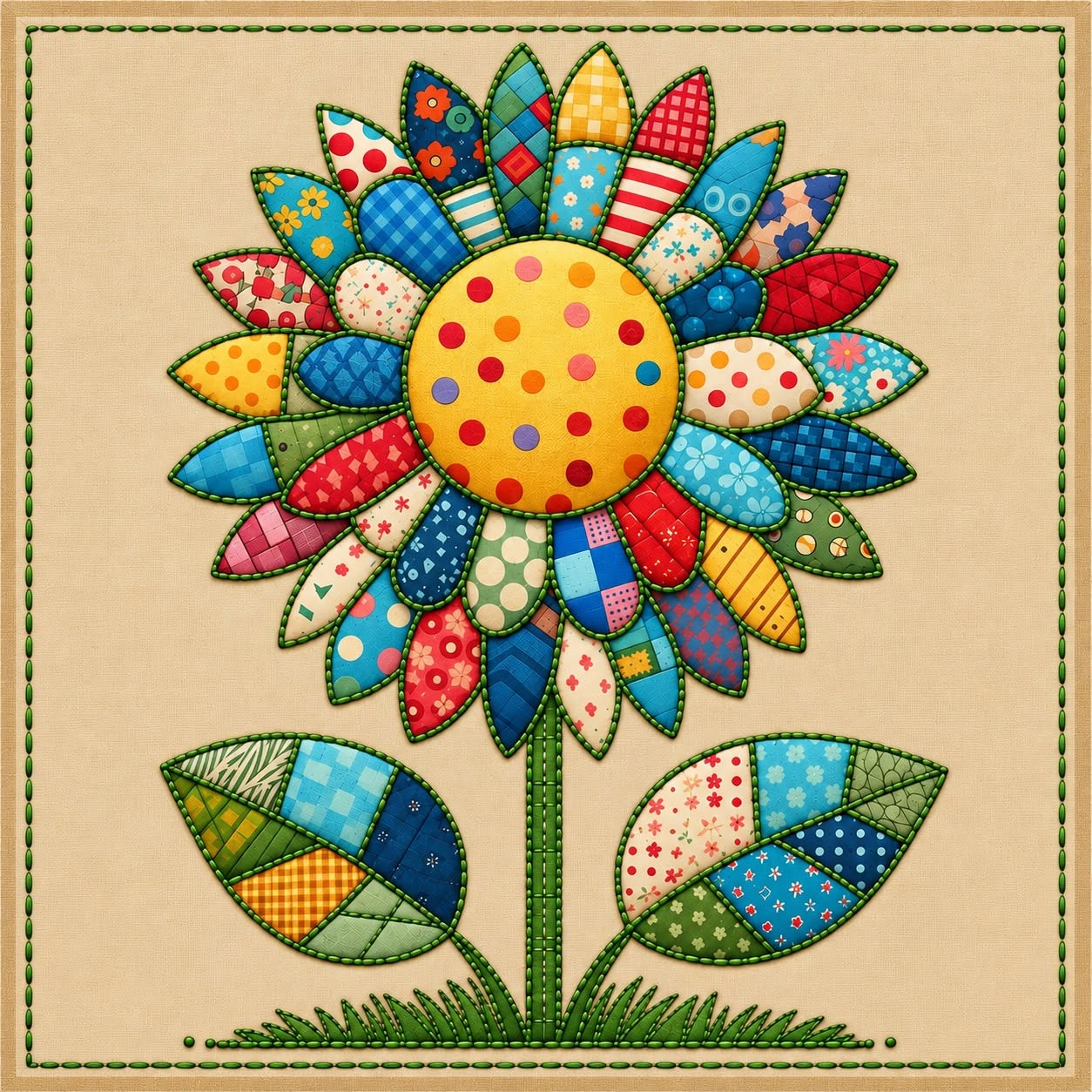
Sunflower Print Patchwork Quilt Pattern is a cheerful fabric-art project that combines the beauty of a sunflower with the warmth and personality of traditional patchwork quilting. Inspired by the colorful design shown in the image, this project features a large circular flower center surrounded by layered fabric petals, two patchwork leaves, a straight stem, and a small section of grass at the base. Each petal can be made with a different fabric print, allowing you to use floral scraps, geometric cotton, polka dots, checks, stripes, and other favorite materials. The result is a lively decorative piece that can become a wall hanging, pillow panel, table decoration, quilt block, or centerpiece for a larger handmade quilt. Because every fabric combination creates a different appearance, no two finished sunflowers will ever look exactly the same.
Creating a Sunflower Print Patchwork Quilt Pattern is also a practical way to use leftover fabric from previous sewing projects. Small pieces that might otherwise remain forgotten in a scrap basket can be transformed into petals, leaf sections, decorative circles, and background details. The design is suitable for confident beginners because most of the shapes are simple and can be assembled using basic quilting, appliqué, and hand-stitching techniques. More experienced quilters can add decorative embroidery, free-motion quilting, fabric shading, raw-edge appliqué, or dimensional elements. The most important part of the process is planning the composition before sewing, especially the placement of the petals and the distribution of colors around the flower.
This tutorial explains how to recreate the project step by step while maintaining the joyful handmade character of the original image. You will learn how to choose fabrics, prepare a reusable pattern, construct the flower center, arrange the patchwork petals, sew the leaves, add the stem, and finish the background. The instructions can be adapted to different dimensions, so the design may be enlarged for a wall quilt or reduced for a cushion, tote bag, fabric book cover, or framed textile artwork. The term patchwork quilt pattern refers to a planned design created by joining or layering different pieces of fabric, while sunflower print describes the recognizable flower composition that guides the colors, shapes, and overall arrangement of the project.
Understanding the Sunflower Print Patchwork Quilt Pattern
The main feature of this Sunflower Print Patchwork Quilt Pattern is its circular structure. The flower begins with a large center, and several rows of pointed or rounded petals are positioned around it. Although the design looks detailed, it can be divided into manageable sections that are prepared separately and joined during the final assembly.
DISCOVER MORE FREE PATTERNS HERE!
The sunflower center can be created from one bright yellow fabric or assembled from several curved pieces. A solid yellow cotton produces a clean result, while a lightly textured or mottled fabric creates more visual depth. Small circles in red, orange, blue, and purple can be appliquéd over the center to imitate seeds and decorative spots.
The petals are the most expressive part of the project. Instead of using one repeated yellow fabric, the reference design uses many colors and prints. This creates a playful interpretation of a sunflower while preserving its familiar shape. Floral fabrics, gingham, stripes, dots, diamonds, and small geometric motifs work especially well.
A patchwork petal may be cut from a single scrap or constructed from two or three smaller pieces. Combining fabrics within individual petals adds movement and makes the design appear more elaborate. Beginners may prefer one fabric per petal, while experienced makers can add tiny patchwork sections before cutting the final petal shape.
The leaves follow the same creative approach. Each leaf is divided into several curved or angled fabric sections. Dark blue, green, cream, turquoise, and yellow scraps can be mixed to create contrast. The two leaves do not need to match because slight differences strengthen the handmade appearance.
The background should remain simple enough to highlight the flower. White, ivory, pale cream, light blue, or soft gray quilting cotton provides a clean foundation. A plain background also makes it easier to see the outline of every petal, leaf, and decorative stitch in the finished fabric sunflower appliqué.
Choosing Materials and Preparing the Printable Shapes
Begin by selecting a strong cotton fabric for the background. Prewash the fabric if the finished project will be washed frequently, because natural cotton may shrink. Press the background thoroughly and cut it several inches larger than the planned finished dimensions so there is enough room for trimming and finishing.
Collect a varied selection of quilting fabric scraps for the petals. Medium and small prints are usually more effective than very large designs because the shapes are relatively narrow. Try to include light, medium, and dark values so that neighboring petals remain visible instead of blending together.
For the flower center, prepare yellow fabric, lightweight fusible web, and several tiny scraps for the decorative circles. The colored circles may be cut with fabric scissors, a small circular template, or a hole-punch-style fabric cutter designed for appliqué. Keep their sizes slightly different for a natural arrangement.
Additional supplies include paper, a pencil, a ruler, fabric scissors, paper scissors, pins or appliqué glue, an iron, coordinating thread, a sewing machine, and optional embroidery floss. A lightbox or bright window can help transfer the sunflower quilt template onto paper or fusible web.
Draw one large circle for the center, several petal templates, two leaf outlines, internal leaf sections, one stem, and a narrow grass shape. It is helpful to make at least three petal variations: a long pointed petal, a medium rounded petal, and a shorter wide petal. These variations create fullness around the flower.
Add a seam allowance only when you plan to turn the fabric edges under. A ¼-inch seam allowance is generally enough for turned-edge appliqué. For raw-edge fusible appliqué, trace the exact finished shape without adding extra fabric. Clearly label each template before cutting to avoid confusion during assembly.
Step-by-Step Construction of the Patchwork Sunflower
First, prepare the background and mark its vertical center using a removable fabric pen or a light finger-pressed fold. Place the stem near the middle, leaving enough room above it for the large flower and below it for the grass. Do not sew anything permanently until the complete layout has been tested.
Create the stem from a long strip of green fabric. It may be cut straight for a graphic appearance or slightly curved for a softer effect. Fuse or pin the stem to the background, then stitch around its edges using a small zigzag, blanket stitch, straight stitch, or hand-sewn appliqué stitch.
Construct each leaf separately. Cut the full leaf shape from a lightweight foundation fabric, then cover it with overlapping patchwork pieces. Sew the sections together, press the seams carefully, and trim the completed unit to the leaf template. This method keeps the many small pieces stable.
Position one leaf on each side of the stem. The leaves can be placed at slightly different heights and angles to imitate the reference image. Tuck the narrow ends beneath the stem or overlap them naturally. Secure the edges using your preferred appliqué quilting technique.
Next, prepare approximately twenty-four to thirty-six petals, depending on their width and the size of the center. Arrange the longer petals in the back row and shorter petals closer to the center. Alternate colors, prints, and values so that similar fabrics are not grouped too closely together.
When you are satisfied with the arrangement, take a photograph of the layout before moving the pieces. The photograph will serve as a placement guide. Numbering the backs of the petals is another useful method, especially when the sunflower contains two or three overlapping rows.
Assembling, Quilting, and Finishing the Design
Attach the back row of petals first. Work around the circle gradually instead of sewing all the petals on one side before moving to the other. This helps maintain a balanced shape. The pointed ends should face outward, while the wider bases should remain hidden beneath the flower center.
Add the second layer of petals over the first, filling any visible gaps. Allow some petals to overlap more than others so the flower appears full and organic. Small variations in direction are desirable because perfectly identical spacing may make the design look too mechanical.
Prepare the yellow center by fusing or appliquéing the colored circles onto it. Distribute red, orange, blue, and purple dots across the surface. Stitch around each circle if the project will be washed, or secure them with dense decorative stitching for additional texture.
Place the completed center over the bases of the petals. Confirm that all unfinished petal edges are covered before pressing or pinning the circle into position. Stitch around the outer edge slowly, rotating the fabric frequently to maintain a smooth circular seam.
Add the grass beneath the stem using green fabric triangles, narrow strips, or embroidered stitches. The grass may be simple or detailed, depending on the final purpose of the project. A few irregular blades on either side of the stem help anchor the sunflower visually.
Finish by layering the quilt top with batting and backing fabric. Baste the layers and quilt around the flower, inside selected petals, along the leaf sections, and across the background. Trim the edges and add binding, an envelope-style cushion back, or another finish appropriate for your chosen project.
Frequently Asked Questions About the Sunflower Print Patchwork Quilt Pattern
Is the Sunflower Print Patchwork Quilt Pattern suitable for beginners?
Yes. A beginner can complete the project by using single-fabric petals and raw-edge fusible appliqué. The design becomes more advanced only when individual petals and leaves are constructed from multiple patchwork sections. Starting with fewer pieces makes the process easier without changing the main appearance.
What is the best fabric for this project?
Quilting cotton is usually the best option because it is stable, easy to cut, and available in many colors and prints. Linen blends may also be used for the background, but very stretchy or slippery fabrics can make the small appliqué pieces more difficult to control.
How large should the finished sunflower be?
The size depends on the intended use. A flower measuring approximately 12 to 16 inches across works well for a cushion or wall panel. A smaller version can decorate a tote bag, while a larger sunflower can become the central block of a bed quilt.
Can the petals be sewn by hand?
Yes. Needle-turn appliqué, blanket stitch, and small whip stitches are all appropriate for hand sewing. Hand stitching takes longer but produces a soft traditional finish. Decorative embroidery around the petals can also emphasize the handmade quality of the design.
Should fusible web be used on every piece?
Fusible web is helpful for stabilizing small shapes and maintaining the layout before stitching. However, it is not required. Quilters who prefer a softer finish may use pins, temporary fabric glue, freezer paper templates, or traditional turned-edge appliqué methods.
How many different fabrics are needed?
There is no fixed number. The sunflower can be made with five coordinated prints or more than thirty unique scraps. Using many fabrics produces a colorful scrappy look, while a limited palette creates a calmer and more coordinated design.
Can I use leftover fabric from other quilting projects?
Absolutely. The Sunflower Print Patchwork Quilt Pattern is ideal for scrap quilting because most components are small. Even narrow strips can be joined together and recut into petals, leaf sections, grass, or decorative circles.
How can I stop the petals from fraying?
Raw-edge petals can be protected with a narrow zigzag stitch, satin stitch, blanket stitch, or fabric sealant intended for sewing projects. Another option is to add seam allowances, turn the edges under, and stitch them using a traditional appliqué method.
What type of quilting design works best around the sunflower?
Echo quilting is an effective choice because it follows the outline of the flower and makes the appliqué stand out. Gentle loops, leaves, spirals, or simple straight lines can also be used. Avoid extremely dense quilting directly over dimensional petals unless a flatter finish is desired.
Can the pattern be made with a different color palette?
Yes. The flower can be adapted to seasonal or decorative themes. Autumn fabrics create a warm harvest sunflower, pastel prints create a softer spring version, and red, white, and blue fabrics can produce a patriotic interpretation. The circular construction remains the same.
How should the finished quilted panel be cleaned?
Follow the washing instructions for the fabrics, batting, fusible web, and thread used in the project. A decorative wall hanging may only need gentle dusting or spot cleaning. Washable cushions and quilts should be cleaned on a delicate cycle and air-dried or dried at a low temperature.
Can this sunflower be added to a larger quilt?
Yes. The completed panel can serve as a central medallion, a large feature block, or one design within a garden-themed quilt. Additional borders, smaller flowers, butterflies, birds, or simple patchwork blocks can be added around it to expand the composition.
Conclusion
The Sunflower Print Patchwork Quilt Pattern transforms simple fabric scraps into a bright and memorable textile project. Throughout this tutorial, you learned how to prepare the background, create reusable templates, choose balanced colors, construct patchwork petals, assemble divided leaves, add a stem, decorate the flower center, and finish the design with quilting and binding.
EASILY FIND THE PDF FOR THIS PATTERN HERE!
The project can be simplified for beginners or enriched with advanced embroidery, detailed patchwork, and dimensional appliqué. Its flexible construction makes it suitable for wall hangings, cushions, tote bags, table decorations, and larger quilts. Most importantly, the wide variety of fabrics gives every sunflower its own character and allows each maker to create a truly personal result. After completing your Sunflower Print Patchwork Quilt Pattern, take a moment to observe how the prints, colors, and stitches work together. Please leave your sincere opinion about the project and share suggestions that could help improve the pattern, the color arrangement, or the construction process for future quilting creations.