
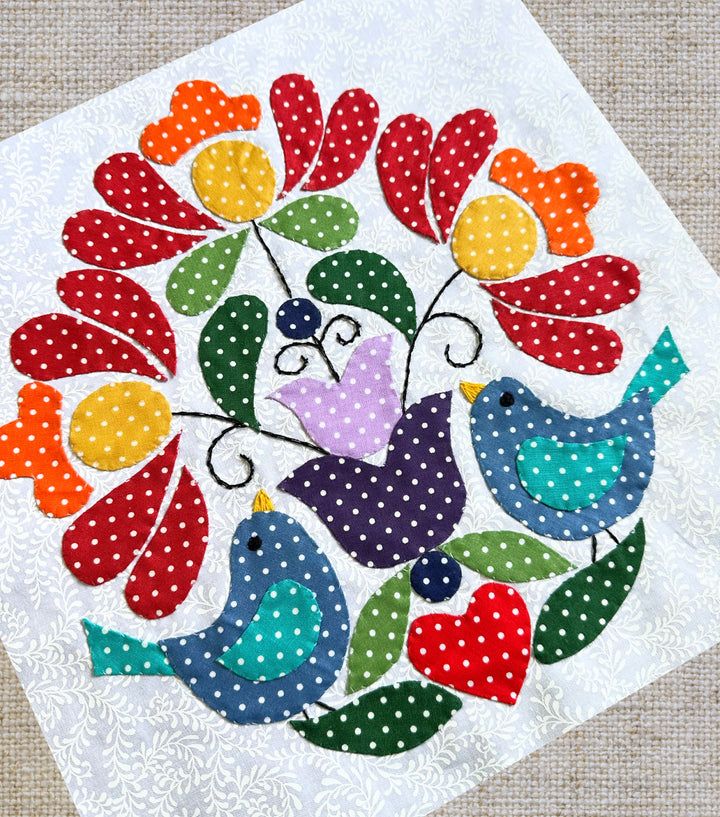
Quilt Block with Pennsylvania Dutch Style Bird and Flower Appliqué Pattern is a cheerful textile project that combines folk-art charm, colorful fabric shapes, decorative stitching, and the warm personality associated with traditional appliqué quilting. Inspired by the visual language often seen in Pennsylvania Dutch decorative arts, this block features stylized birds, flowers, leaves, hearts, and flowing stems arranged in a balanced composition. The beauty of the project comes from its simplicity: each individual shape is easy to recognize and relatively uncomplicated to sew, yet when the pieces are assembled together they create a detailed and lively design. For quilters who enjoy working with small fabric scraps, this type of block is especially rewarding because it allows many colors and prints to be combined without requiring large amounts of material. Polka dots, tiny florals, tone-on-tone fabrics, and solid cottons can all work beautifully. The finished block can become a wall hanging, cushion front, table topper, quilt center, tote panel, or part of a larger folk-inspired quilt.
The term Pennsylvania Dutch style appliqué generally refers to decorative motifs influenced by the folk-art traditions associated with Pennsylvania German communities. Flowers, birds, hearts, tulip-like shapes, leaves, curves, and symmetrical arrangements frequently appear in this visual style. For this project, the goal is not to reproduce a historical artifact exactly, but to use those recognizable design principles in a modern handmade quilt block. The birds provide movement and personality, while the flowers frame the composition and help guide the viewer’s eye around the design. Small hearts and circular details add additional interest. Because the shapes are made from contrasting fabrics, the project becomes a wonderful opportunity to experiment with color coordination, fabric appliqué, and decorative hand or machine stitching while still creating a block that feels cohesive.
Another advantage of the Quilt Block with Pennsylvania Dutch Style Bird and Flower Appliqué Pattern is its flexibility. You do not need to use exactly the same prints or colors shown in the inspiration image. A red, green, yellow, blue, purple, and turquoise palette creates a lively folk-art appearance, but softer pastels could produce a romantic version, while deeper burgundy, mustard, navy, and forest green fabrics could create a more traditional country look. The most important principle is contrast. The appliqué shapes should remain clearly visible against the background fabric, and neighboring pieces should be different enough in value or color to keep the design readable. Throughout this tutorial, we will explore how to prepare the block, make the appliqué templates, arrange the birds and flowers, sew each component, and complete the quilting so that even someone approaching this style for the first time can confidently create a beautiful finished piece.
Materials, Fabric Choices, and Preparing the Appliqué Templates
Begin by choosing a background fabric for your Pennsylvania Dutch style quilt block. A white, ivory, cream, or very pale patterned quilting cotton works particularly well because it provides enough visual contrast for brightly colored appliqué pieces. Cut a square approximately 40 x 40 cm for a comfortable working area. You may trim the block later after the appliqué and quilting are finished. Starting slightly oversized helps prevent problems if the fabric contracts a little during stitching or pressing.
DISCOVER MORE FREE PATTERNS HERE!
For the appliqué pieces, gather several coordinating cotton fabrics. Scraps measuring approximately 10 x 15 cm are usually enough for most individual shapes. Choose red for flower petals or hearts, green for leaves, yellow for flower centers, blue or navy for birds, turquoise for wings, purple for a central decorative element, and orange for additional flower accents. Small-scale polka-dot fabric works especially well because the repeated dots give the project a playful handcrafted appearance without overwhelming the shapes.
Next, prepare paper templates for the main components. You will need several elongated flower petals, rounded flower centers, leaf shapes, bird bodies, bird wings, small circles, hearts, and a central tulip-like flower. The birds can be approximately 12 to 15 cm long from chest to tail, while the larger flower petals may measure approximately 7 to 9 cm. Leaves can range between 6 and 10 cm long. These measurements are flexible because folk-art appliqué often looks more natural when shapes are slightly varied rather than perfectly identical.
Trace each template onto the paper side of fusible web if you plan to use fusible appliqué. Remember that fused shapes will appear reversed after application, so reverse any directional pieces when necessary. Cut loosely around each traced shape, leaving a few millimeters of extra fusible web around the drawing. Iron the fusible web onto the wrong side of the selected fabric following the manufacturer’s heat recommendations, then allow it to cool before cutting directly on the traced lines.
If you prefer traditional needle-turn appliqué, add a seam allowance of approximately 5 to 7 mm around each template instead of using fusible web. The raw edge will later be turned underneath while stitching. This method creates an elegant traditional finish, but it requires more time and hand-sewing experience. Beginners may find raw-edge fusible appliqué more approachable because the pieces remain stable while the block is assembled.
Before attaching anything permanently, arrange every fabric shape on the background. Place the birds near the lower and right portions of the block, then position the flowers around the upper and left edges. Add green leaves between the major motifs and keep enough open background space to prevent the design from looking crowded. Take a photograph of the arrangement before removing any pieces. This simple step gives you a visual reference when you begin fusing or sewing the appliqué in place.
Building the Bird, Flower, Heart, and Leaf Appliqué Design
Start with the larger flower motifs because they establish the outer structure of the Quilt Block with Pennsylvania Dutch Style Bird and Flower Appliqué Pattern. Arrange clusters of elongated petals around circular yellow centers. In the inspiration design, red petals create strong contrast while orange shapes add extra brightness. Allow small sections of the background to show between some petals so that the individual components remain distinct and the flowers do not become one solid mass of color.
Once the flowers are positioned, place the green leaves around them. Use more than one shade of green to create depth. Alternating medium and dark green fabrics can make a simple leaf arrangement feel much richer. Leaves do not need to match perfectly. Slight differences in size, angle, and color support the informal folk-art character of the design. Keep the tips of some leaves pointing toward the center so they naturally guide attention toward the birds.
The bird appliqués are the visual stars of this quilt block. Use a rounded body shape with a slightly raised tail and a compact head. Add a contrasting wing shape to each bird. A dark blue body paired with turquoise wings provides beautiful contrast, but many other combinations will work. Small black circles or embroidered knots can form the eyes, while tiny yellow or orange triangular shapes can represent the beaks.
Place the birds so that they appear to interact with one another rather than simply sitting in a straight row. One can face inward while another angles upward or toward the center of the block. This creates movement and makes the composition feel more natural. When positioning the birds, leave enough room for decorative stems and curls between them. These thin stitched lines are small details, but they contribute greatly to the traditional folk-inspired personality of the project.
Add a red heart near the lower portion of the composition and a purple or lavender tulip-inspired flower toward the center. The heart appliqué motif is particularly suitable for folk-style quilting because it adds warmth and creates a recognizable focal point. Keep the heart relatively small compared with the birds so that it complements them rather than competing for attention. A small circular fabric detail above the heart can connect the surrounding leaves and provide another pop of contrast.
When you are satisfied with the entire arrangement, fuse or baste the pieces into position. Work gradually from the shapes that appear underneath toward those that overlap them. For example, stems should usually be stitched or marked before large foreground pieces cover their ends. Press fused appliqué with an up-and-down motion instead of sliding the iron across the fabric. Sliding can shift small pieces out of alignment. Once everything is secure, allow the block to cool completely before beginning the edge stitching.
Appliqué Stitching, Decorative Details, and Pennsylvania Dutch Style Character
One of the most attractive features of this project is the visible stitching surrounding the appliqué pieces. A simple blanket stitch, zigzag stitch, satin stitch, or narrow straight stitch can all be used depending on the appearance you prefer. Blanket stitch appliqué gives a particularly charming handmade finish and helps emphasize the outline of every colorful shape. Choose thread that either blends with each fabric or contrasts slightly for a more decorative effect.
If using a sewing machine, test the stitch on scrap fabric before starting on the actual block. A stitch length of approximately 2 to 2.5 mm is a good starting point for straight stitching, while blanket and zigzag settings will depend on your machine. Sew slowly around tight curves. When changing direction, stop with the needle down, lift the presser foot, pivot the fabric slightly, lower the foot, and continue sewing. This technique creates smoother outlines around leaves, petals, hearts, and wings.
Hand stitching is another beautiful option for this bird and flower appliqué pattern. Small blanket stitches worked with embroidery floss can give the project a charming folk-art texture. Use two or three strands of embroidery floss and keep the stitches reasonably consistent. They do not need to look mechanically perfect. Slight handmade variations often enhance the character of folk-style textile work.
After securing the fabric shapes, add the narrow stems and decorative curls. These can be created with embroidery thread using a stem stitch, backstitch, or chain stitch. Black or very dark brown thread provides excellent visibility against a pale background and echoes the bold outlines often associated with traditional folk decoration. Draw the curves lightly with an erasable fabric marker before stitching so that you can maintain smooth flowing lines.
The facial details of the birds can also be embroidered. A French knot or small satin-stitched circle works nicely for the eye. The beak may be appliquéd from a tiny triangle of yellow fabric or embroidered with several closely packed stitches. Because these elements are small, simple treatment is best. Too much detail can distract from the clean graphic quality that makes the Pennsylvania Dutch style bird appliqué so appealing.
After all appliqué stitching and embroidery are complete, inspect the block carefully. Clip loose threads and check that every raw edge is secured. If any fused section has lifted, press it again according to the fusible manufacturer’s instructions before quilting. Give the block a gentle press from the back using a pressing cloth when necessary. Avoid excessively high heat over delicate embroidery or synthetic threads. At this stage, the entire folk-art composition should look balanced, colorful, and ready to become a quilted piece.
Quilting, Finishing the Block, and Creative Ways to Use the Pattern
To turn the appliqué top into a finished quilt block, create a traditional quilt sandwich using the appliquéd top, batting, and backing fabric. Cut the batting and backing approximately 3 to 5 cm larger than the appliqué block on every side. Place the backing wrong side up, position the batting on top, and finally place the appliquéd block right side up. Smooth all three layers carefully to remove wrinkles before basting.
Baste the sandwich using curved safety pins, temporary basting spray, or long hand-basting stitches. Start near the center and work outward so that the layers remain smooth. Because the design contains many small appliqué elements, place the basting points around the motifs rather than directly through delicate embroidery whenever possible. Good basting helps prevent puckers while quilting and produces a cleaner professional-looking finish.
For quilting, one of the easiest options is to stitch around the major appliqué shapes. This technique, often called outline quilting, emphasizes the birds, flowers, hearts, and leaves while securing all three layers. Stitch approximately 2 to 4 mm outside each appliqué edge. You can also quilt inside larger shapes by following the outline of a wing or flower center. This subtle dimension makes the appliqué stand slightly above the background.
The open background areas may be quilted with gentle curves, leaves, loops, or a simple meandering pattern. If you are new to free-motion quilting, straight or gently curved lines are perfectly suitable. The objective is not to cover every centimeter with complicated quilting. The colorful appliqué should remain the main attraction. Balanced quilting across the block will help the surface lie flat and create the soft texture associated with a finished quilt.
After quilting, square the block using a quilting ruler and rotary cutter. Trim it to your chosen final dimension, such as approximately 35 x 35 cm or another size suitable for your project. If you want to transform it into a small wall hanging or table topper, add binding around the outside edge. A coordinating red, green, blue, or multicolored binding can frame the design beautifully. For a cushion, use the finished quilted block as the front panel and attach your preferred envelope or zipper backing.
The completed Quilt Block with Pennsylvania Dutch Style Bird and Flower Appliqué Pattern can also serve as inspiration for many variations. Create several blocks using different color palettes and join them into a full quilt. Enlarge a single bird and flower grouping for a wall hanging. Use only the bird motif on placemats, tote bags, or cushion covers. The versatility of appliqué makes this pattern especially useful because individual elements can be rearranged, resized, repeated, or combined with other traditional quilt blocks.
Frequently Asked Questions
What is a Quilt Block with Pennsylvania Dutch Style Bird and Flower Appliqué Pattern?
It is a decorative quilt block featuring stylized folk-art motifs such as birds, flowers, hearts, leaves, and curved stems. The pieces are created from contrasting fabrics and attached to a background using appliqué techniques. The Pennsylvania Dutch influence is reflected mainly in the balanced arrangement, vivid colors, floral imagery, and simplified decorative shapes.
Is this appliqué pattern suitable for beginners?
Yes. Beginners can simplify the project by using fusible web and machine stitching. Fusible appliqué holds the pieces securely in position before sewing, making it easier to manage small shapes. More experienced quilters can use needle-turn appliqué or hand blanket stitching for a traditional appearance.
What fabric is best for this quilt block?
Quilting cotton is an excellent choice because it is stable, easy to cut, and available in countless colors and prints. Small-scale polka dots, tiny florals, tone-on-tone prints, and solid fabrics all work especially well for folk art appliqué quilting.
Do I need to use the same colors shown in the project?
No. The colors can be completely customized. The most important consideration is contrast between the background and the appliqué pieces. Bright primary colors create a playful design, while earthy shades can produce a more traditional country-style appearance.
Should appliqué pieces be sewn by hand or machine?
Either technique works. Machine stitching is faster and provides strong edges, while hand appliqué creates a softer handcrafted finish. Some quilters combine the two methods by machine-stitching the main shapes and hand-embroidering smaller decorative details.
How do I stop appliqué edges from fraying?
Fusible web combined with blanket stitch or zigzag stitching helps stabilize raw edges. For completely enclosed edges, needle-turn appliqué is another excellent option because the seam allowance is folded beneath the shape before stitching.
Can I enlarge or reduce the pattern?
Yes. The birds, flowers, leaves, and hearts can be resized to fit different projects. When enlarging the design, remember to increase the surrounding background proportionally so the composition maintains enough negative space.
Can this block be used for something other than a quilt?
Absolutely. A finished bird and flower appliqué block can become a cushion cover, tote bag front, wall hanging, table topper, framed textile artwork, or decorative panel. Individual motifs can also be used separately for smaller sewing projects.
How should I quilt around the appliqué?
Outline quilting is one of the simplest and most effective options. Stitch close to the outside of each appliqué shape to emphasize its silhouette. Additional quilting can be added in the background using loops, curves, leaves, or gentle meandering lines.
Why are birds, hearts, and flowers commonly combined in folk-style appliqué?
These shapes create a visually harmonious composition and have long been popular elements in decorative folk traditions. In modern quilting, they remain popular because they are recognizable, adaptable, colorful, and easy to personalize through fabric selection and placement.
Conclusion
Creating a Quilt Block with Pennsylvania Dutch Style Bird and Flower Appliqué Pattern is a rewarding way to explore colorful appliqué while producing a piece filled with folk-inspired character. Throughout this tutorial, we covered how to choose a suitable background, coordinate contrasting fabrics, prepare bird, flower, leaf, heart, and decorative templates, arrange the composition, secure the appliqué pieces, stitch around the edges, add embroidered details, assemble the quilt sandwich, and complete the final quilting.
The most important lesson is that this project does not depend on perfect repetition. Its charm comes from the combination of recognizable shapes, expressive colors, careful stitching, and the individual choices made by the quilter. Small variations in petals, leaves, birds, and decorative lines can make the finished block feel even more personal and handmade.
EASILY FIND THE PDF FOR THIS PATTERN HERE!
Once you understand the basic construction process, the Quilt Block with Pennsylvania Dutch Style Bird and Flower Appliqué Pattern can be adapted into countless creative projects. Try changing the fabric palette, rearranging the flowers, creating different bird combinations, or enlarging selected motifs for cushions and wall hangings. Each variation offers another opportunity to experiment with quilting, fabric appliqué, folk art design, and decorative stitching. If you create your own version of this pattern, leave your sincere opinion about the project and share your suggestions. Which colors would you choose for the birds and flowers? Would you prefer hand appliqué or machine stitching? Your ideas and creative variations can inspire new ways to interpret this cheerful quilt design.