
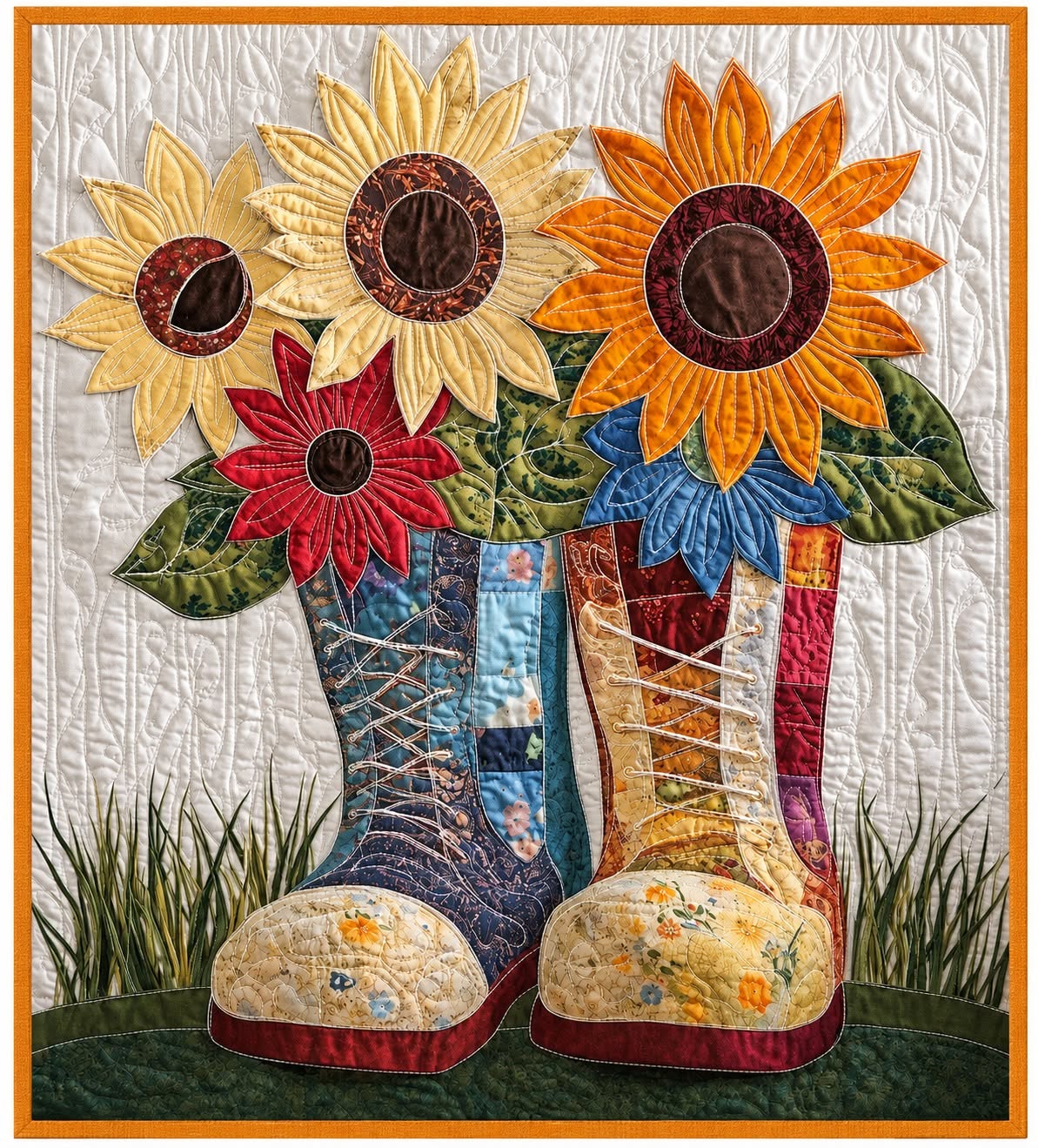
The Boots with Sunflowers Patchwork Panel Pattern is a cheerful textile project that brings together the warmth of a country garden and the creative personality of traditional patchwork. Inspired by the image, the design features a pair of richly decorated boots surrounded by oversized sunflowers, colorful leaves, smaller blossoms, grass, and a softly quilted background. What makes this project especially appealing is the combination of recognizable shapes with many different fabric textures. Instead of depending on complicated piecing alone, the composition can be built gradually with fabric appliqué, layered pieces, decorative stitching, and quilting, making every section an opportunity to experiment with color and texture.
A successful Boots with Sunflowers Patchwork Panel Pattern begins with planning rather than sewing. Look carefully at the composition and divide it into visual layers: background, grass, boots, leaves, flowers, and smaller decorative details. This approach makes the project much easier to organize because each element can be prepared separately before the final assembly. The boots are the main focal point and should have enough contrast to stand clearly against the background, while the sunflowers create height and movement above them. Scraps of cotton fabric are especially useful because the variation between prints helps reproduce the wonderfully handmade appearance associated with scrap quilting and artistic textile panels.
Another important feature of this project is that perfection is not the goal. Slight variations in prints, stitching, flower shapes, and patch placement can actually make the finished panel more interesting. The original inspiration has a wonderfully organic character, with different fabrics appearing throughout the boots and flowers. You can follow the same general composition while choosing fabrics from your own collection. This makes the Boots with Sunflowers Patchwork Panel Pattern suitable for anyone who enjoys turning leftover quilting cotton into decorative art while practicing useful techniques such as raw-edge appliqué, layered appliqué, decorative quilting, and fabric collage.
Materials, Fabric Selection, and Preparing the Patchwork Panel
Begin by selecting a sturdy cotton fabric for the background. A cream, ivory, beige, or very pale neutral works particularly well because it allows the colorful boots and flowers to remain the center of attention. Cut the background several centimeters larger than your intended finished panel. The extra fabric gives you room for quilting and final trimming, since quilted fabric can sometimes draw inward slightly during stitching.
DISCOVER MORE FREE PATTERNS HERE!
For the boots, collect a varied assortment of patchwork fabric scraps. Blues, turquoise, burgundy, brown, red, cream, and muted floral prints work beautifully together. You do not need large pieces. In fact, smaller scraps can make the boots more visually interesting because they allow you to create the irregular patchwork effect visible in the inspiration. Coordinate the fabrics without making them identical.
The sunflowers require several values of yellow and orange fabric. Pale buttery yellow can be used for the lighter flowers, while golden yellow, amber, pumpkin, and orange can create the stronger sunflower on the opposite side. For the flower centers, choose dark brown, burgundy, chocolate, or deep patterned fabric. Combining two fabrics within a flower center can produce additional depth.
Next, prepare green scraps for the leaves and grass. Try using several shades rather than one solid green. Olive, forest green, moss, sage, and patterned botanical fabrics can all work together. The variety helps the foliage look more dimensional. Blue fabric can also be introduced into smaller flowers or shadow areas to balance the warm colors of the sunflowers.
Useful supplies include quilting cotton, lightweight fusible web, fabric scissors, paper scissors, an iron, coordinating thread, batting, backing fabric, pins or temporary fabric adhesive, a sewing machine, and a quilting needle. Decorative threads can be added if you want the stitching around individual shapes to become a visible part of the artwork. Always follow the manufacturer’s directions when using fusible products and heated tools.
Before cutting expensive or favorite fabric, draw or trace the major shapes onto paper. Separate the design into manageable templates such as boot shaft, boot toe, sole, heel, sunflower petals, flower centers, leaves, and smaller flowers. Label every template clearly. This simple preparation prevents confusion when dozens of colorful pieces are waiting to be assembled.
Creating the Boots and Building the Main Appliqué Design
Start the Boots with Sunflowers Patchwork Panel Pattern with the two boots because they establish the scale of the entire composition. Draw two tall boot silhouettes on paper. They can be approximately 24–30 cm tall for a medium decorative panel, although the measurements can be adjusted proportionally. Give each boot a broad rounded toe, defined sole, narrow ankle, and taller upper section.
Instead of cutting each boot from one fabric, divide the silhouette into multiple sections. Create irregular rectangular, curved, and vertical patches to imitate a scrappy patchwork boot. Arrange the pieces directly over your paper template before sewing or fusing anything. Move the colors around until neighboring fabrics have enough contrast. One boot can lean toward blue tones while the other emphasizes warm browns and reds.
Join the smaller pieces into larger boot sections using approximately a 0.6 cm seam allowance when traditional piecing is practical. For very irregular sections, fabric collage appliqué may be easier. Attach lightweight fusible web to the back of each fabric, cut the desired shapes, and overlap them slightly. Once satisfied with the arrangement, fuse them according to the product instructions.
The toe sections provide another opportunity for decorative fabric. A pale floral print, small-scale botanical fabric, or vintage-inspired cotton can contrast beautifully with the darker shafts. Add a darker strip along the sole to define the bottom edge. This visual separation makes the boots easier to recognize from a distance and gives them a more substantial appearance.
One of the most distinctive details is the suggestion of laces across the front. These can be created using narrow fabric strips, embroidery thread, decorative cord, or dense machine stitching. Position the laces diagonally in alternating directions so they cross over the central area. Secure everything firmly because these details will attract attention in the finished patchwork wall panel.
Once both boots are complete, position them near the lower center of the background. They should overlap the future grass area slightly and leave enough space above for the sunflower arrangement. Do not permanently attach every surrounding element yet. First place the boots, then use temporary positioning to test the flowers and leaves. Taking a photograph of the arrangement can help you evaluate the balance before sewing.
Making the Sunflowers, Leaves, Grass, and Decorative Details
The sunflowers are the dramatic feature that gives the Boots with Sunflowers Patchwork Panel Pattern its joyful garden character. Create several flower sizes rather than repeating one identical template. A large sunflower can measure approximately 18–22 cm across, while smaller flowers can range from about 10–16 cm. Adjust these dimensions according to the final size of your panel.
For each sunflower, prepare individual elongated petals with pointed or gently rounded tips. Layering petals produces a fuller appearance. Place the first row around the center, then add another row behind or between those petals. Alternating pale yellow and golden fabrics can give a flower natural variation without requiring complicated shading techniques.
Create the flower centers from circles of brown or burgundy fabric. For additional detail, make the center from two concentric circles: a larger patterned outer ring and a smaller dark inner circle. Stitch around both layers. Decorative free-motion stitching, small curves, or repeated lines can suggest the textured seed pattern found in real sunflower heads without needing to reproduce every seed individually.
Prepare leaves using several green fabrics. Some leaves can be large and pointed, while others may be smaller and partially hidden behind flowers. Stitching a central vein and several smaller side veins adds definition. Free-motion quilting is particularly useful here because the stitched lines become both structural and decorative.
The grass at the bottom can be created with narrow fabric shapes, machine embroidery, or free-motion stitching. Mix different heights and directions so the grass does not appear mechanically uniform. Dark and medium green threads can create depth, but even a single coordinating thread can work when the lines overlap naturally. Keep the densest grass near the boots and gradually reduce it toward the sides.
Now arrange all floral elements behind and above the boots. Place larger flowers higher in the composition and use smaller blossoms to fill visual gaps. Tuck leaves partially behind the flowers and boots to create overlapping layers. When you are satisfied with the arrangement, secure the pieces and stitch around them using blanket stitch, narrow zigzag, straight stitching, or another preferred appliqué method.
Quilting, Finishing, and Displaying Your Fabric Art
After the appliqué is completed, prepare the quilt sandwich. Place the backing fabric wrong side upward, position the batting over it, and center the decorated quilt top on the batting. Smooth all three layers carefully to remove wrinkles. Baste with quilting pins, temporary adhesive, or your preferred method so the layers remain stable during quilting.
Begin quilting around the major appliqué shapes. This technique is sometimes called outline quilting and helps emphasize the boots, flowers, petals, and leaves. Stitching close to the edges creates subtle dimension because the batting around each shape compresses while the appliqué remains slightly raised. Work gradually from the center outward to minimize distortion.
Next, quilt the background. The inspiration shows flowing vertical and organic stitched lines that contrast nicely with the structured appliqué. You can recreate this feeling with gentle curves, vines, loops, elongated waves, or free-motion patterns. Avoid making every line identical. Slight variations reinforce the handmade character of the quilted fabric panel.
Additional quilting can be added inside the boots. Follow patchwork seams, outline individual fabric sections, or stitch decorative motifs into larger areas. The flower petals can receive central stitched lines that resemble natural veins. These small details help unify the project because quilting becomes part of the illustration rather than merely a method for holding the layers together.
Once quilting is complete, place the panel on a flat surface and carefully square the edges. Trim away excess backing and batting. Add a narrow binding using a fabric that complements the composition. Burgundy, deep green, brown, or another color already present in the design can frame the artwork without competing with the central motifs.
Finally, press the finished project carefully according to the requirements of the fabrics and fusible materials you used. The completed Boots with Sunflowers Patchwork Panel Pattern can become wall décor, the center of a larger quilt, a decorative textile panel, or even the starting point for another handmade project. A hanging sleeve can be added to the back if you intend to display the piece as quilted wall art.
FAQ About the Boots with Sunflowers Patchwork Panel Pattern
Is the Boots with Sunflowers Patchwork Panel Pattern suitable for beginners?
Yes, especially if the design is approached one section at a time. Beginners can simplify the number of fabric patches and use fusible appliqué rather than complex traditional piecing. More experienced quilters can add detailed free-motion quilting, decorative stitching, and additional fabric layers.
What type of fabric is best for this patchwork project?
Good-quality quilting cotton is one of the easiest options because it is stable, widely available, and easy to combine. Cotton scraps are particularly useful for the boots, leaves, and flowers because the design benefits from having many different prints and colors.
Can I make the project entirely from fabric scraps?
Most of the decorative design can certainly be created from scraps. The background, batting, and backing will normally require larger pieces. Using scraps for the appliqué makes this project an excellent example of scrap quilting and gives every finished version its own personality.
Do I need fusible web for the appliqué?
No, but it can make positioning much easier. Fusible web temporarily or permanently stabilizes the pieces before edge stitching. Traditional needle-turn appliqué or other preferred appliqué techniques can also be used if you already have experience with them.
What stitch should I use around the sunflower petals?
A blanket stitch is a popular decorative option, while a narrow zigzag provides strong coverage along raw edges. Straight stitching near the edge creates a more relaxed raw-edge appliqué appearance. Choose the technique that matches the finish you want.
How can I make the boots look more dimensional?
Use contrasting fabric values, darker soles, lighter toe sections, overlapping patches, decorative laces, and quilting around the outer silhouette. These details create visual separation and help the boots stand forward from the background.
Can the pattern be enlarged or reduced?
Yes. Keep all elements proportional when resizing the design. If the boots are enlarged significantly, increase the flowers and leaves at approximately the same ratio so the composition remains balanced.
What is the difference between patchwork and appliqué in this project?
Patchwork generally refers to joining smaller pieces of fabric to create a larger unit, such as the multicolored sections forming the boots. Appliqué involves placing shaped fabric pieces on top of a background, as with the sunflower petals, leaves, and complete boot silhouettes.
Is free-motion quilting necessary?
No. A regular sewing machine with a walking foot can produce beautiful straight lines, gentle curves, and outline quilting. Free-motion quilting simply offers greater freedom for organic grass, leaf veins, background textures, and decorative details.
How should I choose colors for the Boots with Sunflowers Patchwork Panel Pattern?
Begin with the recognizable sunflower palette of yellow, orange, brown, and green, then introduce blues, reds, turquoise, burgundy, and floral neutrals into the boots. Repeating a few colors in different parts of the panel helps create visual harmony.
Can this design be used as part of a larger quilt?
Absolutely. The completed panel can become the center block of a larger quilt. Additional patchwork borders, floral blocks, log cabin sections, or simple fabric strips can be added around it to increase the final dimensions.
How do I keep small appliqué pieces from shifting while sewing?
Fusible web, appliqué glue, temporary fabric adhesive, or careful pinning can help. Work slowly and secure one section before moving to another. Preparing the entire arrangement before permanent stitching also reduces the need to reposition pieces later.
Conclusion
Creating the Boots with Sunflowers Patchwork Panel Pattern is a wonderful way to combine patchwork, fabric appliqué, scrap quilting, decorative stitching, and free-motion quilting in one expressive textile project. The process begins with a neutral background and carefully planned templates, continues with colorful patchwork boots, and gradually grows into a garden composition filled with sunflowers, leaves, smaller blossoms, and stitched grass.
The most important lesson is to build the artwork in layers. Construct the boots first, prepare the flowers and foliage separately, test the complete arrangement, secure the appliqué, and only then move on to the final quilting. This organized sequence makes a visually detailed project much easier to manage and gives you opportunities to make adjustments before anything becomes permanent.
Color and texture are equally important. Mixing floral cottons, small prints, warm sunflower shades, deep browns, varied greens, blues, reds, and burgundy tones creates the lively handmade appearance that makes this design special. Decorative stitching then adds definition to the petals, leaves, boot patches, laces, and background while helping transform ordinary fabric scraps into dimensional textile art.
EASILY FIND THE FREE PDF FOR THIS PATTERN HERE!
Whether you keep the finished piece as a patchwork wall hanging, incorporate it into a larger quilt, or adapt the composition for another sewing project, the techniques learned here can be reused in countless future designs. Most importantly, allow your own fabric collection and creativity to influence the final result rather than trying to make every detail perfectly identical. If you make your own Boots with Sunflowers Patchwork Panel Pattern, leave your sincere opinion about the project and share your suggestions. Which colors would you choose for the boots, and what details would you add to make this cheerful sunflower patchwork design uniquely yours?