
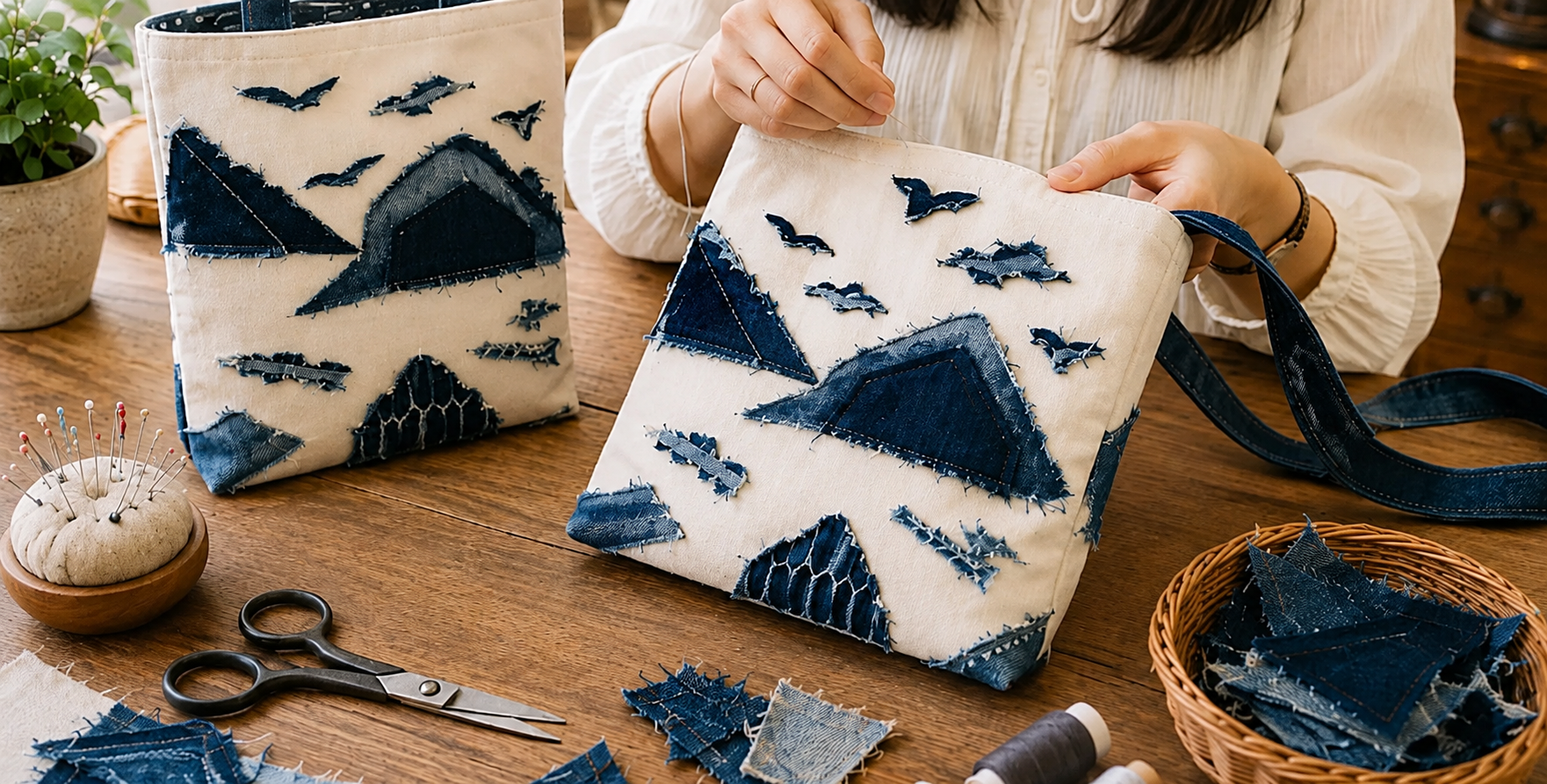
The Patchwork bag made from old jeans Pattern is a creative way to transform worn denim into a practical accessory while giving leftover fabric a completely new purpose. Inspired by the handmade bag shown in the image, this project combines a light neutral fabric base with dark and medium-blue denim scraps arranged as mountains, birds, and small decorative patches. The contrast between the cream-colored background and the different shades of recycled jeans gives the bag a charming rustic appearance that feels intentionally handmade rather than overly perfect. Exposed fabric edges are part of the visual character, allowing the denim to fray slightly and create texture after sewing. Because most of the decoration is created from irregular scraps, you do not need large pieces of denim or advanced patchwork equipment. It is an approachable project for anyone who enjoys recycled denim sewing, patchwork, appliqué, and useful handmade accessories.
One of the most appealing features of the Patchwork bag made from old jeans Pattern is that every finished bag can look different. Old jeans naturally provide several shades of blue, especially when you combine faded knees, darker seams, pockets, waistbands, and interior sections of the fabric. Instead of trying to make every appliqué identical, the design benefits from slight variations in size and shape. The mountain shapes in the photographed project use layered triangular denim pieces, while smaller irregular scraps suggest distant landscape details and flying birds. Decorative stitching keeps these pieces attached while emphasizing their rough edges. This technique is often described as raw-edge appliqué, because the edges are intentionally left unfinished rather than folded underneath. As the project is used, subtle fraying can add even more personality to the surface.
The finished piece can function as a shoulder bag, project bag, casual tote, or everyday handmade purse depending on the dimensions and strap length you choose. For a medium version inspired by the photograph, a finished size of approximately 32 cm wide by 28 cm high works well, although the pattern can easily be enlarged or reduced. A sturdy cotton canvas, duck cloth, or heavyweight cotton makes a reliable foundation because denim appliqués add some weight to the exterior. A lining makes the inside cleaner and protects the decorative stitches, while interfacing or batting can provide additional structure when desired. Most importantly, this project encourages thoughtful reuse: instead of discarding old jeans because of worn knees or damaged hems, you can cut around those areas and save the strongest sections. That combination of creativity, functionality, and material reuse is what makes a Patchwork bag made from old jeans Pattern especially satisfying.
Choosing Fabrics and Preparing the Recycled Denim
Begin by selecting one or two pairs of old jeans in different blue tones. Medium and dark denim create strong contrast, while faded denim is useful for highlights and secondary shapes. Wash and dry all recycled jeans before cutting so that dirt, shrinkage, and loose fibers are removed. Jeans containing a small percentage of stretch fiber can still work, but traditional non-stretch denim is generally easier to control when creating appliqué shapes.
DISCOVER MORE FREE PATTERNS HERE!
For the main bag, cut two rectangles of sturdy neutral fabric approximately 35 cm wide by 31 cm high. These measurements include seam allowances and should produce a finished bag close to 32 cm by 28 cm. You will also need two matching lining rectangles. If you prefer a softer but structured bag, add medium-weight interfacing to the exterior pieces before beginning the decorative work.
Next, open the jeans by cutting along the inner leg seams and removing bulky sections that are difficult to flatten. Do not immediately throw away pockets, hems, or waistbands because they can become decorative details in future projects. Press the usable denim sections with an iron so they lie flat before tracing your denim patchwork pieces. Preparing the fabric carefully at this stage makes later stitching much easier.
To reproduce the landscape look from the image, cut several triangles in different sizes for the mountain design. A large mountain can measure approximately 16 to 20 cm across the base and 10 to 13 cm high, while smaller background mountains can measure around 8 to 12 cm wide. Layer dark denim over lighter denim so that the lower layer remains visible around portions of the edges, creating depth.
For the birds, begin with very simple silhouettes. You do not need detailed bird templates; two shallow curved or pointed wing shapes connected in the center are enough to suggest a bird flying in the distance. Cut some birds around 3 cm wide and others up to approximately 6 cm wide. Using different sizes will make the composition look more natural and visually interesting.
Finally, save irregular denim scraps measuring roughly 2 to 7 cm. These can be placed around the larger mountain appliqués to resemble distant landscape fragments, abstract clouds, shadows, or decorative marks. This is one of the advantages of a recycled jeans bag: even unusually shaped pieces can become useful design elements instead of waste.
Creating the Raw-Edge Denim Patchwork Design
Before sewing anything permanently, position the main exterior panel flat on your work surface and experiment with the composition. Place the largest mountain slightly below the center rather than exactly in the middle. Add a second or third mountain toward one side, then distribute the bird shapes above them. Leaving open areas of neutral fabric prevents the design from becoming visually crowded.
When you are satisfied with the arrangement, temporarily secure the appliqués. Fabric glue designed for sewing, fusible web, or a small amount of washable glue can help prevent movement. Pins are also possible, although multiple tiny denim shapes can become difficult to manage with many pins. The objective is simply to hold each piece still until the permanent stitching is completed.
The distinctive handmade appearance comes from raw-edge denim appliqué. Sew approximately 2 to 4 mm inside the edge of each denim piece using a straight stitch. You can intentionally allow small threads to remain visible around the edges. Denim naturally frays, so the surface will gradually develop a soft textured border that complements the recycled aesthetic.
Use contrasting thread when you want the stitching to become part of the decoration. Cream, gray, light blue, or even gold-toned thread can look attractive against dark denim. For a more discreet result, use navy thread. Sew slowly around corners and points, stopping with the needle down whenever you need to rotate the fabric.
Layered mountains benefit from additional decorative stitching. After attaching the lower triangle, position a smaller darker triangle on top and sew around it. You can also add one or two diagonal seams across the mountains to suggest slopes. These lines do not need to be perfectly symmetrical; small differences reinforce the handmade quality of the Patchwork bag made from old jeans Pattern.
Once the main motifs are attached, add the smaller denim fragments. Avoid filling every empty area. Instead, place a few pieces near the lower corners, around the mountains, and between some of the birds. When the entire panel is finished, gently rub the raw edges with your fingers to loosen a few threads, then trim only excessively long strands. The objective is controlled texture rather than a completely finished appliqué edge.
Sewing the Bag Body, Lining, and Denim Strap
After completing the exterior artwork, place the two outer bag panels with right sides facing each other. Pin or clip along both sides and the bottom, leaving the top edge open. Sew with approximately a 1.5 cm seam allowance. Because denim appliqués can create thicker areas, use a strong universal or denim needle and reduce your sewing speed when crossing bulky seams.
To create a slightly dimensional base similar to a casual shoulder bag, box the lower corners. With the bag still inside out, flatten each bottom corner so that the side seam aligns with the bottom seam. Mark a line approximately 3 to 4 cm from the point and sew across it. Trim away the excess corner fabric, leaving about a 1 cm seam allowance.
Construct the lining in the same way, but leave an opening of approximately 10 cm in the bottom seam. This opening will later allow you to turn the entire project right side out. If you want an interior pocket, attach it before assembling the lining. A simple rectangle approximately 18 cm wide by 15 cm high is sufficient for small sewing tools, keys, or a phone.
The shoulder strap can also be made from the old jeans. For a comfortable crossbody-style strap, join denim strips until you have a piece approximately 110 to 125 cm long and 8 cm wide. Fold both long edges toward the center, then fold the entire strip in half so the raw edges remain inside. Topstitch along both long sides to produce a finished strap about 3 cm wide.
If your available jeans scraps are too short for one continuous strap, joining several strips can actually enhance the recycled appearance. Sew the pieces together with diagonal seams rather than straight horizontal seams whenever possible. Press the joins open before folding the strap. This distributes the bulk and creates a cleaner finished result.
Position each end of the strap at the upper side seams of the exterior bag, with the strap hanging downward against the bag body. Baste it securely in place. Put the exterior bag inside the lining so that their right sides are facing, align the top edges, and sew completely around the opening. Turn the bag through the opening left in the lining, close that opening with a narrow machine stitch or invisible hand stitching, then topstitch around the upper edge for a crisp finish.
Finishing Details, Care, and Creative Variations
After turning the project, press the upper edge carefully. Denim can react differently to heat depending on its fiber content, so test the iron temperature on a leftover scrap first. Topstitch approximately 3 to 5 mm from the top edge. This final line of stitching helps the lining remain inside the bag and gives the opening a more professional appearance.
Inspect all appliqué pieces before using the bag. If any corners have lifted during construction, secure them with a few additional stitches. You can intentionally add another line of stitching to certain mountains or birds, especially if you want a more visibly quilted aesthetic. Repeated stitching also strengthens areas that may experience frequent contact.
The project does not have to remain limited to a mountain landscape. Once you understand the Patchwork bag made from old jeans Pattern, you can apply the same technique to houses, trees, flowers, cats, stars, hearts, abstract geometric designs, or seaside scenes. The neutral background acts almost like a fabric canvas, while denim scraps become the illustration.
You can also incorporate recognizable parts of the original jeans. A small back pocket can become an exterior pocket on the opposite side of the bag, while a section of waistband can create a decorative loop. Belt loops may be reused as tabs for key rings or small accessories. These details make the history of the recycled material more visible.
For routine care, gentle washing is preferable because excessive agitation can increase fraying around the raw-edge appliqués. Some fraying is expected and contributes to the design, but loose threads can occasionally be trimmed with small scissors. Allowing the bag to air dry can also help preserve its shape, particularly when interfacing or multiple fabric layers have been used.
The most important finishing step is simply to evaluate the balance of the design. A successful denim patchwork bag does not require perfect shapes or mathematically precise placement. The differences between denim shades, irregular edges, visible stitching, and small imperfections are exactly what create its character. What begins as an ordinary pair of worn jeans becomes a completely individual handmade piece.
FAQ – Frequently Asked Questions About the Patchwork bag made from old jeans Pattern
Can beginners make this recycled denim bag?
Yes. The construction uses mostly straight seams and simple appliqué shapes, making it accessible to confident beginners. The decorative pieces do not require perfectly turned edges because the project intentionally uses the raw-edge appliqué technique. Beginners should practice sewing through two or three layers of denim scraps before starting the final panel.
What kind of old jeans work best for patchwork?
Medium-weight cotton denim is usually easiest to sew. Jeans in several shades are particularly useful because they create natural contrast without requiring additional fabrics. Very thick workwear denim can still be used, but it may be better reserved for small appliqués instead of heavily layered sections.
Do I need a special sewing machine for denim?
A standard domestic sewing machine can usually handle this project. The most important adjustment is using an appropriate denim or jeans needle when crossing multiple layers. Sewing slowly and avoiding extremely bulky intersections also reduces skipped stitches and needle breakage.
Should the raw denim edges be finished?
Not for this particular style. The visible frayed edges are an intentional feature of the Patchwork bag made from old jeans Pattern. Stitching a few millimeters inside each edge prevents the entire appliqué from separating while still allowing the outermost fibers to develop texture.
Can I use only denim for the entire bag?
Yes, although a completely denim bag will be heavier. Using a cotton canvas or heavyweight cotton foundation provides contrast and makes the appliqué easier to see. If you prefer an all-denim version, consider using lightweight jeans fabric for the main panels and heavier scraps for selected details.
How large should the finished bag be?
A practical medium bag can measure around 32 cm wide by 28 cm high. However, the same pattern concept works for smaller handbags or larger totes. When changing the dimensions, remember to increase or reduce the mountain and bird motifs proportionally so the composition remains balanced.
Can I add a zipper?
Certainly. A recessed zipper panel can be installed between the exterior and lining, although it adds another construction step. Beginners may prefer an open top, magnetic snap, or simple fabric tie for their first version.
Can the denim pieces be attached with fabric glue instead of sewing?
Glue can temporarily hold the shapes in position, but stitching is recommended for permanent construction. Bags are handled frequently, and sewn appliqués will generally withstand movement and washing better than pieces secured only with adhesive.
Why does the project use several shades of denim?
Different denim values create visual depth. Dark pieces can represent foreground mountains, while faded blue denim can suggest distant peaks, highlights, birds, or small landscape fragments. This natural color variation is one reason old jeans are especially suitable for denim patchwork projects.
How can I keep the bag from becoming too bulky?
Avoid placing several thick denim seams directly on top of one another. Remove original jean seams before cutting appliqués whenever possible, and use lighter sections for layered motifs. Press each construction seam carefully and grade bulky seam allowances if necessary.
Is interfacing necessary?
Not always. Heavy canvas may already provide enough structure. Medium-weight interfacing is helpful when the exterior fabric is relatively soft or when you want the finished bag to stand upright more easily. Lightweight batting can also be used if you prefer a slightly quilted feel.
Can small jeans scraps really be used in this project?
Absolutely. In fact, this is one of the best reasons to make a Patchwork bag made from old jeans Pattern. Tiny scraps that would normally be discarded can become birds, mountain highlights, abstract landscape details, or small decorative accents. Even pieces only a few centimeters wide can contribute to the final composition.
Conclusion
The Patchwork bag made from old jeans Pattern combines practical sewing with creative fabric reuse. Starting with old jeans, a sturdy neutral foundation, lining fabric, and basic sewing supplies, you can build a distinctive bag decorated with layered denim mountains, flying birds, and irregular textured scraps. The process includes preparing recycled denim, designing the appliqué layout, using raw-edge patchwork, constructing the bag body, sewing a lining, creating a durable denim shoulder strap, and completing the project with secure topstitching.
More than simply making a bag, this method demonstrates how materials that might otherwise be discarded can become useful and attractive handmade projects. The imperfect edges and varied shades of old denim are not problems to hide; they are central elements of the design. Once you understand the technique, the same construction method can inspire many other landscapes and appliqué themes. I hope this guide helps you create your own version of this recycled denim project. If you make the Patchwork bag made from old jeans Pattern, leave your sincere opinion about the design and the tutorial, and share your suggestions for other colors, appliqué themes, shapes, or creative details you would like to see in future projects.