
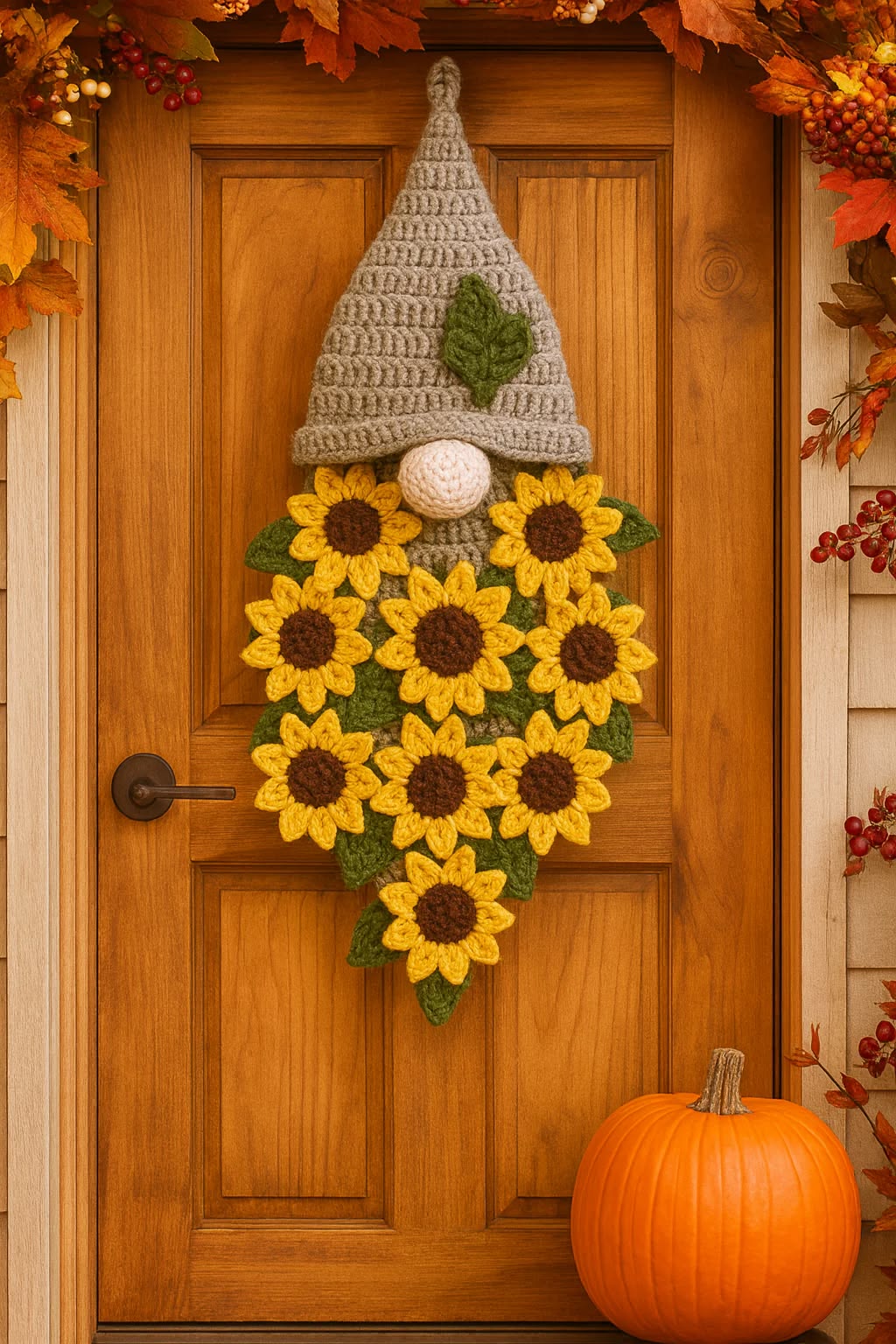
The Gnome and Sunflower Door Decoration Pattern is a cheerful crochet project that combines the cozy personality of a handmade gnome with the warm beauty of bright sunflowers. Designed as a decorative piece for a front door, craft room, kitchen, covered porch, or interior wall, this project creates an inviting seasonal accent while giving crocheters an opportunity to practice several useful techniques. The design shown in the inspiration features a tall textured hat, a rounded nose, layered green leaves, and a cascading arrangement of yellow sunflowers with deep brown centers. Although the finished decoration looks detailed, it can be created one component at a time, which makes the process much easier to understand. The pattern is especially appealing for crocheters who enjoy assembling separate motifs into one larger decorative project. Throughout this guide, you will learn the essential crochet stitch keys, construction sequence, assembly process, and finishing techniques needed to recreate a similar handmade decoration.
One of the greatest advantages of the Gnome and Sunflower Door Decoration Pattern is its flexibility. You can keep the traditional autumn palette of mustard yellow, earthy brown, olive green, beige, and cream, or adapt the colors to match your home décor. The sunflower arrangement can also be customized by changing the number and size of the flowers, while the gnome hat can be made longer, shorter, wider, or more textured depending on your preference. Because the project consists mainly of simple crochet shapes, it offers plenty of opportunities for personalization without changing the basic construction method. Beginners who already understand basic stitches can use this project to practice shaping, working in rounds, increasing, decreasing, and sewing motifs together. More experienced crocheters can add dimensional petals, decorative edging, textured stitches, or additional leaves for an even richer handmade appearance.
Before starting the Gnome and Sunflower Door Decoration Pattern, it is useful to become familiar with the abbreviations and crochet keys used throughout the instructions. In US crochet terminology, ch means chain, sl st means slip stitch, sc means single crochet, hdc means half double crochet, dc means double crochet, tr means treble crochet, inc means increase, and dec means decrease. The instruction MR refers to a magic ring, which is commonly used when beginning circular motifs such as flower centers and the gnome nose. You may also see st/sts, meaning stitch or stitches, and rep, meaning repeat. When the pattern says to work 2 sc in the same stitch, that is an increase, while sc2tog means single crochet two stitches together to create a decrease. Understanding these basic terms before beginning will make every stage of the project easier to follow.
Materials, Crochet Keys, and Preparation
For this Gnome and Sunflower Door Decoration Pattern, choose medium-weight yarn, often categorized as worsted or aran weight. A combination of golden yellow, dark brown, olive green, warm gray or taupe, and a pale cream or blush shade will closely reflect the rustic look of the inspiration. You will also need an appropriately sized crochet hook, usually around 4 mm to 5 mm, depending on your yarn and natural tension. Additional supplies include a yarn needle, scissors, stitch markers, polyester stuffing for the nose, and optional floral wire or lightweight craft support if you want the hanging decoration to maintain a firmer shape. Always check the yarn label when choosing the hook size.
DISCOVER MORE FREE PATTERNS HERE!
The first important crochet key is ch – chain. To make a chain, create a slip knot, place it on your hook, yarn over, and pull the yarn through the loop already on the hook. Chains are commonly used to begin rows, create foundation lengths, and form small hanging loops. In this project, chains can be used when creating the gnome body foundation, beginning leaf shapes, and adding a loop at the top of the hat for hanging. Try to keep your chain stitches relaxed and consistent so the finished pieces do not curl unnecessarily.
The next essential stitch is sc – single crochet. Insert the hook into the indicated stitch, yarn over, pull up a loop, yarn over again, and pull through both loops on the hook. Single crochet creates a firm, compact fabric and works particularly well for the hat, gnome body, nose, and structural sections of the decoration. When making the nose, tight single crochet stitches help prevent the stuffing from showing through. Consistent tension is especially important when working stuffed crochet shapes.
The abbreviation hdc – half double crochet creates a stitch that is slightly taller than single crochet. Yarn over, insert the hook into the stitch, yarn over and pull up a loop, then yarn over once more and pull through all three loops on the hook. Half double crochet gives the fabric a soft texture without becoming too open. It can be used for the hat or leaves in the Gnome and Sunflower Door Decoration Pattern, particularly when you want smooth shaping with a little more height than single crochet provides.
The stitch dc – double crochet is extremely useful when creating sunflower petals. Yarn over, insert the hook into the stitch, yarn over and pull up a loop, yarn over and pull through two loops, then yarn over again and pull through the final two loops. Double crochet produces taller stitches that allow petals to extend naturally away from the flower center. Combining sc, hdc, dc, and tr stitches within a single petal helps create a pointed, realistic sunflower shape without complicated techniques.
Finally, become comfortable with sl st – slip stitch, inc – increase, and dec – decrease. A slip stitch is made by inserting the hook into the designated stitch, yarning over, and pulling the yarn directly through both the stitch and the loop already on the hook. An increase usually means working two stitches into one stitch, while a decrease combines two stitches into one. These three techniques are essential for shaping the gnome hat, narrowing leaves, joining flower rounds, and creating rounded crochet pieces. Practicing them on a small yarn swatch before beginning can make the main project much smoother.
How to Crochet the Gnome, Hat, Nose, and Leaves
Begin the gnome portion of the Gnome and Sunflower Door Decoration Pattern with the body or backing structure. A simple elongated oval, tapered panel, or triangular crochet base works well because much of it will later be covered by sunflowers and leaves. Start with a foundation chain and work rows of sc or hdc, increasing near the upper section and decreasing toward the bottom if you want a tapered silhouette. A finished backing measuring approximately 35 to 45 cm long provides enough space for a generous arrangement of flowers. Keep the fabric reasonably firm because it will support the decorative motifs.
To make the tall gnome hat, begin at the narrow top and gradually increase toward the bottom. Start with MR, ch 1, 4 sc into MR, then tighten the ring. Continue working either in continuous rounds or joined rounds. Increase gradually by adding one or two extra stitches every few rounds rather than increasing heavily on every round. This produces the long pointed shape associated with a traditional gnome hat. Continue until the hat measures approximately 25 to 30 cm from the tip to the brim, adjusting the size according to your overall decoration.
For a textured hat similar to the inspiration, alternate ordinary single crochet rounds with raised or ribbed sections. One easy option is to work some rows through the back loop only (BLO), which produces horizontal ridges across the fabric. Another option is to use front-post or back-post stitches if you are comfortable with them. Finish the lower edge of the hat with several rounds of sc or hdc so the brim appears thicker. You can gently curve the tip of the hat after assembly for a softer handmade look.
The gnome nose is a small stuffed crochet sphere. Begin with MR, 6 sc into MR. On the next round, work 2 sc in each stitch for a total of 12 stitches. Continue increasing evenly until the nose reaches the desired width, usually around 5 to 7 cm in diameter. Crochet several rounds without increasing, then begin decreasing using sc2tog. Add a small amount of polyester stuffing before completely closing the opening, making sure the nose remains rounded rather than overly firm.
Leaves add depth and help connect the flowers visually. To crochet a simple pointed leaf, ch 10, then begin in the second chain from the hook. Work sc, hdc, dc, dc, tr, dc, dc, hdc, sc along one side. If desired, work several stitches into the final chain and continue along the opposite side to create a fuller leaf. Finish with a sl st, fasten off, and leave a long yarn tail for sewing. Make leaves in several sizes so the final arrangement appears natural.
Assembly of the gnome base should begin before attaching all the flowers. Position the hat over the upper section of the body and sew it securely with a yarn needle. Place the nose immediately beneath the brim so part of the upper edge is slightly hidden by the hat. Arrange a few leaves around the lower body as a background layer, but do not attach every leaf yet. Keeping some pieces loose until the flowers are positioned will allow you to adjust the composition and create a balanced crochet door decoration.
Crocheting the Sunflowers and Building the Floral Arrangement
The sunflowers are the visual focus of the Gnome and Sunflower Door Decoration Pattern. Begin each flower with dark brown yarn. Make an MR, then work 6 sc into the ring. Tighten the center and continue in rounds, increasing evenly until the brown circle measures approximately 4 to 6 cm across. For example, work 2 sc in each stitch on the second round, followed by 1 sc, inc repeated around on the third round. Continue the increase pattern if you want larger flowers.
To add the yellow petals, join golden yellow yarn to any stitch around the brown center. A simple petal sequence can be worked as ch 2, dc, tr, dc, ch 2, sl st in or around the same base area. Move to the next stitch or space and repeat the sequence around the flower. Another useful petal formula is sc, hdc, dc, tr, dc, hdc, sc, which produces a longer pointed petal. Both methods can create beautiful sunflowers, so choose the version that best matches your preferred appearance.
For fuller sunflowers, create two petal layers. Make the first round of petals slightly smaller, then work the second round behind or between them. On the second layer, use taller stitches such as dc and tr so the petals extend beyond the first layer. Staggering the petals prevents them from lining up directly on top of one another and produces a much more natural flower. A second layer also helps the decoration appear dimensional when viewed from a distance.
Create approximately seven to nine sunflowers for a medium-sized door decoration, though there is no fixed requirement. The inspiration uses multiple flowers arranged from the upper body down toward the bottom, creating a cascading bouquet. Make a few flowers slightly smaller by using fewer center rounds or shorter petals. Variations in size prevent the arrangement from looking overly symmetrical and give the finished sunflower crochet pattern a more handcrafted character.
Before sewing, place the gnome base on a flat surface and experiment with your sunflower arrangement. Position two flowers near the shoulders, several across the middle, and progressively fewer toward the bottom to form a loose triangular or cascading shape. Insert green leaves between the flowers, allowing some leaves to extend beyond the outer edges. Take a quick reference photo once you are satisfied with the placement so you can remember the arrangement while sewing each piece securely.
Attach the flowers using matching yarn and a yarn needle. Sew mainly around the center and inner petal area while leaving the outer petal tips slightly free. This technique preserves the dimensional appearance of the flowers instead of flattening them completely against the backing. Sew the leaves behind the flowers, securing their centers while allowing the pointed ends to lift naturally. When all motifs are attached, gently reshape each flower and leaf with your fingers to complete the layered floral design.
Finishing, Hanging, Care, FAQ, and Final Tips
Once the decorative pieces are assembled, inspect the back of the Gnome and Sunflower Door Decoration Pattern carefully. Weave in every loose yarn end by passing it through several nearby stitches with a yarn needle. Trim excess yarn only after confirming that each tail is secure. Because a hanging decoration can move whenever a door opens or closes, strong finishing is more important than it might be for a purely stationary crochet piece. Reinforce any flowers or leaves that feel loose before adding the hanger.
A hanging loop can be made with a strong crochet chain. Attach yarn at the upper tip of the hat, ch 20 to 30, depending on the size of your hook or door hanger, then join the chain back to the starting point using a sl st. For additional durability, work one row of sc around the chain loop. If the decoration is heavy, consider adding hidden support behind the hat or body so the weight of the flowers does not stretch the crocheted fabric over time.
Blocking can improve the appearance of the finished piece. Lightly dampen the leaves and sunflower petals, arrange them into their desired shapes, and allow them to dry completely on a flat surface. Follow the care recommendations for your specific yarn fiber, because acrylic, wool, and cotton may react differently to moisture and heat. Avoid excessive heat unless the yarn manufacturer specifically allows it. Gentle shaping is usually enough to make the petals and leaves look crisp and defined.
When displaying your crochet gnome door decoration, choose a location protected from heavy rain, strong sunlight, and extreme humidity whenever possible. Yarn decorations are generally best suited to indoor doors, covered porches, sheltered entryways, and interior walls. If the piece becomes dusty, gently shake it outside or clean it according to the yarn manufacturer’s instructions. Avoid aggressive machine washing if the design contains layered motifs, stuffing, wire, or other structural materials.
The Gnome and Sunflower Door Decoration Pattern can also be adapted for different seasons. Replace the sunflowers with daisies for spring, roses for summer, maple leaves for fall, or snowflakes for winter. The hat can change from warm gray to red, green, cream, blue, or any color that coordinates with the flowers. Even the gnome nose can be adjusted slightly in size. Keeping the same basic construction while changing the decorative motifs makes this pattern an excellent foundation for many handmade door ornaments.
For a professional finish, focus on consistency rather than perfection. Keep similar sunflower petals approximately the same length, distribute leaves across the design, and check the decoration from several feet away before permanently attaching every piece. Crochet projects often look different from a distance than they do while sitting on a worktable. Small variations are part of the charm of handmade work, and they can make each Gnome and Sunflower Door Decoration Pattern completely unique.
FAQ – Frequently Asked Questions About the Gnome and Sunflower Door Decoration Pattern
Is the Gnome and Sunflower Door Decoration Pattern suitable for beginners?
Yes. A confident beginner who already knows chain, single crochet, half double crochet, double crochet, slip stitch, increases, and decreases should be able to complete the project. The decoration may look complicated because it contains many pieces, but each individual component uses relatively straightforward crochet techniques.
What do the main crochet abbreviations mean?
The most important keys are ch = chain, sl st = slip stitch, sc = single crochet, hdc = half double crochet, dc = double crochet, tr = treble crochet, MR = magic ring, inc = increase, dec = decrease, st = stitch, and rep = repeat. Learning these abbreviations makes it easier to read almost any standard crochet pattern written in US terminology.
How many sunflowers should I crochet?
For a decoration similar to the inspiration, approximately seven to nine sunflowers works well. However, the number depends on the size of your flowers and gnome backing. You can use fewer large sunflowers or create a fuller arrangement with several small flowers.
What yarn is best for a crochet door decoration?
Medium-weight yarn is a practical choice because it provides enough structure while remaining easy to crochet. Cotton yarn can produce well-defined stitches, while acrylic yarn is widely available and offers many color choices. A blended yarn can also work well.
How large should the finished decoration be?
A medium project can measure approximately 50 to 65 cm long, including the hat and lower leaves. The width may range from approximately 30 to 40 cm, depending on the sunflower arrangement. These measurements are flexible and can easily be adjusted.
Can I make the sunflowers in different sizes?
Absolutely. Smaller flowers can be made with a smaller brown center, fewer petal stitches, or a smaller hook. Larger flowers can include additional center rounds and longer petals. Mixing several sizes gives the finished arrangement more visual depth.
How do I keep the sunflower petals from curling?
Consistent tension and gentle blocking can help. Avoid making the chains and slip stitches at the base of each petal too tight. Once the flower is finished, gently shape the petals while the motif is slightly damp and allow it to dry naturally.
Can I use this pattern as a wall decoration instead of a door decoration?
Yes. The Gnome and Sunflower Door Decoration Pattern works beautifully as wall art, especially in kitchens, craft rooms, entryways, and seasonal displays. Because a wall decoration experiences less movement than a door hanging, it may also require less structural reinforcement.
How can I make the gnome hat more textured?
Try working selected rounds through the back loop only, using alternating rows of single crochet and half double crochet, or incorporating post stitches. These techniques create ridges and shadows that make the hat look thicker and more dimensional.
Should the gnome body be stuffed?
The main backing does not usually need stuffing. Keeping it relatively flat makes it easier to hang against a door or wall. The gnome nose, however, looks best with a small amount of polyester stuffing to create its characteristic rounded shape.
How do I prevent the finished decoration from stretching?
Use firm crochet tension for the backing, secure every component carefully, and add reinforcement behind the upper portion if necessary. A strong hanging loop is also important. If the decoration contains many large flowers, lightweight plastic canvas or another suitable craft support can be placed discreetly behind the crocheted base.
Can the colors be changed?
Yes, and color customization is one of the easiest ways to make this project your own. Traditional sunflower colors include golden yellow, dark brown, olive green, beige, and warm gray, but cream, rust, burgundy, sage, orange, or muted seasonal colors can also create attractive combinations.
How long does this crochet project take?
Completion time varies according to crochet speed, flower size, and the amount of detail added. Because the project is constructed from separate components, it is easy to divide the work into several sessions. You might crochet the hat one day, prepare the flowers over several evenings, and complete assembly afterward.
Conclusion
The Gnome and Sunflower Door Decoration Pattern combines several enjoyable crochet techniques in one welcoming handmade project. You learned how to understand essential crochet keys and abbreviations, create a structured gnome backing, shape a long textured hat, crochet and stuff a rounded nose, make pointed leaves, and build dimensional sunflowers with brown centers and golden petals.
The project also demonstrates how individual crochet motifs can be arranged into a cohesive decorative piece. Rather than trying to crochet the entire design as one complicated construction, you can work on the hat, nose, leaves, flowers, and backing separately. This modular approach makes the pattern easier to manage and gives you complete control over the final flower placement.
Remember that the suggested stitch counts and measurements can be adjusted according to your yarn, hook, tension, and preferred finished size. Handmade crochet does not need to look mechanically identical from one piece to another. Small differences in flower shapes, leaf angles, and hat texture often make a finished decoration more appealing and personal. Once you understand the construction of the Gnome and Sunflower Door Decoration Pattern, you can use the same basic idea to create many seasonal variations. Different flowers, leaves, colors, hat textures, and embellishments can completely transform the design while allowing you to reuse the same fundamental crochet skills.
EASILY FIND THE PDF FOR THIS PATTERN HERE!
Most importantly, take time during the final assembly to arrange every sunflower and leaf before sewing. Good placement helps create the cascading floral effect that makes this crochet gnome decoration so distinctive. Secure the components carefully, weave in the yarn ends, shape the petals, and make sure the hanging loop can comfortably support the finished piece. If you make your own Gnome and Sunflower Door Decoration Pattern, leave your sincere opinion about the project and share any suggestions you have for colors, flower arrangements, or creative variations. Your ideas can inspire new versions of this cheerful crochet decoration and help other crochet enthusiasts discover fresh ways to personalize their handmade projects.