
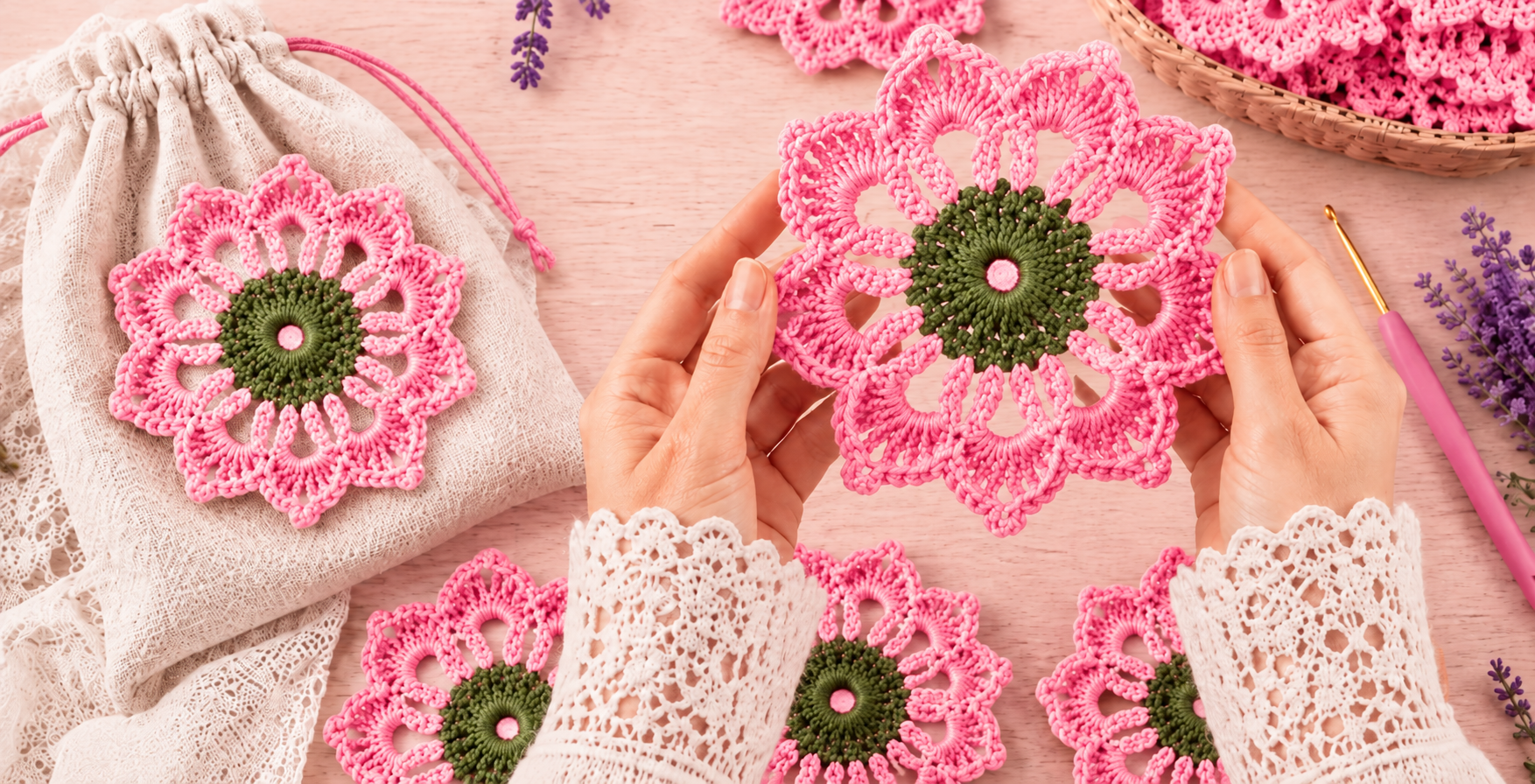
Crochet with a beautiful flower motif Pattern is a charming project for anyone who enjoys creating decorative crochet pieces with strong color contrast, delicate openwork, and a handmade floral appearance. Inspired by the flower motif shown in the image, this pattern combines a dense circular center with open loops and sculpted outer petals. The combination of deep green and bright orange gives the flower a warm, cheerful personality, but the same construction can be adapted to almost any color palette. Because the motif is worked primarily in rounds, it is also an excellent project for practicing circular crochet, stitch placement, increases, chains, and decorative edging. Once you understand how the rounds are organized, you can easily make several matching flowers for home décor, accessories, table decorations, appliqués, or creative handmade gifts.
One of the most interesting features of this Crochet with a beautiful flower motif Pattern is the transition between the compact center and the airy petals surrounding it. That contrast gives the finished flower visual depth without requiring extremely complicated crochet techniques. The center begins with closely worked stitches, while chains and taller stitches gradually create open spaces around the flower. The outer petals are shaped with groups of stitches placed into chain spaces, producing the curved, lace-like appearance visible in the design. Beginners with some experience in basic crochet should be able to follow the process, while intermediate crocheters can experiment with stitch counts, colors, and yarn thickness to personalize the final result. Understanding the crochet symbols and abbreviations before beginning will make every round much easier to follow.
For this tutorial, the instructions are written using standard U.S. crochet terminology and describe the construction in a clear round-by-round format. The key stitches used are ch (chain), sl st (slip stitch), sc (single crochet), hdc (half double crochet), dc (double crochet), tr (treble crochet), and sp (space). You will also see instructions such as rep, meaning repeat, and st/sts, meaning stitch or stitches. The exact size of your finished flower will depend on your yarn and hook, but a medium cotton yarn with a hook around 3.0–3.5 mm creates a decorative motif with good definition. Keep your tension relaxed and consistent, especially when working the chain loops, because balanced tension is one of the most important details for making the petals look even and symmetrical.
Materials, Crochet Key, and Preparation
Choose two contrasting yarn colors to emphasize the structure of the Crochet with a beautiful flower motif Pattern. A deep green works beautifully for the center and a vivid orange, coral, yellow, or red can be used for the petals. Cotton yarn is especially suitable because it provides excellent stitch definition and helps the petals keep their shape. You will need only a small amount of each color, making this flower motif a practical project for using leftover yarn.
DISCOVER MORE FREE PATTERNS HERE!
For the crochet hook, select a size appropriate for your chosen yarn. With light or medium cotton, a 3.0 mm to 3.5 mm crochet hook is a useful starting point. A smaller hook produces tighter stitches and a firmer flower, while a larger hook produces a softer, more open motif. You will also need small scissors and a yarn needle for weaving in the ends once the flower is complete.
Before beginning, become familiar with the crochet stitch key. Ch = chain, which creates the foundation loops and spaces. Sl st = slip stitch, commonly used to join rounds. Sc = single crochet, a short and dense stitch. Hdc = half double crochet, slightly taller than single crochet. Dc = double crochet, used frequently for shaping petals. Tr = treble crochet, a taller stitch that helps create height and dramatic curves.
When you see an instruction such as ch-3 sp, it means the space created by three chains in the previous round. If the pattern says work 5 dc in the next ch-5 sp, insert the hook underneath the entire chain loop rather than into individual chain stitches unless specifically instructed otherwise. This technique makes decorative crochet motifs much easier to work and allows stitches to spread naturally across each space.
A repeat, normally written as rep, means that the same sequence should be worked several times around the motif. For example, an instruction such as [sc, ch 5] rep around means that you should continue working one single crochet followed by five chains according to the placement indicated. Carefully counting repeats is essential because every outer petal depends on the number and location of the loops created in previous rounds.
Gauge is not critical for this decorative project, but consistent tension matters. Make a few chains before starting the flower and check that they are neither extremely loose nor tight. The petal chains must have enough flexibility to curve naturally. If your chains are too tight, the motif may cup inward. If they are excessively loose, the petals can lose their defined shape. Consistent crochet tension will give the beautiful flower motif a polished and professional finish.
Crocheting the Green Center Step by Step
Begin the Crochet with a beautiful flower motif Pattern with the green yarn. Make a magic ring and work ch 1 to secure it. Crochet 12 sc into the magic ring. Gently pull the yarn tail to close the center and join the last single crochet to the first with a sl st. This creates the small circular foundation from which the entire flower will grow.
For the second round, ch 1, then work 2 sc in each stitch around. You should have approximately 24 single crochet stitches when the round is complete. Join with a slip stitch. This simple increase creates a flat circle instead of a narrow tube. If the center begins curling severely, check your stitch count and loosen your tension slightly.
In the next round, begin adding texture to the green center. Ch 2, then work a combination such as 1 hdc in the first stitch and 2 hdc in the next stitch. Repeat this sequence around. Join the round with a slip stitch. These increases continue expanding the circle while providing a little more height than the previous single crochet stitches.
For additional texture similar to the dense center visible in the flower, work another round using sc stitches placed evenly around the circle. You may work through the back loops for a slightly raised appearance, or use regular single crochet through both loops for a smoother surface. The goal is to create a firm, approximately circular center that will support the decorative petal rounds.
Now begin creating the foundation for the petal openings. Ch 1, sc in the next stitch, ch 4, skip one stitch, sc in the next stitch. Repeat this sequence evenly around the green circle. Depending on your stitch count, you may need to adjust the spacing slightly so that all the loops are distributed symmetrically. The number of loops determines the number of decorative sections around the flower.
Finish the green section by joining the last stitch to the beginning of the round with a sl st. Fasten off the green yarn, leaving enough of a tail to weave in securely later. At this point, lay the motif flat and gently arrange the loops with your fingers. The green center should remain relatively flat, with evenly spaced chain arches around its perimeter. These arches will become the anchor points for the bright outer portion of the crochet flower pattern.
Building the Orange Loops and Decorative Petals
Join the orange yarn to one of the chain spaces around the green center. Ch 1 to secure the new color. Work 1 sc into the same chain space, then ch 6 and work 1 sc into the next chain space. Continue around the motif, creating a new chain arch between every pair of green foundation spaces. Join the final stitch with a slip stitch.
The next round begins adding height to those orange arches. Slip stitch into the first chain space, then work ch 3, which can count as the first double crochet. Work approximately 5 to 7 dc into the same chain space, depending on the size of your loops and yarn. Finish with a single crochet near the base or in the next anchoring point. Repeat around to create rounded orange sections.
To produce the elongated openwork appearance characteristic of this Crochet with a beautiful flower motif Pattern, the following round uses longer chains. From an anchoring point, ch 7 or ch 8, then secure the chain with a single crochet at the next appropriate point. Repeat these loops around the flower. Make sure each chain contains the same number of stitches because uneven chains will produce noticeably different petal sizes.
Begin forming each large outer petal by working several stitches inside one chain loop. A useful sequence is 1 sc, 1 hdc, 3 dc, 3 tr, 3 dc, 1 hdc, 1 sc inside the same loop. This progression gradually increases the stitch height toward the middle and decreases it again, naturally forming a rounded petal. Spread the stitches evenly along the chain loop as you work.
For a more decorative lace effect, you can add small chains between the tall stitches. For example, work dc, ch 1, tr, ch 1, tr, ch 1, dc within the upper section of each petal. These small openings help reproduce the airy appearance of the flower shown in the inspiration image. Keep these chains relaxed so they do not pull the petal inward.
Continue working the same petal sequence into every outer chain loop. After completing the final petal, join with a sl st at the starting point. Do not fasten off immediately. First, examine the flower and make sure all petals are facing outward. If one appears significantly tighter than the others, gently reshape it or redo that section before finishing. Consistency in each repeat is what gives a crochet flower motif its beautiful radial symmetry.
Finishing, Shaping, Creative Uses, FAQ, and Conclusion
Once all the petals have been completed, you can add a final decorative edging. Work sl st or sc stitches around selected areas of each petal if you prefer a firmer outline. Another attractive option is to work picots at the highest points. To create a simple picot, ch 3 and sl st into the first chain. This creates a tiny decorative point without significantly changing the basic shape.
Fasten off the orange yarn and use a yarn needle to weave each end through several stitches on the wrong side of the flower. Change direction once while weaving to make the yarn end more secure. Trim the excess yarn only after you are certain the end will not work itself loose. Proper finishing is especially important when the motif will be washed or handled frequently.
The finished Crochet with a beautiful flower motif Pattern may look slightly irregular immediately after crocheting. Blocking can dramatically improve the appearance. Lightly dampen the motif, arrange it on a flat surface, and gently shape every petal until the flower looks symmetrical. Allow it to dry completely before moving it. Always follow the care recommendations appropriate for the yarn you selected.
One of the advantages of this pattern is its versatility. A single flower can be used as a decorative appliqué on a handmade bag, cushion, table runner, wall hanging, or fabric organizer. Several flowers can be joined to create a colorful table centerpiece or decorative crochet panel. Smaller versions can become ornaments, while larger versions can work as coasters or decorative mats depending on the yarn used.
You can also transform the design by changing only the colors. A green center with orange petals creates a warm botanical appearance, while cream and gold can create a more elegant effect. Pink and white can produce a romantic flower, and several bright colors can turn the project into a cheerful scrap-yarn design. Because the structural rounds remain the same, experimenting with color does not require learning a completely new pattern.
The most important lesson when making this Crochet with a beautiful flower motif Pattern is to pay attention to repetition and stitch placement. Every chain space created in one round becomes a foundation for the next round. When the spaces are evenly distributed, the petals naturally become balanced. Count carefully, maintain consistent tension, and take time to shape each section as you go. These simple habits can make a significant difference in the appearance of the finished crochet flower.
FAQ About the Crochet with a Beautiful Flower Motif Pattern
Is this crochet flower pattern suitable for beginners?
Yes, it can be suitable for an adventurous beginner who already understands basic stitches such as chain, single crochet, double crochet, and slip stitch. The outer petals also use taller stitches, so practicing double and treble crochet before beginning can make the project easier.
What does ch mean in a crochet pattern?
Ch stands for chain. Chains are some of the most important stitches in this flower because they create the open spaces and loops that support the decorative petals. A chain is made by yarn over and pulling the yarn through the loop already on your hook.
What does sl st mean in crochet?
Sl st means slip stitch. It is a very short stitch commonly used for joining rounds or moving the working yarn to another position without adding significant height.
What does sc mean in the pattern?
Sc means single crochet in U.S. terminology. To make it, insert the hook into the stitch or space, yarn over, pull up a loop, yarn over again, and pull through both loops on the hook.
What is a double crochet stitch?
The abbreviation dc means double crochet. Yarn over, insert the hook into the required stitch or space, yarn over and pull up a loop. Yarn over and pull through two loops, then yarn over again and pull through the remaining two loops. Double crochet is especially useful for giving the flower petals height.
What does tr mean in crochet?
Tr, or treble crochet, is taller than double crochet. Yarn over twice before inserting your hook, pull up a loop, then yarn over and pull through two loops at a time until only one loop remains. Using treble crochet near the center of a petal helps create its rounded peak.
Why is my crochet flower curling?
Curling usually occurs because the stitch count, increases, or tension are not balanced. If the center curls upward, check whether you made enough increases. If the outer petals curl dramatically, the chain loops may be too tight. Gentle blocking can correct minor curling after the flower is finished.
Why are my petals different sizes?
Different petal sizes usually result from inconsistent chain counts, missed stitches, or changing tension. Count every chain and make sure the same stitch combination is worked into each corresponding loop. Repeating exactly the same sequence is the simplest way to achieve uniform petals.
Can I use acrylic yarn instead of cotton?
Yes. Acrylic yarn can be used successfully, although the flower may feel softer and have less stitch definition. Cotton yarn is often preferred for decorative motifs because it creates crisp stitches and holds the shape of the petals particularly well.
Can I make the flower larger?
Yes. The easiest method is to use thicker yarn and a larger hook. You can also enlarge the center or increase the number of stitches in the petal rounds, but structural changes require careful adjustment so the motif remains flat.
How can I make a smaller crochet flower?
Use fine yarn or crochet thread with a smaller hook. Keeping the same construction while reducing the yarn thickness is generally easier than altering every stitch count.
Do I need to block the finished flower?
Blocking is not mandatory, but it is highly recommended for an openwork motif. It helps separate the petals, improve symmetry, flatten the center, and give the finished crochet flower a cleaner appearance.
Can several flowers be joined together?
Absolutely. Multiple motifs can be sewn together with a yarn needle or joined with crochet stitches. They can be arranged into decorative panels, table runners, cushion fronts, bags, or larger textile projects.
How can I keep the center hole small?
A magic ring is one of the best methods because it allows you to tighten the starting circle after completing the first round. Pull the yarn tail carefully until the opening reaches the desired size, then weave the end in securely.
Conclusion
The Crochet with a beautiful flower motif Pattern combines a structured circular center, decorative chain spaces, open loops, and layered petals to create a striking handmade flower. Throughout this tutorial, you learned how to begin with a magic ring, expand the center using basic increases, create chain spaces, change yarn colors, build decorative loops, shape petals with different stitch heights, and finish the project neatly.
You also learned the essential crochet keys and abbreviations, including ch, sl st, sc, hdc, dc, tr, sp, sts, and rep. Understanding these terms makes it much easier to read crochet patterns and follow new projects confidently. The same skills used in this flower can be applied to many other circular motifs and decorative crochet designs.
Remember that your first flower does not need to look perfectly symmetrical. Crochet is a handmade craft, and small variations are completely natural. Concentrate on consistent tension, careful stitch counting, and evenly spaced repeats. With each new motif, your stitches will become more uniform and the shaping process will feel increasingly intuitive. This project is also an excellent opportunity to explore your creativity. Experiment with contrasting colors, soft neutral combinations, variegated yarns, thinner threads, or thicker cotton. You can create a collection of flowers in different sizes while continuing to use the basic structure taught in this Crochet with a beautiful flower motif Pattern.
Whether you use your finished motif as an appliqué, ornament, decorative mat, part of a larger crochet panel, or simply as a way to practice your skills, the project demonstrates how a relatively small collection of basic stitches can produce an elaborate-looking result. After trying this Crochet with a beautiful flower motif Pattern, leave your sincere opinion about the project and share your suggestions. What colors would you choose for your flower, and what would you create with the finished motifs? Your ideas can inspire new combinations and creative ways to use this beautiful crochet design.