
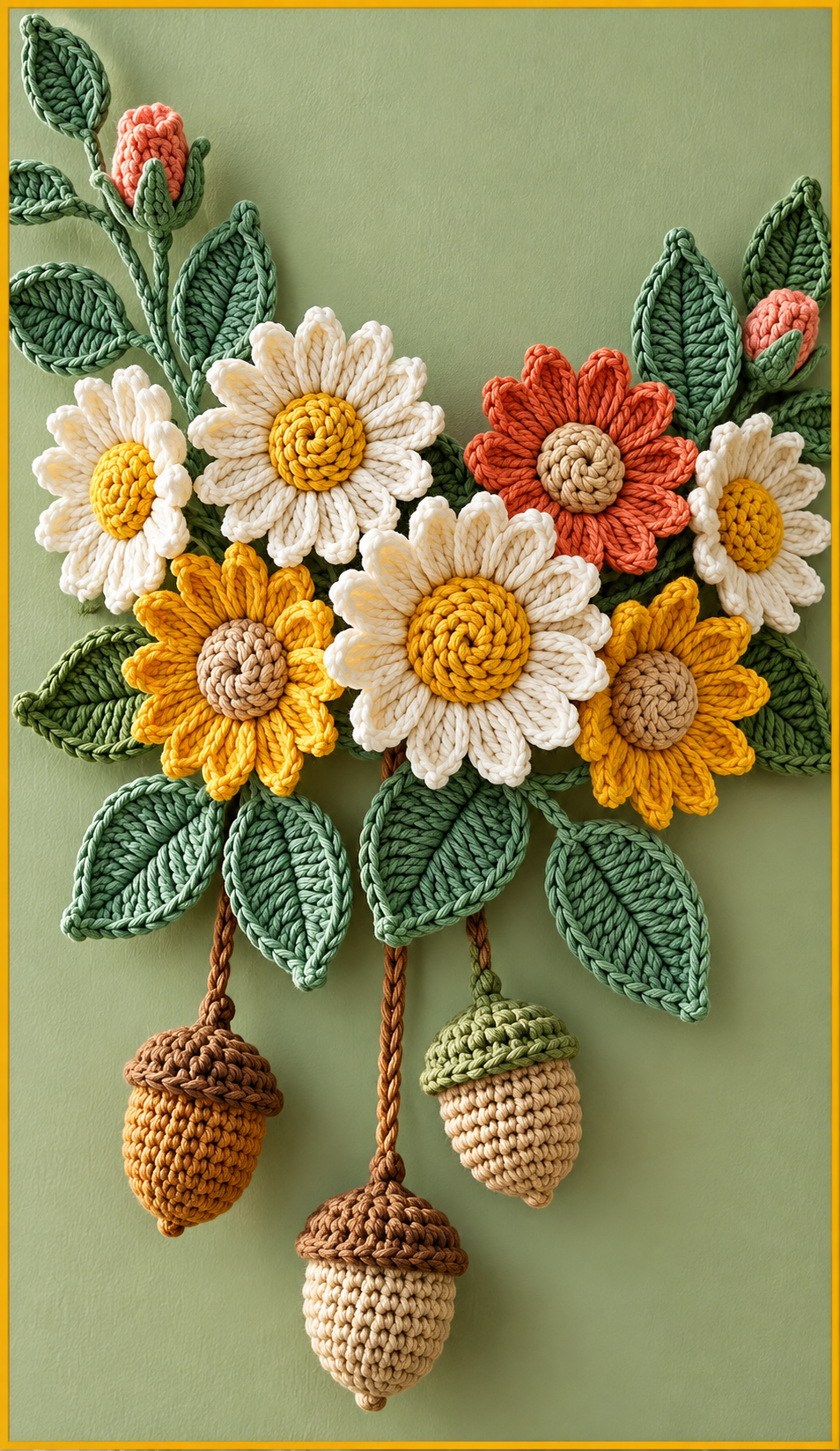
The Crochet Curtain Tieback with Flower and Acorn Pattern is a charming decorative project that combines practical home décor with the warmth of handmade crochet. Inspired by a garden arrangement of daisies, warm-colored flowers, textured green leaves, and hanging acorns, this pattern can transform a simple curtain into an eye-catching feature. The finished piece works especially well in bedrooms, kitchens, reading corners, cottage-style interiors, and seasonal fall décor. Although the arrangement looks elaborate, the project can be built gradually from separate crochet components, making it approachable for confident beginners and enjoyable for intermediate crocheters. The main idea is to crochet individual flowers, leaves, stems, cords, and acorns before assembling everything onto a sturdy curtain tieback base. By understanding a few basic stitch abbreviations and construction techniques, you can customize the number of flowers, colors, and overall length to suit your own curtains.
One of the greatest advantages of the Crochet Curtain Tieback with Flower and Acorn Pattern is its flexibility. You do not need to reproduce every flower exactly as shown to create a beautiful result. White daisies with golden centers can form the focal point, while mustard and coral flowers add warmth and visual contrast. Sage or muted green leaves create a natural background, and small crocheted acorns hanging below the floral section bring texture and movement to the finished piece. Cotton yarn is particularly suitable because it provides excellent stitch definition and holds the shape of petals and leaves well. A cotton-acrylic blend can also work if you prefer a softer result. The project is also a wonderful way to use leftover yarn because most individual elements require only small quantities of each color.
Before starting the Crochet Curtain Tieback with Flower and Acorn Pattern, become familiar with the basic crochet stitch key used throughout the instructions. In this pattern, ch = chain, sl st = slip stitch, sc = single crochet, hdc = half double crochet, dc = double crochet, tr = treble crochet, st = stitch, sts = stitches, MR = magic ring, inc = increase, meaning two stitches worked into the same stitch, and dec = decrease, meaning two stitches joined together. The instructions use standard US crochet terminology. A stitch marker is useful when crocheting the acorns in continuous rounds, while a tapestry needle will be needed for assembly. Other useful supplies include approximately 3 mm to 4 mm crochet hooks, cotton yarn in cream, mustard, coral, beige, brown, sage green, and olive green, scissors, removable stitch markers, and optional fabric-safe stiffener for the leaves and petals.
Materials, Crochet Stitch Key, and Preparing the Tieback Base
Begin by choosing the yarn for your crochet curtain tieback. A medium-light cotton yarn works especially well because floral shapes need enough firmness to remain visible when attached to the curtain. You can use cream or ivory for the daisy petals, mustard yellow for several flower centers and accent flowers, dusty coral for a contrasting bloom, beige for softer centers, sage green for leaves, olive green for acorn caps, and warm brown for the acorns. Exact shades are not essential; coordinating natural tones will produce a harmonious result.
DISCOVER MORE FREE PATTERNS HERE!
Choose a crochet hook that creates a fairly compact fabric. A 3.0 mm, 3.5 mm, or 4.0 mm crochet hook is suitable for many cotton yarns, but always check your yarn thickness. The stitches should not be so loose that stuffing can escape from the acorns. For the flowers and leaves, slightly tight stitches help the pieces keep their shape. Gauge is not critical because the individual motifs can vary slightly without affecting the functionality of the tieback.
The base of the Crochet Curtain Tieback with Flower and Acorn Pattern should be strong enough to hold the floral arrangement while wrapping comfortably around a curtain. To make a simple crocheted base, ch 55–70, depending on the thickness of your curtain. Starting in the second chain from the hook, work 1 sc in each ch across. Turn, ch 1, and crochet another row of sc. Repeat for 3 to 5 rows until you have a narrow, sturdy band approximately 2 to 3 cm wide.
For a softer rounded tieback cord, make ch 70, then work sl st loosely into each chain back to the beginning. You can make a second cord and twist the two together for additional strength. Another option is to crochet an I-cord, which creates a neat rope-like finish. Leave long yarn tails at both ends so loops can later be formed for fastening the tieback around the curtain.
The stitch key is important when you begin building the dimensional flowers. Remember that sc creates a short dense stitch, hdc produces slightly more height, dc forms taller petals, and tr creates long pointed shapes. Combining different stitch heights is what gives the petals and leaves their curved natural appearance. The sl st is primarily used to join rounds, move around a motif without adding height, or anchor petals to the flower center.
Before making all your motifs, crochet one test flower and one leaf. Hold them against the curtain where the completed tieback will be used. A daisy measuring approximately 8 to 10 cm across generally works well as a central focal flower, while smaller accent flowers of 6 to 8 cm help create depth. Leaves can range from 6 to 10 cm long. Adjust the hook size or number of stitches if you prefer a larger or more delicate arrangement.
How to Crochet the Flowers and Create Dimensional Petals
Start with the large white daisy, which is one of the main features of the Crochet Curtain Tieback with Flower and Acorn Pattern. Using mustard yarn, create an MR and work 6 sc into the ring. Pull the ring closed. For round 2, work 2 sc in each st around, giving you 12 stitches. For round 3, repeat [1 sc, inc] around to create 18 stitches. Fasten off if you want a flat center, or add one additional round of sc if you prefer a larger raised center.
Attach cream or white yarn to any stitch around the flower center. To make one elongated daisy petal, ch 7. Beginning in the second chain from the hook, work 1 sc, 1 hdc, 3 dc, 1 hdc down the chain. Join to the next stitch of the center using a sl st. Repeat this sequence around the center until you have approximately 12 to 18 petals. More petals create a fuller daisy, while fewer petals produce a simpler farmhouse-style flower.
For additional dimension, crochet a second layer of petals behind the first. Attach the cream yarn to the back loops or around the base of the petals. Make slightly longer petals by working ch 8, followed by 1 sc, 1 hdc, 4 dc, 1 hdc, and then sl st into the next available base stitch. Position the second layer between the petals of the first layer. This technique creates the dense, dimensional appearance visible in decorative crochet flowers.
To crochet a mustard flower, begin with beige yarn for the center. Make an MR, 6 sc, then inc around for 12 stitches. Change to mustard yarn. For each petal, work ch 6, then from the second chain crochet 1 sc, 1 hdc, 2 dc, 1 hdc. Slip stitch into the next center stitch. Continue around. If you want a flower with broader petals, place two tall stitches in the middle chains.
The coral flower can follow the same basic construction, but increasing the petal length adds variety. Make a beige center approximately 3 to 4 cm wide. Join coral yarn and work each petal using ch 7, sc, hdc, 3 dc, hdc, then sl st to the next center stitch. Shape the petals gently with your fingers after finishing. Crochet stitches naturally curl slightly, which helps the flower look more organic and three-dimensional.
Once all the flowers are complete, weave in the ends on the back but keep one long matching yarn tail on each flower for assembly. For a balanced arrangement, make approximately three cream daisies, two mustard flowers, and one coral flower. You may add small rosebud-style motifs at the upper sides by crocheting a narrow strip of sc and dc shells, rolling it into a spiral, and stitching the base closed. These small buds help fill open spaces between leaves.
Crocheting Leaves, Stems, Acorns, and Decorative Details
The leaves give the Crochet Curtain Tieback with Flower and Acorn Pattern its botanical character. Using sage green yarn, ch 12. Starting in the second chain from the hook, work 1 sc, 1 hdc, 2 dc, 4 tr, 2 dc, 1 hdc. Work 3 sc into the final chain so you can turn around the opposite side of the foundation chain. Mirror the stitches along the second side: 1 hdc, 2 dc, 4 tr, 2 dc, 1 hdc, 1 sc. Join with a sl st.
To make the leaf more structured, crochet one round of sc around the outside edge, placing 3 sc into the tip. You can also add a raised center vein. Insert the hook at the base of the leaf and work a line of surface sl sts toward the tip. Alternatively, thread a tapestry needle with a darker shade of green and embroider a simple straight vein through the middle. Slightly different green shades make the arrangement look more realistic.
Make approximately 8 to 12 leaves, varying the starting chain from 9 to 14 stitches. Smaller leaves work well near the flower centers, while longer leaves can extend upward and outward. Some leaves can be attached individually, while others can be connected to crocheted stems. For a stem, ch 15–30, then sl st back through every chain. Stitch one or more leaves to the stem using matching green yarn.
The hanging acorns are a distinctive part of this flower and acorn crochet pattern. Begin the acorn body with beige or tan yarn. Make an MR and 6 sc. Round 2: inc around for 12 stitches. Round 3: [1 sc, inc] around for 18 stitches. Work 3 to 5 rounds of 1 sc in each stitch. Then begin decreasing: [1 sc, dec] around, followed by dec around. Before the opening becomes too small, add a small amount of polyester stuffing.
For the acorn cap, use brown, camel, or olive yarn. Create an MR, 6 sc, then work inc around for 12 stitches. Next, crochet [1 sc, inc] around for 18 stitches. Work one or two rounds of sc without increases. For extra texture, work the final round using alternating front loop only and back loop only sc, or use small bobble stitches. Place the cap over the stuffed acorn body and sew it securely in position.
To create the hanging cord, attach yarn to the top of the acorn cap and ch 20–35, depending on the desired hanging length. Slip stitch back down the chain for a stronger cord. Make three acorns at slightly different lengths to create a natural cascading effect. One can be warm brown, another beige with a brown cap, and another light tan with an olive-green cap. This variety creates the handcrafted woodland appearance that makes the pattern especially attractive.
Assembling and Finishing the Crochet Curtain Tieback
Before sewing anything permanently, lay all components of the Crochet Curtain Tieback with Flower and Acorn Pattern on a flat surface. Position the largest white daisy near the center. Place another white flower slightly above and to the left, then position the remaining flowers on either side. Avoid placing everything in a perfectly straight row. A slightly irregular garden-style arrangement looks more natural and gives the tieback greater visual depth.
Arrange the leaves behind the flowers before attaching them. Larger leaves should extend toward the upper corners and lower edges, while smaller leaves can fill spaces between flower heads. Some leaves should remain partially visible behind the flowers. Overlapping the pieces is important because it disguises joining stitches and creates the dense, layered appearance of a floral bouquet.
Sew the leaves and stems to the crochet tieback base first. Use the long yarn tails or matching green yarn and a tapestry needle. Secure each leaf primarily along its lower section so the tip remains slightly free. This gives the finished arrangement more dimension. Tug gently after attaching each piece to confirm that it will withstand normal use when the curtain is opened and closed.
Next, sew the flowers over the leaves. Begin with the largest focal flower and secure it firmly through the center and several points around the outer edge. Add the surrounding daisies, mustard flowers, and coral flower one by one. Do not flatten all the petals while sewing. The dimensional quality of the petals is one of the most attractive elements of the Crochet Curtain Tieback with Flower and Acorn Pattern.
Attach the three acorn cords along the lower part of the tieback. Space them irregularly and vary the cord length. Stitch through the upper section of each cord several times so that the hanging decorations remain secure. The acorns should move slightly when the curtain moves, but they should not pull heavily on the floral arrangement.
Finally, make a fastening method at both ends of the tieback. You can crochet a small chain loop on one end and attach a crocheted button, wooden-style decorative button, or sturdy crochet knot to the other. Another method is to make loops at both ends and secure them around a discreet wall hook. Once assembled, gently steam-block the leaves and petals if the yarn manufacturer allows it. Do not press the crochet flat; the goal is to shape the motifs while preserving their texture.
Frequently Asked Questions About the Crochet Curtain Tieback with Flower and Acorn Pattern
What yarn is best for a Crochet Curtain Tieback with Flower and Acorn Pattern?
Cotton yarn is one of the best choices because it provides clear stitch definition and enough structure for flowers and leaves. A cotton blend also works well. Very soft acrylic yarn can be used, but the petals may need light blocking or shaping.
What crochet skill level is required for this pattern?
A confident beginner can complete the project if they already know chain, slip stitch, single crochet, half double crochet, double crochet, increases, and decreases. Intermediate crocheters may find the project particularly relaxing because the construction mainly involves repeating small motifs.
How large should the curtain tieback be?
Measure around the gathered curtain before making the base. The finished band should comfortably wrap around the fabric without compressing it too tightly. A base between approximately 45 and 65 cm works for many curtains, but curtain thickness varies significantly.
Can I make fewer flowers?
Yes. The Crochet Curtain Tieback with Flower and Acorn Pattern is very easy to personalize. A smaller version can contain one large daisy, two smaller flowers, several leaves, and one hanging acorn. A more dramatic version can contain seven or more flowers.
How do I keep crochet leaves from curling?
Use a slightly smaller hook, maintain even tension, and block the leaves after crocheting. You can also add a round of single crochet around the perimeter. Cotton yarn generally holds a leaf shape better than very soft yarn.
Do the acorns need stuffing?
A tiny amount of fiberfill helps the acorns maintain their rounded three-dimensional shape. However, you can leave them unstuffed if you prefer a flatter and lighter decoration.
How can I make the flower centers more raised?
Instead of ending the flower center after two or three flat rounds, crochet an additional round without increases. You can also work the center in continuous rounds and lightly stuff it before attaching it to the petals.
Can this pattern be used for something other than curtains?
Yes. The floral arrangement can be adapted for decorative wreaths, wall hangings, bag embellishments, nursery décor, table decorations, or seasonal garlands. Individual flowers and acorns can also be used separately.
How do I wash a crochet curtain tieback?
Hand washing is usually the safest option for detailed crochet decorations. Use cool or lukewarm water and mild detergent, avoid aggressive rubbing, gently remove excess water with a towel, reshape the petals and leaves, and allow the piece to dry flat.
Why are my flower petals different sizes?
Uneven tension or accidentally changing the number of stitches in the foundation chains can cause this. Count the chains and stitches carefully for each petal. Small differences are usually not a problem, however, because slight variation can give handmade flowers a natural appearance.
Can I change the colors in the pattern?
Absolutely. While cream, mustard, coral, sage green, brown, and beige create a warm botanical palette, the same crochet flower curtain tieback can be made with pink roses, blue flowers, lavender petals, bright spring shades, or deeper autumn colors.
How can I make the tieback more durable?
Use tightly spun cotton yarn, reinforce the base with several rows of single crochet, and secure every flower and leaf at several points. Pay particular attention to the attachment points of the hanging acorns because these pieces receive more movement.
Conclusion
The Crochet Curtain Tieback with Flower and Acorn Pattern brings together several enjoyable crochet techniques in one decorative home project. Throughout this tutorial, you learned how to prepare a sturdy tieback base, understand the main crochet stitch keys, create textured flower centers, build elongated daisy petals, crochet leaves with defined veins, form dimensional stuffed acorns, make stems and hanging cords, and assemble all the pieces into a balanced botanical arrangement.
The project may appear complex at first because of the number of individual details, but the construction becomes much easier when it is divided into small steps. Each flower, leaf, stem, and acorn is created separately, allowing you to work at your own pace and adjust the arrangement before final assembly. This modular approach is also what makes the pattern so customizable.
EASILY FIND THE PDF FOR THIS PATTERN HERE!
Whether you choose the warm cream, mustard, coral, sage, and brown palette described here or create an entirely different color combination, the finished Crochet Curtain Tieback with Flower and Acorn Pattern can become a distinctive handmade accent for your home. The combination of botanical flowers and woodland acorns adds both texture and character while still serving the practical purpose of holding curtains neatly in place. If you make this pattern, leave your sincere opinion about the tutorial and share your suggestions. Which flower colors would you choose, and what other crochet details would you add to personalize your curtain tieback? Your ideas can inspire new variations of this charming handmade project.