
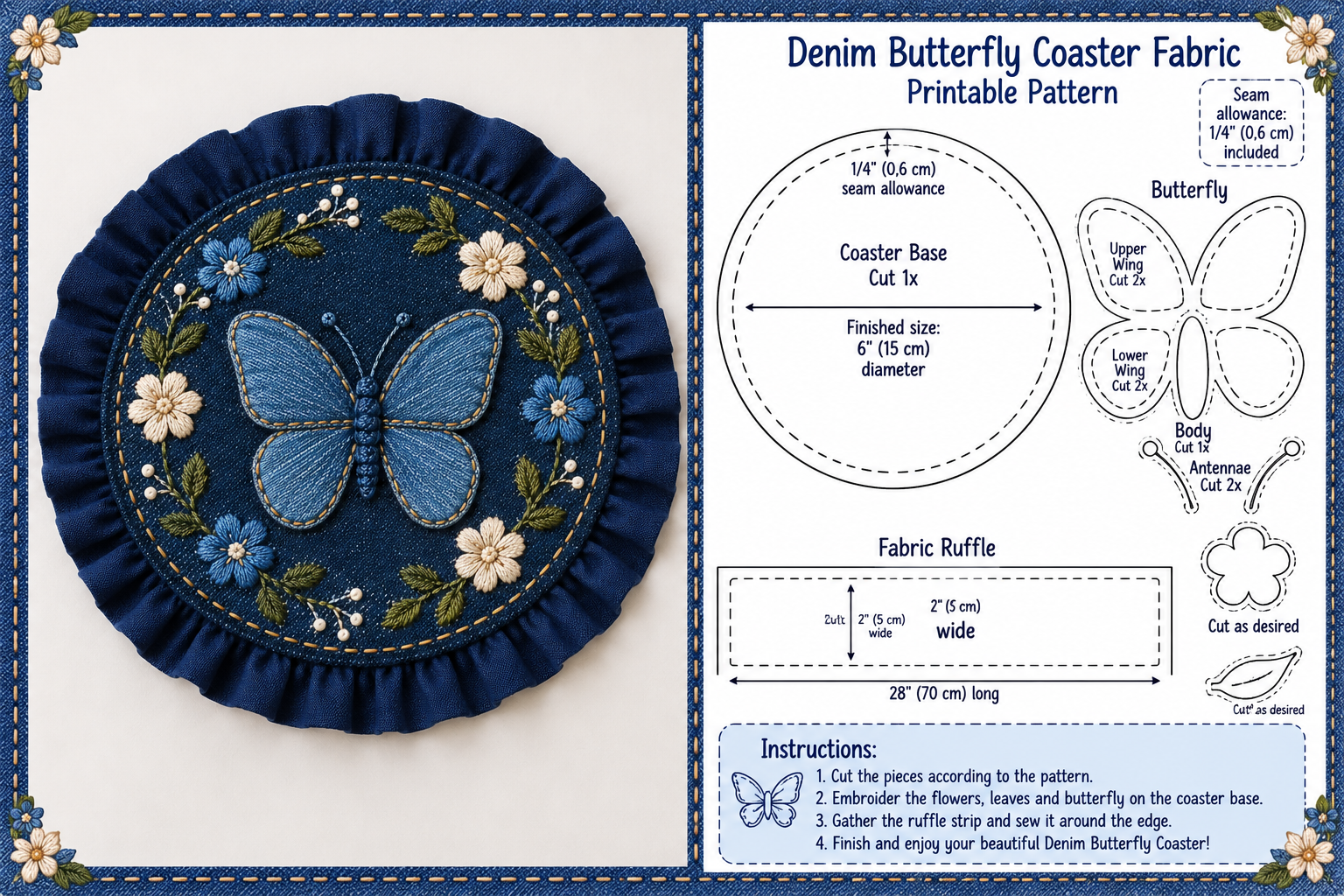
Denim butterfly coaster Fabric Pattern is a charming sewing project that transforms small pieces of denim and colorful fabric into practical decorations for a coffee table, dining area, or craft room. Inspired by the handmade coasters shown in the photo, this design combines a circular denim center, a softly gathered fabric border, and an appliquéd butterfly with embroidered details. The finished coaster can protect wooden surfaces from warm cups while adding color, texture, and personality to the room. It is also an excellent way to reuse old jeans, fabric scraps, leftover batting, and small pieces of decorative trim. Because the project uses relatively simple shapes, it can be adapted for beginners while still offering enough creative detail to interest experienced sewing enthusiasts.
The main feature of the Denim butterfly coaster Fabric Pattern is the layered construction. A sturdy denim circle forms the foundation, while a ruffled outer border gives the coaster a soft, decorative appearance. In the center, a butterfly appliqué is created with printed cotton, felt, embroidery thread, or a combination of these materials. The contrast between rugged denim and delicate butterfly wings makes the design visually appealing. You can use bright floral fabrics for a cheerful spring style, pastel fabrics for a romantic look, or deep blue and orange tones for a more rustic finish. Every coaster can be different, allowing you to create a coordinated set without making every piece exactly the same.
This project is especially useful for anyone interested in fabric scrap projects, denim crafts, butterfly appliqué, and handmade home accessories. The pattern can be resized to produce small drink coasters, larger mug rugs, decorative trivets, or even matching table mats. Careful cutting, accurate stitching, and thoughtful fabric selection will help the finished project look polished. However, small variations are part of the handmade character and should not be considered mistakes. The following instructions explain the materials, preparation, construction, decoration, and finishing process so that you can recreate the project in the photo with confidence.
Materials and Preparation for the Denim Butterfly Coaster
Begin by gathering the materials required for your Denim butterfly coaster Fabric Pattern. You will need medium-weight denim, colorful cotton fabric for the ruffle and butterfly wings, thin batting or fusible fleece, backing fabric, matching sewing thread, embroidery floss, fabric scissors, pins or clips, a hand-sewing needle, and a sewing machine. Optional supplies include fusible web, fabric markers, decorative buttons, beads, and pinking shears. Washed denim is often easier to sew because it is softer and less likely to shrink after the coaster is completed.
DISCOVER MORE FREE PATTERNS HERE!
Choose denim that is strong but not extremely thick. Heavy jeans fabric can become bulky when several layers are sewn together, particularly around the curved edges. Lightweight or medium-weight denim provides enough stability while remaining manageable. Old jeans are ideal for this project, but avoid areas with worn patches, stretched fibers, or permanent stains. The legs of jeans usually provide the largest smooth sections and can be cut into several coaster centers.
For the ruffled border, select a cotton fabric that coordinates with the butterfly design. The photo features several blue variations, including plain denim, dark polka dots, and floral prints. This mixture creates a handmade collection that feels coordinated without becoming repetitive. A border made from contrasting fabric can make the center stand out, while a border in a similar shade produces a softer and more unified appearance.
Create a circular template using cardboard, sturdy paper, or reusable plastic. A finished coaster measuring approximately 6 to 7 inches across works well for most cups and mugs. Draw one circle for the denim front and another circle for the backing. Add about ¼ inch around the pattern pieces for the seam allowance. A seam allowance is the narrow area between the stitching line and the raw fabric edge, and it prevents the finished coaster from becoming smaller than planned.
Prepare a second template for the butterfly. You can sketch a simple butterfly with two upper wings, two lower wings, and a narrow body. Keep the shapes slightly rounded because smooth curves are easier to appliqué than sharp, narrow points. If you prefer a symmetrical design, fold a piece of paper in half, draw one side of the butterfly, and cut through both layers. When the paper is opened, both sides will match.
Wash, dry, and press all fabrics before cutting. Prewashing removes manufacturing residue and reduces the possibility of shrinkage. Pressing also makes the fabric easier to measure and cut accurately. If the denim has deep creases, use steam and press it from the wrong side. Once the fabric is smooth, trace the templates with a removable fabric marker and cut each component carefully.
Cutting and Sewing the Ruffled Coaster Base
Cut one denim circle for the top, one backing circle, and one circle of thin batting. The batting should be slightly smaller than the fabric circles to reduce bulk in the seam. If you want a firmer coaster, use fusible fleece instead of loose batting. Follow the manufacturer’s instructions when fusing it to the wrong side of the denim. Always protect the iron and work surface when using adhesive materials.
To create the gathered border, cut a long fabric strip approximately 2 to 3 inches wide. The strip should measure about one and a half to two times the circumference of the denim circle. A longer strip creates fuller gathers, while a shorter strip produces a subtle ruffle. Join shorter strips with diagonal seams when a single continuous strip is not available. Press the joining seams open so they do not create thick areas.
Fold the ruffle strip in half lengthwise with the wrong sides together and press it carefully. Sew two rows of long gathering stitches close to the raw edge. Do not backstitch at the beginning or end. Leave several inches of thread available so the bobbin threads can be pulled gently. Using two rows instead of one helps distribute the gathers evenly and reduces the risk of a broken gathering thread.
Pull the bobbin threads until the ruffle fits around the outside edge of the denim circle. Spread the gathers evenly with your fingers, avoiding large clusters or flat sections. Place the ruffle on the right side of the denim with the raw edges aligned and the folded edge pointing toward the center. Pin or clip it securely around the curve. Overlap the ends slightly or join them with a seam for a cleaner finish.
Baste the ruffle to the denim using a narrow seam allowance. Basting is a temporary line of stitching that holds the layers in position before the final seam is sewn. Check the front to confirm that the gathers are balanced. Make adjustments now if necessary, because uneven sections will be more difficult to correct after the backing is added. Keep the folded part of the ruffle away from the stitching line.
Place the backing circle over the prepared front with the right sides facing. The ruffle will be enclosed between the two circles. Pin around the edge and sew slowly, leaving an opening of approximately 2 to 3 inches for turning. Clip small notches around the curved seam without cutting through the stitches. Turn the coaster right side out, smooth the curve, and press gently. Fold the opening inward and close it with a ladder stitch or neat topstitching.
Creating the Butterfly Appliqué and Embroidery
Trace the butterfly wing templates onto fusible web or directly onto the chosen fabrics. Fusible web is a thin adhesive material that helps secure appliqué pieces before they are stitched. Remember that traced shapes may be reversed after fusing, so consider the direction of the printed fabric. Cut the pieces slightly outside the traced lines, fuse them to the wrong side of the fabric, and then cut accurately along the final shape.
Arrange the wings in the center of the denim coaster before permanently attaching them. The upper wings should be slightly larger than the lower wings to create a recognizable butterfly silhouette. Leave enough space around the butterfly so the design does not disappear beneath the ruffle. Test several fabric combinations before deciding. Floral prints, polka dots, stripes, and tiny geometric patterns can all produce attractive results.
Remove the paper backing from the fusible web and place the wing pieces on the denim. Press them according to the adhesive instructions. Use a pressing cloth to protect delicate fabrics and prevent glue from touching the iron. After fusing, stitch around the edges using a small zigzag stitch, blanket stitch, or straight stitch. A narrow zigzag provides a secure edge, while blanket stitching creates a traditional handcrafted appearance.
Create the butterfly body from a narrow oval of fabric, felt, or padded appliqué. Position it over the center edges of the wings so that it hides small gaps and secures the design. Stitch around the body and add several horizontal lines to suggest body segments. The antennae can be embroidered with backstitch or stem stitch. Small knots at the ends will make them more visible.
Add decorative embroidery to the wings using contrasting thread. The photo shows curved lines, dots, small flowers, and teardrop-shaped details. You can recreate these features with running stitch, chain stitch, French knots, lazy daisy stitches, or simple straight stitches. Embroidery details give the butterfly dimension and allow each coaster to become unique. Keep knots and thread tails secure so they do not loosen during washing.
For additional texture, quilt a circle around the butterfly or stitch decorative lines across the denim background. Quilting connects the top, batting, and backing while helping the coaster remain flat. Work slowly and rotate the project gradually around curves. Avoid pulling the fabric, as this may create wrinkles. Once the stitching is finished, press the coaster from the back using moderate heat.
Finishing, Customizing, and Caring for the Coasters
Examine the entire Denim butterfly coaster Fabric Pattern and trim any visible threads. Check the closing seam, appliqué edges, and ruffle attachment for loose areas. Reinforce them with hand stitches when needed. If the coaster does not lie flat, press it with steam and place a heavy book over it until it cools. This simple step can help flatten bulky seams and stabilize the circular shape.
You can personalize the butterfly with beads, tiny buttons, fabric paint, or metallic embroidery thread. Use embellishments sparingly if the coaster will hold cups, because raised decorations may make the surface uneven. Flat embroidery is usually the most practical choice. Beads can be placed near the wing tips or around the outer denim circle, where they are less likely to interfere with the cup.
Create a coordinated set by keeping the same denim center while changing the ruffle fabrics and butterfly colors. Another option is to use the same butterfly design with different denim shades. Light-wash, medium-wash, and dark-wash fabrics can create a beautiful graduated collection. Sets of four or six coasters make thoughtful handmade gifts for birthdays, housewarmings, holidays, or craft exchanges.
For a reversible version, decorate both fabric circles before assembling the coaster. One side can feature the butterfly, while the other can have simple quilting or a floral appliqué. Remember that heavy decoration on both sides may add bulk. Choose thin materials and secure all threads carefully. A reversible design is useful when you want more variety without storing additional coasters.
Wash the finished coasters by hand or on a gentle machine cycle using cool water. Place them in a laundry bag to protect the ruffles and embroidery. Avoid strong bleach because it can fade denim and damage colorful threads. Reshape the coasters while damp and allow them to air dry on a flat surface. A light pressing from the back will restore the smooth appearance.
The same construction method can be used for other designs, including dragonflies, flowers, birds, hearts, leaves, and seasonal motifs. You can also enlarge the pattern to create a matching denim mug rug or small table mat. Once you understand the circular base, gathered border, and appliqué process, the creative possibilities become almost unlimited.
Frequently Asked Questions
What size should a denim butterfly coaster be?
A practical finished size is usually between 6 and 7 inches in diameter, including the ruffle. This provides enough room for a standard coffee mug while allowing the decorative butterfly to remain visible. You can reduce the design for small teacups or enlarge it for oversized mugs and snack bowls.
Can I make the Denim butterfly coaster Fabric Pattern without a sewing machine?
Yes. The entire project can be completed by hand using backstitch for construction and blanket stitch for appliqué. Hand sewing will require more time, but it can produce a beautiful traditional finish. Use small, consistent stitches and strong polyester or cotton-covered polyester thread for the main seams.
What type of denim is best for fabric coasters?
Medium-weight denim is usually the best choice. It is durable, absorbent, and easier to sew than very heavy denim. Recycled jeans work well as long as the selected areas are not overly stretched or worn. Lightweight chambray may be used, but additional interfacing or batting will be needed for stability.
Do I need batting inside the coaster?
Batting is recommended because it provides softness, insulation, and absorbency. Thin cotton batting is especially suitable for hot and cold drinks. Very thick batting may make the coaster unstable, so use only one thin layer. Fusible fleece is another convenient option for creating a structured base.
How do I prevent the ruffle from becoming uneven?
Mark the denim circle and ruffle strip into four equal sections. Match the quarter marks before distributing the gathers. This method helps maintain consistent fullness around the entire coaster. Two rows of gathering stitches also provide better control than a single row.
Can I use raw-edge appliqué for the butterfly?
Yes. Raw-edge appliqué works particularly well with fusible web. Stitch around the fabric edges using a narrow zigzag, satin stitch, or straight stitch. Some light fraying may occur after washing, but this can contribute to the rustic character of the denim project.
How can I make the butterfly appear three-dimensional?
Add a small layer of batting beneath the wings or use trapunto-style padding. You may also stitch only the inner wing edges and leave the outer edges slightly free. However, avoid excessive thickness because the coaster must remain level enough to support a cup safely.
Is the pattern suitable for beginners?
The project is suitable for confident beginners who understand basic cutting and straight stitching. The gathered ruffle and curved seam may require patience, but neither technique is overly difficult. Beginners can start with a plain border and simple butterfly shapes before adding detailed embroidery.
Can these coasters be washed regularly?
Yes, provided that all fabrics have been prewashed and the appliqué is securely stitched. Gentle washing in cool water is recommended. Air drying helps preserve the ruffled border and embroidered design. Avoid high heat, which can shrink cotton fabric or weaken fusible adhesives.
How can I make a complete matching table set?
Use the same fabrics to create coasters, mug rugs, placemats, napkin rings, and a small table runner. Repeat the butterfly motif in different sizes to maintain a coordinated theme. Denim can serve as the main background throughout the collection, while printed cotton adds variety and color.
Conclusion
The Denim butterfly coaster Fabric Pattern combines practical sewing, fabric recycling, appliqué, embroidery, and creative customization in one enjoyable project. You learned how to select suitable denim, prepare the circular pieces, create a gathered border, assemble the padded base, and decorate the center with a colorful butterfly. You also discovered ways to personalize the design, care for the finished coasters, and adapt the method for other handmade table accessories.
EASILY FIND THE PDF FOR THIS PATTERN HERE!
This project is a wonderful opportunity to turn small fabric remnants and old jeans into something useful and decorative. Whether you make one coaster as a sewing experiment or create an entire matching set, each piece can reflect your personal style. Please leave your honest opinion about this Denim butterfly coaster Fabric Pattern and share any suggestions, fabric combinations, or creative variations you would like to try.