
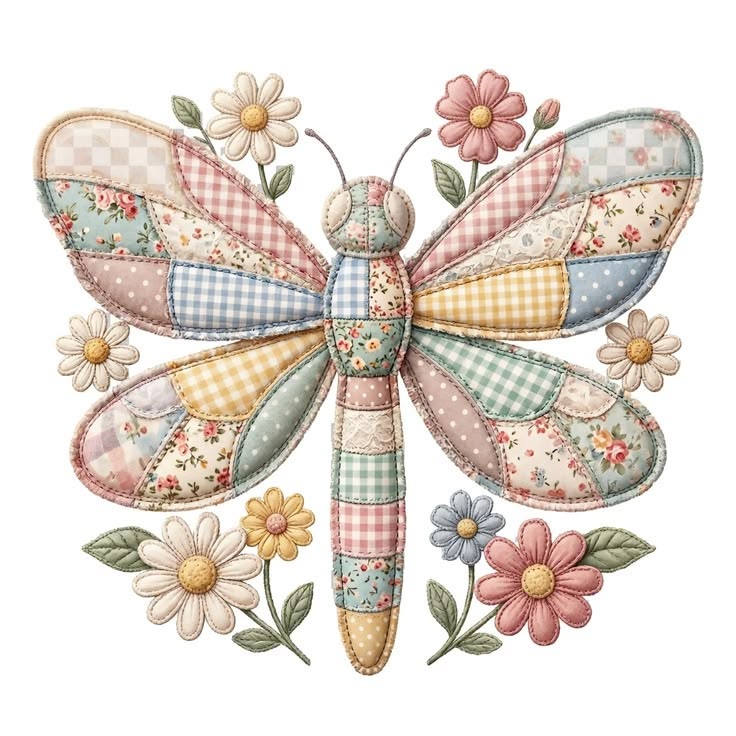
Dragonfly Patchwork Fabric Appliqué Pattern is a charming sewing project that combines the warmth of traditional patchwork with the delicate beauty of nature-inspired appliqué. The dragonfly shown in this design is built from many small pieces of coordinating fabric, including floral prints, gingham, polka dots, soft solids, and vintage-style patterns. Instead of depending on one large piece of fabric for each wing, the project celebrates variety, making it an excellent way to transform treasured scraps into decorative textile art. The softly padded appearance, visible stitching, symmetrical wings, and surrounding flowers give the finished piece a handcrafted character that works beautifully for wall hangings, quilt blocks, cushion fronts, tote bags, or framed fabric art.
One of the most attractive features of a Dragonfly Patchwork Fabric Appliqué Pattern is the freedom it gives the maker to personalize every section. Soft pink, sage green, dusty blue, cream, mustard, and muted brown create the gentle vintage palette seen in the inspiration image, but the same construction can be adapted to brighter contemporary colors or even a monochromatic collection. The dragonfly can also be made from leftover quilting cotton, which makes this an especially practical fabric scrap project. By carefully balancing prints across the wings and repeating selected colors throughout the body, even a collection of unrelated scraps can become a harmonious composition.
Although the finished dragonfly looks detailed, the construction becomes much easier when it is divided into manageable stages. The essential techniques include fabric appliqué, patchwork piecing, template preparation, pressing, light padding, edge stitching, and decorative quilting. Beginners can simplify the number of sections inside each wing, while experienced quilters can add more intricate pieces, embroidery, free-motion quilting, or hand stitching. The following tutorial explains how to recreate the visual character of the pictured project from beginning to end while allowing enough flexibility to make the finished dragonfly uniquely yours.
Materials, Templates, and Fabric Selection for the Dragonfly
Begin by choosing the fabrics for your Dragonfly Patchwork Fabric Appliqué Pattern. Quilting cotton is particularly suitable because it is stable, easy to press, and available in countless prints. For a vintage-inspired dragonfly, collect small pieces in cream, blush pink, muted green, pale blue, mustard, beige, and dusty rose. Mix floral fabric, gingham, checks, dots, and subtle geometric prints rather than selecting fabrics that all look identical. The contrast between patterns is what gives the wings their distinctive patchwork appearance.
DISCOVER MORE FREE PATTERNS HERE!
You will need a background fabric, assorted cotton scraps, lightweight fusible web if using fused appliqué, coordinating sewing thread, thin batting or fusible fleece, basic sewing tools, paper for templates, and an iron. A removable fabric marker is helpful for positioning the different elements. If the project will become a quilt block or cushion, cut the background several centimeters larger than the desired finished dimensions so that it can be trimmed accurately after the appliqué and quilting are complete.
Create the dragonfly template before cutting the decorative fabrics. The main pattern should include four wings, a segmented body, a rounded head, and two slender antennae. Because symmetry is important, draw one upper wing and one lower wing first, then mirror them to create the opposite side. A practical decorative dragonfly could measure approximately 30 to 40 cm wide, although the pattern can be enlarged or reduced according to its intended use.
Next, divide each wing template into several curved patchwork sections. The inspiration design uses elongated panels that follow the natural direction of the wings rather than ordinary square patchwork. Number every section on the paper template before cutting it apart. Add approximately 0.7 to 1 cm seam allowance when sections will be traditionally pieced together. If the pieces will instead be fused individually and covered with decorative stitching, follow the requirements of the appliqué method you choose.
The body should also be separated into multiple sections. Alternate floral fabric, gingham, dots, and small neutral prints to create the characteristic segmented appearance. Keep the central body slightly wider near the upper section and gradually taper it toward the tail. The rounded head can be divided vertically or into several curved sections to echo the patchwork treatment used in the wings.
Before sewing anything permanently, arrange all the cut fabrics on a flat surface. Move individual pieces around until the colors appear evenly distributed. Avoid placing every strong pink fabric on one side or every green fabric on the other. Color balance in patchwork does not require perfect duplication, but repeating colors on opposite sides creates visual harmony and helps the dragonfly retain its symmetrical character.
Building the Patchwork Wings and Segmented Dragonfly Body
Start construction with the four wings. Work on one wing at a time so the numbered pieces remain organized. When using traditional piecing, place the first two pieces right sides together, align their edges, and sew with the chosen seam allowance. Press the seam carefully before attaching the next section. Continue adding pieces according to the numbered template until the entire wing has been assembled.
Curved sections require slightly more patience than straight patchwork seams. Pin or clip the beginning, center, and end of each curve before filling in the spaces between them. Sew slowly without pulling either layer. Gentle curves can usually be stitched comfortably on a domestic sewing machine. Once the seam is finished, clip the allowance carefully where necessary so that it can relax when pressed. This technique produces the softly flowing divisions visible throughout the patchwork dragonfly wings.
When each wing is complete, place it over thin batting or fusible fleece. This additional layer gives the appliqué a slightly raised, textile-art appearance. Stitch around the patchwork seam lines using a straight stitch, hand quilting, or another decorative stitch. A contrasting thread can emphasize every fabric section, while matching thread produces a quieter result. Consistent stitching is more important than making every line perfectly identical.
Construct the body separately by joining the small horizontal segments in sequence. Alternate prints to prevent neighboring sections from blending together. Once assembled, lightly press the body from the reverse side. A narrow strip of batting beneath the body can create gentle dimension, but avoid excessive bulk because the narrow tail must remain easy to stitch around.
The head can be assembled from two or more small pieces and lightly padded. Position it immediately above the body, leaving enough room for the antennae. The antennae themselves do not need to be cut from fabric. They can be created with embroidery stitches, narrow cord, couching, or dense machine stitching. Slightly curved antennae usually look more natural than perfectly straight lines.
Now place the completed upper and lower wings around the central body. Check the spacing carefully before attaching anything. The upper wings should rise gently outward, while the lower wings angle downward. Step away from the project and look at the entire arrangement rather than focusing only on individual seams. Small adjustments at this stage can dramatically improve the symmetry of the finished Dragonfly Patchwork Fabric Appliqué Pattern.
Appliqué Assembly, Decorative Stitching, and Floral Details
Prepare the background by pressing it thoroughly and marking its center with temporary guidelines. Position the dragonfly body along the vertical center first. The wings can then be aligned relative to this central reference. If using fusible web, follow the product instructions to secure each component temporarily. Do not rely entirely on visual estimation when placing four symmetrical wings; measure the distance between corresponding points on both sides.
Attach the wings with your preferred appliqué stitching technique. A narrow zigzag or blanket stitch is practical for machine appliqué, while a straight stitch positioned slightly inside the raw edge creates a rustic raw-edge finish. For a softer traditional appearance, turn the edges under and use nearly invisible hand stitches. The method can be selected according to your experience and the amount of time you want to spend on the project.
After securing the outer edges, reinforce the internal patchwork lines with decorative stitching. This step highlights each individual fabric and makes the segmented construction easier to see. You can use ordinary straight stitching, small hand running stitches, or subtle quilting. Keep the stitch length reasonably consistent and avoid overworking the fabric. The objective is to emphasize the patchwork rather than cover it with thread.
The flowers surrounding the dragonfly add personality to the composition but can be simplified if desired. Create basic flower templates with five or more rounded petals, a circular center, stems, and simple leaves. Cut the petals from cream, pink, mustard, or dusty blue fabrics. For extra dimension, add a thin layer of batting beneath selected flowers before stitching around them. This creates the softly padded appearance associated with dimensional fabric appliqué.
Arrange flowers asymmetrically around the dragonfly while maintaining overall balance. A few blossoms can appear near the upper wings, while larger flowers can be positioned below the lower wings. Leaves made from muted green fabric help connect the flowers visually. Stems may be formed from narrow bias strips, embroidery, or machine stitching. Avoid overcrowding the dragonfly; leaving visible background around the shapes allows the central motif to remain the focal point.
Once all appliqué pieces are secured, inspect the project for loose edges, puckering, or missed stitching. Trim unnecessary thread tails and press gently from the reverse side. When batting has been used, avoid flattening the piece with excessive heat or pressure. A light final press is generally sufficient to smooth the background while preserving the raised texture of the patchwork fabric appliqué.
Quilting, Finishing, and Creative Ways to Use the Pattern
If you want to transform the appliqué into a small quilted panel, create a traditional quilt sandwich using the decorated top, batting, and backing fabric. Baste the three layers together and quilt around the outside of the dragonfly. Echo quilting approximately 0.5 to 1 cm away from the motif can make the dragonfly appear even more dimensional. Additional background quilting may be added, but simple quilting often complements a detailed appliqué more effectively.
For a wall hanging, square the finished panel carefully after quilting. Add binding around all four edges using fabric that coordinates with the dragonfly. A soft neutral, dusty rose, sage green, or muted floral binding works particularly well with a vintage palette. Add a hanging sleeve to the reverse if the piece will be displayed on a wall. The same panel can also be mounted in a textile frame if preferred.
To make a cushion, use the completed appliqué panel as the front. Trim it to the desired cushion size, remembering to include seam allowance. Add a backing with an envelope opening or zipper, then sew the front and back together. Because the dragonfly contains raised details, turn the cushion carefully and gently shape the corners before inserting the cushion form.
The pattern can also be adapted for tote bags, table decorations, memory quilts, and personalized gifts. For smaller projects, reduce the number of patchwork sections rather than trying to sew extremely tiny pieces. A miniature dragonfly might have only two or three fabrics in each wing. A larger wall panel, by contrast, offers enough space for detailed floral prints, lace inserts, embroidery, and additional quilting.
Fabric choice is one of the easiest ways to change the personality of the project. Bright turquoise, orange, purple, and lime fabrics can produce a playful contemporary dragonfly. Navy, cream, and gray can create a sophisticated version, while pink florals and pastel gingham reinforce a romantic cottage style. Whatever palette you choose, repeat at least a few colors throughout the four wings and body so the composition remains visually connected.
The most important finishing step is simply to examine the entire project before declaring it complete. Check whether additional stitching would improve a loose edge, whether the antennae need more definition, and whether any flower requires reinforcement. Remove temporary markings according to the marker manufacturer’s instructions. Your completed Dragonfly Patchwork Fabric Appliqué Pattern should feel carefully constructed while still preserving the gentle imperfections that make handmade patchwork appealing.
Frequently Asked Questions About the Dragonfly Patchwork Fabric Appliqué Pattern
What fabric works best for a Dragonfly Patchwork Fabric Appliqué Pattern?
Medium-light quilting cotton is an excellent choice because it cuts cleanly, presses well, and remains relatively stable during appliqué. Small floral prints, gingham, dots, checks, and subtle vintage patterns can be mixed successfully. Very stretchy fabrics are more difficult for beginners because the small pieces may distort during sewing.
Can beginners make this dragonfly appliqué?
Yes. Beginners should consider simplifying the internal wing sections and using fusible appliqué. Instead of creating many curved seams, divide each wing into three or four manageable sections. Practice the chosen edge stitch on scrap fabric before sewing the actual dragonfly.
How large should the finished dragonfly be?
There is no mandatory size. A width of approximately 30–40 cm creates enough room for visible patchwork sections without requiring extremely small pieces. Smaller motifs work well for bags and cushions, while larger versions are ideal for quilt panels and wall art.
Do I need fusible web for fabric appliqué?
No. Fusible web is convenient because it keeps pieces stable while they are stitched, but traditional needle-turn appliqué, raw-edge appliqué, or other appliqué methods can also be used. Choose the method that best matches the desired finish and your sewing experience.
Should the right and left wings use exactly the same fabrics?
Not necessarily. Matching fabrics can produce strong symmetry, but coordinated fabrics often create a more interesting scrappy patchwork design. Repeat several colors and prints across both sides without making every section identical.
How can I make the dragonfly look padded like the inspiration project?
Place thin batting or fusible fleece behind the individual wings and body before attaching them to the background. Stitching around the outer shapes and internal divisions will gently compress the edges while leaving the center slightly raised.
What stitch should I use around the appliqué pieces?
A blanket stitch, narrow zigzag, straight raw-edge stitch, or hand appliqué stitch can all work. For the handcrafted appearance of the pictured design, visible straight stitching or a subtle blanket stitch can beautifully emphasize the outlines and patchwork divisions.
Can I make the flowers separately from the dragonfly?
Absolutely. The flowers are decorative additions rather than structural parts of the dragonfly. You can use only the dragonfly, add fewer flowers, replace them with leaves, or design a completely different botanical arrangement around the central motif.
How can I prevent the background from puckering?
Use a stable cotton background, press fabrics before cutting, avoid stretching pieces during sewing, and consider using a lightweight stabilizer when doing dense machine appliqué. Work gradually around curves instead of pulling the fabric through the machine.
Can fabric scraps be used for this project?
Yes, and this is one of the best features of the pattern. Small scraps are ideal for the segmented wings, body, flowers, and leaves. Organizing scraps by color before beginning can make it much easier to create a balanced scrap fabric appliqué project.
Should the appliqué be quilted after it is finished?
Quilting is optional if the motif is being used on a simple bag or decorative item. For a quilt block or wall hanging, quilting adds stability, texture, and definition. Stitching close to the dragonfly’s outline can also help the padded motif stand out from the background.
Can I wash the finished project?
A washable project should be made from washable fabrics, thread, batting, and appliqué materials. Prewashing cotton fabrics can reduce unexpected shrinkage, especially when combining scraps from different sources. Decorative wall art generally requires less frequent washing than functional items such as cushions or bags.
Conclusion
Creating a Dragonfly Patchwork Fabric Appliqué Pattern is a wonderful way to combine patchwork sewing, fabric appliqué, decorative stitching, quilting, and scrap-friendly creativity in one project. By beginning with a symmetrical template, dividing the wings into manageable sections, carefully coordinating different prints, and constructing the body in colorful segments, you can reproduce the distinctive handcrafted character of the inspiration while still creating an original piece.
Throughout the process, the key is to work gradually. Prepare the templates accurately, organize the fabric before sewing, construct each wing separately, press carefully, assemble the body, position the appliqué symmetrically, and add decorative stitches only after the major components are secure. Flowers, leaves, padded details, embroidery, and background quilting can then be added according to your preferred style and skill level.
EASILY FIND THE FREE PDF FOR THIS PATTERN HERE!
The finished dragonfly can become much more than a practice block. It can serve as the centerpiece of a wall hanging, cushion, quilt, tote bag, or special handmade gift. Most importantly, the Dragonfly Patchwork Fabric Appliqué Pattern offers an enjoyable opportunity to give small fabric scraps a new purpose while practicing several valuable sewing techniques in a single decorative project. If you make your own version, leave your sincere opinion about the pattern and share any suggestions you have for colors, fabrics, stitching techniques, or creative variations. Your ideas may inspire an entirely new interpretation of this beautiful patchwork dragonfly.