
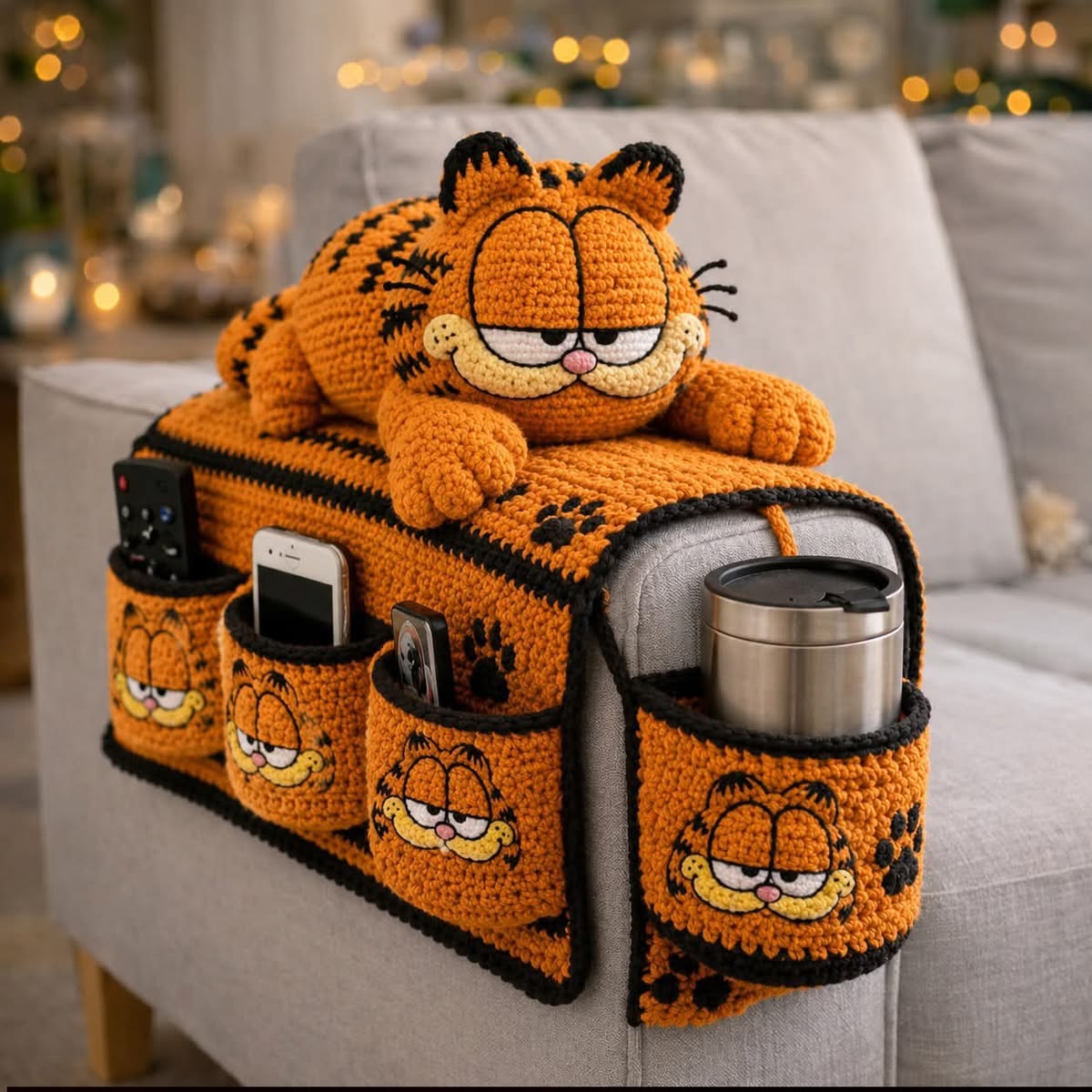
Crochet Sofa Armrest Organizer with Garfield Print Pattern is a playful and practical crochet project designed to turn an ordinary sofa arm into a convenient storage area while adding a recognizable orange-cat-inspired decorative theme. The finished piece combines a long crocheted armrest mat, several useful pockets, contrasting black edging, paw-print details, and a soft three-dimensional cat figure resting on top. It is especially appealing for crocheters who enjoy projects that are both decorative and functional, because the organizer can keep remotes, a phone, reading glasses, small accessories, and other lightweight everyday items close at hand. Although the photographed version contains many details, the basic construction can be broken into manageable crochet sections that are assembled at the end.
A successful crochet sofa organizer begins with measurements rather than a fixed stitch count. Sofa arms vary considerably in width, height, and shape, so this pattern is best treated as an adaptable guide. The organizer in the reference image has a central rectangular section that sits across the top of the armrest, with panels extending down the sides and pockets attached to the hanging areas. For a similar proportion, a finished width of approximately 30–35 cm works for many sofas, but you should measure your own furniture first. The primary crochet fabric can be worked with orange yarn and accented with black, cream, white, yellow, and pink. Using a firm yarn and a fairly dense stitch produces the structure needed to prevent the pockets from stretching excessively.
The Crochet Sofa Armrest Organizer with Garfield Print Pattern also provides an opportunity to practice several fundamental U.S. crochet techniques. The primary fabric can be created almost entirely with single crochet (sc), while slip stitch (sl st) and chain (ch) are useful for joining, edging, and shaping. Increases and decreases are needed for the dimensional cat, while embroidery or surface crochet can create facial features, stripes, paw prints, and other decorative elements. Beginners can simplify the design by making only the organizer and pockets, while experienced crocheters can add the complete stuffed cat topper and detailed appliqués shown in the inspiration.
Materials, Measurements, Crochet Keys, and Preparation
For this crochet armrest organizer pattern, choose a medium-weight yarn that produces a durable fabric. Cotton, cotton blends, or sturdy acrylic yarn can all work well. You will need orange as the dominant color, black for borders and markings, cream or pale yellow for the muzzle, white for the eyes, a small quantity of pink for the nose, and dark yarn for facial embroidery. You will also need an appropriately sized crochet hook, scissors, a yarn needle, stitch markers, and optional polyester fiberfill for the stuffed cat.
DISCOVER MORE FREE PATTERNS HERE!
The most important abbreviation in this project is sc = single crochet. To make a U.S. single crochet, insert the hook into the indicated stitch, yarn over, pull up a loop, yarn over again, and pull through both loops on the hook. Single crochet produces a compact surface that is ideal for organizers because it offers considerably more stability than tall, open stitches.
Other crochet keys include ch = chain, sl st = slip stitch, st/sts = stitch/stitches, inc = increase, and dec = decrease. For an increase, work two single crochet stitches into the same stitch. For a decrease, use an invisible single crochet decrease whenever possible: insert the hook through the front loops of the next two stitches, yarn over and pull through, then yarn over and complete the stitch. These shaping techniques become especially important when making the head, paws, body, and ears.
Before crocheting, measure the sofa arm from the inside edge, across the top, and down the outside. Also measure the width of the flat upper section. Make a small crochet gauge swatch, approximately 10 × 10 cm, using single crochet. Count how many stitches and rows fit into 10 cm. This information allows you to calculate a starting chain that fits your particular sofa instead of depending on a universal number that might be too narrow or too wide.
To create the main panel, chain enough stitches to reach the desired organizer width. As an example, you might begin with approximately 50–60 chains when using medium-weight yarn, but your gauge should determine the actual count. Work one single crochet into the second chain from the hook and continue across. Chain 1, turn, and work one single crochet into every stitch. Repeat these rows until the panel is long enough to cross the armrest and hang comfortably down both sides.
The reference design uses orange as its visual foundation and black as a strong contrasting border. Once the main rectangle reaches the correct dimensions, fasten off the orange yarn and join black yarn at a corner. Work an even round of single crochet around the entire panel, placing approximately three stitches into each corner when needed to keep the fabric flat. This black crochet edging strengthens the perimeter while visually framing the orange fabric.
Finally, block the main panel gently before adding pockets. Lay it flat and adjust the edges until the rectangle is even. If using acrylic yarn, avoid excessive heat. Cotton can generally tolerate damp blocking more easily. The goal is not to stretch the piece dramatically, but simply to make the organizer lie flat and give you an accurate foundation for positioning the remaining components.
Crocheting and Attaching the Organizer Pockets
The pockets are one of the most useful features of the Crochet Sofa Armrest Organizer with Garfield Print Pattern. Rather than trying to crochet every pocket directly into the main panel, make separate rectangles and sew them into position afterward. This construction method makes it much easier to customize pocket width and depth according to what you plan to store.
For a remote-control pocket, chain enough stitches to make a rectangle approximately 10–12 cm wide. Work rows of single crochet until the piece measures roughly 13–16 cm tall. Add a black single crochet border along the upper edge. You can make the pocket slightly wider than its final placement area so that it has enough room to hold a bulky remote without pulling the main organizer out of shape.
A phone pocket can be constructed using the same technique but should be sized around your device. Leave some ease rather than making an extremely tight pouch. For example, if the phone is approximately 8 cm wide, make the finished pocket around 10–11 cm wide. The additional space accommodates the thickness of the phone and makes it easier to insert and remove it.
For the larger front or side pocket, make a wider rectangle suitable for reading glasses, a small notebook, or another lightweight accessory. Work the rectangle in orange single crochet and finish its opening with black yarn. If you want the opening to remain especially firm, work a row of slip stitches along the upper edge after completing the black border. Do not make these stitches too tight or the pocket may curl.
Arrange all pockets on the organizer before sewing anything permanently. Pin or temporarily tack them in place, then place the organizer over your sofa arm. Check whether the pockets hang at convenient heights and make sure they do not interfere with the seated area. This fitting stage is extremely useful because a placement that looks balanced on a table may feel awkward once the organizer is actually installed.
Sew each pocket along the two sides and bottom, leaving the upper edge open. Use a yarn needle and strong matching yarn. A whipstitch can work, but a mattress-style seam or carefully spaced backstitches can provide additional stability. Reinforce the upper corners because these points receive the most stress whenever an item is inserted into the pocket.
Decorative cat-face appliqués can then be added to the pocket fronts. For an original handmade interpretation, crochet small orange face shapes, cream muzzle pieces, white eye sections, and a pink nose, then embroider black details. Attach each element securely while keeping the inside of the pocket as smooth as possible. The decorative motifs should remain relatively flat so they do not interfere with the practical purpose of the pockets.
Making the Orange Cat Topper and Decorative Details
The dimensional cat topper is the most advanced component of this crochet organizer pattern. It is essentially a simplified amigurumi construction made from a large head, rounded body, four limbs, ears, muzzle sections, and facial pieces. If you are new to amigurumi, use stitch markers carefully because most of these pieces are worked continuously in spirals rather than joined rounds.
Begin the head with orange yarn and a magic ring. Work 6 sc into the ring. On the following round, increase in every stitch to obtain 12 stitches. Continue increasing evenly over successive rounds until the circle reaches the desired circumference. Once the head is wide enough, work several rounds without increases to establish depth. Then decrease gradually and stuff firmly but not excessively before closing.
The body can be made as an elongated oval rather than a perfect sphere. Start with a short foundation chain and crochet around both sides of that chain, placing several stitches at each end to create an oval. Continue working in rounds, increasing at both ends until the body reaches the desired width. Crochet even rounds for length, then decrease gradually toward the back. Stuff the body lightly enough that it remains soft and can rest comfortably on the organizer.
For each front paw, begin with a magic ring and 6 sc, increase gradually, and then work several even rounds to create a short rounded cylinder. Stuff lightly and flatten the attachment end. The rear legs can be larger and slightly elongated. Attach the limbs so the finished cat appears relaxed across the upper portion of the sofa organizer, similar to the lounging position that gives the inspiration piece much of its charm.
The ears are small triangular pieces. They can be crocheted in rows by starting with a wider orange base and decreasing toward the tip. Add black yarn along the upper portion to reproduce the strong dark ear accents. Sew both ears symmetrically to the top of the head. Before tightening the stitches completely, examine the face from the front to make sure both ears sit at similar angles.
Create the muzzle with two cream or pale-yellow oval pieces. Crochet the eye areas separately in white and orange, then use black yarn to define the eyelids and pupils. A small pink oval makes the nose. Facial details can be attached with careful hand sewing, while whiskers and dark stripes are best embroidered after the main pieces are securely positioned. Avoid leaving loose yarn loops that could catch on objects.
Black stripes and crochet paw-print details complete the orange-cat theme. These can be embroidered directly onto the body and organizer using a yarn needle. For a paw print, make one larger central pad with several smaller toe shapes above it. The black accents should be distributed thoughtfully rather than covering the orange foundation. This creates the bold contrast visible in the inspiration while keeping the design visually balanced.
Final Assembly, Finishing, Care, and Customization
Place the completed cat on the central upper portion of the organizer and test the entire project on the sofa before attaching it. The cat should not make the organizer excessively top-heavy. If necessary, reduce the amount of stuffing in the body. Once you are satisfied with the placement, sew the underside of the body to the main crochet panel at several secure points.
Check every seam after assembly. Pull gently on the pocket corners, border, cat limbs, and decorative appliqués. Reinforce any area that feels loose. Because the crochet sofa armrest organizer is a functional household piece rather than a purely decorative item, durability matters. Secure all yarn tails by weaving them through multiple stitches on the wrong side before trimming them.
If the organizer slides on smooth upholstery, you can improve stability without permanently altering the sofa. One simple approach is to make the center panel slightly longer so the hanging sections provide more counterweight. The pockets should also be distributed reasonably evenly. Avoid filling one side with several heavy objects while leaving the opposite side empty.
Customization is one of the strengths of this pattern. You can change the width, pocket arrangement, number of pockets, decorative motifs, or color palette. The orange-and-black combination creates the recognizable comic-cat aesthetic of the photographed project, but the same construction can be adapted into an original striped cat, solid-colored pet, or completely different decorative theme.
Cleaning requirements depend primarily on the yarn label. For a washable yarn, place the organizer inside a large laundry bag or pillowcase to protect the decorative details. A gentle cycle or hand washing is preferable for elaborate crochet work. Remove detachable objects first, reshape the organizer while damp, and allow it to dry completely before returning it to the sofa.
When using the pockets, reserve them for lightweight household objects. Phones, remotes, glasses, and small accessories are appropriate. Heavy containers can stretch crochet fabric over time, so a drink holder should be considered decorative unless it has a rigid, stable support specifically designed to prevent tipping. Keeping liquids away from electronics and upholstered furniture is also the safer practical choice.
The finished Crochet Sofa Armrest Organizer with Garfield Print Pattern combines several skills in one satisfying project: rectangular crochet construction, pocket making, edging, appliqué, embroidery, amigurumi shaping, and final assembly. Taking the project one component at a time makes the detailed appearance much less intimidating, and careful measurements ensure the organizer fits the sofa rather than relying on a one-size-fits-all pattern.
FAQ – Crochet Sofa Armrest Organizer with Garfield Print Pattern
What crochet skill level is recommended for this project?
An adventurous beginner can make the basic organizer and rectangular pockets, but the complete design is better suited to an intermediate crocheter. The three-dimensional cat involves working in rounds, increases, decreases, stuffing, embroidery, and assembling multiple pieces.
What are the most important U.S. crochet abbreviations for this pattern?
The main terms are ch (chain), sc (single crochet), sl st (slip stitch), st/sts (stitch/stitches), inc (increase), and dec (decrease). Most of the organizer can be completed with single crochet, making it relatively approachable despite its detailed appearance.
How do I determine the correct size for my sofa?
Measure the width of the armrest and the distance from one hanging edge, across the top, to the opposite hanging edge. Crochet a gauge swatch and calculate the required starting stitches from your personal gauge. Measuring is more reliable than following a fixed stitch count because sofas vary significantly.
Can I make the organizer without the stuffed cat?
Yes. The organizer functions perfectly well with only the rectangular base, border, and storage pockets. You can also replace the dimensional topper with flat crochet appliqués if you prefer a quicker project.
What yarn works best for a crochet sofa organizer?
A sturdy medium-weight cotton, cotton blend, or durable acrylic is a practical choice. A firm yarn helps the pockets maintain their shape. Extremely soft or stretchy yarn may cause the pockets to sag when holding remotes or phones.
How can I make the pockets stronger?
Use a slightly smaller crochet hook to create dense stitches, reinforce the pocket corners, and add a firm single-crochet or slip-stitch border around the openings. You can also double the fabric for pockets intended to carry slightly heavier objects.
Should the cat topper be heavily stuffed?
No. Moderate stuffing is generally better. Excessive stuffing makes the cat heavy and rigid, which can cause the organizer to shift. The body should remain soft enough to rest naturally across the sofa arm.
Can the organizer be machine washed?
That depends on the yarn and stuffing used. Always follow the yarn-care instructions. Because this design contains several appliqués, embroidered details, and stuffed components, gentle hand washing is often the easiest way to preserve its shape.
How can I resize the pattern without changing its overall appearance?
Maintain the same general proportions while adjusting stitch counts according to your gauge. Make the central rectangle fit the armrest first, then size each pocket relative to that foundation. The decorative cat can also be made smaller or larger independently.
Why is single crochet recommended for most of the project?
Single crochet creates a dense, relatively firm fabric with small spaces between stitches. That makes it particularly suitable for an organizer because phones, remote controls, and other small objects are less likely to distort or slip through the fabric.
Conclusion
The Crochet Sofa Armrest Organizer with Garfield Print Pattern turns basic crochet techniques into a creative piece of functional home décor. Throughout this project, you learned how to measure the sofa, calculate the main panel, work dense single crochet, create contrasting borders, construct individual storage pockets, add decorative appliqués, shape an amigurumi-style cat, embroider facial and paw details, and assemble everything securely.
The key to achieving a polished result is to work gradually. Begin with an accurate crochet gauge, complete the main rectangular foundation, test it directly on the sofa, and only then determine the final dimensions and positions of the pockets. Once the functional construction is correct, you can spend time on the decorative elements without worrying about whether the organizer will fit.
This pattern is also highly adaptable. You can simplify it, add extra pockets, change the dimensions, modify the colors, or use the construction as inspiration for your own original cat-themed design. Whether you make the detailed dimensional topper or choose a simpler appliqué version, the combination of crochet storage pockets, sturdy edging, and playful decoration can produce a charming handmade accessory for a living room.
EASILY FIND THE FREE PDF FOR THIS PATTERN HERE!
Most importantly, enjoy the process and make the project your own. Handmade crochet does not need to look factory-perfect; small variations give every finished organizer its individual character. If you make your own version of this Crochet Sofa Armrest Organizer with Garfield Print Pattern, leave your sincere opinion about the project and share your suggestions for colors, pocket arrangements, decorative details, or other improvements you would love to try.