
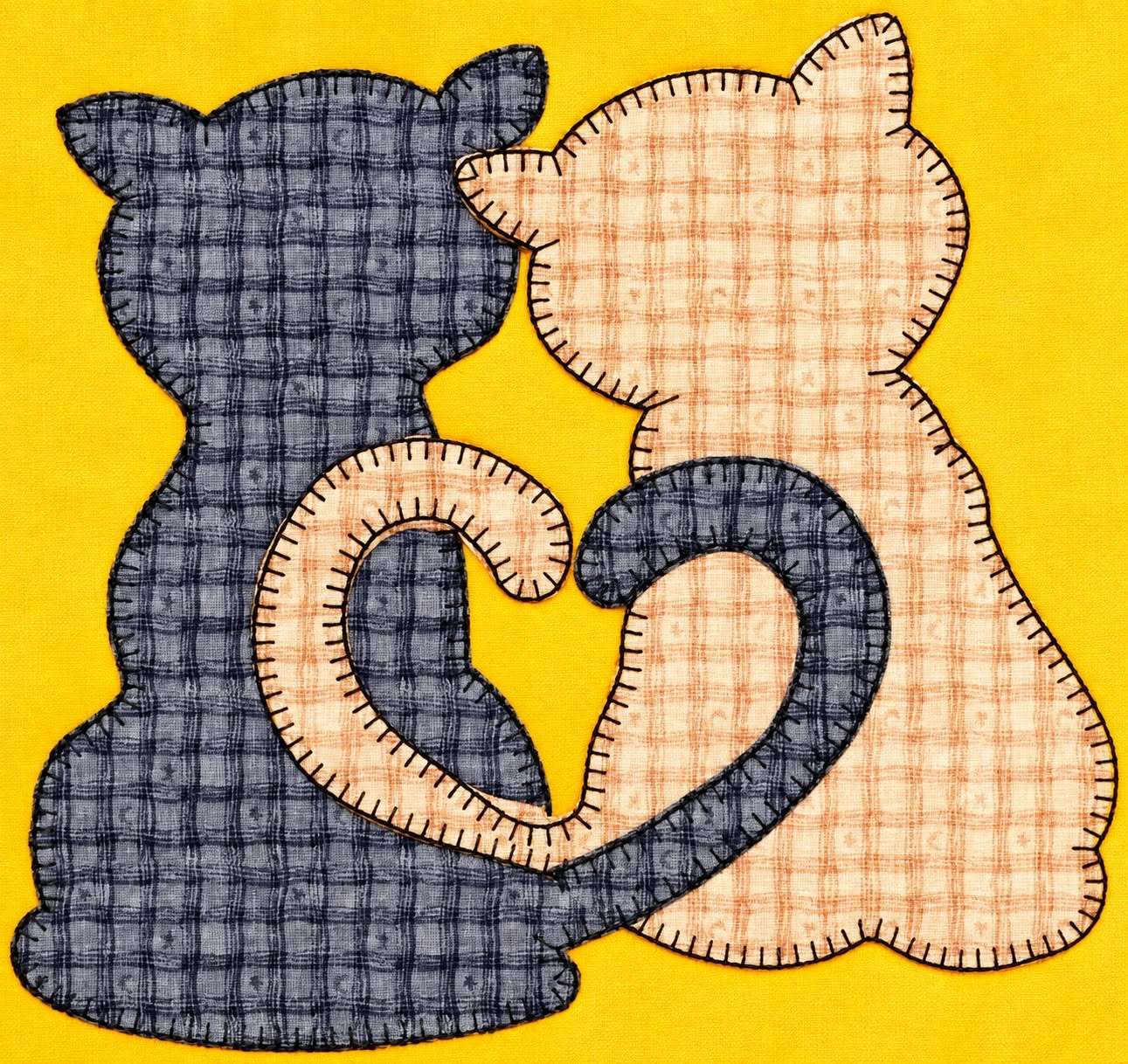
The Two Cats with Heart Appliqué Pattern is a charming fabric project that combines the warmth of handmade appliqué with a simple, meaningful design. Two cat silhouettes sit side by side while their curved tails meet in the center to create the recognizable shape of a heart. The result is especially appealing for people who enjoy cat appliqué patterns, country-inspired sewing, patchwork, and handmade home décor. Although the finished design looks detailed, it can be created with straightforward techniques that are accessible to beginners who are comfortable cutting fabric and making basic stitches. The project also provides plenty of room for personalization through fabric prints, colors, thread choices, and finishing methods.
One of the strongest features of this Two Cats with Heart Appliqué Pattern is the contrast between the two silhouettes. In the reference design, one cat uses a darker plaid-style fabric while the second uses a softer cream or peach-toned print. Repeating those fabrics in the opposite tails visually connects the animals and makes the central heart much easier to notice. Decorative blanket stitching around the edges adds another handmade element while simultaneously helping secure the appliqué pieces. You can preserve this rustic appearance or adapt the project with modern cotton prints, solids, florals, gingham, batiks, or fabrics left over from previous quilting projects.
This project can become much more than a decorative fabric picture. Once you understand the construction method, the cat appliqué design can be incorporated into a cushion cover, wall hanging, quilt block, tote bag, table mat, fabric organizer, or framed textile decoration. The same pattern can also be enlarged or reduced to suit different projects, provided that all pieces are resized proportionally. Careful preparation is particularly important around the tails because their curves form the focal heart. By working slowly through tracing, cutting, positioning, fusing, and stitching, you can create a neat project without needing complicated sewing equipment.
Materials and Preparation for the Two Cats with Heart Appliqué Pattern
Begin by selecting two coordinating fabrics for your Two Cats with Heart Appliqué Pattern. Quilting cotton is an excellent option because it is stable, easy to trace, and comfortable to stitch. Choose fabrics with enough contrast that the two cats remain visually separate. For example, a charcoal plaid paired with a cream plaid creates a traditional appearance similar to the reference image. You can also experiment with navy and beige, red and cream, gray and pink, or any combination that suits your décor.
DISCOVER MORE FREE PATTERNS HERE!
You will also need a background fabric large enough to comfortably accommodate the complete design. A plain or subtly textured background usually works well because it allows the fabric cat appliqué to remain the main attraction. Cotton, linen blends, and quilting fabrics are practical choices. Before cutting anything, press all fabrics carefully with an iron so wrinkles do not distort the templates or affect the accuracy of the appliqué placement.
For a fusible appliqué method, prepare lightweight fusible web, fabric scissors, paper scissors, an iron, an ironing surface, pins or appliqué glue if desired, and coordinating embroidery or sewing thread. Fusible web is placed between the appliqué fabric and background and helps hold the pieces securely while you stitch around them. Always follow the temperature and pressing instructions supplied with the fusible product you are using because different products can require different settings.
The pattern itself consists primarily of two cat bodies and two curved tail sections. Notice that the tails are especially important: they curve inward and together produce the heart-shaped appliqué in the center. When creating your templates, carefully reproduce the rounded body shapes, pointed ears, head contours, paws, and tail curves. Smooth curves will make both cutting and stitching easier.
Remember that fusible appliqué templates are commonly traced in reverse because the fusible web is applied to the wrong side of the fabric. This is particularly relevant when orientation matters. For this symmetrical-looking pair of cats, maintaining the correct left-and-right positioning will help the two tails align naturally. Labeling templates as Left Cat, Right Cat, Left Tail, and Right Tail can prevent confusion during assembly.
Before cutting the final fabrics, make a quick paper version of the entire design. Place the paper pieces together and inspect the central heart. The two curved tails should create a smooth, balanced outline without awkward gaps. This simple preparation step can save fabric and gives you an opportunity to adjust the scale or curves before working with your chosen materials.
Cutting and Positioning the Cat Appliqué Pieces
Trace each template onto the paper side of your fusible web. Leave a small amount of space between the individual pieces rather than cutting directly on the traced outlines immediately. Rough-cut around each shape, leaving a narrow margin outside the line. This makes the fusible material easier to handle and gives you greater control when attaching it to your appliqué fabric.
Place each fusible shape adhesive-side down against the wrong side of its corresponding fabric. Follow the fusible manufacturer’s instructions to press it into position. Avoid sliding the iron back and forth as though ironing clothing. Instead, lift and press the iron section by section. This helps prevent distortion, which is particularly important along the curved tails and smaller areas around the ears.
Once the pieces have cooled, carefully cut directly along the traced lines using sharp fabric scissors. Turn the fabric gradually while cutting around curves rather than making many abrupt cuts with the scissors. Pay special attention to the ears, paws, neck areas, and inner tail curves. Clean cutting makes the subsequent blanket stitch appliqué considerably easier and gives the finished cats a more polished silhouette.
Arrange the two cat bodies on your prepared background before removing the fusible backing paper. The cats should sit close enough together to communicate the paired composition while retaining clear individual outlines. Look at the negative space around the heads and between the bodies. Balanced spacing helps the finished Two Cats with Heart Appliqué Pattern feel intentional rather than crowded.
Next, position the curved tails. This is the defining stage of the design because the tails must work together to form the heart. One tail curves inward from one side while the contrasting tail approaches from the opposite direction. Adjust them until the inner opening resembles a smooth heart. Do not permanently fuse anything until you are satisfied with this relationship.
When everything looks balanced, lightly mark the positions if necessary, remove the paper backing, and fuse the pieces according to the product instructions. Work from the larger body shapes toward the smaller or overlapping sections. Allow the project to cool completely on a flat surface afterward. The appliqué should now be stable enough for decorative stitching without shifting excessively.
Sewing the Blanket Stitch and Creating the Heart Detail
The visible edge stitching is an important characteristic of this cat appliqué pattern. A traditional blanket stitch works particularly well because it produces short stitches extending inward from a continuous line around the edge. The result resembles the handcrafted stitching visible in the reference design. Blanket stitch can be completed by hand for a rustic appearance or by machine if your sewing machine includes an appropriate appliqué stitch.
If sewing by hand, choose embroidery floss or a strong decorative thread that contrasts clearly with the fabrics. Dark brown, charcoal, black, cream, or another coordinating shade can work beautifully. Separate the embroidery floss strands if necessary to obtain a thickness appropriate for the scale of your project. Try several stitches on a fabric scrap before beginning the actual Two Cats with Heart Appliqué Pattern.
Start stitching along a relatively straight or gently curved section rather than at a sharp ear point. Maintain reasonably consistent spacing between stitches. Perfect mathematical uniformity is unnecessary in a handmade project, but keeping the stitches similar in size creates a cleaner border. Work slowly around the paws and ears, adjusting stitch spacing slightly whenever the direction changes.
The curved tails deserve additional attention. Since these pieces create the central appliqué heart, uneven stitching is more noticeable here. Use slightly shorter stitches around tight curves to maintain a smooth visual line. If hand stitching, rotate the project frequently so your hand remains comfortable and your needle enters the fabric at a consistent angle. If machine stitching, reduce speed when approaching narrow curves.
At the places where appliqué pieces overlap or visually meet, secure each edge appropriately without creating excessive layers of thread. The goal is to preserve the clear separation between the two contrasting fabrics while allowing the tails to read as one unified heart composition. Pressing gently after stitching can help the project lie flat, but protect decorative threads with a pressing cloth when necessary.
Inspect the entire appliqué once the stitching is complete. Look for loose threads, unsecured corners, uneven sections, or areas where the fusible adhesive has not fully bonded. Correcting these details now is easier than waiting until the appliqué has been incorporated into a finished cushion or wall hanging. A carefully finished edge also improves durability when the project will be handled frequently.
Finishing and Personalizing Your Two Cats with Heart Appliqué Pattern
After completing the appliqué, decide how you want to use the finished panel. For a simple fabric wall hanging, add batting and backing fabric, then quilt around the cats or across the surrounding background. Binding can be sewn around the outside edge just as you would finish a small quilt. A hanging sleeve on the back provides a convenient way to display the piece without disturbing the front design.
To transform the design into a cushion, center the appliqué on a square or rectangular fabric panel before adding the cushion backing. You can frame the central design with coordinating fabric strips to increase the finished size. A border made from one of the cat fabrics is particularly effective because it repeats the colors already present in the composition and gives the project visual continuity.
The design is also ideal for using fabric scraps. Because each cat is constructed as a relatively compact silhouette, you may already have suitable pieces in your sewing collection. Scraps from previous quilts can give the project sentimental meaning. Using fabrics from several memorable projects can transform a simple cat appliqué into a decorative piece with a personal story.
For a more contemporary interpretation, consider solid fabrics with highly contrasting colors. A black cat beside a white, gold, rust, teal, or soft gray cat can create a graphic appearance. For a farmhouse-inspired version, gingham, plaid, muted florals, and natural linen backgrounds are excellent options. The Two Cats with Heart Appliqué Pattern is flexible enough to work with many decorative styles without losing its recognizable character.
You can also add carefully selected details after the main appliqué has been completed. Small embroidered whiskers, collars, tiny fabric bows, or subtle decorative stitching can individualize the cats. However, avoid adding so many embellishments that the central heart becomes difficult to recognize. The simplicity of the two silhouettes and intertwined tails is one of the strongest visual features of the original concept.
Finally, press the completed project from the reverse side whenever possible and trim the background to the dimensions required for your chosen finish. If the piece will be washed, use fabrics, threads, stabilizers, and fusible products suitable for laundering. Proper finishing allows your handmade cat appliqué to remain attractive while protecting the stitching and preserving the carefully shaped heart motif.
FAQ About the Two Cats with Heart Appliqué Pattern
Is the Two Cats with Heart Appliqué Pattern suitable for beginners?
Yes. This project can be suitable for beginners because the construction relies primarily on tracing, cutting, fusing, positioning, and edge stitching. The curved tails require patience, but practicing on scrap fabric first can make the process much easier.
What fabric works best for cat appliqué?
Medium-weight quilting cotton is one of the easiest choices. It cuts cleanly, presses well, and comes in an enormous variety of colors and prints. Linen blends and other stable woven fabrics may also work, but very stretchy fabrics are generally more difficult for beginners.
Do I have to use fusible web?
No. Traditional needle-turn appliqué and other methods can also be used. However, lightweight fusible web makes positioning easier and helps prevent pieces from moving while you stitch, making it a convenient option for a beginner-friendly project.
What stitch should I use around the cats?
A blanket stitch closely matches the decorative appearance shown in this style of appliqué. A narrow zigzag or specialized machine appliqué stitch can also be used. Hand blanket stitching creates a particularly warm, handcrafted finish.
How do I keep the heart shape symmetrical?
Arrange all pieces before fusing them permanently. Focus especially on the inner curves of both tails and view the project from a short distance. A paper mock-up is useful for correcting the shape before cutting valuable fabric.
Can I enlarge the Two Cats with Heart Appliqué Pattern?
Yes. The design can be enlarged for a wall quilt or reduced for smaller projects. Resize every template by exactly the same percentage so the bodies and tails maintain their intended proportions.
Can I make the cats in different colors?
Absolutely. Color customization is one of the easiest ways to personalize the design. You could recreate the coloring of favorite cats or simply coordinate the fabrics with a room, quilt, bag, or cushion.
Should the thread match the fabric or contrast with it?
Either approach works. Contrasting thread emphasizes the blanket stitching and creates a folk-art appearance, while matching thread makes the edge finish more subtle. Choose according to the visual effect you want.
What can I make with the finished appliqué?
The completed design can decorate a wall hanging, cushion, tote bag, quilt block, table mat, fabric organizer, or framed textile artwork. For frequently washed items, make sure all appliqué edges are thoroughly stitched and secured.
How can I prevent the fabric from fraying?
Fusible web helps stabilize raw edges, while blanket stitching provides additional protection. Accurate cutting with sharp scissors also reduces unnecessary fraying. If durability is especially important, keep stitch spacing relatively close around exposed curves.
Why should I test the layout before ironing?
Once fusible adhesive has been permanently pressed, repositioning pieces can be difficult. Testing the entire composition beforehand allows you to correct the cat spacing and perfect the heart formed by the tails.
Can this pattern be sewn entirely by hand?
Yes. In fact, hand sewing can enhance its traditional character. The appliqué pieces can be secured with fusible web or temporary appliqué methods and then finished with carefully spaced hand blanket stitches.
Conclusion
The Two Cats with Heart Appliqué Pattern combines simple shapes, contrasting fabrics, decorative stitching, and a clever central heart into a memorable sewing project. The most important steps are preparing accurate templates, choosing fabrics with enough contrast, carefully cutting the silhouettes, arranging the cats before fusing, and paying particular attention to the curved tails that create the heart.
Throughout the project, techniques such as fusible appliqué, blanket stitching, careful fabric pressing, accurate cutting, and thoughtful placement help produce a cleaner result. These are useful sewing skills that can also be transferred to many other appliqué and quilting projects.
The pattern is also highly customizable. Different fabric combinations can transform it from rustic farmhouse décor into a colorful modern appliqué, while the finished motif can be incorporated into cushions, quilts, bags, wall hangings, and other handmade projects. Using leftover quilting fabric scraps is another practical way to give the design a unique character.
EASILY FIND THE FREE PDF FOR THIS PATTERN HERE!
Most importantly, take your time when forming the heart between the two cats. That central detail gives the project its personality and connects the two silhouettes visually. Careful positioning followed by consistent edge stitching will help preserve the recognizable shape and create a polished handmade finish. If you make your own Two Cats with Heart Appliqué Pattern, leave your sincere opinion about the project. What fabric colors would you choose for the two cats? Share your suggestions and ideas for adapting the pattern—your creativity may inspire another sewing enthusiast’s next project.