
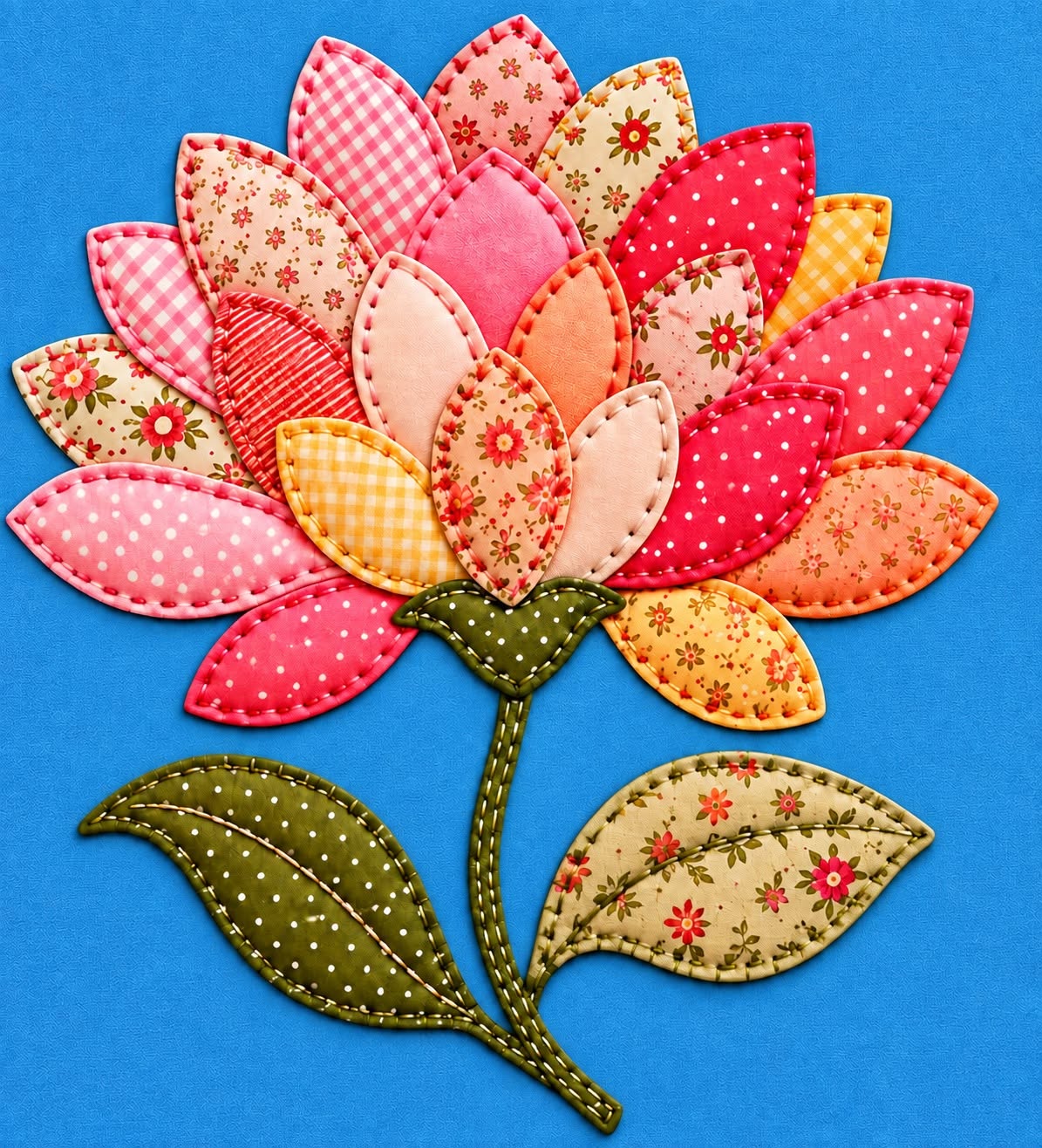
The Fabric Flower Appliqué for a Bedspread Pattern is a cheerful sewing project that transforms small pieces of fabric into a dimensional floral decoration suitable for quilts, bedspreads, wall hangings, pillow covers, and other textile projects. Inspired by the reference image, the design combines layered petals in pink, coral, cream, yellow, and red with contrasting green leaves and a narrow curved stem. The result has the charm of traditional appliqué while adding enough texture and color variation to make the flower stand out beautifully against a simple background.
One of the most appealing features of this fabric flower appliqué is that it can be made with relatively small fabric pieces. Floral prints, gingham, polka dots, stripes, and solid cottons can all be combined in the same flower. Because every petal is an individual component, the project is also a practical way to coordinate scraps from previous quilting projects. Instead of trying to make every petal identical, the design benefits from controlled variation. Repeating a few colors and prints throughout the arrangement creates visual balance without making the flower look overly uniform.
Although the finished design looks elaborate, the construction can be divided into manageable stages. You will first prepare the background and templates, then cut and stabilize the petals, arrange the flower from the outer layer toward the center, create the stem and leaves, and finally secure everything with decorative stitching. Beginners can work slowly with larger pieces, while experienced quilters can customize the Fabric Flower Appliqué for a Bedspread Pattern with additional petals, different fabrics, hand stitching, or machine appliqué. Careful preparation is more important than speed, especially when the finished appliqué will become part of a bedspread that may be handled and washed regularly.
Step 1: Prepare the Fabrics, Templates, and Appliqué Pieces
Begin by selecting a sturdy background fabric. Quilting cotton is an excellent choice because it is easy to press, cut, and stitch. A solid background similar to the warm yellow shown in the inspiration image makes the colorful flower especially noticeable. Before cutting the background, wash and press the fabric if you normally prewash fabrics for your quilts. This can reduce unexpected shrinkage later.
DISCOVER MORE FREE PATTERNS HERE!
For the petals, collect several coordinating cotton fabrics. A combination of floral fabric, gingham, polka dots, stripes, and solid colors gives the flower its lively patchwork appearance. Pink and coral can form the dominant palette, while yellow and cream provide highlights. You do not need a different fabric for every petal. Repeating several prints in different locations actually helps connect the entire arrangement visually.
Create a basic petal template shaped somewhat like an elongated leaf, with a rounded lower section and pointed upper end. For a medium-to-large bedspread appliqué, a useful starting size is approximately 12 to 16 cm long and 5 to 8 cm wide, depending on where the petal will sit. Make several template sizes because the outer petals should generally be larger than the central ones. Add the appropriate seam or turning allowance for your chosen appliqué technique.
Trace the templates onto the wrong side of the fabrics. Pay attention to directional prints such as stripes and gingham. Rotating the pattern direction from one petal to another can add movement, while maintaining the same direction produces a calmer result. Cut accurately with sharp fabric scissors. If you are using a turned-edge method, maintain a consistent allowance around every template.
The green elements require separate templates. Prepare two generous leaf shapes, a small green base or calyx underneath the flower, and a narrow curved strip for the stem. The leaves in the reference design are broad and pointed, giving the lower portion of the appliqué enough visual weight to balance the large flower. Consider using two different green fabrics to create additional contrast.
Before sewing anything permanently, arrange all pieces on the background. This dry layout is one of the most useful stages of the project. Photograph the arrangement once you are satisfied with it so you have a visual reference during assembly. Check the overall height and width against the bedspread block or panel where the appliqué will eventually be placed.
Step 2: Build the Layered Fabric Flower from the Outside In
Start constructing the flower with the outermost petals. Position several large petals in a wide fan shape, allowing their lower ends to overlap near the center. The outer petals establish the final silhouette, so spend time adjusting their angles. A slightly irregular arrangement usually looks more natural than perfectly symmetrical spacing.
Once the outer row is positioned correctly, add a second layer of medium petals. These pieces should cover some of the lower edges of the first layer. This overlapping method creates the dimensional appearance that defines the Fabric Flower Appliqué for a Bedspread Pattern. Alternate prints and solid fabrics so that neighboring petals remain visually distinct.
Continue toward the center using progressively smaller petals. In the reference design, warm pink, coral, cream, yellow, and floral fabrics are distributed throughout the composition. Try not to concentrate all of one color on one side. Instead, imagine the flower divided into sections and distribute strong colors throughout the design to create balance.
The central petals should be placed last because they visually sit in front of the surrounding layers. A narrow floral petal can become a useful focal point, especially when surrounded by softer solid fabrics. Keep checking the flower from a distance. Sometimes a petal that seems correctly positioned at close range can make the complete flower appear uneven.
Depending on your preferred method, the petal edges can be turned under and stitched, prepared with interfacing, or secured using another established appliqué sewing technique. For a soft bedspread, avoid making every layer unnecessarily bulky. Press each component carefully according to the requirements of your fabric and stabilizer, and always protect delicate materials from excessive heat.
Secure the petals systematically instead of trying to stitch the entire flower at once. Work from the lower layers toward the upper layers whenever the construction method allows it. A small, consistent edge stitch can become a decorative feature. If you prefer the handmade appearance visible in the inspiration, use contrasting thread and evenly spaced stitches around the petals.
Step 3: Make the Stem, Leaves, and Decorative Stitching
After the flower head is assembled, prepare the fabric stem. The stem should be narrow enough to look delicate but wide enough to stitch securely. A finished width of approximately 1 to 1.5 cm works well for many medium-sized appliqué projects. Cut the stem on the bias if you want it to follow a pronounced curve more easily.
Arrange the stem so that it begins underneath the flower and curves gently downward. Avoid a perfectly straight line because a subtle curve gives the design more movement. The bottom can bend slightly toward one side, as shown in the reference composition. Pin, baste, or temporarily secure the strip before completing the permanent stitching.
Next, position the two large leaves. Place one leaf on each side of the stem, but avoid making them perfectly symmetrical. One can sit slightly higher than the other. This asymmetrical arrangement contributes to the handcrafted botanical appearance. Make sure the bases of the leaves meet or overlap the stem cleanly so that the construction looks intentional.
For additional detail, create an inner curved line on each leaf. This can be made from a narrow folded strip, decorative stitching, or another appliquéd fabric section. The detail suggests a leaf vein while echoing the stitched outlines around the flower petals. A cream or contrasting thread can be especially effective against darker green fabric.
Decorative stitching is an important part of this bedspread appliqué pattern. Running stitches can be worked around the perimeter of each petal and leaf. Keep the stitch length reasonably consistent, but do not worry about making hand stitches mechanically perfect. Slight variation contributes to the handmade character of the project. If using a sewing machine, experiment on scrap fabric before stitching the finished appliqué.
Inspect intersections carefully after the stem and leaves are attached. Loose corners or unsecured overlapping areas can become vulnerable when the bedspread is used and washed. Reinforce these points discreetly. When everything is secure, press the work from the reverse side with appropriate protection so that the dimensional petals are not flattened excessively.
Step 4: Attach the Finished Appliqué to a Bedspread and Complete the Project
If you created the appliqué directly on a bedspread block, the panel can now be incorporated into the larger quilt top. If you made the flower separately, determine its final position before attaching it. A large floral appliqué motif can work beautifully as a central feature, but repeating smaller versions across several blocks is another attractive option.
For a single focal flower, leave enough negative space around the motif. Crowding additional patterns immediately around the flower can reduce the impact of the layered petals. A solid or subtly textured surrounding fabric allows the patchwork prints to remain the visual focus. This is particularly useful when the flower contains numerous colors and fabric patterns.
When integrating the panel into a bedspread, check that the appliqué lies flat before adding batting and backing. Smooth the fabric gently without stretching it. If necessary, use light basting to prevent shifting. Once the quilt sandwich is assembled, quilting can be worked around the flower to emphasize its outline and help stabilize the surrounding background.
Consider using echo quilting around the outside of the flower, leaves, and stem. This means quilting a line that follows the contour of the appliqué at a consistent distance. The technique can make the motif appear more prominent while also securing the surrounding layers. Keep the quilting simple if the appliqué itself already contains many prints and decorative stitches.
After quilting, finish the bedspread according to your preferred construction method. Trim excess batting and backing carefully, square the edges, and add binding. Inspect the appliqué again before completing the project. Clip loose threads and reinforce any areas where stitching appears weak, particularly at pointed petal tips and leaf ends.
The completed Fabric Flower Appliqué for a Bedspread Pattern can also become the foundation for many related projects. Reduce the templates for cushion covers or tote bags, enlarge them for a wall hanging, or repeat the flower across a full quilt. Changing the fabric palette can completely transform the character of the pattern while preserving the same basic construction method.
FAQ About the Fabric Flower Appliqué for a Bedspread Pattern
What is the best fabric for a Fabric Flower Appliqué for a Bedspread Pattern?
Quilting-weight cotton is one of the easiest materials to use. It is stable enough for accurate cutting while remaining soft enough for turned edges and layered appliqué. Cotton floral prints, gingham, stripes, dots, and solids can all be mixed successfully.
Can beginners make this fabric flower appliqué?
Yes. The design looks complicated mainly because it contains many overlapping pieces. Each individual component is relatively simple. Beginners can make the process easier by preparing all templates first, arranging the complete flower before sewing, and attaching one layer at a time.
How large should the flower be for a bedspread?
There is no mandatory finished size. For a noticeable focal motif, a flower measuring approximately 35 to 50 cm across can work well, although the correct dimensions depend on the size and layout of the bedspread. Always test the templates on the intended panel before cutting your final fabrics.
Do I need fusible web for this appliqué pattern?
Not necessarily. Fusible appliqué can make positioning easier, but traditional turned-edge appliqué, interfaced pieces, or carefully basted components can also be used. Choose a technique based on the finish you want and how soft you would like the completed bedspread to remain.
Can the appliqué be sewn entirely by machine?
Yes. A sewing machine can be used for most or all of the construction. A narrow zigzag, blanket stitch, straight edge stitch, or another suitable appliqué stitch can secure the pieces. Test stitch width, length, tension, and thread on scraps before working on the main project.
Can I sew the decorative stitches by hand?
Absolutely. Hand stitching is especially suitable for this style because visible stitches add character to the petals and leaves. Use a strong quilting or embroidery thread and aim for reasonably consistent stitch spacing around the edges.
How do I prevent the petals from becoming too bulky?
Use lightweight cotton, avoid excessive stabilizer, and plan the overlaps before sewing. Only the lower portion of each petal needs to disappear beneath the next layer. Large unnecessary overlaps can create thickness at the center of the flower.
What colors work best for this pattern?
The inspiration uses warm pink, red, coral, cream, yellow, and green. However, the same pattern could be made with blue and white, purple and lavender, autumn colors, pastel fabrics, or even monochromatic scraps. The most important principle is maintaining enough contrast between neighboring petals.
Should I wash the fabrics before making the appliqué?
Prewashing is useful when shrinkage or color bleeding is a concern, particularly for a bedspread that will eventually be laundered. Follow the care recommendations appropriate for your fabrics and make sure all pieces are completely dry and pressed before cutting.
How can I make all the petal shapes consistent?
Create reusable templates from template plastic, sturdy paper, or thin cardboard. Trace around the same templates rather than drawing every petal freehand. You can still use several sizes to create the layered appearance while maintaining consistency within each size group.
Can I use fabric scraps for the flower?
Yes, and this project is especially suitable for a fabric scrap appliqué. Small leftover pieces can become individual petals. Try organizing scraps into a coordinated color palette before cutting so that the finished flower looks intentionally varied rather than random.
How should I quilt around the finished flower?
Simple quilting is often the most effective choice. You can outline the appliqué, echo its silhouette, or quilt the open background while leaving the flower relatively dimensional. The goal is to secure the quilt layers without visually competing with the colorful floral centerpiece.
Can this pattern be used for something other than a bedspread?
Certainly. The same Fabric Flower Appliqué for a Bedspread Pattern can be adapted for pillow covers, table runners, fabric bags, wall panels, quilt blocks, decorative banners, or framed textile art. Simply resize the templates according to the dimensions of the new project.
How do I keep the appliqué durable after washing?
Secure every edge carefully, reinforce vulnerable points, use appropriate thread, and follow suitable washing instructions for the fabrics used. A bedspread receives considerably more handling than decorative wall art, so strong construction is particularly important.
What is the most important step when making this flower?
The arrangement stage deserves special attention. Before permanent stitching, position every petal, leaf, and the stem on the background. Check the distribution of colors, overlaps, overall silhouette, and proportions. A well-planned layout makes the actual sewing process much easier.
Conclusion
The Fabric Flower Appliqué for a Bedspread Pattern combines traditional appliqué techniques with the playful personality of patchwork. By building the design from individual fabric petals, you can create a flower filled with floral prints, gingham, dots, stripes, solids, and other coordinating scraps while still maintaining a balanced overall composition.
The process begins with preparing accurate templates and selecting the fabrics. From there, the larger outer petals establish the flower’s shape, medium and small petals create overlapping layers, and the central pieces complete the dimensional effect. A curved green fabric stem, two substantial leaves, and a small calyx visually connect the flower to the lower part of the composition.
Careful edge finishing and decorative stitching give the design its characteristic handmade appearance. Whether you choose hand appliqué or machine stitching, consistent construction and secure edges are particularly important when the finished piece will become part of a functional bedspread.
EASILY FIND THE FREE PDF FOR THIS PATTERN HERE!
Most importantly, this pattern leaves plenty of room for creativity. You can change the scale, number of petals, fabric prints, background color, stitching style, and overall palette while following the same basic method. The result can be adapted to coordinate with a bedroom, use favorite fabric scraps, or become a distinctive handmade gift. If you make your own Fabric Flower Appliqué for a Bedspread Pattern, leave your sincere opinion about the project and share your suggestions. Your ideas about color combinations, fabrics, stitching methods, and creative variations can inspire even more ways to personalize this beautiful fabric flower design.