
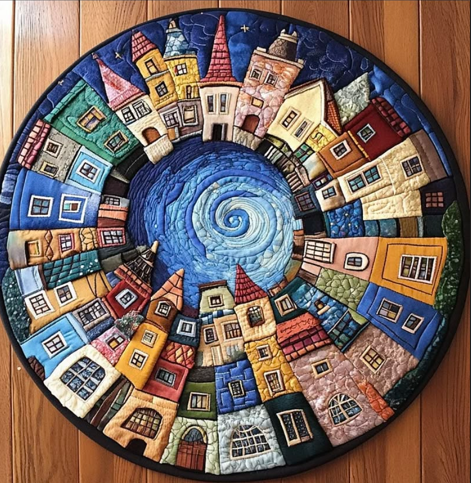
The Twisted Village Bedspread Quilt Pattern is a captivating quilting project that transforms a collection of colorful little houses into a dramatic spiral village surrounding a swirling blue center. Inspired by the visual composition in the reference image, this design combines patchwork quilting, curved construction, appliqué details, dimensional stitching, and playful architectural shapes. What makes the project especially memorable is the illusion of movement: instead of arranging the houses in straight streets or traditional quilt blocks, the buildings appear to bend around a central whirlpool of blue fabric. The result feels imaginative, artistic, and full of personality while still being achievable through careful planning and patient assembly. Although the sample has a circular presentation, the same concept can be incorporated into a larger bedspread by placing the village medallion in the center and surrounding it with coordinating borders or additional quilt blocks.
A Twisted Village Bedspread Quilt Pattern also offers wonderful opportunities to use fabric scraps creatively. Each building can be made from a different print, solid, batik, or textured cotton, allowing the quilt to grow naturally from fabrics already available in a sewing room. Warm yellows, reds, terracottas, greens, blues, creams, and muted pinks create the charming village atmosphere seen in the design, while darker fabrics around roofs, doors, and borders help define every shape. Small pieces are especially useful for windows, chimneys, roof sections, and decorative accents. This makes the project not only visually rich but also practical for quilters who enjoy scrap quilting, fabric appliqué, and projects in which no two houses need to look exactly alike. The slight irregularity of the buildings is part of the appeal because it gives the village a handcrafted, storybook character.
Creating this quilt successfully begins with understanding the structure before cutting any fabric. The composition can be divided into three main areas: the swirling blue center, the ring of twisted village houses, and the finishing border. Each section should be planned separately and then joined into one balanced design. For a bedspread version, the completed circular village can serve as a large center medallion, while additional background fabric expands the project to the desired mattress size. Accurate cutting is helpful, but this is not a pattern that depends on absolute geometric perfection. Gentle curves, slightly leaning houses, uneven rooflines, and varied windows actually strengthen the artistic effect. Throughout the process, focus on quilt construction, secure seams, balanced colors, and consistent quilting so the finished Twisted Village Bedspread Quilt Pattern remains beautiful, durable, and comfortable.
Planning the Twisted Village Layout and Choosing Fabrics
The first step is deciding the finished dimensions of your quilt. If you want a decorative circular piece similar to the reference image, a diameter of approximately 100 to 120 cm creates enough space for detailed houses without making the individual pieces excessively small. For a full bedspread, you can build the circular village as a central medallion measuring approximately 110 cm and then add square or rectangular background sections around it. Before cutting fabric, sketch the circle on paper and divide it into an inner spiral area and an outer village ring.
DISCOVER MORE FREE PATTERNS HERE!
Next, select the fabric palette. The Twisted Village Bedspread Quilt Pattern works especially well with a broad range of colors rather than a tightly controlled two- or three-color scheme. Gather cotton fabrics in blue, turquoise, navy, cream, mustard, gold, brick red, coral, burgundy, green, brown, beige, and soft pink. Include a few small prints to create visual texture, but avoid using extremely busy prints for every house because windows, roofs, and doors need enough contrast to remain visible.
For the center, prepare several blue fabrics ranging from very pale aqua to deep navy. The spiral effect becomes stronger when the values gradually change from light to dark. Cut the fabrics into curved strips between approximately 2.5 and 5 cm wide. They do not need to be identical. In fact, slightly irregular widths make the central swirl feel more organic. Arrange the lightest blues near the center and progressively introduce medium and dark tones as the spiral expands outward.
The houses should be planned as individual units. Draw simple building shapes on paper first, varying their width from approximately 6 to 11 cm and their height from approximately 10 to 18 cm. Include tall narrow houses, short cottages, rectangular buildings, towers, and occasional unusual shapes. Add triangular, sloped, and curved roof pieces so the village does not look repetitive. Because the houses will eventually follow a circular path, allow some buildings to lean slightly left or right.
Small architectural details are essential to the personality of the Twisted Village Bedspread Quilt Pattern. Prepare scraps for windows measuring approximately 1.5 to 3 cm, doors measuring around 2 to 4 cm wide, and narrow strips for frames. Dark brown, black, charcoal, navy, and deep red are useful for defining these features. Window centers can be cream, pale blue, turquoise, or white so they stand clearly against the building walls.
Before sewing, place the fabrics together on a large table or design wall. Move the houses around until the colors feel balanced. Avoid placing too many similar shades next to each other. If three red houses appear together, move one to another part of the circle and replace it with blue, yellow, or green. This visual planning stage may take time, but it prevents difficult changes later and helps create a lively yet harmonious village quilt design.
Creating the Spiral Center and Building the Patchwork Houses
Begin the center by marking the middle of a foundation piece of lightweight cotton. The foundation should be slightly larger than the intended spiral. Start with a small circular or oval piece of light blue fabric approximately 4 to 6 cm wide. Position the first curved strip around it, right sides together along the edge, stitch with an approximately 0.6 cm seam allowance, and press the strip outward. Continue working around the center in a spiral motion.
Add progressively darker blue strips as the circle grows. Slightly rotate each strip as you sew so the seams do not create perfect concentric rings. The goal is to create movement. Some strips may overlap more heavily on one side than another, and that is perfectly suitable for this style. Press carefully after every few additions. Avoid stretching the curved fabric excessively because distortion could make the finished medallion difficult to assemble.
Once the spiral is complete, reinforce the swirling appearance with quilting lines. You can use free-motion quilting or a walking foot to stitch gentle curves following the direction of the fabric pieces. Quilt lines spaced approximately 0.5 to 1.5 cm apart will create the textured appearance associated with art quilting. Variegated blue thread can add extra visual depth, although matching blue thread produces a quieter result.
Construct the houses separately before joining them to the village ring. Sew each wall section first, then attach doors and windows using appliqué or small patchwork units. For raw-edge appliqué, position the pieces with fusible web and secure them with a narrow zigzag, blanket stitch, or straight stitch close to the edge. For turned-edge appliqué, add a small seam allowance and press the edges underneath before stitching.
Create roofs from triangles, trapezoids, narrow rectangles, or slightly curved shapes. Reds, browns, burgundy, gray, blue, and terracotta fabrics work beautifully for this purpose. Add chimneys to selected buildings, but not every house needs one. One of the strengths of the Twisted Village Bedspread Quilt Pattern is its variety. A tall tower beside a tiny cottage immediately makes the arrangement more interesting.
After completing several houses, arrange them around the blue spiral before permanently joining anything. Allow the lower portions of the buildings to point toward the center while the rooflines extend outward. Depending on your interpretation, some houses may appear almost sideways as they follow the circular movement. Trim the side edges carefully so neighboring buildings fit together while preserving their charming irregular appearance.
Assembling the Twisted Village Bedspread Quilt Pattern
Once all the buildings are prepared, divide the village ring into manageable sections. Instead of trying to sew the entire circle at once, group approximately four to seven neighboring buildings. Stitch these groups together using a consistent seam allowance and press the seams in whichever direction creates the least bulk. These partial sections make it easier to adjust curves and maintain the overall circular shape.
Place the completed sections around the spiral again and check the fit. Small gaps can be filled with narrow pieces representing roads, trees, walls, or additional buildings. Dark green scraps can suggest foliage, while gray, brown, or dark blue strips can create separation between houses. This flexible approach is especially useful because a handmade Twisted Village quilt naturally develops small variations during construction.
Join the village sections carefully until a complete ring surrounds the center. Pin frequently along curved areas and avoid pulling the fabric while sewing. If the circumference does not match perfectly, make small adjustments between buildings rather than forcing one large correction into a single seam. Minor differences can often be hidden naturally by changing the width of a roof edge, pathway, or narrow background section.
When the center and village ring are connected, place the finished quilt top on a flat surface and examine it from several directions. The spiral should remain visually centered even if the buildings themselves are intentionally irregular. Look for areas that seem too empty or too heavy. Additional small windows, doors, stitching, trees, or roof details can be added at this stage to balance the composition.
For a bedspread, extend the central medallion using coordinating fabric. One option is to appliqué the circular village onto a large square background. Another is to surround it with progressively larger pieced borders. Dark navy, cream, muted blue, or neutral fabrics allow the colorful village to remain the focal point. Additional simple patchwork borders can repeat some of the house colors without competing with the center.
After the quilt top reaches the required dimensions, prepare the backing and batting. Cut both pieces at least 8 to 10 cm larger than the quilt top on every side. Smooth the backing on a clean surface, place the batting on top, and position the quilt top over it. Baste the three layers using safety pins, thread basting, or temporary fabric adhesive according to your preferred quilting method.
Quilting, Binding, Finishing Details, and Long-Term Care
Quilting is where the Twisted Village Bedspread Quilt Pattern gains much of its dimensional character. Different sections can be quilted in different ways. Follow the blue spiral with curved lines, outline the buildings to emphasize their shapes, and add straight or slightly irregular lines across roof sections. Quilting around each window and door gives the architecture extra definition and helps the small details remain visually crisp.
Consider adding texture to individual buildings. Brick-like horizontal lines work well on red or brown walls, while diagonal crosshatching can create the appearance of shingles or decorative siding. Curved lines can suggest stonework, and vertical stitching can imitate wooden boards. These details should remain subtle; the fabric composition is still the main feature, while stitching provides depth and character.
The outer edge can be finished with a dark binding similar to the reference design. Navy, charcoal, deep brown, or black creates a strong frame around the colorful village. For a circular quilt, cut bias binding because it bends around curves much more easily than straight-grain binding. A finished binding width of approximately 1 to 1.5 cm creates a clean edge without visually overwhelming the houses.
If you are making a rectangular bedspread instead, use straight-grain binding around the outer edges of the complete quilt. Cut binding strips approximately 6 to 7 cm wide, join them diagonally, press the long strip in half, and attach it around the perimeter. Fold it to the back and secure it by hand or machine. Pay particular attention to the corners so they form neat miters.
After binding, inspect the entire Twisted Village Bedspread Quilt Pattern carefully. Trim loose threads, check appliqué edges, and reinforce any areas that seem less secure. If you used marking tools, remove the markings according to the manufacturer’s instructions. When appropriate for the fabrics and materials used, washing the quilt gently can soften the finished piece and encourage the quilting texture to become more visible.
For ongoing care, store the quilt in a dry location away from strong direct sunlight. If it is used regularly as a bedspread, gentle washing and careful drying will help preserve the appliqué and quilting. Avoid aggressive bleaching products that may affect the varied fabric colors. With thoughtful construction and proper care, this patchwork village quilt can remain an eye-catching handmade piece for many years.
Frequently Asked Questions About the Twisted Village Bedspread Quilt Pattern
What is a Twisted Village Bedspread Quilt Pattern?
A Twisted Village Bedspread Quilt Pattern is a decorative quilt design in which colorful fabric houses are arranged around a central circular or spiral composition. Instead of forming straight rows, the buildings follow a curved path, creating a sense of movement. The technique combines elements of traditional patchwork, appliqué, medallion quilting, and artistic quilting.
Is this quilt suitable for beginners?
An adventurous beginner can make a simplified version, although the full design is better suited to someone who already understands basic piecing, pressing, appliqué, and quilting. Beginners can make the process easier by using larger houses, fewer architectural details, and a simpler central spiral.
What fabric is best for a village quilt?
Good-quality quilting cotton is one of the easiest options because it cuts accurately, presses well, and is available in many colors and prints. Cotton scraps are especially useful for the small roofs, windows, doors, and walls required in a scrap quilt pattern.
How many different fabrics do I need?
There is no fixed number. A richly detailed version might contain dozens of fabrics, while a simpler project can be completed with approximately 15 to 25 coordinated fabrics. The most important consideration is having enough contrast between neighboring houses and between the walls, roofs, windows, and doors.
How can I make the spiral effect look natural?
Use several shades of blue and gradually change their value from light to dark. Curved strips should vary slightly in width and direction. Quilting along the spiral after construction will reinforce the movement and visually connect the individual pieces.
Do all of the houses need to be the same size?
No. Varied sizes are one of the main attractions of the Twisted Village Bedspread Quilt Pattern. Combining narrow towers, small cottages, wide houses, and unusually shaped buildings produces a whimsical village and makes the composition more visually interesting.
Can I make the quilt without appliqué?
Yes. Most elements can be traditionally pieced if preferred, but appliqué makes tiny details such as windows, doors, chimneys, and decorative roof sections much easier to create. Many quilters combine piecing for the main structures with appliqué for the smallest elements.
Can the circular design be turned into a rectangular bedspread?
Yes. Complete the circular village medallion first, then appliqué or piece it into a square background. Add additional fabric or patchwork borders until the quilt reaches the dimensions required for your bed. This preserves the circular effect while creating a practical rectangular bedspread.
What kind of batting works best?
A medium- or low-loft batting is a practical choice because it allows the small architectural details and dense quilting to remain clearly visible. Cotton batting provides a traditional appearance, while cotton-blend batting can offer additional stability and easier handling.
How should I quilt around the houses?
Outline quilting is particularly effective. Stitch close to the edges of roofs, walls, windows, and doors, then add decorative textures inside selected sections. Straight lines, curves, crosshatching, and small geometric patterns can help differentiate one building from another.
Why does my circular quilt not lie completely flat?
Waves or puckering may appear if curved sections have been stretched during construction or if the outer and inner circumferences do not match correctly. Press gently rather than aggressively, pin curved seams frequently, and distribute small adjustments throughout the circle instead of correcting everything in one location.
Can leftover fabric scraps be used for this project?
Absolutely. The Twisted Village Bedspread Quilt Pattern is particularly suitable for scraps because many components are small. Even tiny pieces can become windows, doors, roof tiles, chimneys, or sections of the central spiral. Using leftovers also increases the variety that gives the village its characteristic appearance.
How large should each house be?
For a medallion approximately 100 to 120 cm in diameter, houses between roughly 6 and 11 cm wide and 10 to 18 cm tall provide a useful starting range. These measurements can be adjusted according to the size of the overall project and the amount of detail you want to include.
Should I quilt each house before joining the project?
The easiest method for most makers is to complete the entire quilt top first and quilt all three layers afterward. However, experienced quilters may adapt the project to a quilt-as-you-go technique. Either approach can work as long as seams and finishing methods are planned in advance.
What makes this pattern different from a traditional house quilt?
Traditional house quilts often use repeated square blocks with houses positioned upright in rows. The Twisted Village Bedspread Quilt Pattern uses radial placement and a spiral center, making the architecture appear to rotate around the composition. This creates a more artistic and whimsical visual effect.
Conclusion
The Twisted Village Bedspread Quilt Pattern is a creative way to combine traditional quilting skills with imaginative fabric art. Starting with the blue spiral, you can gradually build a colorful community of individual fabric houses, each with its own roofs, windows, doors, colors, and personality. Careful fabric selection, strategic contrast, curved piecing, appliqué, and detailed quilting all work together to create the sense of movement that makes this project so distinctive.
Throughout this tutorial, we explored how to plan the dimensions, select fabrics, construct the spiral center, create individual houses, assemble the village ring, expand the medallion into a bedspread, prepare the quilt sandwich, add decorative quilting, and complete the project with professional-looking binding. The process may require patience, but it also provides plenty of freedom to improvise and personalize each section.
EASILY FIND THE PDF FOR THIS PATTERN HERE!
One of the most rewarding aspects of this quilt pattern is that your finished village does not have to copy another version exactly. Change the colors, add more towers, simplify the windows, introduce trees, enlarge the spiral, or use favorite scraps from previous sewing projects. These individual choices are what turn the Twisted Village Bedspread Quilt Pattern into a unique handmade quilt rather than a repetitive manufactured design. If you make your own version, leave your sincere opinion about the project and share your suggestions. Which part of the twisted village would you change, and what colors would you choose for your own quilt? Your ideas can inspire new combinations and creative variations for future quilting projects.