
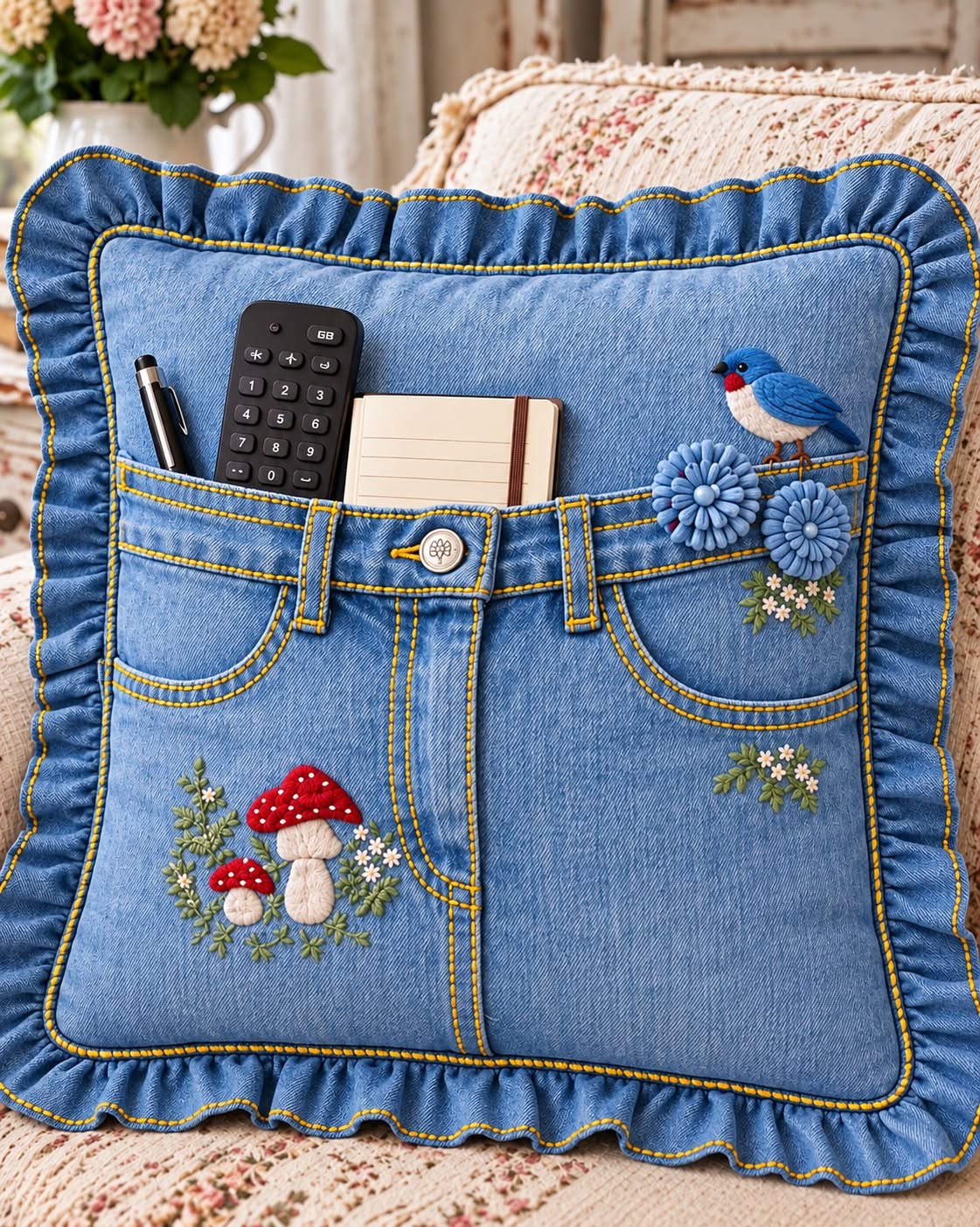
Denim Cushion with Pocket and Ruffle Fabric Pattern is a charming sewing project that turns the familiar look of blue jeans into a decorative and practical cushion for a bedroom, sewing room, reading corner, or living room. Inspired by the cushion shown in the reference image, the design combines a soft denim base, an authentic jeans-style pocket section, a gathered denim ruffle, decorative embroidery, and useful storage space. The finished cushion can hold a remote control, notebook, pen, reading glasses, craft tools, or other small items while still looking like a carefully designed home décor piece. One of the biggest advantages of this project is that it can be made with recycled jeans, new denim fabric, or a combination of both, making every cushion slightly different and full of character.
The style of this denim cushion pattern works especially well because it balances rustic texture with delicate handmade details. The visible seams, belt loops, button, pockets, faded denim, flowers, mushrooms, and small bird motif create the impression that an old pair of favorite jeans has been transformed into something completely new. You do not need to reproduce every decorative detail exactly to achieve a beautiful result. The most important features are the square cushion shape, the large functional front pocket, the soft gathered ruffle around the edges, and neat topstitching that gives the finished piece a professional appearance. Beginners can simplify the embroidery, while experienced sewists can add appliqué, hand stitching, fabric flowers, quilting, or personalized embellishments.
This guide explains how to create the Denim Cushion with Pocket and Ruffle Fabric Pattern from beginning to end using straightforward sewing techniques. A finished size of approximately 45 x 45 cm is a practical starting point and creates a cushion similar in proportion to the project shown. You can easily resize the pattern for a smaller chair cushion or a larger decorative pillow. The tutorial includes fabric preparation, cutting, pocket construction, decorative techniques, ruffle assembly, cushion construction, and finishing. Taking time to press the fabric, measure accurately, and sew slowly around the thicker denim areas will make the project much easier and help you create a cushion that looks handmade in the best possible way.
Choosing Materials and Preparing the Denim Cushion Pattern
Begin by selecting the denim for your Denim Cushion with Pocket and Ruffle Fabric Pattern. Medium-weight denim is usually easier to sew than very heavy jeans fabric, especially where several layers overlap. For a 45 x 45 cm cushion, prepare two main denim squares measuring approximately 47 x 47 cm, allowing about 1 cm seam allowance on each side. One square will become the decorated front and the other will form the back. If you are recycling old jeans, open the legs along the inner seams and press the fabric flat before measuring your pieces.
DISCOVER MORE FREE PATTERNS HERE!
The main feature of this denim cushion with pocket is the jeans-style pocket panel across the lower half of the cushion. The easiest method is to cut the upper hip section from an existing pair of jeans, keeping the front pockets, waistband, belt loops, button, and center seam together. Trim this section into a panel approximately 43 to 45 cm wide and 22 to 25 cm high. If the jeans are too small to span the entire cushion, join additional denim pieces at the sides or create a similar pocket panel from new fabric.
If you prefer making the pocket completely from scratch, cut a rectangular denim piece approximately 44 x 24 cm. Fold the upper edge toward the wrong side twice and topstitch it securely. Create two curved patch pockets from additional denim, positioning one on each side to imitate traditional jeans pockets. Add a center vertical seam, belt loops, a narrow waistband strip, and a decorative button to reproduce the recognizable jeans appearance. This method gives you greater control over the final dimensions.
For the gathered border, cut several long strips of denim approximately 7 to 9 cm wide. When joined end to end, the strips should measure approximately 220 to 250 cm in total length for a 45 cm square cushion. The extra length is necessary because the fabric will be gathered into the denim ruffle. Lightweight denim, chambray, or thin recycled jeans fabric works particularly well for this section because very heavy denim can create bulky corners.
You will also need matching or contrasting sewing thread, a denim sewing-machine needle, pins or sewing clips, fabric scissors, a ruler, a marking tool, an iron, and approximately 45 x 45 cm of cushion filling or a pillow insert. For a removable cover, prepare a zipper measuring approximately 35 to 40 cm. Decorative supplies can include embroidery floss, small fabric scraps, buttons, fabric flowers, appliqué pieces, and fusible web. These additions are optional, but they help recreate the whimsical character visible in the original project.
Before sewing, wash and dry recycled or new denim whenever possible. Denim can shrink, and prewashing prevents the finished cushion from changing shape after its first cleaning. Press every piece carefully with steam and check that the main squares are straight. Accurate preparation is especially important for a fabric cushion pattern because small measurement differences can become obvious when the front, ruffle, and back are assembled.
Creating the Functional Jeans Pocket and Decorative Details
Place the front cushion square right side up on a flat work surface. Position the prepared jeans pocket panel across the lower section, leaving enough plain denim visible above it to create the balanced composition seen in the reference image. A good starting point is to place the upper edge of the pocket approximately 20 to 22 cm below the top edge of the cushion. Center the pocket horizontally and make sure the lower and side edges remain inside the cushion’s seam allowance.
Pin or clip the panel carefully and sew it to the cushion front along the sides and bottom. Do not sew across the upper pocket opening because the space must remain functional. If you are using an original jeans section with two existing pockets, preserve those openings as well. Reinforce the upper corners with a few extra stitches because these areas receive the most stress when objects are placed inside the functional cushion pocket.
Topstitching is one of the details that makes a Denim Cushion with Pocket and Ruffle Fabric Pattern look polished. Use a slightly longer stitch length, around 3 to 3.5 mm, and sew slowly along the visible edges of the pocket. Traditional gold or tan denim thread creates a classic jeans appearance, while blue thread produces a softer look. Keep the rows of stitching even and parallel to the edges whenever possible.
The mushroom embellishment shown near the lower left pocket can be recreated with simple appliqué. Cut two or three small mushroom caps from red or patterned fabric and stems from cream fabric. Apply lightweight fusible web to the back, arrange the pieces on the denim, and press according to the product instructions. Sew around the edges using a small straight stitch, blanket stitch, or narrow zigzag. Add green hand embroidery around the mushrooms to suggest grass, leaves, and tiny plants.
On the opposite side, you can reproduce the floral and bird theme with fabric flowers, embroidery, or appliqué. Small layered fabric circles gathered at the center create dimensional flowers similar to those visible in the photograph. Sew them securely to the cushion so that they can withstand normal handling. A small bird appliqué placed above the pocket provides an attractive focal point. Use blue fabric for the body, a lighter piece for the breast, and a tiny dark stitch for the eye.
Try not to overcrowd the design. The denim fabric pattern is attractive partly because the faded blue fabric itself contributes texture and visual interest. Leave areas of plain denim between the embellishments so that each motif remains easy to see. Once the decoration is complete, press the cushion front gently from the wrong side. Avoid pressing directly over dimensional flowers or delicate appliqué pieces, which could become flattened.
Sewing the Gathered Denim Ruffle and Assembling the Cushion
Join the prepared ruffle strips by placing two ends right sides together and stitching with approximately a 1 cm seam allowance. Continue joining strips until you have one long continuous piece. Press the joining seams open to reduce bulk. You may leave the outer edge raw for a soft frayed denim effect, finish it with a narrow hem, or fold it under twice for a cleaner appearance. The cushion in the reference image has a relaxed gathered edge that complements the vintage denim beautifully.
Set your sewing machine to its longest straight stitch and sew one or two parallel gathering lines along the inner edge of the ruffle strip. Do not backstitch at the beginning or end. Leave long thread tails so you can gently pull the bobbin threads and gather the fabric. Work slowly along the entire strip, distributing the gathers rather than concentrating them in one section.
Lay the finished cushion front right side up. Position the ruffle on top with its gathered edge aligned with the raw outer edge of the cushion and the decorative portion pointing toward the center. Begin at the middle of the bottom edge rather than at a corner. Pin or clip the ruffle around all four sides, adjusting the gathers until they are evenly distributed. At each corner, add a little extra fullness so the ruffled cushion border can curve smoothly.
When you reach the starting point, overlap or join the two ruffle ends neatly. Baste the ruffle to the cushion front using approximately a 7 mm seam allowance. Basting is extremely helpful because it prevents the gathers from moving when the cushion back is added. Inspect the front after sewing and make sure no section of the ruffle has accidentally folded beneath the stitching.
Place the cushion back over the completed front with right sides together. The ruffle should now be sandwiched between the two main denim pieces. Pin or clip around the perimeter, paying special attention to the corners. Sew around the cushion using approximately a 1 cm seam allowance. If you plan to insert loose stuffing directly, leave an opening of about 15 to 20 cm along the bottom edge. For a removable cushion cover, install a zipper in the back or bottom seam before completing this step.
Trim excess bulk from the corners without cutting through the stitches. Turn the cushion right side out and use your fingers or a blunt turning tool to shape each corner gently. Pull the ruffle outward and check that it forms an even frame around the entire cushion. Press the main seams from the front without crushing the gathered edge. At this stage, the Denim Cushion with Pocket and Ruffle Fabric Pattern should already closely resemble the finished inspiration.
Filling, Finishing, Care, and Creative Customization
Insert a 45 x 45 cm cushion form through the zipper or opening. A slightly fuller insert can be used if you prefer a plump decorative cushion, but avoid overfilling because excessive pressure can distort the front pocket. Push the filling carefully into all four corners and smooth the cushion until the front lies evenly. If you used loose polyester fiberfill instead of a removable insert, add small amounts gradually for better control.
Close the final opening with a ladder stitch if you are creating a permanently filled cushion. Small, evenly spaced hand stitches can become almost invisible when sewn with matching thread. If you installed a zipper, close it and gently adjust the filling around the edges. Check that the ruffle extends outward rather than folding toward the back of the cushion.
Test the pocket by adding lightweight items such as a small notebook, television remote, pen, or reading glasses. Avoid placing very heavy objects inside because the cushion is primarily decorative. The combination of storage and decoration is what makes this denim pocket cushion particularly useful beside a sofa, armchair, or reading area.
Recycled denim makes customization especially easy. You can preserve original jeans details such as faded sections, belt loops, branded stitching, buttons, patch pockets, and seams. Instead of mushrooms and flowers, consider stars, hearts, leaves, butterflies, initials, simple geometric appliqué, or seasonal motifs. Each version of the Denim Cushion with Pocket and Ruffle Fabric Pattern can therefore have a completely different personality while following the same construction method.
For cleaning, check the materials used in your embellishments before placing the cushion cover in a washing machine. A removable denim cover without delicate dimensional decoration can usually be washed gently in cool water. Hand washing is safer when the cushion includes fabric flowers, embroidery, beads, or intricate appliqué. Allow the cover to air dry when possible and press the denim from the wrong side.
The final quality of this project depends more on careful construction than complicated sewing. Keep seam allowances consistent, press each stage, use a fresh denim needle, and reduce sewing speed where multiple layers meet. These simple habits make thick fabric much easier to handle. The finished cushion combines recycled denim sewing, functional pocket design, ruffle sewing, and fabric appliqué into one useful project that can be enjoyed for years.
Frequently Asked Questions About the Denim Cushion with Pocket and Ruffle Fabric Pattern
What size should I make the denim cushion?
A finished measurement of approximately 45 x 45 cm is an excellent option for a standard decorative cushion and closely matches the proportions of the inspiration. Cut the main front and back pieces slightly larger to include seam allowances. You can also adapt the Denim Cushion with Pocket and Ruffle Fabric Pattern to 40 x 40 cm, 50 x 50 cm, or another size depending on your pillow insert.
Can I make this cushion from old jeans?
Yes. In fact, recycled jeans are ideal for this project because the existing pockets, waistband, belt loops, seams, and faded areas create instant visual detail. Choose jeans that are still strong and avoid sections where the fabric has become excessively thin or damaged.
Do I need a special sewing machine for denim?
A standard household sewing machine can usually handle medium-weight denim. Use a denim or jeans needle and sew slowly over thick intersections. When several layers meet, turning the handwheel manually for the first few stitches can help prevent needle breakage.
How much fabric is needed for the ruffle?
For a 45 x 45 cm cushion, approximately 220 to 250 cm of continuous ruffle strip is generally enough to create attractive fullness. The exact amount depends on how heavily you want the ruffle gathered. A fuller border requires a longer strip.
Can beginners make this denim cushion?
Yes. A beginner can simplify the pattern by using a ready-made jeans pocket panel and limiting the decoration to simple appliqué. The most important skills are straight stitching, gathering fabric, attaching layers, and basic hand finishing.
How do I prevent the ruffle from becoming uneven?
Divide both the cushion edge and ruffle strip into quarters and mark each section. Match these marks before distributing the gathers. This prevents too much fabric from accumulating on one side and helps create a balanced ruffled denim cushion.
Can the front pocket actually be used?
Absolutely. If you keep the upper edge open while attaching the jeans panel, it becomes a practical storage pocket. Reinforcing the upper corners with extra stitches will make it stronger. Lightweight objects such as notebooks, remotes, pens, or glasses are ideal.
What can I use instead of denim?
Chambray, cotton canvas, twill, corduroy, and sturdy quilting cotton can all be adapted to this pattern. However, denim gives the project its distinctive casual character and supports the weight of the functional pocket particularly well.
How can I add embroidery without damaging the cushion?
It is easiest to embroider the main front panel before assembling the cushion. Use an embroidery hoop where possible and avoid pulling the stitches too tightly. Lightweight stabilizer behind the denim can help maintain smooth fabric while stitching small flowers or leaves.
Should I add the appliqué before or after sewing the cushion together?
Add nearly all decorative elements before assembling the front and back. Working on a flat piece of fabric is much easier than trying to embroider or appliqué onto a completed cushion. Dimensional flowers can be added near the end if necessary.
Can I make the cover removable?
Yes. Install an invisible zipper, standard zipper, or envelope-style back. A removable cover makes cleaning easier, especially when the cushion is used regularly. Just remember that a zipper adds an additional construction step.
How can I make recycled denim easier to sew?
Remove unusually bulky seams wherever they are not required, press all pieces thoroughly, and use a denim needle. A longer stitch length also works well for topstitching. Sew slowly through areas containing multiple layers.
Conclusion
The Denim Cushion with Pocket and Ruffle Fabric Pattern brings together creativity, practical storage, and the timeless character of denim in one satisfying sewing project. Starting with two basic cushion panels, you learned how to incorporate a real or handmade jeans pocket section, create decorative appliqué and embroidery, construct a gathered denim ruffle, assemble the cushion, and finish it with a pillow insert or filling.
The project also demonstrates how ordinary jeans can become valuable crafting material. Waistbands, pockets, belt loops, buttons, faded areas, and existing seams can all become intentional design elements rather than scraps. This makes recycled denim sewing an excellent way to experiment with texture while creating functional handmade décor.
Once you understand the basic construction, the pattern is easy to personalize. You can change the cushion dimensions, add different flowers, replace the mushroom appliqué, embroider names or initials, use contrasting topstitching, or create a completely different decorative theme while preserving the practical front pocket and gathered border.
EASILY FIND THE PDF FOR THIS PATTERN HERE!
Most importantly, take your time with the thicker sections of denim and enjoy the creative process. Careful pressing, accurate cutting, secure pocket stitching, evenly distributed gathers, and thoughtful embellishments will make a noticeable difference in the finished result. The final Denim Cushion with Pocket and Ruffle Fabric Pattern can become a beautiful decorative accent, a useful organizer, or a meaningful handmade gift. If you make your own version, leave your sincere opinion about the pattern and share any suggestions or creative changes you would add. Your ideas can inspire new combinations of denim, embroidery, appliqué, pockets, and ruffles for future sewing projects.