
The Denim Pinafore Dress with Crisscross Back Straps Fabric Pattern is a practical sewing project that combines the durability of denim with the relaxed comfort of a classic apron-style pinafore.
Its simple front silhouette, generous front pocket, and attractive crossed straps at the back make it suitable for sewing, crafting, gardening, cooking, or everyday casual wear.
One of the best features of this design is that it can be adapted to different body measurements without requiring the complicated construction techniques normally associated with fitted dresses.
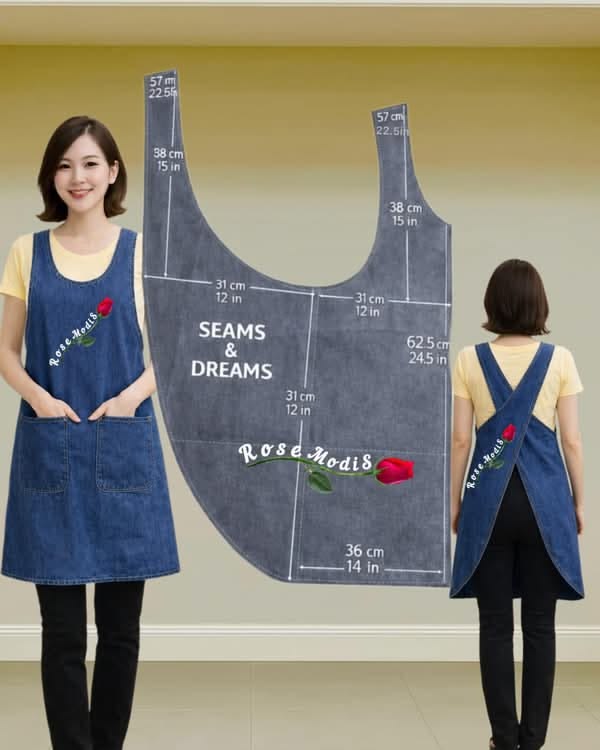
The project shown in the reference image uses a long front panel with a rounded neckline, extended shoulder straps, and overlapping back sections that create the distinctive crisscross back design.
A large rectangular pocket across the lower front adds both function and visual balance while giving the finished garment a handmade workwear character.
In this detailed guide, you will learn how to understand the pattern, choose denim, calculate measurements, cut the pieces, sew the seams, finish the edges, create the pocket, and assemble the crossed back straps.
Making your own Denim Pinafore Dress with Crisscross Back Straps Fabric Pattern also gives you much more freedom than buying a ready-made garment because you can customize nearly every detail.
You can use classic indigo denim for a traditional appearance, lightweight washed denim for a softer dress, or even recycled denim if you enjoy sustainable sewing projects.
Decorative topstitching, embroidery, appliqué, contrasting thread, or personalized pockets can easily be added after the basic construction is understood.
Because the garment has an open and overlapping back rather than a conventional zipper closure, it can be relatively forgiving in fit and comfortable when worn over a T-shirt or lightweight blouse.
The crossed straps help keep the garment positioned on the shoulders while creating the beautiful X-shaped detail visible from the back.
For beginners, the most important approach is to measure carefully, test the pattern with inexpensive fabric when necessary, and press every seam as the project progresses.
The reference pattern provides useful proportions that can serve as a starting point for creating your own denim pinafore sewing pattern, although personal measurements should always take priority when determining the final size.
Visible measurements in the example include approximately 57 cm for the extended upper strap area, 38 cm through the upper vertical section, 31 cm across several construction points, approximately 62.5 cm across the wider body section, and about 36 cm across the lower reference section.
These numbers should be treated as a guide rather than universal sizing because shoulder width, bust circumference, desired garment length, and preferred ease vary considerably from one person to another.
Before cutting denim, create a paper template and hold or pin it against the body to confirm the neckline depth, arm opening, strap length, width, and overall length.
Adding an appropriate seam allowance around the pattern is essential because the dimensions of a finished piece will become smaller after its edges are joined and finished.
With a carefully adjusted template, the following construction process can turn this straightforward shape into a polished and comfortable handmade pinafore.
Understanding and Preparing the Denim Pinafore Pattern
Begin the Denim Pinafore Dress with Crisscross Back Straps Fabric Pattern by studying the main silhouette before cutting anything. The front is essentially a long apron-shaped panel that widens toward the lower body, while the top curves inward to create the neckline and arm areas. Extended shoulder sections eventually become the straps that travel over the shoulders and cross across the back. Creating the entire shape first on paper makes correcting proportions much easier and prevents unnecessary fabric waste.
DISCOVER MORE FREE PATTERNS HERE!
Take your body measurements while wearing the type of clothing you expect to wear underneath the pinafore. Measure the bust, waist, hip, shoulder-to-waist distance, desired finished length, and approximate shoulder-to-opposite-back distance for the crossing straps. Add comfortable wearing ease rather than drafting the garment exactly to the body measurement. A pinafore should generally have enough room for movement, especially when it is intended as a practical denim apron dress.
Use the measurements visible in the reference image only as proportional guidance. The approximately 57 cm strap length, 38 cm upper section, 31 cm construction sections, 62.5 cm body width, and 36 cm lower reference width provide useful clues about the shape, but they should not replace personal fitting. A taller or broader wearer may need longer straps and a wider body, while a petite wearer may need the pattern shortened. Making these changes on paper is much easier than altering cut denim.
Add a seam allowance after establishing the finished dimensions of the pattern. Approximately 1 to 1.5 cm is practical for many standard seams, although the amount can be adapted to your preferred sewing method. Areas that will be turned into a double-fold hem may require additional fabric. Clearly label the center front, shoulder straps, neckline, pocket placement, grain direction, and any fold or matching points directly on your paper pattern.
Choose denim according to the intended use of the garment. Medium-light denim is generally easier to handle for this crisscross back pinafore than extremely heavy jeans denim because several layers can accumulate around hems, pockets, and strap edges. Prewash and dry the fabric before measuring and cutting because cotton denim may shrink. Prewashing also removes some finishing products and lets you see how the fabric will behave after future laundering.
Prepare your sewing area with sharp fabric scissors or a rotary cutter, matching thread, a sturdy machine needle suitable for denim, pins or clips, measuring tools, tailor’s chalk, an iron, and your finished paper template. If you want traditional jeans-style details, prepare contrasting topstitching thread as well. Test stitches on a denim scrap before working on the garment. A small test will help you choose suitable stitch length, thread tension, and needle performance.
Cutting and Sewing the Main Pinafore Dress
Fold or arrange the prepared denim according to the grain direction indicated on your pattern. Place the pinafore dress pattern carefully onto the fabric and check that sufficient fabric remains for pockets, facings, binding, or additional back sections. Trace around the pattern accurately instead of cutting approximately around it. Accurate cutting is especially important around the neckline and curved arm openings because irregular curves are much harder to correct later.
Cut the main panel using long, controlled movements with sharp scissors, or use a rotary cutter if that is your preferred method. Transfer all important marks from the paper pattern to the wrong side of the denim. Mark the center line, pocket position, strap matching points, and any construction references. Never rely only on memory once the paper pattern has been removed because denim pieces can look surprisingly similar when they are turned or rotated.
Before assembling the garment, finish raw edges where appropriate with a zigzag stitch, overlock stitch, or serger. Denim tends to fray, particularly after washing, so clean seam finishes can significantly improve durability. If you plan to enclose certain edges with bias binding or folded facings, those areas may not require preliminary overcasting. Decide on your finishing method before sewing so you do not create unnecessary bulk.
Work on the neckline and arm openings while the garment can still be laid relatively flat. These curves can be finished with bias binding, narrow facings, or carefully turned hems depending on the thickness and flexibility of the denim. Clip curved seam allowances carefully where needed so the fabric can turn smoothly without pulling. Press the finished curves thoroughly because pressing is one of the easiest ways to make a homemade garment look cleaner and more professional.
Next, finish the long outer edges of the body and the edges that will form the overlapping back. Keep both sides symmetrical by measuring from matching reference points rather than judging visually. Add one or two rows of topstitching if you want the garment to resemble classic denim workwear. Denim topstitching is both decorative and useful because it helps keep folded edges flat during repeated wear and washing.
Finish the lower hem only after checking the dress length on the wearer. Fold the hem evenly, press it, and stitch around the bottom using a slightly longer stitch if necessary for thick denim. If the hem becomes bulky at overlapping seams, grade or trim internal layers carefully before stitching. A straight and well-pressed hem provides the visual foundation for the entire Denim Pinafore Dress with Crisscross Back Straps Fabric Pattern.
Creating the Pocket and Crisscross Back Straps
The large front pocket is one of the most practical elements of this denim pinafore dress. You can create one wide pocket divided into sections or make two individual patch pockets according to your preference. Cut the pocket slightly larger than its intended finished dimensions so the raw edges can be folded inward. Reinforce the upper edge with a double fold because this area experiences the most pulling during normal use.
Press the pocket seam allowances toward the wrong side before attaching it to the dress. Position the pocket while the garment is laid flat and measure from the center and side edges to make sure it is level. Pin or clip it securely, then topstitch along the sides and bottom while leaving the top open. Reinforce the upper corners with short backstitches or small triangular stitching because these points receive additional stress.
For additional organization, sew one or more vertical lines through the large pocket to divide it into separate compartments. This simple detail can create convenient spaces for sewing tools, garden gloves, craft supplies, a phone, or other lightweight items. Keep the dividing stitches perpendicular to the upper edge so the pocket maintains a neat appearance. Matching thread gives a subtle finish, while contrasting thread makes the construction lines a decorative feature.
The crisscross back straps are what distinguish this design from a basic apron dress. Each extended shoulder section travels from the front shoulder over the body and toward the opposite side of the back, forming an X. Before permanently securing anything, put the unfinished garment on and temporarily pin the straps in position. Check that the neckline sits comfortably, the front hangs straight, and the straps remain on the shoulders without pulling.
Adjust the overlap at the back until the garment has enough coverage and ease. The reference image shows two long denim sections crossing prominently across the upper back and continuing toward the opposite lower sides. Your exact crossing position will depend on your shoulder width and torso length. Make small adjustments gradually because moving a strap by only a few centimeters can noticeably change how the front neckline sits.
Once the strap position feels comfortable, mark the attachment points clearly and sew them securely. Use reinforced stitching in these areas because they carry much of the garment’s weight. Add topstitching along the strap edges if desired so they coordinate with the pocket and outer hems. Try on the completed Denim Pinafore Dress with Crisscross Back Straps Fabric Pattern again, check the front and back in a mirror, and make any final adjustments before trimming excess seam allowances or completing decorative details.
FAQ About the Denim Pinafore Dress with Crisscross Back Straps Fabric Pattern
What fabric is best for a Denim Pinafore Dress with Crisscross Back Straps Fabric Pattern? Medium-light or medium-weight denim is a practical choice because it provides the characteristic structure of a denim garment without becoming excessively stiff around the straps and neckline. Cotton denim with a comfortable drape is particularly suitable for everyday wear. Very heavy denim can still be used, but beginners may find multiple folded layers difficult to sew.
How much denim do I need for a crisscross back pinafore? The amount depends on fabric width, body size, finished garment length, pocket dimensions, and how the pattern pieces are arranged. Instead of relying on one universal quantity, complete your paper pattern first and arrange the pieces within the usable width of your intended fabric. Remember to allow extra fabric for shrinkage, seam finishing, pockets, and possible cutting corrections.
Can a beginner sew this denim pinafore dress? Yes, the basic construction can be approachable for a confident beginner because the design does not necessarily require buttons, a zipper, sleeves, or a fitted waistband. The most important skills are accurate measuring, cutting, edge finishing, straight stitching, curved neckline finishing, and careful pressing. Practicing on denim scraps before beginning the actual project can make the process much easier.
How do I make sure the crisscross straps fit correctly? Do not permanently attach the straps based only on the paper pattern. Temporarily pin or baste them, put the garment on, and check the position from both the front and back. If the neckline hangs too low, shorten the effective strap length. If the garment pulls upward or feels restrictive, increase the strap length or adjust the crossing angle before final stitching.
Can I customize the Denim Pinafore Dress with Crisscross Back Straps Fabric Pattern? Absolutely. The pattern can be personalized with contrasting denim topstitching, embroidery, fabric appliqué, decorative labels, floral details, divided pockets, curved pockets, patchwork sections, or contrasting binding. You can also shorten the garment into an apron-style tunic or extend it for additional coverage. Keep functional areas such as straps and pocket corners securely reinforced even when adding decorative elements.
Should denim be washed before cutting the pattern? Prewashing is strongly recommended for washable denim because cotton fabrics can change slightly in size and texture after their first wash. Wash and dry the fabric in a manner similar to how you expect to care for the completed garment. Afterward, smooth or press the material before positioning the pattern. This preparation helps your finished Denim Pinafore Dress with Crisscross Back Straps Fabric Pattern maintain a more predictable fit.
Conclusion
Creating a Denim Pinafore Dress with Crisscross Back Straps Fabric Pattern is an enjoyable way to combine practical garment sewing with the timeless appearance of denim. The project begins with accurate body measurements and a carefully prepared paper template, followed by prewashing and cutting the denim, finishing the neckline and outer edges, constructing a functional front pocket, and adjusting the distinctive crossed straps to the wearer’s body. Using the approximate measurements visible in the reference design as guidance can help establish the proportions, but personal measurements should always determine the final fit.
EASILY FIND THE PDF FOR THIS PATTERN HERE!
The most important details are patience, accurate marking, proper seam allowances, strong stitching, careful pressing, and fitting the straps before permanently securing them. Once you understand the basic construction, the same denim pinafore sewing pattern can become the foundation for many personalized versions using different denim washes, pocket configurations, embroidery, appliqué, or decorative topstitching. If you decide to make this project, leave your sincere opinion about the design and share your suggestions for colors, pockets, decorative details, or other improvements you would love to add to your own handmade denim pinafore.