
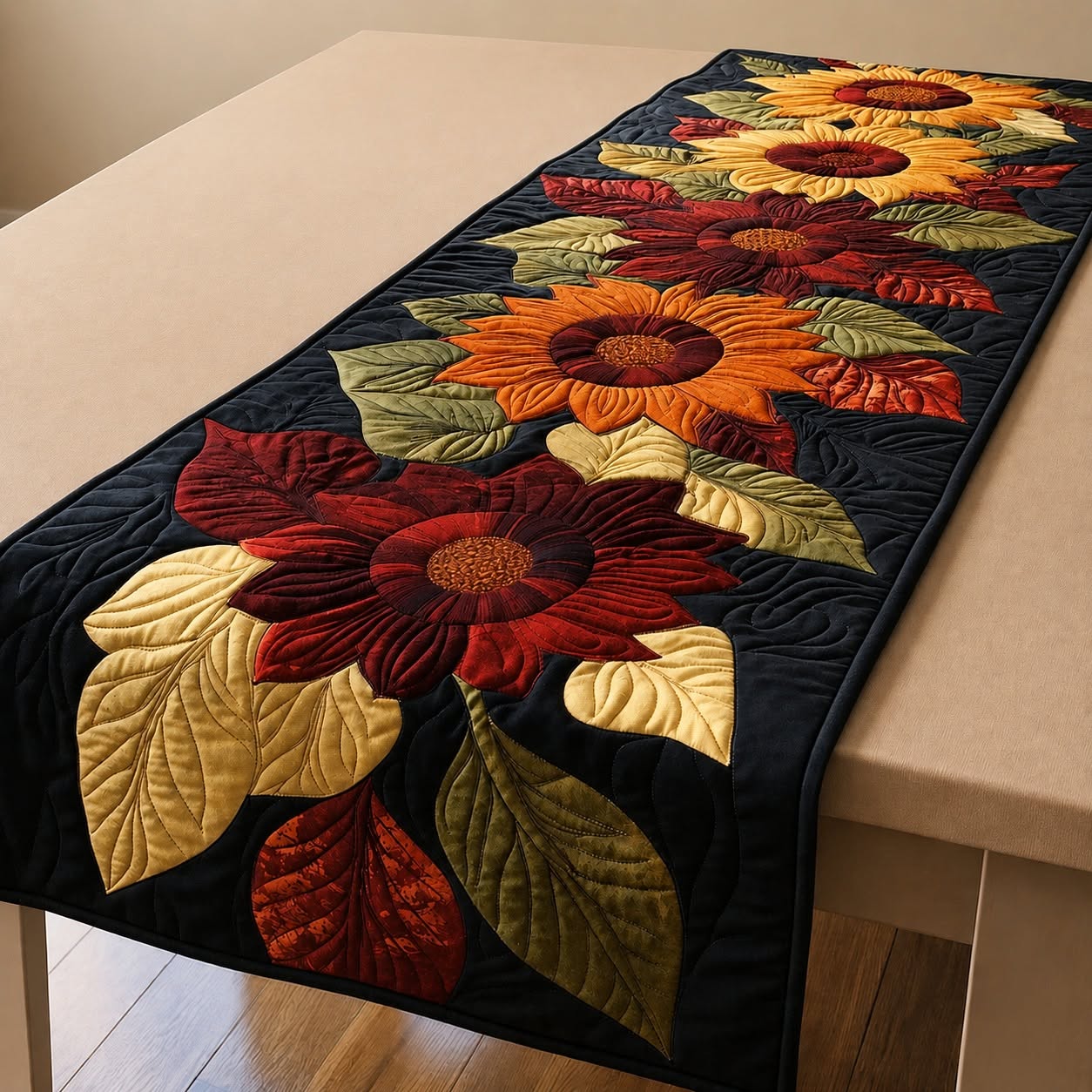
The contrast between black or charcoal fabric and shades of gold, orange, burgundy, olive green, and rust gives the runner a sophisticated seasonal appearance.
Although the finished piece looks highly detailed, the construction can be broken into manageable stages that both confident beginners and experienced quilters can follow.
The main technique is fabric appliqué, where individually cut petals, flower centers, and leaves are arranged on a background before being secured with stitching.
Decorative quilting is then added to create dimension, texture, and the beautiful sculpted appearance visible across the flowers and foliage.
By taking time with cutting, placement, pressing, quilting, and binding, you can create an impressive handmade runner suitable for a dining table, buffet, console, or seasonal centerpiece.
Understanding the Quilted Sunflower Print Table Runner Fabric Pattern also means understanding how color and scale work together in a floral quilt design. Instead of relying on tiny prints, this project uses large flowers as visual focal points, allowing every petal and leaf to become part of the overall composition.
Deep red and burnt-orange flowers can be combined with golden sunflowers, while olive, sage, mustard, and rust-colored leaves create natural transitions throughout the design.
A dark background is especially effective because it separates the appliqué shapes and makes every warm color appear richer and brighter.
The runner can be created with solids, tone-on-tone fabrics, batiks, subtle prints, or a mixture of these materials depending on the look you prefer.
Quilting lines inside each appliqué shape can imitate the natural veins of petals and leaves, adding another layer of visual interest without requiring additional fabric.
The result is a handmade sunflower table runner that feels artistic while still being practical enough for everyday or seasonal decorating.
Another advantage of the Quilted Sunflower Print Table Runner Fabric Pattern is that the dimensions can easily be adapted to the table where it will be displayed. A practical starting size is approximately 40 cm wide by 140 cm long, although a longer dining table may look better with a runner measuring 160 cm or more.
Before cutting fabric, measure the table and decide whether you want the runner to remain completely on top or extend beyond both ends.
Large flowers generally work best when they measure approximately 22 to 30 cm across, while leaves can range from 8 to 18 cm depending on their location.
The design does not need to be perfectly symmetrical; a slightly organic arrangement often produces a more natural and visually interesting composition.
You can also adapt the colors to your décor, replacing autumn tones with cheerful yellows, soft creams, blues, greens, or even contemporary neutrals.
What makes the project recognizable is the combination of large sunflower appliqué pieces, layered foliage, a contrasting background, decorative quilting, and a clean bound edge.
Materials, Fabric Selection, and Preparing the Sunflower Pattern
To begin your Quilted Sunflower Print Table Runner Fabric Pattern, prepare cotton quilting fabric for the background, appliqué flowers, leaves, backing, and binding. You will also need batting, coordinating sewing thread, fabric scissors or a rotary cutter, a cutting mat, pins or quilting clips, an iron, and a sewing machine. For appliqué, fusible web is very useful because it keeps the many individual pieces in position before stitching begins.
DISCOVER MORE FREE PATTERNS HERE!
For a runner approximately 40 cm × 140 cm, cut a background rectangle slightly larger than the desired finished measurement. Leaving an extra 3 to 5 cm around every edge is helpful because quilting can cause minor shrinkage or distortion. After the quilting is finished, the piece can be squared and trimmed accurately before the binding is attached.
Create the sunflower templates by drawing several petal shapes in slightly different sizes. A realistic flower does not require identical petals, so small variations actually make the finished design more interesting. For each large flower, prepare approximately 14 to 22 petals, depending on how full you want the sunflower to appear. Create circular or slightly oval templates for the flower centers as well.
The large leaves are another important feature of this sunflower quilt pattern. Draw broad pointed leaves with gentle curves, then make a few smaller versions to fill spaces between the flowers. When cutting leaves, vary their orientation so that some point toward the center of the runner while others move toward the outer edges. This creates visual movement and prevents the design from appearing rigid.
Choose several related colors instead of using only one fabric for every flower. For example, one sunflower may combine golden yellow, mustard, and burnt orange petals, while another can use burgundy, brick red, and deep rust. Using multiple values of the same color family creates depth and helps reproduce the rich appearance of the photographed runner.
Before fusing anything permanently, place every flower and leaf on the background fabric. Stand several steps away and evaluate the overall balance. The largest flowers should form the main visual path along the runner, while smaller flowers and leaves should fill empty spaces without making the composition overcrowded. Photographing the arrangement before removing the pieces is a simple way to remember their positions.
Cutting, Layering, and Sewing the Sunflower Appliqué
The next stage of the Quilted Sunflower Print Table Runner Fabric Pattern is preparing the appliqué pieces. Trace the petal, center, and leaf templates onto the paper side of fusible web, leaving a small space between shapes. Rough-cut around each template, fuse the pieces to the wrong side of the selected fabrics according to the fusible product instructions, and then cut directly on the traced lines.
Begin assembling each flower with the outer petals. Position them in a circular arrangement, allowing neighboring petals to overlap slightly. Avoid spacing them with perfect mathematical precision because real flowers naturally contain small variations. Once the first layer looks balanced, add several smaller petals closer to the center to create fullness and depth.
Place the circular flower center over the inner ends of the petals. For more dimension, you can create the center with two or three fabric circles in different shades, such as dark burgundy around a smaller brown or golden center. The layered center helps make the sunflower appliqué visually stronger and creates an attractive focal point for decorative stitching later.
Next, position the leaves around and underneath the flowers. Some leaves should partially disappear behind flower petals, creating the impression that the flowers are growing naturally across the runner. Use olive green, muted yellow, brown, sage, or reddish fabrics to produce the warm botanical appearance associated with the reference project.
After checking the entire arrangement one final time, fuse the pieces to the background. Work gradually rather than pressing the whole runner at once. Follow the recommended temperature for your fusible web and avoid sliding the iron across the fabric because this can move the pieces. Pressing each section carefully helps maintain the original arrangement.
Secure the edges using a blanket stitch, narrow zigzag stitch, satin stitch, or small straight stitch. A matching thread creates subtle outlines, while slightly darker thread emphasizes each shape. Sew slowly around tight curves, leaving the needle down whenever you need to lift the presser foot and pivot. This technique produces smoother edges around the many petals found in the Quilted Sunflower Print Table Runner Fabric Pattern.
Quilting, Texture, Assembly, and Finishing the Table Runner
Once the appliqué is complete, prepare the quilting sandwich. Place the backing fabric wrong side up on a clean surface, position the batting over it, and center the appliquéd top on the batting with the right side facing upward. Smooth every layer carefully and secure them with safety pins, temporary basting spray, or your preferred quilting method.
The distinctive character of this project comes from decorative free-motion quilting. Quilt curved lines inside the petals that follow their natural shape from the flower center toward the outer edge. These lines create the sculpted texture visible in the inspiration image and make simple fabric shapes look considerably more detailed.
For each leaf, quilt a central vein first and then add gently curved diagonal lines extending toward the edges. The quilting should follow the imaginary structure of a real leaf. You do not need to reproduce every line perfectly. Slight differences between leaves often make the finished fabric table runner pattern look more organic and handcrafted.
The dark background can be quilted more densely than the appliqué. Curving lines, flowing waves, loops, or echo quilting work especially well around flowers and leaves. Dense background quilting compresses the batting while the appliqué remains visually raised, producing the dimensional appearance that makes this style of floral quilting so attractive.
After quilting the entire runner, place it on a cutting mat and square the edges. Trim the project to its final dimensions, checking that opposite sides remain parallel. Prepare binding strips approximately 6 to 6.5 cm wide, join them into one continuous strip, fold the binding lengthwise, and press it before attaching it around the runner.
Sew the binding to the front using approximately a 0.6 cm seam allowance, create neat mitered corners, fold the binding around the raw edge, and secure it on the back by hand or machine. Give the finished runner a light final press. Your Quilted Sunflower Print Table Runner Fabric Pattern is now ready to decorate a dining room, kitchen table, sideboard, or seasonal display.
FAQ About the Quilted Sunflower Print Table Runner Fabric Pattern
What is a Quilted Sunflower Print Table Runner Fabric Pattern? It is a decorative quilting project featuring sunflower-inspired flowers and leaves arranged on a long fabric background designed for a table. The floral pieces can be created through appliqué and enhanced with quilting stitches that add texture and dimension.
Is this sunflower table runner suitable for beginners? A beginner who already understands basic straight stitching can complete the project, although the appliqué curves and free-motion quilting require patience. Beginners can simplify the design by using fewer flowers, larger petals, and basic straight-line or echo quilting instead of complex free-motion details.
What fabrics work best for a sunflower quilted table runner? Quilting-weight cotton is an excellent choice because it is easy to cut, press, appliqué, and quilt. Batiks and tone-on-tone fabrics are particularly effective for flowers and leaves because their subtle variations create natural shading without requiring complicated piecing.
What colors should I use for the sunflower design? Traditional choices include gold, mustard yellow, orange, rust, burgundy, brown, olive green, and deep red. A charcoal or black background produces strong contrast, but cream, beige, navy, or muted green can also work beautifully. The design can easily be personalized to match your home décor.
How large should the finished table runner be? There is no single required size. Approximately 35 to 45 cm wide works well for many tables, while the length may range from around 100 to 180 cm. Measure your table before cutting and decide whether you want the runner to stop near the ends or hang slightly over them.
Do I need a special sewing machine for this project? No. A standard sewing machine can sew the appliqué, quilting, and binding. A free-motion quilting foot is helpful for creating the flowing texture seen in detailed floral quilts, but a walking foot can also produce beautiful results using echo quilting, gentle curves, or structured stitching.
Conclusion
The Quilted Sunflower Print Table Runner Fabric Pattern combines several enjoyable quilting techniques into one striking home décor project. Starting with a dark background, you learned how to choose coordinating fabrics, create large sunflower and leaf templates, arrange the appliqué pieces, fuse and stitch them securely, and build a balanced floral composition inspired by the reference image.
You also learned how quilting can completely transform flat appliqué. By adding petal lines, leaf veins, dense background stitching, batting, and carefully finished binding, the runner develops the rich texture and professional appearance associated with detailed sunflower quilting projects. These techniques can later be adapted to placemats, wall hangings, cushions, quilts, and many other fabric projects.
EASILY FIND THE PDF FOR THIS PATTERN HERE!
Most importantly, there is no need for every flower or leaf to look identical. Small differences in petal shapes, fabric shades, quilting lines, and placement are part of what gives handmade quilting its character. Use the Quilted Sunflower Print Table Runner Fabric Pattern as a foundation, then adapt the dimensions and colors until the project reflects your own creative style. After finishing your runner, take a moment to look at how the different shades and quilting textures work together. If you make this project, leave your sincere opinion and suggestions about the tutorial, including which step you enjoyed most and what you would like to learn in a future quilting project.