
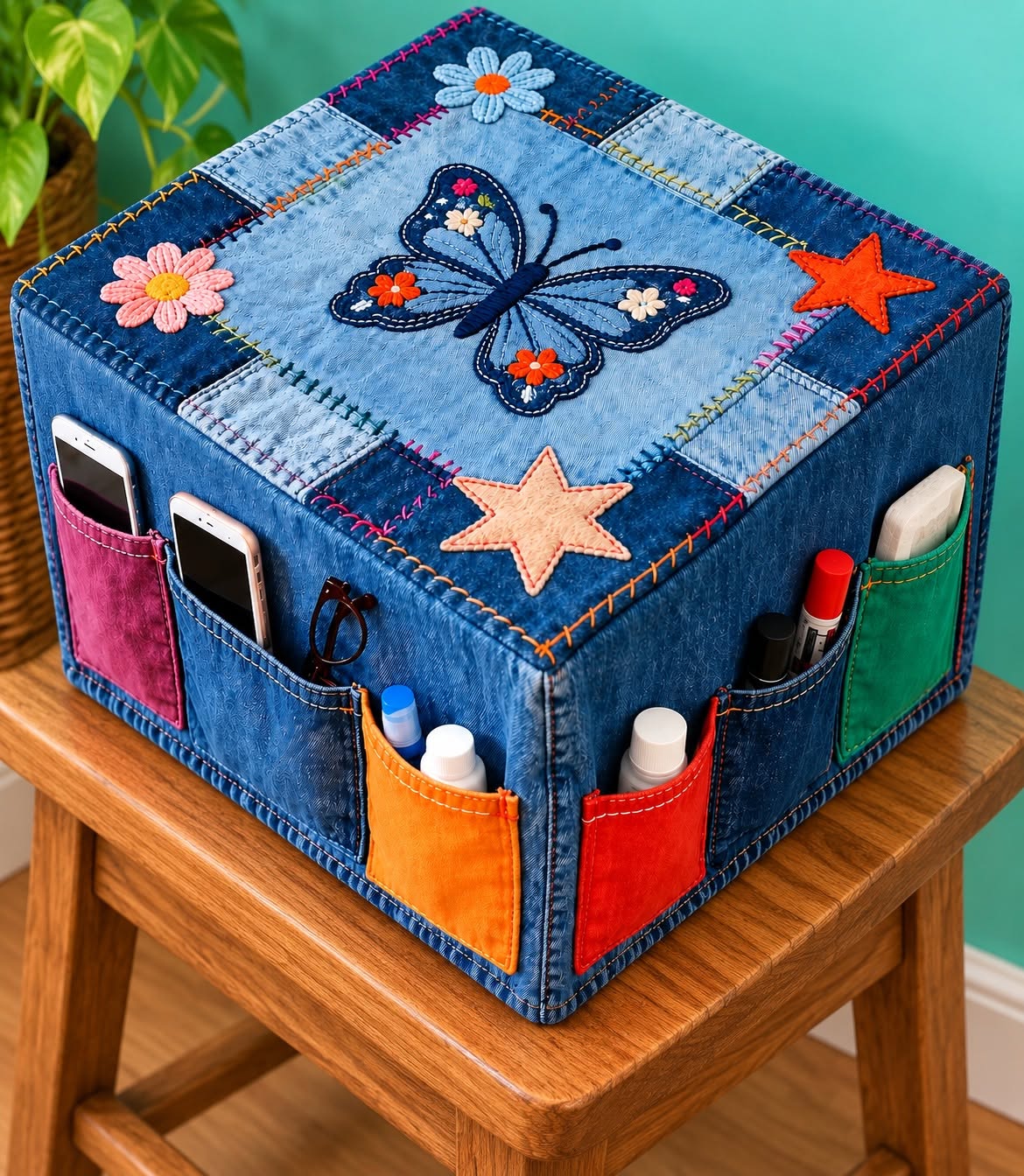
Denim Patchwork Storage Box Cover and Organizer Fabric Pattern is a creative sewing project that combines practical storage with the cozy, handmade character of recycled denim, colorful embroidery, appliqué, and patchwork. Inspired by the organizer shown in the photo, this project transforms an ordinary box, cube, ottoman, or small bedside storage unit into a decorative fabric cover filled with useful exterior pockets. The combination of several shades of blue denim gives the piece depth, while bright pockets, stars, flowers, and the central butterfly make the design cheerful without taking away from its practical purpose. It is also an excellent project for using leftover jeans, cotton scraps, embroidery thread, and small pieces of fabric that might otherwise remain unused in a sewing room.
One of the most appealing features of this Denim Patchwork Storage Box Cover and Organizer Fabric Pattern is its flexibility. You do not have to reproduce every decorative element exactly as shown. The butterfly can be replaced with a heart, bird, flower, monogram, or another appliqué motif, while the outside pockets can be adapted to hold sewing supplies, phones, glasses, remote controls, craft tools, pens, cosmetics, or other lightweight objects. The project can also be resized for a square storage cube, sewing stool, bedside organizer, or small table. By understanding the basic construction process, you can customize the dimensions while keeping the same patchwork appearance and functional pocket arrangement.
For the best result, think of this project as a combination of denim patchwork, fabric appliqué, decorative hand stitching, and storage organizer sewing. Each of these techniques has a specific purpose. Patchwork builds the surface from smaller pieces of fabric, appliqué adds recognizable decorative shapes, hand stitching highlights seams and gives the cover a folk-art look, and the organizer pockets turn the finished textile piece into something genuinely useful. The following tutorial explains how to plan the measurements, prepare the fabric, create the decorative top panel, make the side pockets, assemble the cover, and finish the edges so the final project looks neat, balanced, and durable.
Materials, Measurements, and Fabric Preparation
Begin by measuring the box or cube that you want to cover. Measure the width and depth of the top, followed by the height of each side. For example, if your storage cube measures approximately 38 cm wide, 38 cm deep, and 35 cm high, the finished cover should match those measurements while including a small amount of ease. Add approximately 1 to 1.5 cm to the width and depth if you want the cover to slide on and off easily, especially when working with heavy denim fabric.
DISCOVER MORE FREE PATTERNS HERE!
For a medium organizer, gather approximately 1 to 1.5 meters of denim in several shades. Old jeans are ideal because they naturally provide light, medium, and dark blue sections. You will also need colorful cotton scraps for the pockets and appliqués, lightweight fusible web for the decorative shapes, batting or interfacing if you want extra structure, matching sewing thread, embroidery floss, pins or clips, scissors, a ruler, and a sewing machine. A denim needle, generally size 90/14 or 100/16, is especially helpful when sewing through several layers.
Wash and dry recycled denim before cutting it. This removes residue and allows the fabric to shrink before the project is assembled. Cut away thick waistbands, rivets, zippers, and very bulky seams unless you intentionally want to incorporate them as decorative features. Flatten each usable section with an iron so that measuring and cutting become easier. Avoid stretching the fabric while pressing because some denim contains elastane.
To reproduce the patchwork appearance of the photo, divide the top panel into a large central square or rectangle surrounded by smaller pieces of denim. A useful starting point is a central panel measuring about 24 × 24 cm for a 38 cm top, although your dimensions should be adjusted according to the actual box. Surround this centerpiece with strips and rectangles cut from contrasting denim shades until the assembled patchwork is slightly larger than the required finished top.
The colorful visible stitches are an important part of the Denim Patchwork Storage Box Cover and Organizer Fabric Pattern. After joining the denim pieces with a regular machine seam, press the seam allowances open or to one side. Add decorative stitching near the seam lines using embroidery floss or thicker thread. Blanket stitch, cross stitch, running stitch, whip stitch, and simple decorative machine stitches all work well. Using several colors creates the playful handcrafted effect seen in the inspiration image.
Before assembling anything permanently, arrange all the pieces on a flat surface. Move the light and dark denim sections around until the colors feel balanced. Place the central appliqué temporarily in position and test the location of the flowers and stars. Planning the composition at this stage prevents one side from becoming visually heavier than another and helps you create a professional-looking patchwork organizer rather than a random collection of scraps.
Creating the Butterfly Appliqué and Decorative Patchwork Top
The large butterfly is the visual centerpiece of the organizer, so begin by creating a paper template. Fold a sheet of paper in half and draw half of a butterfly to obtain a symmetrical shape, or draw the four wings individually for a more organic appearance. A butterfly approximately 20 to 23 cm wide works nicely on a medium-size top panel. Trace the pattern onto fusible web, remembering that the final shape may be reversed after fusing.
Fuse the web to the wrong side of your chosen fabric according to the product instructions, then cut out the butterfly pieces. Dark blue denim is ideal for the outer wings because it contrasts beautifully with a lighter denim background. For additional dimension, cut smaller inner wing shapes from pale denim or printed cotton. Remove the paper backing and fuse each section carefully onto the center panel.
Secure the butterfly with appliqué stitching. A narrow zigzag or satin stitch can create a clean machine-finished edge, while a blanket stitch gives a more handcrafted look. In the photographed design, light-colored stitching around dark edges helps define the wings. You can imitate this by using cream, white, pale blue, or another contrasting thread. Work slowly around curves so the stitches remain even.
Create the butterfly’s body from a narrow piece of dark fabric, felt, corded embroidery, or dense satin stitching. The antennae can be embroidered directly onto the denim using a stem stitch or backstitch. Small floral appliqués placed inside the wings give the design a charming folk-art character. These miniature flowers can be made from tiny fabric pieces, felt, or embroidery stitches, depending on the materials you have available.
Add additional motifs around the top panel to create balance. The photo combines a pink flower, a pale blue flower, and warm-colored star appliqués. For a similar effect, choose three or four accent colors and repeat them throughout the design. This repetition is important because it visually connects the different areas of the Denim Patchwork Storage Box Cover and Organizer Fabric Pattern. Orange, coral, pink, yellow, and turquoise pair especially well with blue denim.
Once every appliqué has been attached, inspect the entire top panel. Trim loose threads and reinforce any corners that may lift. If you want a slightly padded top, place lightweight batting behind the completed patchwork and quilt a few simple lines around the central motifs. Do not add excessive padding if the organizer needs to sit firmly on a flat box, because a very thick layer can make the cover harder to fit accurately.
Sewing the Side Panels and Useful Organizer Pockets
Measure the four sides of your box again before cutting the side panels. Each side panel should equal the width of its corresponding box side plus seam allowances. The height should cover the entire side and may extend 1 or 2 cm below the bottom edge if you prefer a longer cover. If all sides are identical, you can cut four equal rectangles. If the box is rectangular rather than square, prepare two panels for the width and two for the depth.
The side panels can be made from single pieces of denim or assembled from recycled denim patchwork. Using several pieces makes the organizer more visually interesting and helps use smaller scraps. Join the pieces, press the seams, and add decorative stitching just as you did on the top. Keep bulky jeans seams away from corners because multiple layers of thick denim can become difficult to sew.
For the pockets, cut colorful rectangles slightly larger than the desired finished size. A practical small pocket might begin as a 14 × 18 cm rectangle, while a phone pocket can be longer. Fold the upper edge to the wrong side by approximately 1 cm, then fold it again by another 1 to 1.5 cm. Press and topstitch this double-folded edge to make the pocket opening neat and strong.
Turn the remaining pocket edges under by approximately 1 cm and press them carefully. Position each pocket on a side panel and pin or clip it securely. Stitch around the sides and bottom, leaving the upper edge open. Reinforce both upper corners with a small triangle, square, or short bar tack because these areas receive the most stress when objects are inserted and removed.
Mix pocket colors to recreate the lively appearance of the original organizer. Orange, red, green, purple, and denim pockets work particularly well against the blue background. You can make pockets of different widths for different purposes. Narrow pockets are convenient for pens, crochet hooks, or craft tools, while wider pockets can hold glasses, a phone, small bottles, notebooks, or lightweight sewing supplies.
When planning pocket placement, consider what you actually want to store. Avoid placing every pocket at exactly the same height because slightly varied shapes can improve both function and visual interest. However, keep the lowest edge high enough that the pockets will not drag against the floor or furniture. This thoughtful combination of decoration and usability is what makes the Denim Patchwork Storage Box Cover and Organizer Fabric Pattern especially practical for a craft room, bedroom, or living space.
Assembling, Finishing, and Customizing the Denim Organizer
To assemble the cover, place two side panels right sides together and align their vertical edges. Sew using the seam allowance chosen earlier, usually around 1 cm. Continue joining the four side panels until they form a fabric tube. Before closing the final seam, test the fit around the box if possible. The cover should slide on without pulling excessively at the corners.
Next, attach the patchwork top. Divide both the top panel and the upper edge of the side tube into quarters and mark these points with pins or washable fabric marker. Match the quarter points first, then align the corners and distribute the remaining fabric evenly. Clip rather than pin very thick denim layers if that makes the construction easier. Sew slowly around the entire perimeter.
Clip excess bulk from the corner seam allowances without cutting into the stitching. Turn the cover right side out and push each corner gently into shape. Place it over the box and check the fit. If one corner looks loose, remove the cover and adjust the seam slightly. Small corrections at this stage can dramatically improve the finished appearance.
Finish the lower edge with a double-fold hem. Turn the raw edge under by approximately 1 cm and then again by 1.5 to 2 cm before topstitching. If the denim is too thick for a double fold, bind the lower edge with cotton bias tape instead. Bias binding can also introduce another accent color and provide an attractive professional finish.
For additional decorative detail, add hand embroidery after the cover is assembled. Colored blanket stitches along selected seams, small crosses, running stitches, and simple floral embroidery can transform ordinary denim into a unique textile surface. This technique is sometimes associated with visible mending and decorative repair, but here it becomes an intentional design feature. The uneven character of handmade stitches often makes the piece more appealing rather than less polished.
Your completed Denim Patchwork Storage Box Cover and Organizer Fabric Pattern can be customized in countless ways. Replace the butterfly with a sunflower, owl, cat, heart, tree, cottage, or geometric block. Use neutral fabrics for a modern version, bright scraps for a playful craft-room organizer, or vintage denim with muted embroidery for a rustic style. The same construction method can even be adapted to cover a small ottoman, sewing stool, storage cube, or side table.
FAQ – Frequently Asked Questions
What is a Denim Patchwork Storage Box Cover and Organizer Fabric Pattern?
It is a sewing pattern or construction concept used to create a removable fabric cover for a box, cube, ottoman, or similar piece of furniture. Denim scraps are joined in patchwork sections, while pockets attached to the sides provide additional storage. Decorative appliqués and embroidery can be added to personalize the project.
Can I make this organizer from old jeans?
Yes. Old jeans are one of the best materials for this project because they provide durable fabric in several natural shades of blue. Use the legs and other flat areas for larger pieces and save smaller sections for appliqué or patchwork. Remove very thick seams, metal rivets, and hardware from areas that will need to pass through the sewing machine.
Do I need batting inside the cover?
Batting is optional. A thin layer can give the top a quilted appearance and make the appliqué stand out, but heavy padding is usually unnecessary. Denim already has considerable body, especially when several seams and decorative elements are incorporated.
What sewing machine needle works best for denim?
A denim or jeans needle is recommended. Size 90/14 is suitable for many medium-weight fabrics, while size 100/16 may work better when several thick layers are being sewn together. Always test the combination of needle, thread, and fabric scraps before working on the finished project.
How can I stop the organizer pockets from tearing?
Reinforce the two upper corners of every pocket. A short bar tack, stitched triangle, or small square of additional stitching distributes stress and helps prevent the fabric from pulling away from the side panel. Avoid overloading pockets with excessively heavy objects.
Can beginners make this project?
A confident beginner can complete it by working one section at a time. Straight seams form most of the construction, and the appliqué can be simplified if necessary. Beginners may want to practice decorative stitches on scrap denim before applying them to the final panel.
How do I resize the pattern for my own storage box?
Measure the top width, top depth, and side height of your box. Create the top panel according to the top dimensions and cut each side according to the corresponding width and height. Add seam allowances to every piece and a small amount of ease if you want a removable cover.
Should the denim pieces all be the same color?
No. Using different washes is one of the easiest ways to create visual interest. Light, medium, and dark denim pieces provide natural contrast even before embroidery or appliqué is added. Alternating shades around the central panel helps frame the main motif.
What stitches can I use for the decorative seams?
Running stitch, blanket stitch, cross stitch, whip stitch, herringbone stitch, and simple machine decorative stitches are all suitable. Bright embroidery floss creates the colorful handmade appearance seen in this style of organizer.
Can the cover be washed?
A removable cover made from prewashed fabrics can usually be gently washed, but the care method depends on the appliqués, interfacing, embroidery thread, and other materials used. Prewashing the denim and cotton scraps before construction reduces the risk of uneven shrinkage later.
What can I store in the exterior pockets?
The pockets are ideal for lightweight everyday items such as phones, glasses, remote controls, notebooks, pens, craft tools, yarn accessories, small sewing supplies, or other frequently used objects. Design the pocket sizes according to their intended purpose before sewing them to the side panels.
Can I make the project without the butterfly appliqué?
Absolutely. The butterfly is only a decorative focal point. You can replace it with any simple appliqué shape that suits your room or personal style. Flowers, stars, birds, hearts, leaves, houses, geometric shapes, and initials are all attractive alternatives.
Conclusion
Creating a Denim Patchwork Storage Box Cover and Organizer Fabric Pattern is a rewarding way to combine practical organization, recycled materials, patchwork sewing, appliqué, and decorative embroidery in one functional handmade project. The process begins with accurate measurements, continues with the preparation of different denim pieces, and develops through the construction of the decorative top, colorful side pockets, reinforced seams, and neatly finished edges.
The most important lessons are to measure carefully, keep bulky seams under control, reinforce pocket openings, balance the different denim shades, and plan decorative details before final assembly. Once these basic techniques are understood, the same pattern can be adapted to many storage cubes, stools, boxes, and small pieces of furniture. Every version can look completely different depending on the fabrics, embroidery colors, pocket arrangement, and central appliqué chosen.
EASILY FIND THE PDF FOR THIS PATTERN HERE!
This project is also a wonderful reminder that useful sewing does not need to be plain. With thoughtful denim patchwork, colorful stitching, functional pockets, and a beautiful central appliqué, an everyday storage piece can become a distinctive handmade feature in your home. It is a practical project for anyone who enjoys recycling fabric while creating something that is decorative, organized, and genuinely useful. If you make your own version of this Denim Patchwork Storage Box Cover and Organizer Fabric Pattern, leave your sincere opinion about the project and share your suggestions. Which appliqué would you choose for the center, and what colors would you use for the pockets? Your ideas can inspire new variations and creative ways to personalize this versatile denim organizer.