
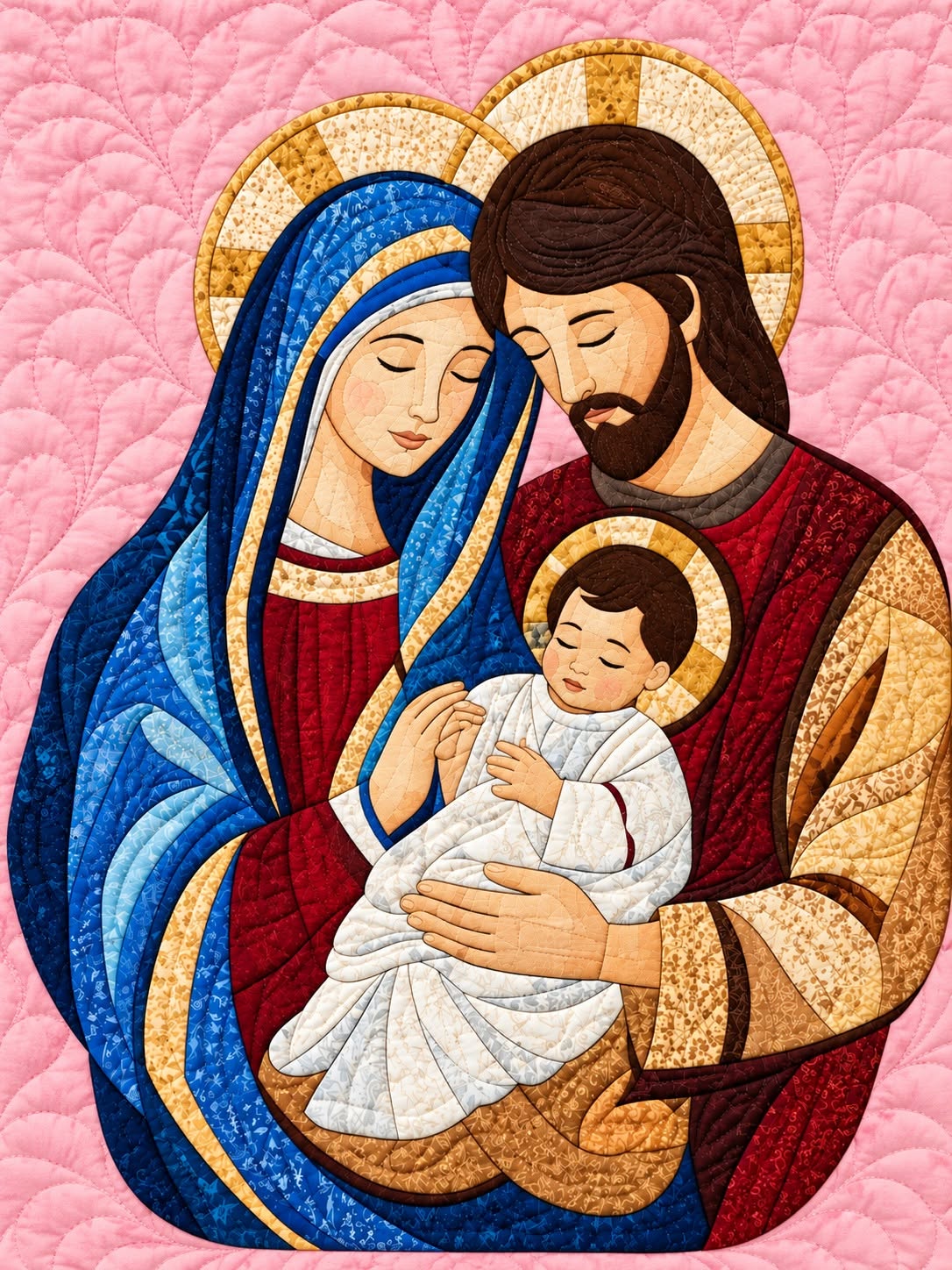
The Holy Family Bedspread Quilt Pattern is a meaningful quilting project that combines traditional patchwork, fabric appliqué, careful color planning, and decorative quilting to create a striking representation of the Holy Family. Inspired by the composition shown in the reference image, the project centers on Mary, Joseph, and the infant Jesus, surrounded by curved halos, flowing garments, and an elegant decorative border. Although the original composition has the appearance of an art quilt, the same construction principles can be adapted to a larger bedspread by increasing the dimensions of each section proportionally. This type of quilt is especially appealing to sewists who enjoy religious quilt patterns, fabric appliqué, curved shapes, pictorial quilting, and projects in which fabric becomes a form of illustration. The finished piece can serve as a bedspread, decorative quilt, seasonal display, or meaningful handmade gift. Because many small fabric pieces are involved, the project also offers an excellent opportunity to use coordinated scraps while maintaining a sophisticated and unified appearance.
Before beginning a Holy Family Bedspread Quilt Pattern, it helps to understand what the word pattern means in this type of quilting project. A quilt pattern is more than a single paper template; it is the complete construction plan that determines the shapes, proportions, fabric placement, assembly order, seam allowances, and quilting strategy. For a pictorial project like this one, the pattern may include separate templates for faces, garments, hands, halos, hair, borders, leaves, and background sections. Some parts are pieced traditionally, while others are easier to create using appliqué quilting techniques. The reference design uses an attractive palette of deep blue, burgundy, cream, brown, gold, tan, and light neutral fabrics, producing both contrast and visual warmth. Repeating these colors throughout the quilt helps connect the figures with the borders and keeps the detailed composition from feeling visually crowded. Planning these relationships before cutting fabric is one of the most important steps in producing a polished result.
Another important characteristic of the Holy Family Bedspread Quilt Pattern is its layered appearance. Instead of constructing the entire picture as one complicated block, it is easier to think of the project as several visual layers assembled one at a time. The cream background forms the first layer, followed by the halos, large garments, faces, hair, smaller clothing sections, hands, and finally the infant figure. Decorative corner leaves and blue borders frame the central scene and make the composition feel complete. Quilting lines can then be added over the finished quilt top to emphasize folds in the garments, contours of the faces, curves of the halos, and movement throughout the background. Working from large shapes toward smaller details makes the process far more manageable. It also allows beginners in pictorial appliqué to approach an advanced-looking design through a logical series of smaller sewing tasks.
Planning the Holy Family Quilt Design and Choosing Fabrics
Begin your Holy Family Bedspread Quilt Pattern by deciding on the finished size. For a wall quilt, the reference proportions can be followed fairly closely, but for a bedspread you will need to enlarge the design while preserving its vertical composition. Measure the mattress and determine how much drop you want on each side before adding seam and quilting allowances.
DISCOVER MORE FREE PATTERNS HERE!
Create a simplified drawing of the entire quilt before making individual templates. Mark the outer border, inner blue frame, cream background, decorative corners, halos, Mary, Joseph, and the infant Jesus. You do not need to draw every tiny detail immediately; the purpose of this first sketch is to establish proportion and placement.
The main keyword Holy Family Bedspread Quilt Pattern describes a quilt design featuring the Holy Family that is specifically planned for construction as a bed covering or large decorative textile. In practical terms, this means the pattern must consider both artistic composition and quilt-making requirements such as durability, batting, backing, binding, seam stability, and comfortable drape.
Choose fabrics that create clear separation between the figures. Deep and medium blues work beautifully for Mary’s veil, while burgundy or wine-colored fabrics provide strong contrast in the clothing. Warm brown fabrics can be used for Joseph’s hair and beard, while gold, tan, cream, and beige fabrics help create halos and decorative accents.
For the faces and hands, prepare several skin-tone fabrics rather than relying on only one solid color. Subtle tonal differences make it easier to create cheeks, noses, neck areas, fingers, and facial contours. Small-scale prints or tone-on-tone quilting cotton can add dimension without making the figures appear overly busy.
Finally, wash and press all cotton fabrics before cutting if you normally prewash quilting materials. Pressing is especially important because curved appliqué pieces are easier to position accurately when the fabric lies completely flat. Keep each fabric group organized by color so that you can quickly find coordinating pieces during assembly.
Creating the Templates, Halos, Faces, and Main Appliqué Pieces
Start template preparation with the largest shapes in the Holy Family Bedspread Quilt Pattern. Trace the outlines for Mary’s veil, Joseph’s robe, the infant’s clothing, and the three halos onto template material or sturdy paper. Number each template and mark its orientation so that pieces are not accidentally reversed.
For curved sections such as the halos, divide the rings into manageable fabric segments. The reference image uses several gold and cream prints, which creates a beautiful stained-glass-like effect. Sew or appliqué these sections together before placing the completed halo units on the cream background.
The faces require more patience because they determine much of the personality of the finished quilt. Build each face from a main skin-tone shape and smaller overlays for areas such as the nose, neck, ear, cheek, and hairline. Keep the facial features simple and graceful rather than trying to reproduce every tiny visual detail with fabric.
Mary’s veil can be created from several curved blue strips in different shades. Arrange dark navy, royal blue, medium blue, and lighter blue pieces so that the colors appear to flow around the face and down toward the lower portion of the quilt. A narrow cream or golden strip can be added as a decorative edge.
Joseph’s hair and beard can be constructed using dark brown fabrics with subtle prints. Large shapes should establish the hairstyle first, followed by smaller sections around the beard, mustache, and forehead. Decorative quilting added later can provide additional texture, so the fabric pieces themselves do not need to represent every strand of hair.
The infant figure should be prepared as a separate layered appliqué unit whenever possible. Construct the head, hair, body, robe, hands, and visible feet before permanently attaching the figure to the main quilt. This approach makes it easier to correct alignment and gives you greater control over the small pieces.
Assembling the Holy Family Bedspread Quilt Pattern Step by Step
Prepare the large cream background panel first and mark its vertical and horizontal center lines with a removable fabric marker. These guidelines will help keep the Holy Family Bedspread Quilt Pattern balanced. Position the halos first because most of the figures will overlap them.
After the halos are secured, place the largest sections of Mary’s and Joseph’s garments. Do not immediately stitch every piece permanently. Arrange the entire composition temporarily and evaluate the relationship between the figures, especially the placement of the heads, shoulders, arms, and infant.
When you are satisfied with the layout, attach the appliqué pieces using your preferred method. Raw-edge appliqué with a narrow machine stitch is practical, while turned-edge appliqué produces a softer traditional finish. Fusible appliqué can also simplify construction, particularly when working with many small pieces.
Add the facial sections after the main garments are secure. Eyes, eyebrows, mouths, and other delicate details may be created with very narrow fabric appliqué, machine stitching, or carefully controlled embroidery. Keep these elements understated because the peaceful expression of the figures is an important part of the composition.
Next, position the infant across the lower center of the two adult figures. The overlapping arrangement creates the strong focal point seen in the reference design. Add the adult hands around the child only after checking that their size, direction, and placement look natural within the composition.
Complete the quilt top by adding the decorative framing sections. Use a narrow dark blue inner border, a wider pieced blue border, and a coordinating outer border containing warm gold or floral fabrics. Leaf-like patchwork motifs in the corners can repeat colors from the central design and visually connect the border with the Holy Family scene.
Quilting, Finishing, and Adapting the Pattern for a Bedspread
Once the top of your Holy Family Bedspread Quilt Pattern is complete, prepare the quilt sandwich using backing fabric, batting, and the finished top. The backing should extend several inches beyond every edge. Smooth all layers carefully and baste them securely to prevent shifting during quilting.
Quilting can become an important artistic element in this project. Use curved quilting lines in Mary’s veil and Joseph’s garments to suggest folds and movement. Gentle contour quilting around faces, hands, and halos can emphasize the appliqué shapes without competing with the fabric design.
The cream background offers an opportunity for denser decorative quilting. Organic curves, gentle vines, flowing lines, or free-motion textures can fill the negative space and make the central figures stand out. If you prefer a simpler result, evenly spaced echo quilting around the main shapes can also work beautifully.
For a true bedspread, durability should be considered along with appearance. Secure all appliqué edges carefully and avoid leaving loose embellishments that could catch during normal use. Choose batting that provides the amount of warmth and loft you want while still allowing the finished quilt to drape comfortably over the bed.
Square the quilt only after all quilting is completed. Trim away excess backing and batting, then measure each side before attaching the binding. A dark blue, brown, or coordinated gold binding can frame the entire Holy Family quilt and provide a clean professional finish.
Finally, inspect the project from a distance. Check the balance of the colors, the symmetry of the borders, and the visibility of the central figures. Small imperfections are a natural part of handmade quilting, and they do not prevent the finished Holy Family Bedspread Quilt Pattern from becoming a beautiful and expressive piece of textile art.
FAQ – Frequently Asked Questions About the Holy Family Bedspread Quilt Pattern
What is a Holy Family Bedspread Quilt Pattern?
A Holy Family Bedspread Quilt Pattern is a quilting plan designed around an artistic representation of Mary, Joseph, and the infant Jesus. It can combine traditional patchwork, appliqué, curved piecing, embroidery, and decorative quilting. When designed as a bedspread, the composition is enlarged to provide enough coverage for the intended mattress size.
Is this quilt suitable for beginners?
The complete composition is better suited to confident beginners or intermediate quilters because it contains several curved and layered appliqué sections. However, a beginner can still make the project successfully by dividing it into smaller stages and practicing the appliqué method on scrap fabric before beginning the final quilt.
What is the best fabric for a Holy Family quilt?
High-quality quilting cotton is one of the easiest choices because it is stable, widely available, easy to press, and suitable for both piecing and appliqué. Tone-on-tone fabrics and subtle prints work especially well because they provide visual texture while keeping the shapes recognizable.
How many colors should I use?
There is no fixed number, but the reference style works well with coordinated families of blue, burgundy, brown, cream, tan, gold, white, and skin tones. Using several shades within each color family creates depth. The key is repeating colors throughout the design so that the finished quilt remains visually harmonious.
Can I make the Holy Family Bedspread Quilt Pattern using scraps?
Yes. This is an excellent project for fabric scraps because the halos, garments, borders, and decorative sections can contain many small pieces. Try to sort your scraps into coordinated color groups before cutting. Maintaining a controlled palette will prevent a scrap-based quilt from looking disorganized.
Should I use fusible appliqué or needle-turn appliqué?
Both techniques are suitable. Fusible appliqué is faster and can make complicated shapes easier to position, particularly for beginners. Needle-turn appliqué requires more time but produces beautifully soft edges and a traditional handmade appearance. Machine appliqué is another practical option for a bedspread that will receive regular use.
How do I enlarge the pattern for a bed-size quilt?
Measure the desired finished dimensions and calculate the enlargement percentage based on your original drawing. Increase all pattern pieces using the same percentage so that the figures remain proportional. Borders can then be widened independently if additional length or width is required.
What batting works best for this type of quilt?
Cotton batting provides a traditional feel and good stitch definition, while cotton-blend batting may offer slightly easier care and increased stability. A relatively low- or medium-loft batting is usually preferable for detailed appliqué because it keeps the shapes clearly defined.
How should I quilt around the faces and hands?
Use subtle contour quilting rather than dense stitching directly over the facial features. Stitching close to the edges of the appliqué can define the shapes, while gentle curved lines can add dimension to hair, garments, and halos. Avoid excessively heavy quilting on small facial sections.
Can this design be made as a wall hanging instead of a bedspread?
Absolutely. The same Holy Family Bedspread Quilt Pattern concept can be reduced to create a wall hanging, decorative panel, church display, seasonal quilt, or framed textile artwork. A smaller version can also be a useful way to practice the construction technique before making a full-size bed quilt.
How can I make the quilt look more dimensional?
Use multiple values of the same color, placing darker shades in areas that should visually recede and lighter shades where you want highlights. Curved quilting lines can reinforce the effect. The combination of fabric value, overlapping appliqué pieces, and directional stitching creates depth without requiring heavy embellishment.
How long does a Holy Family quilt take to make?
The construction time depends on the finished size, appliqué technique, number of fabric pieces, and amount of quilting. Because this is a detailed pictorial design, it is best treated as a project made in stages rather than one that needs to be completed quickly. Careful preparation usually saves considerable time during final assembly.
Conclusion
Creating a Holy Family Bedspread Quilt Pattern is a rewarding way to combine patchwork quilting, fabric appliqué, color coordination, detailed cutting, and decorative quilting in one cohesive project. By beginning with a proportional drawing, preparing the large templates first, constructing the halos and garments in layers, assembling the faces carefully, and positioning the infant as the central focal point, the complex-looking composition becomes much easier to manage. The most important lesson is to build the quilt gradually. Start with the background and large shapes, move toward the smaller appliqué details, complete the borders, and only then begin the final quilting. Choosing coordinated blues, burgundies, creams, golds, browns, and neutral fabrics will help reproduce the warm and elegant character of the inspiration while still allowing you to create your own interpretation.
EASILY FIND THE PDF FOR THIS PATTERN HERE!
Whether you transform this Holy Family Bedspread Quilt Pattern into a full bedspread, a smaller decorative quilt, or a wall hanging, careful planning and patient construction will make a significant difference in the final result. Use the techniques in this guide as a foundation, experiment with fabrics that reflect your own quilting style, and enjoy every stage of bringing the design together. If you make your own version, leave your sincere opinion about the project and share your suggestions. Your ideas about color combinations, appliqué methods, border designs, quilting patterns, and possible variations can inspire new approaches to this beautiful Holy Family quilt pattern.