
Baby Animal Bedspread Pattern is a charming sewing and quilting project designed to transform a child’s bedroom into a warm, colorful, and welcoming space.
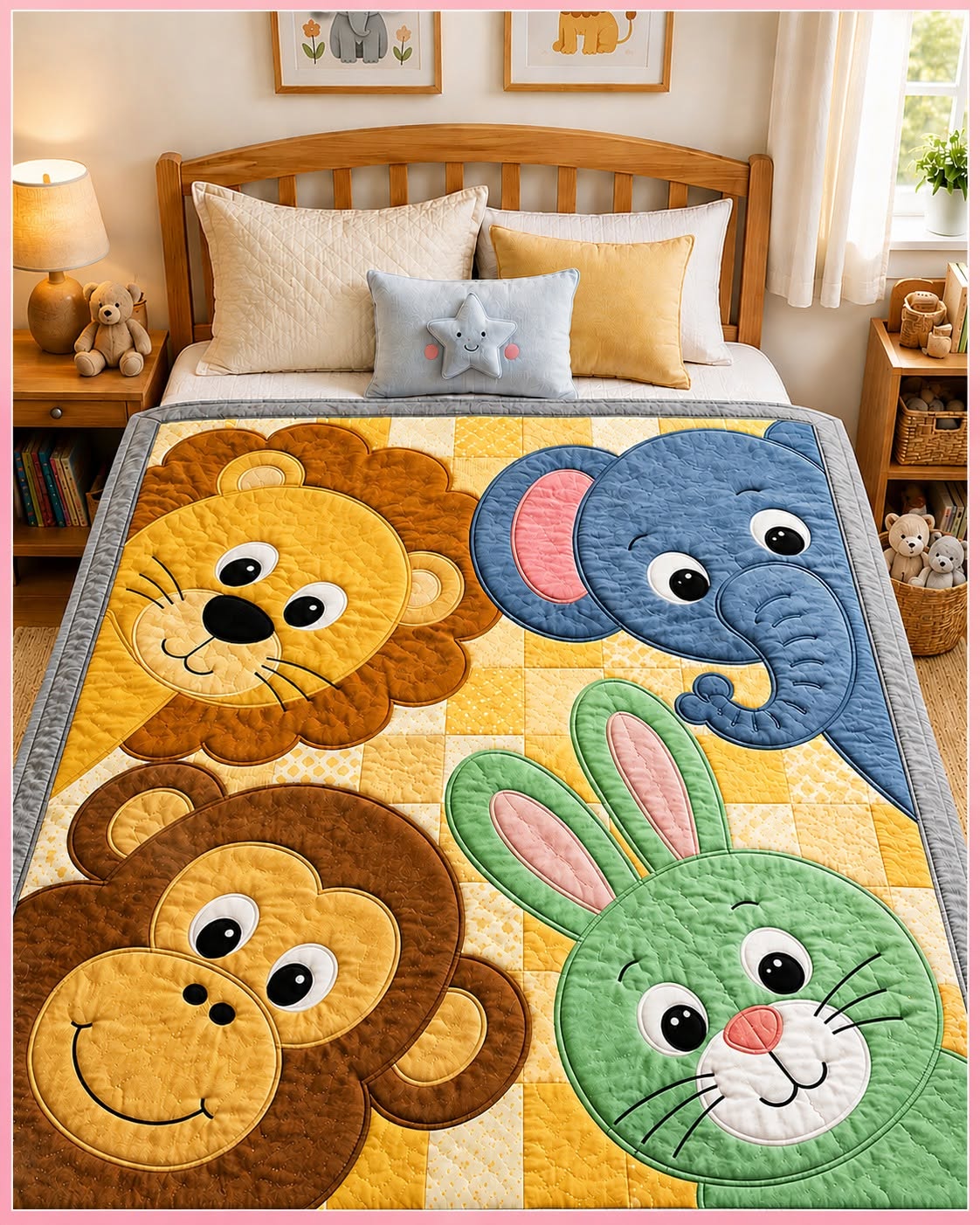
The design shown in the reference image combines a softly pieced background with four large appliqué animals: a friendly lion, a playful elephant, a smiling monkey, and a gentle rabbit.
Each character is created with rounded shapes, expressive eyes, and carefully stitched facial details that make the finished bedspread especially appealing to babies and young children.
Although the project looks detailed, it can be completed successfully by dividing the work into simple stages such as fabric selection, background piecing, appliqué preparation, quilting, and binding.
The Baby Animal Bedspread Pattern can also be customized with different colors, fabrics, animal arrangements, and dimensions, making it suitable for a crib, toddler bed, single bed, or decorative play mat.
With patience and accurate preparation, this project becomes a beautiful handmade piece that combines practical comfort with the personality of a nursery decoration.
One of the most attractive features of this baby animal quilt is the contrast between the neutral patchwork background and the oversized animal faces placed near the corners.
The background uses soft shades of cream, ivory, pale yellow, and subtle printed fabrics, creating visual interest without competing with the appliqué characters.
A gray inner border and wider gray outer border frame the central panel, giving the entire composition a balanced and professional appearance.
The animal fabrics have a slightly textured look, which can be recreated with cotton, flannel, brushed cotton, or quilting fabric in coordinating solid colors.
Machine appliqué is a practical method for attaching the pieces, but hand appliqué can also be used when a softer and more traditional finish is preferred.
The completed Baby Animal Bedspread Pattern is therefore not only decorative but also an excellent opportunity to practice several essential sewing and quilting techniques.
Before starting, it is important to understand that the project can be adapted to the maker’s current experience level.
Beginners can simplify the characters by using fewer pieces and larger shapes, while experienced quilters can add detailed free-motion stitching, embroidered expressions, or dimensional elements.
Every appliqué should be securely attached because the bedspread will likely be washed frequently and used as part of a child’s daily routine.
For safety and durability, avoid loose buttons, beads, plastic eyes, long cords, or any embellishment that could detach from the quilt.
All facial features can be created with fabric appliqué, tightly secured embroidery, or dense machine stitching instead of removable accessories.
Following this approach allows the Baby Animal Bedspread Pattern to remain comfortable, washable, child-friendly, and visually delightful.
Materials and Planning for the Baby Animal Bedspread Pattern
Begin by deciding the finished dimensions of the bedspread. Measure the mattress and determine whether the quilt should cover only the top or extend over the sides. Add extra length and width for the desired drop, remembering that quilting may cause slight shrinkage. A practical toddler quilt might measure approximately 110 by 140 centimeters, while a larger single-bed version may require significantly more fabric.
DISCOVER MORE FREE PATTERNS HERE!
For the pieced background, select several coordinating quilting cotton fabrics in cream, pale yellow, soft beige, and delicate prints. Using different fabrics within the same color family creates the gentle patchwork effect visible in the design. Choose prints with small dots, stars, checks, or subtle nursery motifs so that they support the animals without making the background appear overly busy.
The lion can be made with golden yellow, caramel, cream, and warm brown fabrics. The elephant works beautifully in muted blue with pale pink inner ears, while the monkey can combine chocolate brown, medium brown, and tan. For the rabbit, use mint green, pale pink, white, and a small amount of black fabric for the stitched facial details. These colors may be changed to match the child’s room.
You will also need fabric for the two borders and backing. Medium gray is an excellent choice because it defines the central design while coordinating with the soft nursery palette. Purchase enough backing fabric to extend at least 8 to 10 centimeters beyond every side of the quilt top. This extra fabric makes the quilting and trimming stages easier.
For the inner layer, choose a lightweight or medium-weight quilt batting appropriate for the climate. Cotton batting provides a natural feel and good stitch definition, while polyester batting creates a lighter and slightly puffier bedspread. A cotton-polyester blend is another practical option because it combines softness, durability, and easier washing. Always read the manufacturer’s instructions before cutting or quilting.
Other useful supplies include coordinating thread, sharp fabric scissors, a rotary cutter, cutting mat, quilting ruler, pins, safety pins, temporary fabric adhesive, an iron, and fusible appliqué web. A sewing machine with a zigzag, blanket, or satin stitch will make the appliqué process faster. Test the selected stitch on scrap fabric before working on the actual animal pieces.
Preparing the Background and Animal Appliqué Pieces
To create the central patchwork panel, cut squares of equal size from the cream, ivory, yellow, and printed fabrics. Squares measuring approximately 14 to 16 centimeters are easy to handle, but their size should be adjusted according to the finished dimensions. Arrange them on a large table or clean floor, distributing the colors and prints evenly throughout the layout.
Sew the squares together in horizontal rows using a consistent seam allowance, usually 6 millimeters or ¼ inch. Press the seams of alternating rows in opposite directions so that the intersections nest neatly when the rows are joined. After assembling all the rows, press the complete background carefully without stretching the fabric. The result should be flat, square, and evenly aligned.
Create paper templates for the lion, elephant, monkey, and rabbit. Each animal should be divided into simple shapes, including the head, ears, muzzle, eyes, nose, mane, trunk, or other characteristic features. Large rounded forms are easier to sew and recreate the friendly appearance of the reference project. Label every template clearly to avoid confusion during assembly.
Trace the templates onto the paper side of the fusible appliqué web. Remember that shapes traced directly onto fusible web will be reversed after cutting and fusing. Leave a small space between the pieces, cut around them roughly, and fuse them to the wrong side of the chosen fabrics. Use the iron temperature recommended by the fusible-web manufacturer.
Once the fabric has cooled, cut each shape accurately along the traced line. Before removing the backing paper, arrange all pieces on the patchwork panel to check the scale and composition. Place the lion in the upper-left area, the elephant in the upper-right, the monkey in the lower-left, and the rabbit in the lower-right. Allow some parts to extend naturally toward the panel edges.
Remove the backing paper and fuse the shapes one layer at a time. Begin with the pieces that need to sit underneath, such as the lion’s mane, the monkey’s ears, or the rabbit’s rear ear sections. Continue adding the face, muzzle, eyes, nose, and other details. Press rather than sliding the iron, since sliding can shift the appliqué pieces away from their intended positions.
Sewing, Quilting, and Finishing the Bedspread
After fusing the animals, stitch around every fabric shape to secure it permanently. A medium-width blanket stitch creates a handmade appearance, while a narrow zigzag stitch offers a clean and flexible finish. A satin stitch produces a bold outline but requires more thread and careful control. Use a stabilizer behind the appliqué if the fabric begins to wrinkle.
Create the eyes with layered white and black fabric pieces, adding a small white highlight to give each character a lively expression. Stitch the mouths, eyebrows, whiskers, and small facial lines with a reinforced straight stitch or narrow satin stitch. Practice these curved lines on scrap fabric first. The expressions should remain simple, friendly, and suitable for a nursery environment.
When all appliqué stitching is complete, add the gray borders. Sew the narrower inner border to the top and bottom of the patchwork panel, then attach matching strips to the sides. Repeat the process with the wider outer border. Measure through the center of the quilt before cutting each border strip to prevent stretched edges or unwanted waves.
Prepare the quilt sandwich by placing the backing fabric wrong side up on a clean surface. Position the batting over the backing and place the completed quilt top right side up. Smooth each layer carefully from the center toward the edges. Secure the layers with curved safety pins, long basting stitches, or temporary quilting adhesive.
Quilt the bedspread using a combination of straight lines and gentle outlines. Stitching along the patchwork seams will stabilize the background, while echo quilting around the animals will emphasize their shapes. Additional curved or free-motion lines can be added inside the appliqué pieces to suggest texture. Keep the quilting soft enough that the bedspread remains comfortable and flexible.
After quilting, trim the excess backing and batting so that all edges are straight. Prepare double-fold binding from coordinating gray fabric and sew it around the entire quilt. Miter the corners for a tidy result, then secure the folded edge by machine or hand. Wash the finished Baby Animal Bedspread Pattern according to the fabric instructions and inspect every seam before use.
Frequently Asked Questions About the Baby Animal Bedspread Pattern
What sewing skill level is required for this project? The Baby Animal Bedspread Pattern is suitable for confident beginners and intermediate quilters. Basic experience with straight seams, pressing, appliqué, and binding is helpful. A beginner can simplify the design by making larger appliqué pieces and using a basic zigzag stitch. Completing one animal at a time also makes the process feel more manageable.
Which fabric is best for a baby animal quilt? High-quality cotton quilting fabric is usually the most practical choice because it is easy to cut, press, sew, and wash. Soft flannel may be used for some animal pieces to create additional texture, but it should be prewashed because it can shrink. Avoid fabrics that are scratchy, unstable, heavily embellished, or difficult to clean.
Should the fabrics be washed before cutting? Prewashing is recommended when the fabrics have strong colors, unknown shrinkage rates, or different fiber contents. It helps remove excess dye and reduces the possibility of uneven shrinking after the quilt is finished. After washing, press every fabric carefully before cutting. Some precut quilting fabrics are not prewashed because their small size can cause fraying.
Can the animals be sewn by hand instead of by machine? Yes. Traditional needle-turn appliqué can create a soft and refined finish, although it takes more time. The edges can also be turned under and secured with small invisible stitches. Hand embroidery may be used for the mouths, whiskers, and eyebrows, provided every thread is firmly fastened and no loose embellishments are added.
How can the pattern be resized for a crib or larger bed? Resize the quilt by changing the number and size of the background squares, widening the borders, or enlarging the central panel. The animal templates may be printed or drawn at a larger or smaller scale while maintaining their proportions. Before cutting fabric, create a complete layout plan that includes the bed measurements, side drop, borders, and seam allowances.
How should the finished bedspread be washed? Use a gentle cycle with mild detergent and cool or warm water, depending on the fabric and batting instructions. Avoid harsh chemicals that may weaken the fibers or fade the colors. Dry the quilt on a low setting or lay it flat in a well-ventilated area. Check the appliqué stitching periodically and repair any loose section promptly.
Conclusion
The Baby Animal Bedspread Pattern brings together patchwork, appliqué, decorative stitching, quilting, and binding in one cheerful nursery project. Throughout this guide, you learned how to select coordinated fabrics, calculate the dimensions, assemble a soft patchwork background, prepare animal templates, secure each appliqué piece, create friendly facial expressions, add borders, quilt the layers, and finish the edges with durable binding.
EASILY FIND THE PDF FOR THIS PATTERN HERE!
The lion, elephant, monkey, and rabbit can be personalized with different colors and expressions, allowing every maker to produce a truly unique bedspread. Remember to choose washable materials, secure all stitching carefully, and avoid detachable decorations when creating an item for a young child. Please leave your honest opinion about this project and share your suggestions for colors, animals, or creative details that could make the design even more special.