
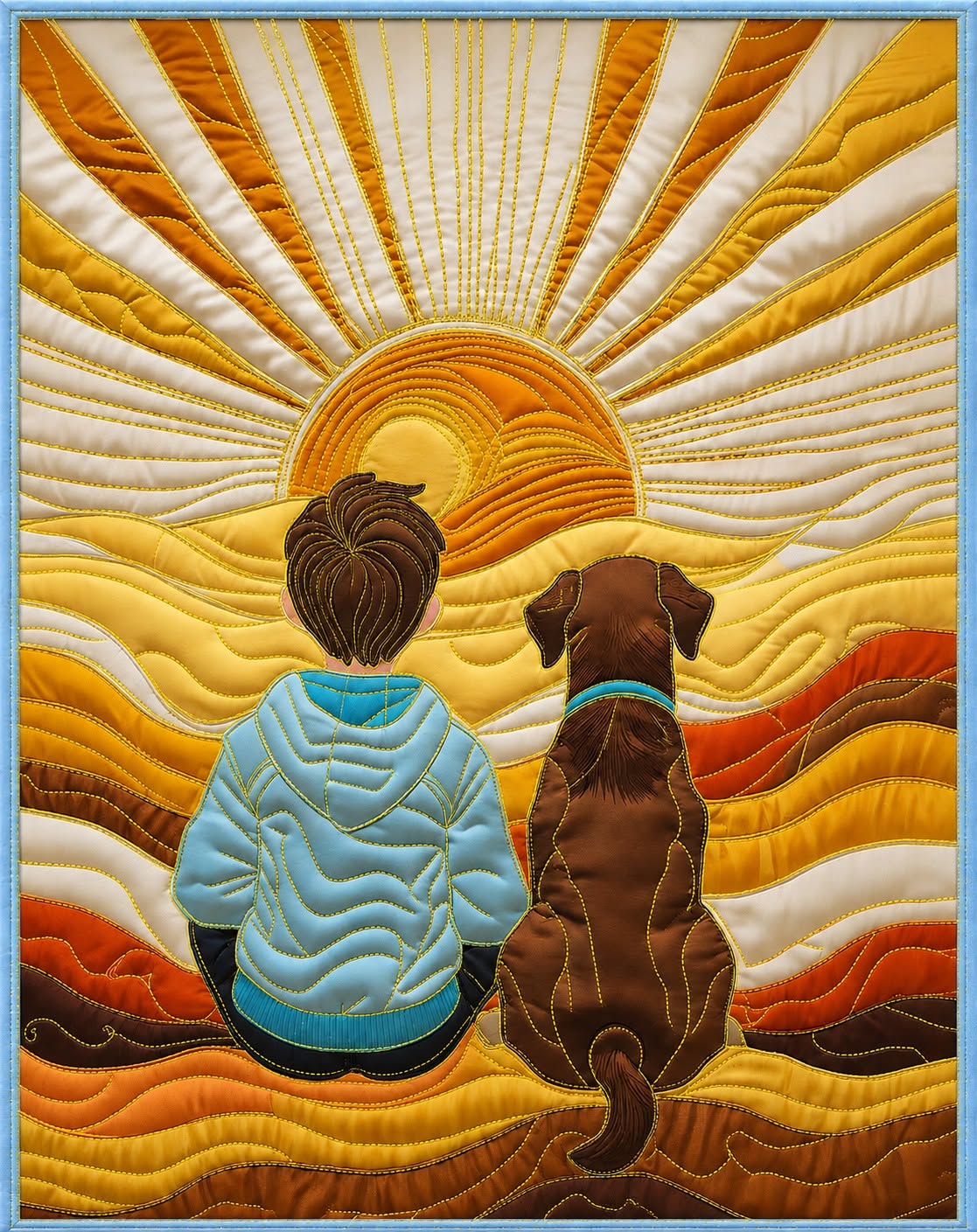
The Sunrise Friends Bedspread Quilt Pattern is a warm and expressive textile project that combines landscape quilting, appliqué, fabric layering, and decorative stitching in one memorable composition. Inspired by the image, the design shows a child and a loyal dog sitting together while watching a glowing sunrise over a peaceful landscape. The curved hills, expanding sunbeams, and carefully quilted clothing create depth without making the scene feel overly complicated. This project can be adapted into a bedspread, wall hanging, throw quilt, or decorative panel, depending on the dimensions you choose. Its emotional theme makes it especially suitable for a child’s room, family space, guest bedroom, or handmade gift. Throughout this tutorial, you will learn how to plan the shapes, choose harmonious fabrics, assemble the background, create the appliqué figures, and complete the quilting. The goal is not simply to copy an image, but to understand how every layer works so you can produce your own beautiful version of the Sunrise Friends Bedspread quilt Pattern.
One of the most attractive features of this quilt is the use of flowing shapes instead of traditional square blocks. The landscape is formed with softly curved strips of fabric in shades of cream, yellow, caramel, orange, rust, and brown. These colors represent morning light moving across the sky and land, while the pale blue jacket and turquoise dog collar provide refreshing contrast. The central sun is built with layered circular and curved sections, giving the impression of light spreading outward. Long fabric rays extend toward the edges, creating movement and directing attention to the center of the composition. Decorative stitching follows the shapes of the pieces and emphasizes their contours. Even though the finished quilt looks detailed, it becomes manageable when the design is divided into separate sections and completed in a logical order.
Before cutting fabric, decide whether you want to create a full-size bedspread quilt pattern or a smaller practice panel. A wall hanging measuring approximately 30 by 40 inches is a comfortable starting size, while a bedspread will require the design to be enlarged and surrounded by additional landscape sections or borders. Prepare a paper sketch showing the sun, rays, hills, child, and dog in their approximate positions. You do not need advanced drawing skills because the main pieces are made from circles, curved strips, and simplified silhouettes. Trace each appliqué component separately and label it before cutting anything. Remember to include seam allowances when using turned-edge appliqué, or cut directly on the line when using fusible raw-edge appliqué. Careful planning at this stage will prevent fabric waste and help maintain the balanced proportions that make the Sunrise Friends Bedspread Quilt Pattern visually appealing.
Materials and Fabric Choices for the Sunrise Quilt
Begin by selecting a range of cotton quilting fabrics with similar weights. For the sunrise, gather golden yellow fabric, amber, burnt orange, pale cream, warm beige, and soft brown. Solid colors work beautifully because they allow the stitching to become an important part of the design. Subtle tone-on-tone prints may also be used if they do not distract from the landscape.
DISCOVER MORE FREE PATTERNS HERE!
For the child’s jacket, choose light blue or another cool color that contrasts with the warm background. You will also need dark brown fabric for the hair, a soft skin-tone fabric for the head and ears, and dark navy or charcoal for the trousers. Small amounts of turquoise fabric can be used for the jacket trim and dog collar. These cooler accents help the foreground figures stand apart from the sunrise.
The dog requires two or three shades of brown to create definition. Use a medium brown for the body, a darker shade for the ears, tail, and shadows, and an optional lighter brown for subtle highlights. The dog appliqué pattern should remain simple, with a recognizable head, back, shoulders, hind legs, and curved tail. Details can be added later with thread rather than tiny fabric pieces.
You will also need lightweight fusible web, fabric scissors, paper scissors, an iron, pins or appliqué glue, quilting rulers, a rotary cutter, and a cutting mat. Select polyester or cotton threads that coordinate with each fabric section. A dark brown thread is useful for outlining the figures, while gold, beige, cream, and orange threads are ideal for quilting the sunrise.
For the quilt sandwich, prepare backing fabric and batting slightly larger than the completed quilt top. A low-loft cotton or cotton-blend batting is an excellent option because it supports dense stitching without making the project excessively bulky. If the finished piece will be used as a warm bedspread, a slightly loftier batting may provide extra softness while preserving the sculpted appearance.
Finally, prepare large sheets of tracing paper or pattern paper. These will be used to enlarge and organize the Sunrise Friends quilt template. Number every pattern piece and mark its orientation. Adding small arrows to show the top of each shape will prevent accidental reversing, particularly when tracing pieces onto fusible web.
Creating the Sun, Rays, and Flowing Landscape
Start the background with the upper sky section. Cut a large cream or ivory fabric panel according to the dimensions of your quilt top. This base will support the sunbeams and make it easier to arrange the radiating shapes. Press the fabric carefully so that no folds interfere with accurate placement.
To create the sun, trace a large circle and divide it into curved sections. The outer portion can be deep orange, the middle section golden yellow, and the inner circle pale yellow. Overlap these pieces slightly or fuse them onto a lightweight foundation. The layered colors are essential to the sunrise quilt design because they create the impression of glowing light.
Draw several long, tapered rays extending from behind the sun toward the top and sides of the quilt. Alternate cream, gold, orange, and mustard fabrics to produce a balanced rhythm. Some rays should be narrow, while others can be wider and gently curved. Avoid making every ray identical, since natural variation gives the composition energy and a handmade appearance.
Arrange the rays on the cream foundation before fusing or sewing them. Begin with the central rays and work outward, checking that the spaces remain visually balanced. When you are satisfied with the layout, secure the pieces using your chosen appliqué method. Stitch around each ray with a narrow zigzag, blanket stitch, or straight raw-edge appliqué.
The lower landscape is made with long, wavy strips. Create paper templates for each hill, remembering that neighboring strips should overlap slightly. Use pale yellow and cream near the horizon, then gradually introduce stronger oranges, rust tones, and browns toward the bottom. This color progression creates depth and makes the foreground appear closer to the viewer.
After attaching the landscape strips, press the entire quilt top from the back. Do not move the iron sideways over fused pieces, as this may distort the curves. At this point, the main quilted sunrise background should be complete, but the decorative quilting will be added only after the child and dog have been positioned.
Making the Child and Dog Appliqué Figures
Create the child’s silhouette from a simple back-view drawing. Separate the pattern into hair, face, neck, jacket, cuffs, waistband, trousers, and shoes if they are visible. Keep the figure slightly left of center so there is enough room for the dog. This placement helps preserve the companionship theme of the Sunrise Friends Bedspread quilt Pattern.
Begin with the pieces that sit underneath other sections. Position the legs and lower body first, followed by the jacket, neck, face, and hair. The jacket should have a relaxed shape with slightly curved shoulders and bent arms. Fuse or baste every piece before stitching around the edges to make sure the proportions remain natural.
To create the jacket’s hood, cut a separate rounded piece and place it over the upper back. Add a narrow strip along the lower edge to represent ribbed trim. Quilting lines can later form folds, seams, and fabric texture. Avoid adding too many tiny appliqué pieces because thread work can produce cleaner details.
For the hair, use dark brown fabric and shape the lower edge into soft points or locks. After attaching it, stitch curved lines from the crown toward the edges to suggest strands. A slightly darker thread creates definition, while matching thread produces a softer effect. Keep the lines flowing in the natural direction of the hairstyle.
Construct the dog quilt appliqué from the back legs upward. Attach the body, hind legs, head, ears, and tail in overlapping layers. Place the ears slightly outward to create a friendly and recognizable silhouette. Add a bright turquoise collar around the neck, echoing the blue tones in the child’s jacket.
Once both figures are attached, add minimal facial or anatomical details because they are viewed from behind. Use thread painting or closely spaced quilting lines to create fur on the dog’s neck, back, and tail. The final effect should remain warm and artistic rather than overly realistic. The emotional connection comes mainly from the figures’ posture and their shared view of the sunrise.
Quilting, Finishing, and Personalizing the Bedspread
When the quilt top is complete, layer it with batting and backing. Smooth each layer carefully and baste them together using safety pins, temporary spray, or long hand stitches. Begin quilting near the center and gradually move outward. This approach reduces shifting and helps keep the landscape art quilt smooth.
Quilt the sun with closely spaced curved lines that follow its circular shape. In the rays, sew long lines from the sun toward the outer edges. Vary the spacing slightly to give the light a natural appearance. Coordinating thread will blend into the fabric, while contrasting thread will emphasize the graphic structure.
For the rolling hills, use free-motion quilting to create long, horizontal waves. Follow the direction of each fabric strip so the stitching strengthens the landscape’s movement. Add occasional spirals or flowing curves in the darker foreground areas. These details give the bedspread a richly textured and professionally finished surface.
Quilt the child’s jacket with curved contour lines that suggest folds and padding. Add stitching around the hood, sleeves, cuffs, and waistband. For the dog, follow the body’s shape with elongated lines and shorter fur-like strokes. Avoid overly dense quilting around the edges of the appliqué, which could cause the figures to appear stiff.
Square the quilt after all quilting is finished. Trim the batting and backing evenly, checking that the corners form right angles. Bind the edges with brown, rust, mustard, or dark orange fabric. A darker binding creates a strong frame, while a golden binding gives the sunrise bedspread quilt a brighter finish.
Personalize the project by changing the jacket color, dog breed, hair shape, or landscape palette. You may also add embroidered names, a meaningful date, small birds, distant trees, or a short message on the back label. These custom elements can transform the design into a special family keepsake while preserving the central theme of friendship and peaceful companionship.
Frequently Asked Questions About the Sunrise Friends Bedspread Quilt Pattern
What does the term Sunrise Friends Bedspread Quilt Pattern mean?
The term Sunrise Friends Bedspread Quilt Pattern refers to a quilt design featuring two companions, represented here by a child and a dog, watching a sunrise together. “Bedspread” indicates that the project can be enlarged to cover a bed, while “quilt pattern” describes the templates, fabric arrangement, appliqué shapes, and stitching instructions required to reproduce the composition.
Is this quilt suitable for beginners?
The complete project is best suited to confident beginners or intermediate quilters because it includes curved shapes, appliqué, layered fabrics, and free-motion quilting. A beginner can still complete it by starting with a smaller wall hanging and using fusible raw-edge appliqué. Practicing the sun, hills, and figures separately will make the final assembly easier.
What is the easiest appliqué method for this design?
Fusible raw-edge appliqué is generally the easiest method. The pattern pieces are traced onto fusible web, attached to the back of the selected fabrics, cut out, and ironed onto the foundation. The edges can then be secured with a straight stitch, narrow zigzag, or blanket stitch.
How can I enlarge the pattern for a bedspread?
Draw the complete design on graph paper and assign a measurement to each square. You can also divide the image into a grid and enlarge one section at a time onto larger paper. Maintain the same proportions for the sun, figures, rays, and landscape. Extra landscape strips or coordinating borders can be added to reach the required bed size.
Which fabrics are best for the Sunrise Friends quilt?
High-quality quilting cotton is the most practical choice because it is stable, easy to cut, and available in many colors. Cotton batiks can also work well for subtle texture. Avoid combining very heavy and very lightweight fabrics unless they are stabilized, as different weights can cause unevenness during quilting.
Can scraps be used for this project?
Yes. The Sunrise Friends Bedspread quilt Pattern is an excellent scrap-friendly project, especially for the rays and landscape strips. Organize scraps by color families before cutting. Larger pieces will still be necessary for the foundation, backing, binding, and some of the main appliqué shapes.
Do I need a free-motion quilting machine?
A standard sewing machine can be used as long as it can handle the quilt’s thickness. A walking foot is helpful for straight and gently curved lines. Free-motion quilting provides more flexibility for waves, fur, hair, and decorative details, but these elements can also be simplified using regular stitching.
How can I prevent the curved strips from puckering?
Work slowly, use lightweight fusible web, and press rather than stretch the fabric. Baste or fuse each strip before sewing it permanently. When quilting, begin near the center and move outward. Avoid pulling the quilt while it passes under the presser foot.
Can the child and dog be replaced with different figures?
Certainly. You can feature two children, an adult and child, two pets, or another meaningful pair. Keep the figures in a seated back-view position so they remain connected to the peaceful sunrise theme. Simplified silhouettes are usually more effective than highly detailed shapes.
How should the finished quilt be washed?
Use cold water, a gentle cycle, and a mild detergent. A color-catching sheet may be helpful during the first wash, particularly when using strong orange, brown, or blue fabrics. Air-dry the quilt flat when possible, or tumble dry on low heat. Always test dark fabrics for color bleeding before beginning the project.
Conclusion
The Sunrise Friends Bedspread Quilt Pattern combines an emotional scene with practical quilting techniques that can be adapted to many skill levels. You learned how to select a warm sunrise palette, create layered sunbeams, assemble flowing landscape strips, construct appliqué figures, and enhance every section with decorative quilting. By completing the project one layer at a time, the detailed composition becomes organized and achievable.
EASILY FIND THE PDF FOR THIS PATTERN HERE!
The finished quilt can serve as a bedspread, wall hanging, thoughtful gift, or meaningful family keepsake. Its child-and-dog silhouette represents trust, companionship, and the quiet beauty of sharing an unforgettable moment. Leave your sincere opinion about this quilt design and share any suggestions, color ideas, or personalized details that you would enjoy adding to your own version.