
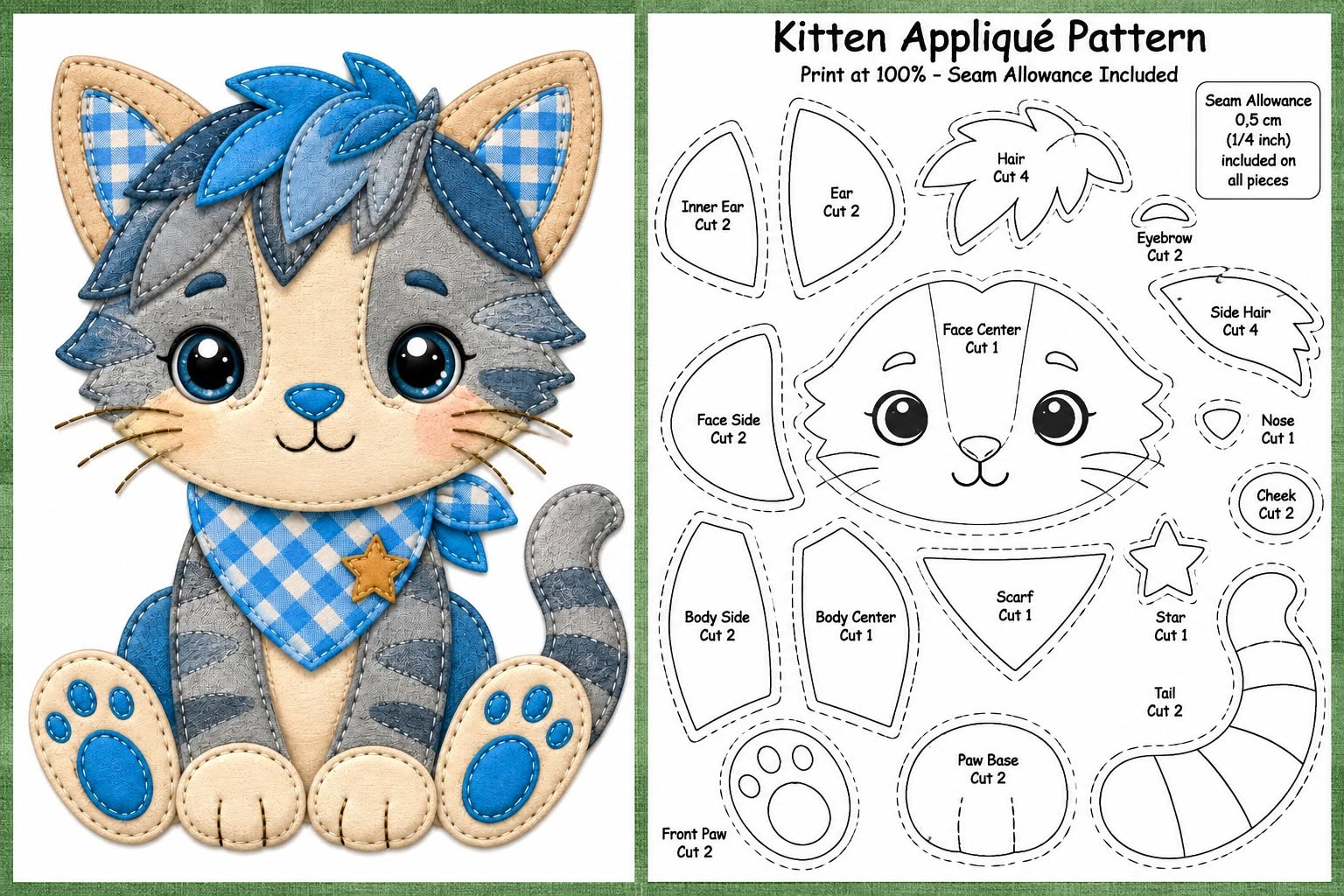
Fabric bedspread with a kitten print Pattern is a charming sewing and appliqué project that transforms a playful kitten design into a cozy decorative piece for a bedroom. The inspiration shown in the image combines the softness of a handmade textile project with carefully layered appliqué pieces, visible stitching, blue gingham accents, gray striped fabric, cream details, and an adorable kitten expression. Although the reference artwork is highly detailed, the same visual concept can be adapted into a practical fabric bedspread, quilt, throw, or decorative bed topper by enlarging the kitten motif and building it from individual fabric shapes. The result can feel cheerful and handmade without requiring every tiny detail to be reproduced exactly.
One of the greatest advantages of making a Fabric bedspread with a kitten print Pattern is the freedom to personalize the project. You can choose colors that coordinate with an existing bedroom, use leftover quilting cotton from previous projects, or create a completely new palette. The kitten in the reference uses several shades of blue and gray together with warm cream fabric, giving the design a balanced appearance. Blue-and-white gingham adds a country-inspired touch, while darker gray stripes create definition in the body and tail. Decorative topstitching around the appliqué pieces is also important because it emphasizes the layered construction and gives the finished kitten a polished, dimensional look.
This tutorial explains the Fabric bedspread with a kitten print Pattern from planning and fabric selection through cutting, appliqué, quilting, and finishing. Instead of treating the kitten simply as a printed picture, we will approach it as a layered fabric appliqué pattern that can become the focal point of a bedspread. This method is especially useful for sewists who enjoy quilting, appliqué, patchwork, and decorative stitching. Measurements can easily be adjusted according to the size of your bed, so the instructions focus on techniques that can be scaled for a crib-size quilt, children’s bedspread, twin bed, or larger decorative quilt.
Materials and Planning for the Fabric Kitten Bedspread
Begin by deciding the finished dimensions of your kitten fabric bedspread. A practical starting size for a decorative throw is approximately 130 × 170 cm, while a bedspread can be enlarged according to the mattress and desired drop on the sides. Measure the bed before purchasing fabric and add approximately 15 to 25 cm on each desired hanging edge. Remember that quilting can cause slight shrinkage, so making the quilt top a little larger than the exact finished measurement is helpful.
DISCOVER MORE FREE PATTERNS HERE!
For the quilt top, choose a good-quality quilting cotton as the background. A light cream, soft beige, pale blue, or neutral fabric will allow the kitten appliqué to stand out clearly. Depending on the finished dimensions, you may need approximately 2.5 to 5 meters of background fabric. You will also need backing fabric of approximately the same overall size and batting slightly larger than the completed quilt top. Cotton or cotton-blend batting works particularly well for a comfortable handmade fabric bedspread.
The kitten itself requires several coordinated fabrics. Select medium gray for the main body, darker gray-blue for the stripes, cream or beige for the muzzle, belly, paws, and outer ears, and bright blue for the hair details, nose, paw pads, and decorative accents. A blue gingham fabric is ideal for the inner ears and neck scarf. Small scraps are sufficient for many of these components, making this an excellent project for using pieces from your fabric collection.
You will also need fusible web for appliqué, coordinating sewing thread, fabric scissors, paper scissors, an iron, an ironing surface, pins or fabric clips, a sewing machine, quilting ruler, rotary cutter, cutting mat, and marking tools. For decorative details, embroidery thread can be useful for the mouth, whiskers, and other small features. Always use products according to their manufacturer’s instructions, especially when working with fusible materials.
Before cutting valuable fabric, prepare a full-size paper kitten appliqué template. Break the kitten into simple shapes: head, muzzle, ears, hair tufts, eyes, nose, body, belly, front paws, back paws, tail, scarf, star, stripes, and paw pads. Enlarging these components individually makes the project easier to assemble. Number each template piece and mark which pieces overlap so you can reconstruct the kitten correctly.
Finally, create a color guide before cutting. Place small fabric samples beside the corresponding template pieces and check how they work together. The reference design succeeds because there is strong contrast between cream, gray, dark blue, and bright blue. Maintaining similar contrast will help the kitten remain recognizable even when viewed from across a bedroom. This preparation stage is essential for a professional-looking Fabric bedspread with a kitten print Pattern.
Cutting and Building the Kitten Appliqué Pattern
Start the construction by tracing each template component onto the paper side of your fusible appliqué web. Remember that traditional fusible appliqué templates generally need to be reversed when tracing if orientation matters. Leave a small amount of space between pieces so they can be cut apart easily. Group shapes according to fabric color to minimize waste and simplify the cutting process.
Rough-cut each traced shape, leaving a narrow margin outside the drawn line. Fuse the pieces to the wrong side of their corresponding fabrics according to the fusible web instructions. Allow everything to cool completely before cutting directly along the traced outlines. Sharp fabric scissors are especially helpful for the kitten’s pointed ears, hair tufts, tail curves, and small decorative pieces.
Build the face first because it is the visual focus of the kitten quilt pattern. Position the main gray head, followed by the cream central face and muzzle sections. Add the darker facial stripes, ears, inner gingham sections, hair tufts, and nose. The eyes can be created from layered fabric circles or ovals in black, white, blue, and gray. If very small fabric pieces feel difficult to handle, selected facial details can instead be added later with embroidery.
Next, assemble the body underneath the head. Position the gray torso, cream belly, front legs, and rounded paws. Add darker stripes along the sides to reproduce the tabby appearance visible in the reference. The seated posture is important to the kitten’s personality, so keep the front paws relatively symmetrical while allowing the larger back paws to angle outward slightly.
The tail should curve upward beside the body and can be constructed from one long gray base piece with several darker stripe appliqués layered over it. Because a long curved tail can shift while being fused, position it carefully and secure the upper and lower sections before pressing the center. Leave enough space around the tail so it does not disappear visually against other quilt elements.
Complete the appliqué arrangement with the gingham neck scarf, blue fabric accents, and small golden star. The scarf adds an especially appealing contrast between the geometric checks and the organic shapes of the kitten. Once you are satisfied with the entire composition, photograph or sketch the arrangement before fusing. Then carefully fuse the pieces in layers, beginning with those that sit underneath and finishing with the foreground details.
Sewing, Appliqué Stitching, and Quilting the Bedspread
After the appliqué has been fused to the background, stitch around each major component. A blanket stitch, narrow zigzag, or straight-edge appliqué stitch can all work well. Straight stitching positioned a few millimeters inside the fabric edge creates a handcrafted appearance similar to the visible seams in the reference. Test your stitch on scrap fabric first so you can choose a length that complements the scale of the design.
Use thread strategically to strengthen the visual separation between pieces. Cream thread can outline the muzzle and paws, medium gray can blend with the body, and blue thread can emphasize the gingham and bright blue sections. You can also deliberately choose contrasting thread to make the stitching a decorative feature. Consistent stitch length is more important than making every line perfectly identical.
The kitten’s expression deserves extra attention. Stitch the mouth with dark thread using a gentle curved line and create the whiskers with embroidery or carefully controlled machine stitching. Small highlights in the eyes can be represented with tiny white fabric circles. The combination of large eyes, small nose, rosy cheeks, and delicate whiskers is what gives the fabric kitten appliqué its friendly personality.
Once the appliqué work is finished, press the quilt top carefully from the back whenever possible. Then prepare the quilt sandwich by laying the backing fabric wrong side up, followed by the batting and quilt top right side up. The batting and backing should extend several centimeters beyond the quilt top on every side. Smooth each layer thoroughly to eliminate wrinkles.
Baste the three layers using your preferred quilting method. Quilt around the outer silhouette of the kitten first because this stabilizes the central design. You can then add quilting across the background using gentle waves, straight lines, diamonds, or free-motion curves. Avoid quilting excessively through tiny appliqué pieces unless you specifically want a flatter appearance. Leaving some areas lightly quilted helps maintain the soft dimensional quality of the design.
For an attractive quilted kitten bedspread, balance decorative quilting with practicality. The quilting should be close enough to secure the batting according to its requirements but not so dense that the bedspread becomes stiff. Echo quilting around the kitten is a particularly effective technique: stitch one line around the silhouette and repeat additional lines farther outward. This subtly frames the kitten and draws attention toward the central motif.
Finishing, Binding, Care, and Creative Variations
When all quilting is complete, spread the bedspread on a large flat surface and inspect it carefully. Look for loose threads, missed appliqué edges, puckering, or sections that require additional quilting. Trim away excess batting and backing with a rotary cutter and quilting ruler, creating clean, straight outer edges. Check all four corners before attaching the binding.
Prepare quilt binding from coordinated fabric strips. Blue gingham is an excellent option if you want the outer border to relate directly to the kitten’s scarf and inner ears. Solid navy, cream, gray, or bright blue can also work beautifully. A contrasting binding visually frames the entire bedspread, while a neutral binding creates a quieter and more traditional finish.
Join the binding strips into one continuous length, press them according to your preferred binding method, and sew the binding around the quilt perimeter. Take extra care when creating the corners so they remain neat. The binding can be finished by machine for durability or stitched by hand on the back for a more traditional appearance. Either method is appropriate for this Fabric bedspread with a kitten print Pattern.
Before regular use, inspect all small appliqué components. Because a bedspread receives more handling than a wall hanging, securely stitched edges are important. Decorative elements such as the star should be firmly attached rather than loosely hanging from the surface. This makes the design easier to maintain while preserving the playful appearance of the original inspiration.
The pattern can also be customized in many ways. Replace blue with pink, sage green, mustard, lavender, turquoise, or another favorite color. The gingham scarf could become floral, striped, polka-dot, or patchwork fabric. You can even create several smaller kittens across the bedspread rather than one large central character. Changing fabric prints is one of the simplest ways to make the kitten print Pattern unique.
For an especially coordinated bedroom project, use leftover fabrics to create matching pillow covers, a small cushion, or a bedside wall hanging. Repeating the kitten’s gingham, gray, cream, and blue fabrics across several handmade pieces can create a unified decorating theme. The important principle is consistency: repeat a limited group of fabrics and colors so all the elements appear intentionally connected.
FAQ About the Fabric Bedspread with a Kitten Print Pattern
What is a Fabric bedspread with a kitten print Pattern?
A Fabric bedspread with a kitten print Pattern is a sewing or quilting design that uses a kitten motif as the main decorative feature. The kitten may be printed directly on fabric or, as in this project, constructed from layered fabric appliqué pieces. Using appliqué allows you to combine different textures, colors, checks, stripes, and solids within a single character.
Is this kitten bedspread suitable for beginners?
An ambitious beginner can make the project, although the small facial pieces require patience. Beginners may simplify the design by reducing the number of hair tufts and body stripes. Starting with larger appliqué pieces and using fusible web makes the construction considerably easier.
What fabrics are best for kitten appliqué?
Quilting cotton is one of the easiest choices because it is stable, widely available, and simple to cut. Cotton gingham works beautifully for patterned details. Lightweight denim or other stable fabrics can also be incorporated, but combining fabrics of similar weight generally makes the appliqué easier to stitch and quilt.
How can I enlarge the kitten pattern for a bedspread?
Divide the original design into a grid and enlarge each section proportionally, or create individual paper templates and scale them to the desired dimensions. Always assemble the enlarged paper pieces on the bedspread background before cutting fabric. This allows you to verify that the kitten is neither too small nor too large for the available space.
Do I need fusible web for this project?
It is not absolutely required, but fusible web appliqué makes positioning complex pieces much easier. Traditional needle-turn appliqué is another option for experienced sewists. Fusible appliqué is especially convenient when working with numerous small components such as stripes, hair sections, eyes, and paw pads.
Which stitch is best around the kitten pieces?
Blanket stitch, zigzag stitch, satin stitch, and straight stitch are all possibilities. A straight stitch near the edge gives a clean handmade effect, while blanket stitching produces a more traditional appliqué appearance. Your choice should complement the fabrics and the overall style of the bedspread.
How do I keep the appliqué from becoming bulky?
Use lightweight cotton fabrics and avoid stacking unnecessary layers. Some pieces need to overlap, but excessive layering can make quilting difficult. Plan the order carefully so only the areas necessary for visual depth overlap.
Can the kitten colors be changed?
Absolutely. The gray, cream, and blue palette is only one possibility. A custom kitten quilt could feature brown tabby colors, orange and cream, black and white, pastel shades, or colors inspired by a favorite pet. Keeping enough contrast between neighboring pieces will make the design easier to see.
Can I wash a bedspread with fabric appliqué?
A properly constructed appliqué quilt can usually be washed according to the care requirements of its fabrics, batting, thread, and fusible products. Prewashing fabrics can help identify possible color bleeding or shrinkage before construction. Secure stitching around appliqué edges also improves durability.
How can I make the kitten look more dimensional?
Use contrasting fabric values, layered pieces, carefully placed stripes, decorative topstitching, and moderate quilting around the character. Darker pieces naturally appear recessed while lighter areas can seem more prominent. Echo quilting around the silhouette also makes the kitten visually separate from the background.
Can this pattern be used for projects other than a bedspread?
Yes. The same fabric kitten pattern can be resized for cushions, tote bags, nursery wall hangings, table toppers, quilt blocks, or decorative fabric panels. For smaller projects, simplify tiny details so the shapes remain practical to cut and stitch.
How long does a kitten appliqué bedspread take to make?
The time depends on the quilt size, number of appliqué pieces, stitching technique, and quilting method. Rather than rushing, divide the project into stages: template preparation, cutting, positioning, fusing, appliqué stitching, quilting, and binding. Working in stages helps maintain accuracy and makes a detailed project feel much more manageable.
Conclusion
The Fabric bedspread with a kitten print Pattern combines practical quilting techniques with the personality of a colorful handmade kitten appliqué. Throughout this project, we explored how to select coordinated fabrics, prepare templates, create individual appliqué components, reproduce the kitten’s face and body, incorporate gingham and striped details, stitch the pieces securely, assemble a quilt sandwich, quilt the bedspread, and finish everything with a neat binding.
The most important lesson is that a detailed image does not need to be approached as one complicated shape. Breaking the kitten into smaller components makes the entire construction easier to understand. The head, muzzle, ears, eyes, hair, body, paws, tail, scarf, stripes, and decorative star can each be created separately and then combined like pieces of a fabric puzzle. This approach makes fabric appliqué quilting accessible while providing plenty of opportunities for personalization.
Your finished bedspread does not have to be identical to the inspiration image. Different fabrics, colors, quilting lines, and decorative stitches will give your kitten its own character. Whether you choose the original blue, cream, and gray combination or create an entirely different palette, careful cutting and secure stitching will help produce a beautiful result.
EASILY FIND THE PDF FOR THIS PATTERN HERE!
A handmade Fabric bedspread with a kitten print Pattern can become much more than a practical bed covering. It can be a cheerful bedroom centerpiece and a rewarding way to practice appliqué, quilting, decorative stitching, color coordination, and binding techniques in one complete project. If you make your own version, leave your sincere opinion about the pattern and share your suggestions. Which colors would you choose for your kitten, and what would you change or add to make the design uniquely yours?