
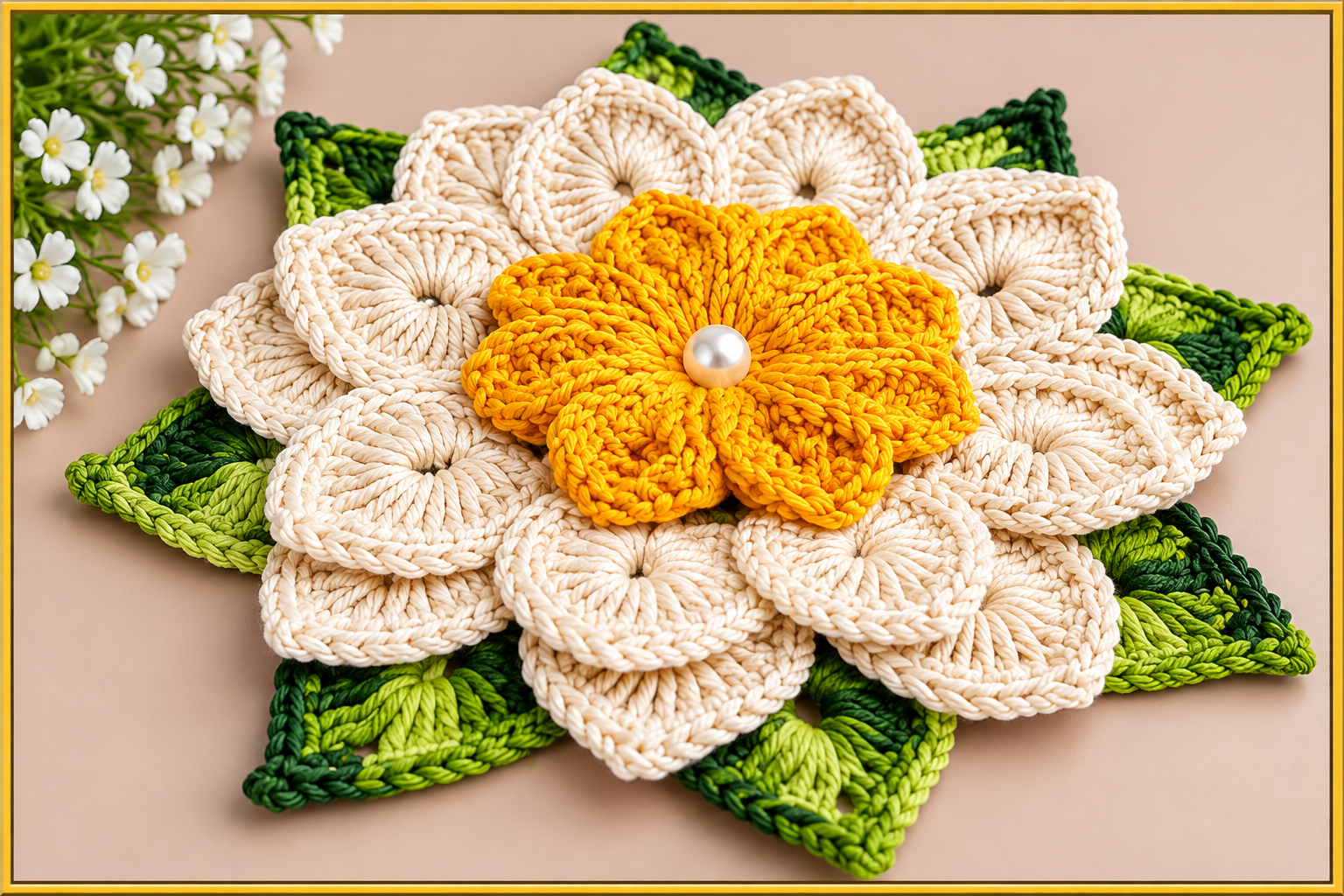
The Crochet flower for a table runner Pattern is a beautiful way to transform simple yarn into a decorative piece filled with texture, dimension, and handmade charm. A layered crochet flower can become the centerpiece of a table runner, placemat, decorative mat, or even a larger floral arrangement created from several connected motifs. The combination of dimensional petals, a contrasting center, and green leaves gives the project an elegant botanical appearance that works especially well on dining tables, coffee tables, sideboards, and seasonal displays. Another advantage of this pattern is that you can personalize almost every detail, including the flower size, petal colors, leaf shades, and yarn texture. Beginners who already understand basic crochet stitches can use the project to practice working in rounds, increasing stitches, creating layered petals, and shaping leaves. More experienced crocheters can adapt the Crochet flower for a table runner Pattern by adding extra petal rounds, combining different yarn weights, or joining several flowers into a longer runner.
Before beginning the project, it is helpful to understand how the construction works because this flower is created in several stages instead of being crocheted as one completely flat circle. The center is worked first, followed by layers of petals that gradually increase in size and create the three-dimensional flower effect. After the petals are completed, individual or connected leaves can be crocheted and positioned behind the flower to form the decorative base. When several flowers are used together, they can be attached directly to one another or sewn onto a crocheted foundation to create a complete crochet table runner. Cotton yarn is an excellent option because it creates defined stitches, holds its shape well, and is practical for table decorations that may need occasional washing. Taking time to maintain consistent tension throughout the project will also make the petals more symmetrical and help the finished flower remain flat underneath while keeping its beautiful raised appearance on top.
Reading the crochet stitch keys correctly is an important part of successfully following the pattern, particularly if you normally work from diagrams or abbreviated written instructions. In this tutorial, ch means chain, sl st means slip stitch, sc means single crochet, hdc means half double crochet, dc means double crochet, tr means treble crochet, st means stitch, sts means stitches, sp means space, and rep means repeat. The abbreviation MR refers to a magic ring, which creates a neat adjustable center, while YO means yarn over. Parentheses such as (dc, ch 2, dc) tell you that all the stitches inside the parentheses are worked into the same stitch or space unless the instructions specify otherwise. An asterisk usually identifies a section that must be repeated around the round. Learning these crochet keys makes the Crochet flower for a table runner Pattern much easier to follow and also helps you understand many other crochet flower patterns.
Materials, Crochet Stitch Keys, and Preparing the Flower
For this Crochet flower for a table runner Pattern, choose a medium-weight cotton or cotton-blend yarn that provides enough structure for the petals. You can use one main flower color, a darker shade for the center, and two shades of green for the leaves. A crochet hook between approximately 3.5 mm and 4.5 mm usually works well with medium cotton yarn, although you should always adjust the hook size according to your yarn and personal tension. You will also need scissors, a yarn needle, stitch markers, and optional pearl beads or decorative buttons for the flower center. If you want a softer table decoration, choose a slightly larger hook, while a smaller hook will create a firmer flower with more defined petals.
DISCOVER MORE FREE PATTERNS HERE!
Understanding ch or chain stitch is the first step because chains are frequently used to create spaces between petals. To make a chain, place a slip knot on the hook, yarn over, and pull the yarn through the loop already on the hook. Each repetition creates one chain stitch. Chains are commonly used at the beginning of crochet rounds and between groups of taller stitches. In this flower pattern, chain spaces will also provide convenient places for building new layers of petals. Avoid making your chains excessively tight because you will need enough space to insert the hook comfortably during later rounds.
The sl st or slip stitch is mainly used for joining rounds and moving the working yarn without adding noticeable height. Insert the hook into the indicated stitch, yarn over, and pull the yarn through the stitch and directly through the loop on the hook. Because this creates a very short stitch, slip stitches are ideal for closing circular rounds. They can also help you travel discreetly across the back of the flower when preparing another petal layer. When joining with a slip stitch, avoid pulling the yarn too tightly because that can distort the shape of the flower center.
The sc or single crochet creates a compact and sturdy fabric that works particularly well for flower centers and leaves. Insert the hook into the stitch, yarn over, pull up a loop, yarn over again, and pull through both loops on the hook. Single crochet stitches can also be worked around chains instead of directly into individual chain stitches. This technique is useful when creating the small arches that support dimensional petals. Because single crochet is relatively short, it gives the flower a stable base without adding unnecessary bulk.
The dc or double crochet is one of the most important stitches in the Crochet flower for a table runner Pattern because it creates the height and flexibility needed for rounded petals. Yarn over before inserting the hook, insert it into the required stitch or space, yarn over and pull up a loop. You should now have three loops on the hook. Yarn over and pull through two loops, then yarn over once more and pull through the final two loops. Groups of double crochet stitches worked into the same space naturally spread outward, creating the beautiful fan shape commonly seen in crochet flowers.
The tr or treble crochet produces an even taller stitch and can be used near the middle of larger petals to emphasize their curved shape. Yarn over twice before inserting the hook, pull up a loop, and then work through the loops two at a time until only one loop remains. Combining sc, hdc, dc, and tr stitches in the same petal creates a gradual increase and decrease in height. This technique is especially helpful for producing natural-looking pointed or oval petals. Once these basic crochet keys are familiar, the construction of the layered flower becomes much easier to understand.
How to Crochet the Center and Layered Flower Petals
Begin the center of the Crochet flower for a table runner Pattern with a magic ring using your darker flower color. Chain 1 and crochet 8 single crochet stitches into the ring. Pull the yarn tail carefully to close the center and join the first single crochet with a slip stitch. If you prefer not to use a magic ring, chain 4 and join with a slip stitch to form a small circle, then work the stitches inside that circle. The magic ring generally creates a tighter and more polished center, which is especially useful when adding a decorative bead later.
For the second round, chain 1 and work 2 single crochet stitches into each stitch around. You should finish with 16 single crochet stitches. Join with a slip stitch, but do not cut the yarn yet. This small circle will become the foundation for the first petal layer. If you want a larger center, you can add another increase round, but remember that increasing the center also changes the overall proportions of the flower.
To create the first petals, chain 3, skip one stitch, and slip stitch into the next stitch. Repeat this sequence around the center until you have created evenly spaced chain loops. These loops are the foundations for the first layer of petals. Inside each chain-3 space, crochet 1 sc, 1 hdc, 3 dc, 1 hdc, and 1 sc. This sequence gradually increases and decreases the stitch height, creating a naturally rounded petal. Repeat the same stitch combination inside every chain space and finish with a slip stitch.
The second petal layer should be positioned behind the first one so that the flower develops visible depth. Turn the flower slightly and locate the unused stitches or back structure behind the petals. Create new chain loops by working a slip stitch around a suitable post or into an available stitch, chaining 5, and attaching the chain behind the next petal. Continue around until each front petal has a larger loop positioned behind it. Keeping these loops evenly spaced is important because they determine the placement of the next row of petals.
Work the larger petals into each chain-5 loop using 1 sc, 1 hdc, 2 dc, 3 tr, 2 dc, 1 hdc, and 1 sc. The taller treble crochet stitches in the middle produce a fuller petal while the shorter stitches along the edges create a smooth curve. Repeat this combination around the entire flower. If your yarn is thick and the petals become crowded, reduce the number of treble crochet stitches slightly. If your yarn is thin, you can add another double crochet or treble crochet stitch to make the petals appear fuller.
A third layer can be added if you want the dramatic appearance often associated with a decorative crochet flower table runner. Create chain-7 loops behind the second petal layer and crochet approximately 1 sc, 1 hdc, 2 dc, 4 tr, 2 dc, 1 hdc, and 1 sc into each loop. Check the flower after completing one or two petals and adjust the stitch count if necessary. Crochet patterns often require small tension adjustments because yarn thickness and individual crocheting styles can influence the final shape. When you are satisfied with the flower, fasten off and weave the yarn ends securely into the back.
Crochet Leaves, Assembly, and Table Runner Construction
The leaves add an important finishing detail to the Crochet flower for a table runner Pattern because they provide color contrast and create a balanced floral composition. Begin each leaf by chaining approximately 12 to 16 stitches depending on the desired size. Starting in the second chain from the hook, work 1 sc, 1 hdc, several dc stitches, 2 or 3 tr stitches, several dc stitches, 1 hdc, and 1 sc toward the final chain. Crochet 3 single crochet stitches into the last chain so you can turn naturally around the opposite side. Work corresponding stitches along the other side of the starting chain to create a symmetrical leaf.
For a pointed leaf, use taller stitches near the center and shorter stitches at both ends. This creates the tapered silhouette typically associated with decorative crochet foliage. You can also work a chain-2 point at the tip before continuing along the opposite side. After completing the leaf, slip stitch into the beginning stitch and fasten off. Leave a reasonably long yarn tail because it can later be used to sew the leaf securely behind the flower.
Using two green yarn shades makes the foliage more visually interesting. For example, crochet some leaves with light green yarn and others with dark green yarn. Another option is to crochet the main leaf in one shade and add a surface slip-stitch line through the center using a contrasting green. This small detail resembles a natural leaf vein and gives the finished project additional texture. Arrange the leaves around the flower before sewing anything so you can experiment with several layouts.
When assembling the flower, place the largest leaves underneath the outer petals and allow their pointed tips to remain visible. Use the yarn tails and a tapestry needle to sew each leaf securely to the back of the flower. Try to sew only through the back loops or hidden areas so the stitches are not visible from the front. If you are adding a pearl or decorative bead, sew it firmly into the center using strong matching thread or yarn. Avoid loose decorative pieces if the finished item will be used where small children may handle it.
To turn individual motifs into a crochet table runner, create several flowers using the same pattern. Three large flowers can make an attractive centerpiece for a shorter table, while five, seven, or more flowers can create a longer runner. Place the motifs on a flat surface before joining them and arrange the flowers so the leaves overlap slightly. Sew neighboring motifs together through hidden stitches along the leaves and outer petals. Another method is to crochet a simple rectangular mesh foundation and sew the floral motifs onto the finished base.
Blocking is highly recommended before using your Crochet flower for a table runner Pattern as table decoration. Gently shape each petal and leaf with your fingers, lightly dampen the project, and arrange it on a blocking mat or clean towel. Allow it to dry completely without stretching the stitches excessively. Blocking helps the leaves remain flat while allowing the petals to maintain their dimensional shape. After blocking, trim any remaining yarn ends carefully and inspect all joining points before displaying the finished runner.
FAQ About the Crochet Flower for a Table Runner Pattern
What yarn is best for a Crochet flower for a table runner Pattern? Cotton yarn is one of the most practical choices because it offers excellent stitch definition and enough structure for dimensional petals. Cotton blends can also work well if you prefer a softer texture. Medium-weight yarn is beginner-friendly because the stitches are easy to see and manipulate. Lightweight yarn can create a more delicate floral design, but it usually requires more stitches and additional time. Try to use yarns with similar thicknesses if you are combining several colors.
What crochet hook size should I use for the flower? A hook between approximately 3.5 mm and 4.5 mm works well for many medium-weight cotton yarns. However, the best hook depends on your yarn and crochet tension. If the flower feels excessively stiff, try moving up one hook size. If the petals are loose and do not maintain their shape, use a slightly smaller hook. Making one test flower before crocheting an entire runner can help you identify the ideal hook size.
How do I make crochet flower petals stand out more? Layering is the main technique used to create dimensional crochet flowers. Instead of crocheting every petal into the same round, create additional chain loops behind the existing petals. New petals can then be worked into those loops, producing visible depth. Using slightly taller stitches in each new layer also increases the dimensional effect. Gentle blocking and hand shaping after the flower is completed can further improve the petal definition.
How many flowers do I need for a table runner? The number depends on the diameter of each finished flower and the desired runner length. Three large motifs may be enough for a small coffee table decoration, while a full dining table runner may require five to nine flowers or more. Before joining the motifs, place them directly on your table to estimate the final dimensions. Remember that leaves can overlap, which reduces the total length slightly. You can also alternate large and small flowers to create a more organic arrangement.
Can beginners make this crochet flower pattern? Yes, especially if the crocheter already understands basic stitches such as chain, single crochet, half double crochet, double crochet, and slip stitch. Treble crochet is also simple once you understand how to work through the loops in stages. The most challenging part is usually positioning the chain loops behind previous petal layers. Working slowly and using stitch markers can make that process easier. Creating one flower at a time also allows beginners to improve their tension before assembling the runner.
How can I make the crochet flower larger? You can enlarge the flower by adding additional petal layers behind the existing rounds. Create slightly larger chain loops for every new round and gradually increase the number of double and treble crochet stitches in each petal. Another option is to use thicker yarn and a larger crochet hook. Keep the flower proportions balanced by increasing the size of the leaves as well. Always check that the back remains reasonably flat if the flower will be placed on a table.
Can different colors be used in the same table runner? Absolutely. Color variation is one of the easiest ways to personalize a Crochet flower for a table runner Pattern. Purple, lavender, burgundy, pink, cream, yellow, orange, and blue are all beautiful possibilities for the petals. You can create identical flowers for an elegant coordinated appearance or use several colors for a cheerful garden-inspired runner. Keeping the leaf colors consistent can help unify a design containing many flower colors.
How do I keep a crochet table runner from curling? Curling usually occurs when the stitch tension is too tight or when there are too few stitches in a round. Make sure your petals and leaves have enough room to expand naturally. Blocking can correct minor curling after the crochet work is complete. For a runner made from several connected flowers, arranging the motifs on a flat surface before joining them also helps prevent distortion. If you use a crocheted foundation, make sure the foundation itself lies flat before attaching the flowers.
Can this flower pattern be used for projects other than table runners? Yes. The same crochet flower pattern can decorate cushions, bags, wall hangings, blankets, baskets, placemats, handmade gifts, or seasonal home decorations. Smaller versions can be used as appliqués, while larger versions can become decorative mats. You can also crochet individual flowers as practice projects before deciding how to use them. This versatility makes the pattern valuable for both beginners and experienced crochet enthusiasts.
How should a crochet flower table runner be washed? Always consider the washing instructions printed on the yarn label. Cotton projects can often be gently hand washed in cool or lukewarm water with mild detergent. Avoid aggressive twisting because it can distort dimensional petals. Press excess water gently between clean towels and reshape the flowers while they are damp. Allow the runner to dry flat so the leaves and petals maintain their intended form.
Conclusion
The Crochet flower for a table runner Pattern combines basic crochet techniques with beautiful dimensional construction, making it an enjoyable project for anyone who loves handmade home décor. Throughout this tutorial, you learned the essential crochet stitch keys, including ch, sl st, sc, hdc, dc, tr, MR, YO, st, and sp, as well as how each abbreviation is used while building the flower. You also learned how to crochet the center, create multiple layers of petals, form decorative green leaves, assemble the motifs, and connect several flowers to produce a complete crochet table runner.
The most important part of this project is allowing yourself to experiment with yarn, color, petal size, and arrangement. A handmade crochet runner does not need to look exactly like another version of the same pattern. Small differences in tension, yarn texture, and flower placement are part of what gives handcrafted pieces their individual character. Once you understand the basic construction, you can easily modify the Crochet flower for a table runner Pattern to create larger flowers, different leaf arrangements, seasonal color combinations, or runners customized to fit your own table.
Whether you make a single decorative flower or connect several motifs into an elaborate floral centerpiece, this project offers plenty of opportunities to practice valuable crochet skills while creating something useful for the home. Take your time with each petal, check your stitch counts regularly, secure every yarn end carefully, and shape the finished motifs before joining them. The result can be a textured, colorful, and elegant table decoration that showcases the beauty of handmade crochet. If you make your own Crochet flower for a table runner Pattern, leave your sincere opinion about the project and share your suggestions. Your ideas about different colors, yarn combinations, petal variations, and creative ways to use the finished flowers can inspire even more beautiful crochet projects.