
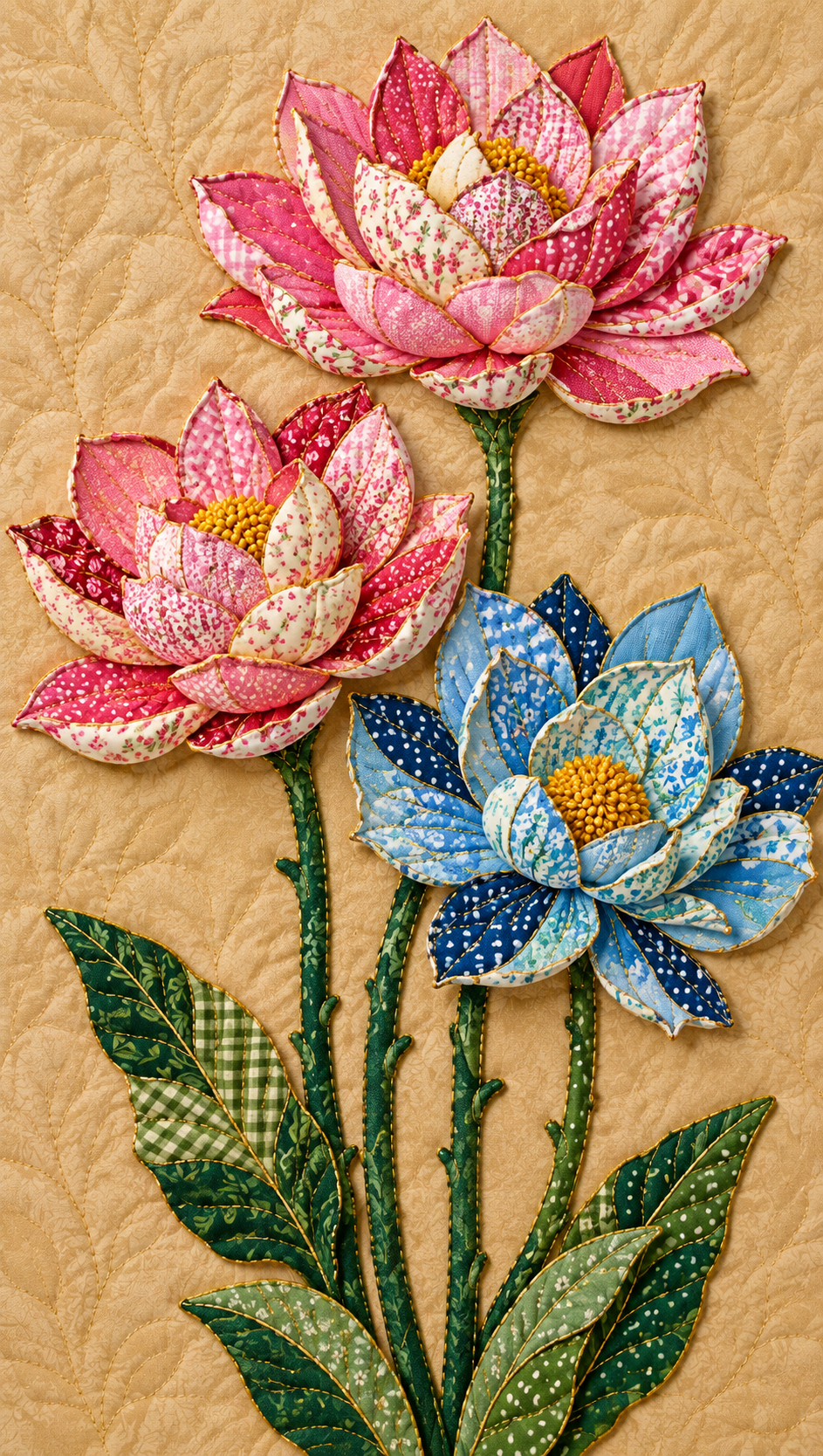
Lotus Flower Shaped Fabric Applique Pattern is a beautiful sewing project that combines dimensional fabric petals, traditional appliqué techniques, quilting, and colorful scrap fabrics to create a striking floral composition. Inspired by the image, this design features layered lotus-style flowers in shades of pink, red, cream, and blue, supported by green stems and leaves on a softly quilted neutral background. The dimensional petals are what make this project especially interesting: instead of creating a completely flat appliqué, the petals rise slightly from the surface, producing texture and a realistic layered appearance. It is an attractive project for anyone who enjoys fabric appliqué, scrap quilting, floral sewing, and decorative textile art.
One of the advantages of making a Lotus Flower Shaped Fabric Applique Pattern is the freedom to work with fabrics already available in your sewing room. Small floral prints, polka dots, gingham, tone-on-tone cotton, and tiny geometric patterns can all be combined within the same flower. Because each lotus contains several individual petals, even relatively small fabric scraps can become useful parts of the finished design. Coordinating the colors rather than matching every print perfectly creates the charming patchwork character seen in the inspiration. Cotton quilting fabric is particularly convenient because it presses neatly, holds its shape well, and is easy to stitch by hand or machine.
Although the finished floral arrangement looks elaborate, the construction becomes much easier when it is divided into manageable stages. You will first prepare the quilted background, then make reusable petal and leaf templates, cut the fabric pieces, create dimensional petals, construct the flower centers, and finally arrange the stems, leaves, and blossoms. Beginners can simplify the design by making one flower, while experienced sewists can reproduce a complete bouquet with several blossoms. The important idea is to build the fabric lotus appliqué gradually from the background toward the foreground so that every overlapping layer looks intentional and secure.
Materials, Fabric Selection, and Preparing the Lotus Pattern
Begin by choosing a sturdy background for the Lotus Flower Shaped Fabric Applique Pattern. A finished panel around 45 × 65 cm works well for a decorative wall hanging, although the project can easily be enlarged or reduced. Cut the backing, batting, and background fabric slightly larger than the intended finished dimensions. A beige, cream, sand, or light gold background provides enough contrast for both pink and blue flowers while maintaining the warm handmade appearance of the inspiration.
DISCOVER MORE FREE PATTERNS HERE!
For the lotus petals, collect several coordinating cotton fabrics rather than using a single print. A pink flower might combine raspberry, blush, cream floral, gingham, and dotted fabrics. A blue lotus can include navy, sky blue, turquoise, cream-and-blue floral prints, and small dots. This approach gives the fabric flower appliqué depth because neighboring petals remain visually distinct even when they belong to the same color family.
Create at least three petal templates: small, medium, and large. A practical starting point is approximately 6 × 3.5 cm for small petals, 8 × 4.5 cm for medium petals, and 10 × 5.5 cm for large petals. Draw each as a symmetrical leaf-like shape with a pointed upper end and rounded lower section. These measurements are flexible because handmade appliqué does not require every petal to be identical. Slight differences can actually make the flower appear more organic.
You will also need green fabrics for the stems and leaves. Select two or three shades of green, preferably with small prints that complement the floral fabrics. Cut stem strips approximately 2 to 2.5 cm wide before folding their raw edges inward. Leaves can range from approximately 10 to 18 cm long. Mixing different leaf sizes helps prevent the lower portion of the composition from appearing overly symmetrical.
Basic supplies include cotton fabric, lightweight batting or fusible fleece, matching thread, contrasting decorative thread if desired, fabric scissors, pins or clips, a sewing machine, hand-sewing needles, an iron, and template material. Fabric appliqué simply means attaching one fabric shape onto another fabric surface. In this project, that technique is combined with dimensional construction so that selected petals remain raised rather than being stitched completely flat.
Before assembling anything permanently, place the stems, paper flower templates, and leaf shapes on the background. Experiment with the composition until the bouquet feels balanced. Positioning the largest flower toward the upper portion and allowing the other blossoms to sit at slightly different heights creates movement. Photographing the temporary arrangement can also help you remember the placement once you begin sewing individual pieces.
Making Dimensional Lotus Petals, Centers, Stems, and Leaves
To make a dimensional petal, place two pieces of fabric right sides together and trace one of your templates onto the wrong side. Sew around the shape using approximately a 0.6 cm seam allowance, leaving a small opening near the bottom. Trim excess fabric, carefully clip the seam allowance around tight curves, and reduce bulk near the pointed tip without cutting through the stitches.
Turn the petal right side out through the opening. Use a blunt turning tool to gently define the point, then press the piece. A very small amount of batting can be inserted before closing the opening if you want a fuller 3D fabric flower. Avoid overstuffing. Lotus petals should remain soft and flexible enough to overlap naturally rather than looking like heavily padded cushions.
Add decorative stitching through the center of each petal. One or two gently curved lines running from the base toward the tip can imitate natural veins while helping control the batting. A contrasting golden, mustard, cream, or coordinating thread can make this detail more visible. Prepare enough petals before assembly so you can freely alternate colors and prints when constructing each blossom.
For the center, make a small padded circular or oval base from yellow or golden fabric. Texture can be created with French knots, seed stitches, closely spaced machine stitches, small fabric knots, or other securely attached textile details. If the finished piece will be handled frequently or used around small children, embroidered or stitched fabric details are preferable to loose beads because everything remains firmly integrated into the textile.
Make each stem by folding the long edges of a green strip toward the center and pressing them. Fold again if necessary to conceal all raw edges. A finished width of approximately 1 to 1.5 cm works well. Position the stems on the background and stitch close to both edges. Gentle curves make the bouquet appear more natural than perfectly straight vertical stems.
Leaves can be constructed using the same right-sides-together method as the petals. Turn them, press carefully, and add stitched veins through the center and outward toward the edges. Another option is traditional turned-edge appliqué, where the seam allowance is pressed underneath before the leaf is stitched to the background. Using several green prints within one leaf can also introduce a subtle patchwork appliqué effect.
Do not attach all the leaves immediately. First secure the stems and place the completed flower heads temporarily above them. Then slide the leaves into the spaces that need additional visual weight. This method makes it easier to create a balanced arrangement because the greenery supports the flowers rather than competing with them.
Assembling the Layered Lotus Flowers and Quilted Background
Prepare the background quilt sandwich before permanently attaching the most dimensional elements. Place the backing fabric wrong side up, batting in the middle, and background fabric right side up. Smooth all three layers carefully and baste them together. Quilt gentle leaf, vine, or flowing organic shapes across the surface, keeping the quilting subtle enough that the Lotus Flower Shaped Fabric Applique Pattern remains the focal point.
Now begin assembling the first flower. Position the largest petals around an imaginary circle with their pointed ends facing outward. Allow neighboring petals to overlap slightly at their bases. Stitch the lower portion of each petal securely to the background while leaving much of the upper section free. This partial attachment is the secret to achieving the dimensional effect visible in the finished flower.
Add a second layer of medium petals. Rotate this row so the new petals cover the spaces between the petals underneath. The arrangement does not need mathematical precision. In fact, slightly irregular spacing can create a more convincing botanical appearance. Alternate prints as you work, avoiding large clusters of identical colors unless you intentionally want a strong focal area.
Continue with the smaller petals toward the center. As the layers become tighter, angle some petals more upright by gathering or lightly folding their bases before stitching. This technique gives the dimensional lotus appliqué its distinctive open-flower shape. Check the flower from several angles while sewing because the petals may shift as additional layers are introduced.
Attach the prepared yellow center once the inner petals are secure. Depending on the desired appearance, the center can remain clearly visible or be partially surrounded by small upright petals. Secure it firmly using concealed hand stitches or careful machine stitching. Tug each component gently afterward to make sure nothing is loose.
Repeat the process for the remaining flowers, changing the number and orientation of petals slightly. One blossom can be wider and more open, while another can have a tighter center. Using different proportions prevents the arrangement from appearing mechanically duplicated. In the inspiration, the contrast between warm pink flowers and the cool blue flower creates an especially effective focal arrangement.
Once all flowers are attached, inspect the areas where stems disappear beneath the blossoms. Add small stitches wherever necessary so transitions look clean. You can also introduce tiny green fabric buds or short stem extensions for additional texture. At this stage, trim loose threads and carefully steam or press the background from the reverse side without flattening the dimensional flowers.
Finishing the Fabric Appliqué and Turning It Into a Decorative Project
After the main construction is complete, inspect every appliqué edge. Dimensional pieces naturally experience more movement than flat appliqué, so the bases of the petals should be securely stitched. Reinforce any area that feels loose with small hand stitches. The goal is to preserve movement at the upper edges while ensuring the flower remains firmly connected to the quilted surface.
Next, finish the outside edges of the panel. Traditional quilt binding works especially well. Cut coordinating binding strips, join them into one continuous strip, and attach them around the perimeter. A neutral binding will blend with the background, while pink, blue, or green binding can frame the floral composition more strongly. Keep the corners neat and carefully press the binding before completing the final stitching.
If you want to turn the Lotus Flower Shaped Fabric Applique Pattern into a wall hanging, add a hanging sleeve to the back before completing the final hand stitching of the binding. The same design can also become the front of a decorative cushion, a framed textile artwork, a table decoration, or the central panel of a larger quilt. Consider the intended use before deciding how dimensional the petals should be.
For a cushion or frequently handled item, keep the petals relatively low and attach a greater portion of each petal to the base. For wall art, the petals can project farther from the surface because they will experience less handling. This simple construction choice allows the same lotus flower fabric pattern to work for several different sewing applications.
Color selection can completely transform the project. Soft pink, ivory, and sage create a romantic appearance, while blue, white, and navy feel fresh and crisp. Orange, burgundy, gold, and forest green can produce an autumn-inspired version. Scrap fabrics are particularly effective because the small-scale variety contributes character without requiring large amounts of any single material.
Finally, display the project away from excessive moisture and prolonged direct sunlight when possible. Dimensional fabric pieces may collect more dust than flat quilts, so gentle cleaning is preferable. Follow the care requirements of the specific fabrics, threads, batting, and embellishments you used. With thoughtful construction and appropriate care, the finished floral panel can remain an attractive example of handmade textile art for years.
FAQ About the Lotus Flower Shaped Fabric Applique Pattern
What is a Lotus Flower Shaped Fabric Applique Pattern?
A Lotus Flower Shaped Fabric Applique Pattern is a sewing design that uses individually cut and stitched fabric shapes to build a lotus-inspired flower. In this project, multiple petal layers create a dimensional appearance instead of a completely flat appliqué.
Is this fabric appliqué suitable for beginners?
Yes, although beginners may find it easier to start with one flower. The individual techniques—cutting templates, turning fabric shapes, making stems, and attaching petals—are relatively straightforward when completed one stage at a time.
What fabric works best for the lotus petals?
Quilting cotton is an excellent option because it is stable, widely available, easy to press, and offered in countless small prints. Lightweight cotton blends can also work, but very stretchy or heavy fabrics may make the dimensional petals more difficult to shape.
How many different fabrics should I use?
There is no fixed number. Four to eight coordinating prints for each color family can create plenty of variety. You can repeat fabrics throughout the flower while changing their position so the design still looks varied.
Do the petals need batting inside them?
No. Two layers of cotton can create attractive dimensional petals without additional filling. However, a thin piece of batting or fusible fleece can provide more structure. Use only a small amount so the petals remain flexible.
Can I make the lotus flowers completely flat?
Absolutely. Instead of constructing turned dimensional petals, cut the shapes with a seam allowance and use turned-edge appliqué, or prepare them with a suitable fusible appliqué method. Flat construction is especially practical for quilts that will be regularly washed or folded.
What size should the finished flowers be?
For a panel around 45 × 65 cm, flowers approximately 18 to 25 cm across create a bold decorative effect. You can scale the templates proportionally for smaller cushions, bags, blocks, or framed textile pieces.
How do I make the petals stand away from the background?
Attach mainly the lower portion of each petal and leave the pointed upper section relatively free. Small folds or gathers at the petal base can also increase dimension. Avoid stitching completely around every petal if you want the pronounced layered effect.
Can fabric scraps be used for this project?
Yes. This is an excellent fabric scrap project because many petals require only small pieces of material. Combining floral prints, dots, checks, and subtle textures can make the lotus arrangement more interesting.
Should I quilt the background before or after attaching the flowers?
For highly dimensional flowers, quilting the main background first is generally easier. You can complete the quilt sandwich and most background quilting before attaching the bulky petals. Additional securing stitches can then be added around the appliqué if necessary.
Can the design be sewn entirely by machine?
Most of it can. Machine stitching is practical for quilting, stems, leaves, decorative petal veins, and many attachment points. Hand stitching remains useful for hiding stitches around dimensional areas that are difficult to reach with a presser foot.
How can I create a professional-looking arrangement?
Vary the flower heights, overlap some leaves, use gentle curves in the stems, and distribute colors throughout the design. Temporarily arranging every major component before sewing is one of the simplest ways to improve the overall composition.
Conclusion
The Lotus Flower Shaped Fabric Applique Pattern combines several enjoyable sewing techniques into one richly textured project. Starting with a quilted neutral background, you learned how to select coordinating scrap fabrics, prepare petal templates, construct dimensional petals, create textured flower centers, sew stems and leaves, and assemble multiple layers into convincing lotus-inspired blossoms.
The most important lesson is to work gradually. Preparing the background first, securing the stems, arranging the largest petals, adding medium and small petals, and finishing with the center makes an apparently complex flower much easier to understand. Careful overlapping and partial stitching give the petals their beautiful three-dimensional quality, while decorative stitching introduces additional texture and definition.
EASILY FIND THE FREE PDF FOR THIS PATTERN HERE!
This project is also wonderfully adaptable. Change the fabrics, flower sizes, number of petals, background color, or arrangement and you can create a completely different version while following the same basic fabric appliqué pattern. Whether you turn it into wall art, a quilt panel, or a decorative cushion, the combination of patchwork prints and dimensional flowers gives the finished piece a distinctive handmade personality. If you make your own version of this Lotus Flower Shaped Fabric Applique Pattern, share your sincere opinion about the project and the techniques you enjoyed most. Suggestions are welcome too—different color combinations, petal arrangements, quilting ideas, and creative variations can provide wonderful inspiration for future fabric projects.