
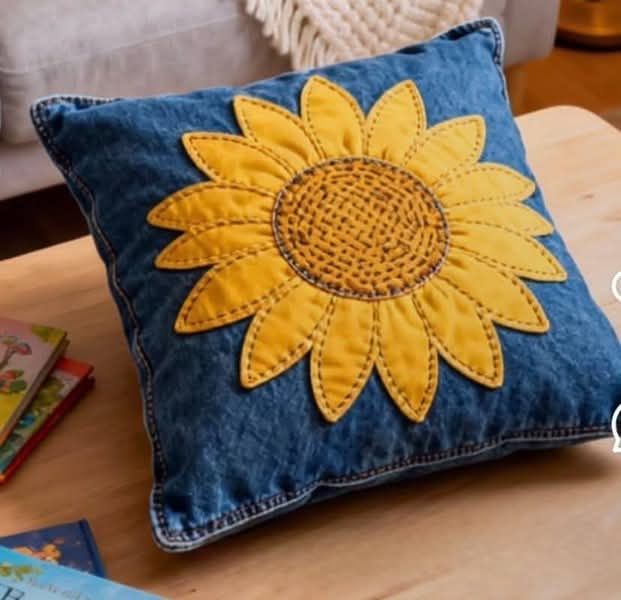
The Cushion with Sunflower Appliqué Pattern is a cheerful sewing project that combines the comfortable look of a handmade cushion with the timeless beauty of a sunflower. Inspired by the cushion shown in the reference photo, this project features a rich blue fabric background, large golden-yellow petals, a textured circular flower center, and visible decorative stitching that gives the entire design a warm handcrafted personality. The contrast between blue fabric and yellow sunflower appliqué makes the flower immediately stand out, while the slightly rustic finish keeps the cushion welcoming rather than overly formal. It is a wonderful project for anyone who enjoys sewing, appliqué, patchwork, or simply adding handmade decorations to the home. Best of all, the basic construction can be adapted to many cushion sizes once you understand how the individual layers work together.
One of the most appealing aspects of this sunflower appliqué cushion is that it looks elaborate without requiring an unnecessarily complicated construction method. The flower can be assembled from individual fabric petals arranged around a circular center, making the pattern easy to enlarge or reduce. Decorative stitching around each petal creates definition and helps secure the appliqué pieces, while additional stitching inside the brown or golden center can reproduce the textured appearance associated with sunflower seeds. For beginners, the project offers an excellent introduction to fabric appliqué techniques, curved sewing, layering, and cushion assembly. More experienced sewists can personalize it with free-motion quilting, hand embroidery, contrasting thread, denim, recycled fabrics, or additional quilting behind the flower.
Before beginning your Cushion with Sunflower Appliqué Pattern, it helps to think of the project as three simple components: the cushion background, the sunflower appliqué, and the finished cushion cover. For a practical decorative cushion, you can begin with two background fabric pieces measuring approximately 45 × 45 cm, adding seam allowance as needed for your chosen construction method. You will also need golden-yellow fabric for the petals, brown or ochre fabric for the center, matching or contrasting sewing thread, lightweight fusible web if desired, pins or fabric clips, fabric scissors, an iron, a sewing machine, and a cushion insert. A sturdy cotton, cotton-linen blend, canvas, or medium-weight denim can work especially well for the background because these materials provide enough structure to support the large flower.
Materials, Measurements, and Preparing the Sunflower Appliqué
Start by selecting the fabrics that will define the personality of your Cushion with Sunflower Appliqué Pattern. The reference design uses a deep denim-like blue background combined with warm yellow petals, creating a strong complementary contrast. You can achieve a similar appearance with blue denim, chambray, canvas, or quilting cotton backed with interfacing. For the petals, choose a golden-yellow cotton fabric that is easy to press and sew. The sunflower center can be made from ochre, mustard, brown, or a textured print. Using fabrics with slightly different textures can make the finished appliqué look even more dimensional.
DISCOVER MORE FREE PATTERNS HERE!
Prepare the cushion front first. For a finished cushion of approximately 43 × 43 cm, cut the front panel slightly larger, around 45 × 45 cm, so you have room for seams and final trimming. Exact dimensions can be adjusted according to your cushion insert and preferred seam allowance. Press the fabric carefully before marking the flower position. Fold the panel lightly in half vertically and horizontally or use a removable fabric marker to identify the center. Accurate placement is important because the large sunflower should feel balanced within the square rather than appearing crowded against one edge.
Next, create a simple sunflower petal template from paper or lightweight cardboard. A practical starting size for a cushion of this scale is approximately 10–12 cm long and 4–5 cm wide at the broadest point. Draw an elongated teardrop or leaf shape with a rounded base and gently pointed tip. The photograph suggests roughly two dozen overlapping petals, but the exact number can vary according to petal width and flower diameter. Cut one paper template first and arrange several paper copies around a circle before cutting your fabric. This quick test helps you determine whether your proportions will produce the full, abundant sunflower appearance you want.
Trace the petal template onto the wrong side of your yellow fabric or onto the paper backing of fusible appliqué web. If you are using raw-edge appliqué, fusible web is especially useful because it keeps the petals stable while you stitch around them. Follow the manufacturer’s directions for whichever fusible product you have, since pressing temperature and time can differ. Cut the petals neatly and consistently, but remember that a handmade sunflower does not need mathematical perfection. Small differences among the petals can actually create a more organic flower and prevent the finished design from looking overly mechanical.
For the flower center, draw a circle approximately 15–17 cm in diameter, adjusting it according to the size of your petals and cushion. The center should overlap the inner ends of the petals enough to hide their bases completely. Cut the circle from brown, ochre, mustard, or textured cotton. If the fabric is lightweight, stabilize it with fusible web or lightweight interfacing. This central circle is an important visual feature of the sunflower appliqué pattern, so choosing a fabric that contrasts slightly with the petals will help preserve the recognizable sunflower structure.
Before attaching anything permanently, arrange all the pieces on the cushion front. Place the petals around the marked center, allowing neighboring petals to overlap slightly. You can create an outer ring first and then adjust alternating petals inward to produce the layered effect visible in the inspiration image. Place the circular center over the petal bases and inspect the design from a short distance. Check the spacing on all four sides of the cushion. Once you are satisfied with the arrangement, secure the pieces with fusible web, appliqué glue intended for fabric, or careful pinning so they remain in position during sewing.
Sewing, Decorative Stitching, and Assembling the Cushion
Begin sewing the petals after the appliqué pieces are securely positioned. A straight stitch, blanket stitch, zigzag stitch, or appliqué stitch can all work depending on the finish you prefer. Straight stitching close to the raw edge produces a rustic look similar to the reference cushion, especially when paired with denim or canvas. Sew slowly around each curved petal and reduce your machine speed as you approach the pointed tip. When necessary, stop with the needle down, lift the presser foot, rotate the fabric slightly, and continue. This technique makes curved outlines much easier to control.
Decorative stitching can transform simple yellow fabric into convincing sunflower petals. After securing the perimeter, sew one or two gently curved lines from the base toward the tip of each petal. These lines imitate the natural veins of a sunflower and add definition without requiring complicated embroidery. You can use gold, brown, dark yellow, or contrasting thread depending on the effect you want. A slightly darker thread creates the highly visible handmade outline seen in the inspiration photo, while matching yellow thread creates a softer and more subtle result.
Now position the circular center over the inner ends of the petals and stitch around its perimeter. For a distinctive handcrafted appearance, use a medium-width decorative stitch or sew two parallel rows near the edge. The sunflower center can then be quilted or embroidered with a grid, spiral, crosshatch, or seed-inspired pattern. One simple method is to sew diagonal lines in one direction and then cross them with another set of diagonal lines. Another option is a loose spiral beginning near the center and gradually expanding outward. These stitches provide visual texture and can help the circular appliqué lie flat against the cushion front.
If you want the cushion to have more dimension, place a thin layer of batting behind the completed front panel before adding extra quilting. Baste the layers together and quilt around the sunflower or add understated lines across the blue background. This optional step gives the appliqué cushion a slightly padded, substantial appearance. Avoid excessive quilting directly over the petals if you want them to remain visually prominent. The objective is to support the appliqué rather than flatten every detail. After quilting, square and trim the panel carefully to your intended final dimensions.
The back of the cushion can be constructed with either a zipper closure or a simple envelope opening. An envelope cushion cover is often the easiest option for beginners because it avoids zipper installation. Cut two back pieces wide enough to overlap generously at the center, hem the exposed edges, and position them right sides together with the completed cushion front. Pin or clip around all four sides, making sure the sunflower appliqué is safely away from the seam allowance. Sew around the perimeter using a consistent seam allowance, reinforcing the corners and areas where the envelope panels overlap.
Trim excess bulk from the corners without cutting through the stitching, then turn the cover right side out through the envelope opening. Gently push out each corner with a blunt turning tool and press the edges carefully. Insert the cushion form and adjust the corners until the filling sits evenly. At this stage, your Cushion with Sunflower Appliqué Pattern should display a large golden flower centered prominently against the blue background. The combination of layered petals, visible stitching, and the textured circular center gives the project its distinctive handmade character while still creating a polished decorative piece suitable for a sofa, chair, reading corner, or bedroom.
FAQ About the Cushion with Sunflower Appliqué Pattern
What fabric is best for a Cushion with Sunflower Appliqué Pattern? Medium-weight cotton, canvas, cotton-linen blends, chambray, and lightweight or medium-weight denim are all practical choices. The background should be stable enough to support the large appliqué without excessive stretching. For the petals, quilting cotton is particularly convenient because it cuts cleanly, presses well, and is available in many shades of yellow. If your chosen background fabric is lightweight, adding interfacing or batting can provide extra stability.
How many petals should a sunflower appliqué have? There is no mandatory number because this is a decorative interpretation rather than a botanical diagram. For a large cushion flower, approximately 20–26 fabric petals can create a full appearance, depending on their width and the amount of overlap. Instead of focusing entirely on the number, arrange the petals around your center template before sewing. The goal is to avoid obvious gaps while maintaining a balanced, natural-looking circular silhouette.
Do I need fusible web for sunflower appliqué? Fusible web is not absolutely necessary, but it can make the process much easier. It temporarily or permanently stabilizes the appliqué shapes and reduces movement while you sew around curved edges. This is particularly useful when working with many separate petals. If you prefer traditional methods, you can use pins, temporary fabric adhesive designed for sewing, or turned-edge appliqué. The best appliqué method depends on your experience, available supplies, and preferred finished appearance.
Can beginners make this sunflower cushion? Yes. The project can be beginner-friendly when approached one stage at a time. Start with a straightforward raw-edge appliqué method and use a simple straight or zigzag stitch around the petals. Beginners should practice on fabric scraps before stitching the actual cushion, especially when learning to pivot around pointed petal tips. Taking time to prepare an accurate template and arrange all pieces before sewing usually makes the construction process considerably easier.
How can I prevent the appliqué fabric from fraying? Fusible web helps stabilize raw edges, while a narrow zigzag or satin-style stitch can cover exposed fabric edges more completely. If you intentionally want a rustic appearance, straight stitching slightly inside the raw edge allows a small amount of controlled fraying over time. For a cleaner finish, use turned-edge appliqué or a dense edge stitch. Always test the selected stitch on scraps of the same fabrics before working on the final cushion front.
Can the sunflower pattern be resized? Absolutely. One advantage of a simple petal-and-circle construction is that it can be scaled for different projects. For a smaller cushion, reduce both the petal template and center circle proportionally. For a larger cushion, enlarge them while preserving enough blue background around the flower. The same sunflower appliqué pattern concept can also be adapted to quilt blocks, fabric panels, tote bags, table decorations, and other sewing projects, provided the appliqué size suits the supporting fabric.
Conclusion
Finishing Your Cushion with Sunflower Appliqué Pattern
Creating a Cushion with Sunflower Appliqué Pattern is an enjoyable way to combine practical sewing with decorative fabric art. The project begins with a stable square background and gradually develops through carefully arranged golden petals, a contrasting circular center, and expressive stitching. Although the completed flower contains many individual elements, each stage relies on accessible techniques: tracing, cutting, positioning, appliqué stitching, decorative quilting, and basic cushion construction. Working carefully through these stages makes the design manageable even if you have limited experience with appliqué.
The color palette plays an especially important role in recreating the visual impact of the inspiration. A deep blue cushion background provides dramatic contrast against golden-yellow petals, while an ochre or brown center adds warmth and visual depth. You do not have to copy these colors exactly, however. Navy, turquoise, cream, gray, sage green, or even natural linen can provide beautiful alternative backgrounds. Likewise, mixing several shades of yellow and gold among the petals can create a more dimensional, scrap-friendly sunflower.
The stitching is another defining feature of this project. Instead of treating seams only as a construction necessity, the decorative appliqué stitching becomes part of the design. Visible outlines around the petals emphasize their shapes, interior lines suggest natural petal veins, and crosshatched or spiral stitching gives the center a seed-like texture. These details are particularly effective because they add character without requiring expensive embellishments. A standard sewing machine with basic stitches can produce an attractive result.
Remember that careful preparation often matters more than speed. Press the fabrics before cutting, test the petal arrangement before fusing, check that the sunflower is centered, and practice your chosen stitches on scraps. These small habits help prevent common problems such as puckered appliqué, uneven spacing, distorted circles, or petals extending too close to the cushion seams. When making your first Cushion with Sunflower Appliqué Pattern, allowing extra time for positioning can make the sewing stage much more comfortable.
Once you understand the construction, you can personalize future versions freely. Try different background fabrics, combine several yellow prints, experiment with denim appliqué, add hand embroidery, introduce subtle quilting, or change the scale of the flower. You could even use leftover fabric from other projects to create a scrappy sunflower. The underlying technique remains the same, but changes in color, texture, thread, and petal arrangement can make every finished cushion unique.
EASILY FIND THE FREE PDF FOR THIS PATTERN HERE!
Most importantly, enjoy the handmade process and allow your individual sewing style to become part of the finished piece. The Cushion with Sunflower Appliqué Pattern brings together bold color, recognizable floral imagery, useful appliqué skills, and a practical home accessory in one approachable project. After finishing yours, take a moment to look at which techniques worked best and what you might change in your next version. Leave your sincere opinion about this sunflower cushion project and share your suggestions—your ideas about colors, fabrics, stitching styles, or creative variations can inspire even more beautiful handmade projects.