
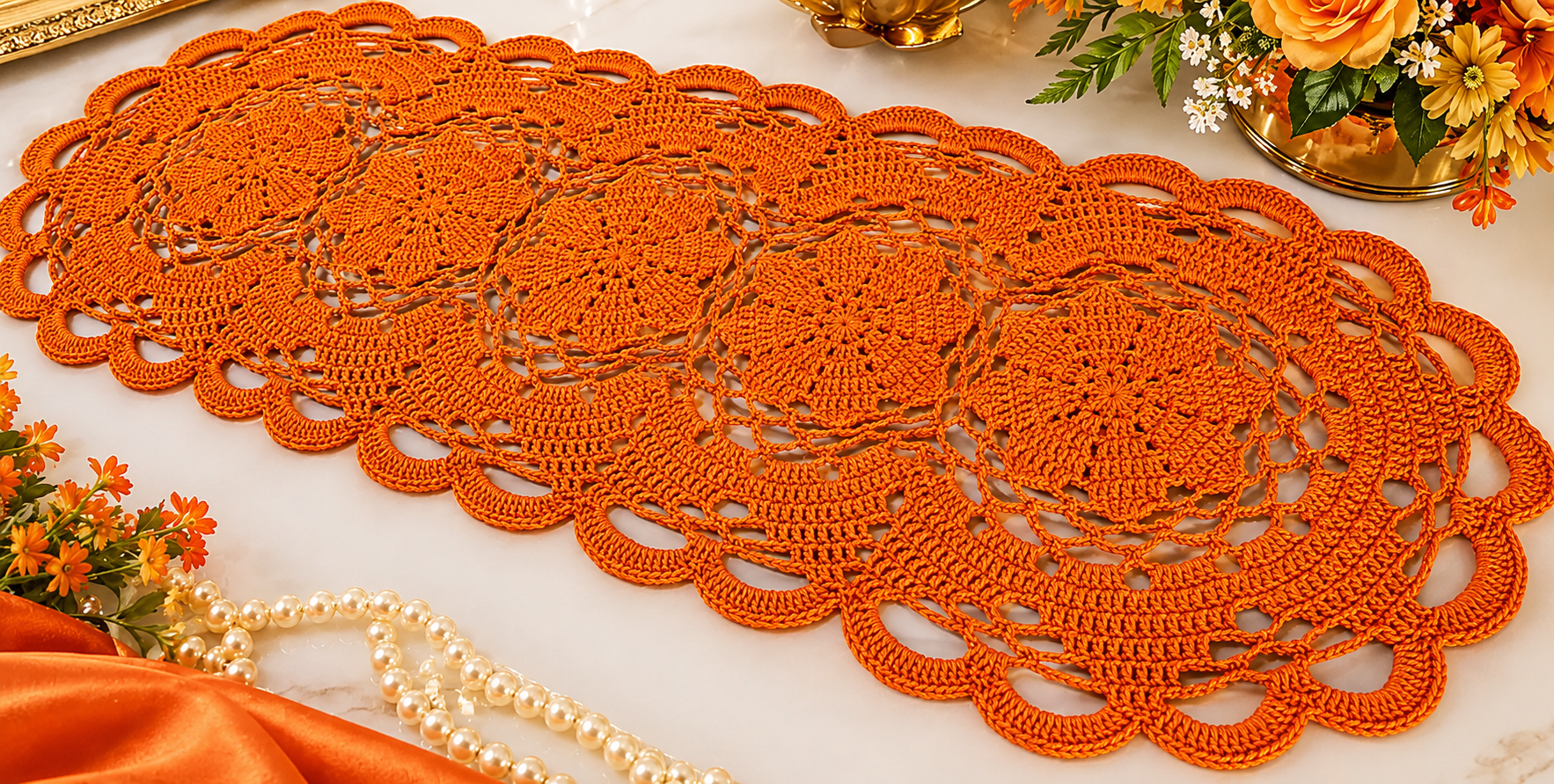
Table runner with flowers and a heart Pattern is a decorative crochet project that combines open lacework, floral-inspired motifs, elegant shaping, and a romantic handmade appearance. A crocheted table runner can completely change the feeling of a dining table, sideboard, coffee table, or special display area without requiring complicated materials. This project is especially attractive because the repeating shapes create visual movement while the delicate openings between the stitches allow the surface underneath to become part of the design. For crocheters who enjoy creating functional pieces with a traditional handmade look, this crochet table runner pattern is a rewarding project that can be adapted to many home décor styles.
One of the most interesting features of the Table runner with flowers and a heart Pattern is the way simple crochet stitches can be combined to create a design that appears much more intricate than it actually is. Chains form the open spaces, double crochet stitches provide structure, and increases help shape the rounded floral sections. Decorative arches around the outer edge can then give the runner a soft, scalloped finish. When these techniques are worked carefully and consistently, the result is a balanced piece that looks elegant from both a distance and up close. Understanding what each crochet symbol or stitch abbreviation means before beginning will make the entire process easier.
The instructions below are written as a practical guide rather than an exact reproduction of a commercial chart. Because crochet tension, yarn thickness, hook size, and the number of repeating motifs can change the final dimensions, measurements should be treated as adjustable. The goal is to teach you how to build a similar flower and heart crochet table runner using common crochet techniques and clearly explained stitch combinations. Before beginning, make a small gauge sample and decide how long you want the finished runner to be. A longer dining table may need additional motifs, while a smaller console table may look better with fewer repeats.
Materials, Crochet Terms, and Preparation
For the Table runner with flowers and a heart Pattern, choose a smooth cotton or cotton-blend yarn that provides good stitch definition. Crochet cotton is particularly useful for decorative table pieces because the stitches remain visible and the fabric usually blocks well. A medium-fine yarn can create a delicate runner, while slightly thicker cotton produces a more substantial piece. Choose a crochet hook that works comfortably with the selected yarn and creates open but stable stitches.
DISCOVER MORE FREE PATTERNS HERE!
You will also need scissors, a yarn needle, several stitch markers, measuring tape, and blocking pins. Stitch markers are useful when working repeating floral motifs because they help identify the beginning of each repeat. Blocking supplies are equally important because lace crochet often looks uneven immediately after finishing. Blocking allows the chains, arches, flowers, and decorative border to open into their intended shape.
The abbreviation ch means chain stitch. To make a chain, create a slip knot, insert the hook into the loop, yarn over, and pull the yarn through. Chain stitches form the foundation of many crochet patterns and are also used to create decorative spaces. In this table runner, groups of chains can create the open lace sections surrounding the flowers and heart-inspired shapes.
The abbreviation sc means single crochet. Insert the hook into the indicated stitch or chain space, yarn over, pull up a loop, yarn over again, and pull through both loops on the hook. Single crochet creates a compact stitch and is helpful for joining motifs, anchoring chain arches, and strengthening the outer border of a crochet table runner.
The abbreviation dc means double crochet. Yarn over before inserting the hook into the stitch, pull up a loop, yarn over and pull through two loops, then yarn over and pull through the remaining two loops. Double crochet is one of the main structural stitches used in decorative crochet because it creates height without making the fabric excessively dense.
You may also use sl st, meaning slip stitch, to join rounds or move the working yarn without adding significant height. Another useful term is ch-sp, meaning chain space. When instructions say to work stitches into a chain space, insert the hook under the chain rather than directly into an individual chain stitch unless otherwise specified.
Creating the Flower and Heart-Inspired Motifs
Begin the first floral section of the Table runner with flowers and a heart Pattern with a small adjustable ring or a chain ring. One practical method is to make ch 6, then join with sl st into the first chain to create a circle. This ring will become the center of the first decorative flower. Keep the ring loose enough to accommodate several stitches without causing the center to buckle.
For Round 1, make ch 3, which can count as the first double crochet. Work approximately 15 dc into the center of the ring, then join with sl st into the top of the beginning chain. You should now have a circular center. If you prefer a fuller motif, increase the stitch count evenly, but always keep the number of stitches divisible by the number of petals you intend to create.
For Round 2, begin forming the petal divisions. A useful sequence is ch 4, skip 1 stitch, sc in the next stitch, repeating around the circle. This creates evenly spaced chain arches. These arches will become the foundation for the petals. Make sure the arches remain consistent in size because uneven chain tension can cause one section of the flower to appear larger than another.
For Round 3, work into each chain arch using a sequence such as sc, hdc, 3 dc, hdc, sc. This creates a gently rounded petal. Continue around until every chain arch contains one petal. Depending on the number of arches created in the previous round, you may end up with eight or more petals. The important point is maintaining symmetry.
To introduce a heart-inspired crochet shape, modify two adjacent petals by adding extra height at their outer edges. For example, work 2 dc, 2 tr, 2 dc into one side of each selected arch. Between those two raised sections, use a slip stitch or single crochet to create a small indentation. This creates the familiar upper curves associated with a heart without requiring an entirely separate motif.
After completing the flower and heart sections, begin the surrounding lace framework. Work a repeating sequence such as ch 5, sc into the next petal tip, ch 5, sc into the following petal tip. These chain loops expand the motif outward while creating the airy appearance associated with decorative crochet runners. Continue evenly around the motif before joining the round.
Joining Motifs and Building the Table Runner
Once the first motif is complete, create additional motifs using the same method. The Table runner with flowers and a heart Pattern becomes elongated by joining individual floral sections into a horizontal arrangement. Three, four, five, or more motifs may be used depending on the desired length. Always compare each new motif with the previous one to make sure your tension remains consistent.
The easiest joining method is the join-as-you-go crochet technique. When working the final chain-loop round of the second motif, replace the middle chain of selected arches with a slip stitch into the corresponding arch of the first motif. For example, instead of making ch 5, you might work ch 2, sl st into the neighboring motif, ch 2, then continue the pattern.
Join the motifs at several points rather than at only one location. Multiple joining points keep the runner flat and prevent the motifs from swinging independently. Two or three connections between neighboring flowers are usually enough for a light lace runner. A larger motif may benefit from additional attachment points.
Continue attaching motifs until the crochet flower table runner reaches your preferred length. Lay the piece flat occasionally while working. This simple step helps identify twisting or pulling before the entire project has been completed. If one side begins curving inward, the joining tension may be too tight. If large gaps appear between motifs, additional joining points may be necessary.
After joining the central motifs, crochet around the entire outer edge to create a continuous framework. Begin with sc stitches and chain spaces around the perimeter. For example, work sc into a petal tip, ch 5, sc into the next available joining point. Adjust the number of chains depending on the distance between structural points.
A second outer round can include groups of double crochet to give the lace more stability. Work something similar to 5 dc into a chain space, ch 3, 5 dc into the next suitable space. This alternating pattern creates decorative fans and open areas. Keep checking that the runner remains flat; if the edges ripple excessively, reduce the number of stitches in the fan groups.
Finish this stage with another round of chain loops or compact stitches. The combination of solid crochet and open spaces gives the Table runner with flowers and a heart Pattern its recognizable lace texture. Each row should support the next rather than dramatically increasing the circumference unless a wider border is intentionally desired.
Crochet Border, Finishing, and Blocking
The border is one of the most visually important elements of the Table runner with flowers and a heart Pattern because it frames the floral motifs. A scalloped crochet border works particularly well with this style. Begin by creating evenly spaced foundation arches around the entire runner using ch 6 or ch 7, anchored with single crochet stitches.
On the next round, work several double crochet stitches into each arch. A common combination is 7 dc into the chain space, sc into the next anchoring point. This creates rounded scallops. For a wider border, increase the number of double crochet stitches slightly, but avoid adding so many stitches that the edge becomes wavy.
A more decorative version can use picot stitches. To make a picot, work ch 3, then slip stitch into the first chain. Picots can be placed at the highest point of each scallop. They create tiny decorative peaks that complement the open lace structure without overwhelming the central flower motifs.
When the final border is complete, cut the yarn while leaving a tail approximately 12 to 15 cm long. Pull the yarn through the final loop and tighten gently. Thread the tail through a yarn needle and weave it through several stitches on the wrong side of the runner. Change direction once or twice so the yarn remains secure.
Blocking is essential for achieving a polished result. Gently wash or dampen the finished runner according to the yarn manufacturer’s care instructions. Remove excess moisture without twisting the crochet fabric. Lay the runner on a blocking surface and carefully stretch the motifs until the flowers, heart-inspired sections, and scalloped edges appear symmetrical.
Pin the runner into position and allow it to dry completely. Once dry, remove the pins and check the final dimensions. A properly blocked crochet table runner with flowers should lie flat, display clearly defined openwork, and maintain consistent curves around the border. Store the runner folded loosely or rolled to protect the decorative stitches.
FAQ About the Table runner with flowers and a heart Pattern
What yarn is best for a crochet table runner?
Cotton yarn is one of the most popular options because it provides excellent stitch definition and generally holds its shape well after blocking. Mercerized cotton can give the project a slightly polished appearance, while softer matte cotton creates a more rustic handmade look.
What crochet hook size should I use?
The hook size depends on the yarn thickness and your personal tension. For fine cotton, hooks around 2.0 mm to 3.5 mm are commonly comfortable. Thicker yarn may require a larger hook. Make a small sample first and choose the hook that produces clear stitches without creating a stiff fabric.
Can beginners make the Table runner with flowers and a heart Pattern?
An adventurous beginner who understands chains, single crochet, double crochet, slip stitches, and working in rounds can attempt the project. The joining process may require extra attention, so beginners should work slowly and use stitch markers when necessary.
How can I make the table runner longer?
Add additional flower motifs before completing the outer border. Because the main structure is based on repeating sections, increasing the length is relatively straightforward. Make sure all motifs are joined consistently so the final runner remains balanced.
How can I make the runner shorter?
Simply use fewer motifs. For example, a small centerpiece may use three motifs, while a longer dining table runner might require five or seven. The exact number depends on the diameter of each finished motif.
Why is my crochet runner curling?
Curling usually happens because the stitch count, chain length, or tension is too tight. Blocking can correct minor curling, but severe distortion may require removing a round and adjusting the number of chains or stitches.
Why is my border becoming wavy?
A wavy edge often indicates too many stitches have been added. Reduce the number of double crochet stitches inside each scallop or slightly increase the distance between border groups.
Can I use acrylic yarn instead of cotton?
Yes, but the finished appearance may be different. Acrylic can be softer and lighter, while cotton usually creates more defined lace. If you use acrylic yarn, follow appropriate blocking methods because excessive heat can damage synthetic fibers.
How do I keep all the flower motifs the same size?
Use the same yarn, hook, stitch counts, and tension for every motif. Measuring each completed flower before joining can help identify differences early.
Can the heart section be made more visible?
Yes. You can increase the height of the two upper curves by using treble crochet stitches and creating a deeper central indentation with a slip stitch. Blocking the heart shape carefully will also make the outline easier to see.
Should I block every motif before joining them?
It is optional. Some crocheters lightly block individual motifs before joining, which can make alignment easier. Others complete the entire runner first and perform one final blocking session.
How do I wash a handmade crochet table runner?
Always consider the care instructions for the yarn. Gentle hand washing is often suitable for cotton lace. Avoid aggressive twisting because it can distort the open stitches and decorative border.
Can I use different colors in this pattern?
Absolutely. A single-color runner emphasizes stitch texture, while multiple colors can highlight individual flowers or the heart-inspired motif. Neutral tones create a classic look, while orange, gold, red, green, or pastel shades can create seasonal variations.
How long does a crochet table runner take to make?
The time depends on the size, yarn thickness, crochet speed, and number of motifs. A small runner may be completed over several crafting sessions, while a detailed larger runner can require considerably more time.
What are the most important stitches to learn for this project?
The essential techniques are chain stitch, single crochet, double crochet, slip stitch, working into chain spaces, creating scallops, and joining motifs. Once these techniques feel comfortable, the construction becomes much easier to understand.
Conclusion
The Table runner with flowers and a heart Pattern brings together several beautiful crochet techniques in one decorative home project. By learning how to create a circular flower center, build petals with increasing stitch heights, shape heart-inspired curves, surround motifs with chain lace, and connect repeating sections, you can create a runner that looks detailed while still being based on familiar crochet stitches.
The most important lesson is to work consistently. Keep your chain tension even, count stitches carefully, compare the size of each motif, and check the runner on a flat surface throughout the process. These simple habits can prevent many common problems and make the joining and border stages much easier.
You also learned how ch, sc, dc, sl st, chain spaces, fan stitches, picots, and scalloped borders work together. Understanding these crochet terms makes it possible to read many other crochet diagrams and patterns with greater confidence.
The design can easily be customized. Add more motifs for a long dining table, use fewer for a small centerpiece, change the yarn color to match different seasons, or experiment with a wider decorative border. This flexibility is one of the reasons handmade table runners remain such enjoyable crochet projects.
Finally, remember that blocking is not simply an optional finishing detail for lace crochet. It helps reveal the openwork, improves symmetry, defines the flowers and heart-inspired shapes, and gives the finished project a more refined appearance. I hope this guide helps you understand the complete process behind the Table runner with flowers and a heart Pattern and inspires you to experiment with your own version. After making it, leave your sincere opinion about the pattern and share any suggestions you have for colors, borders, stitch combinations, or future crochet projects.