
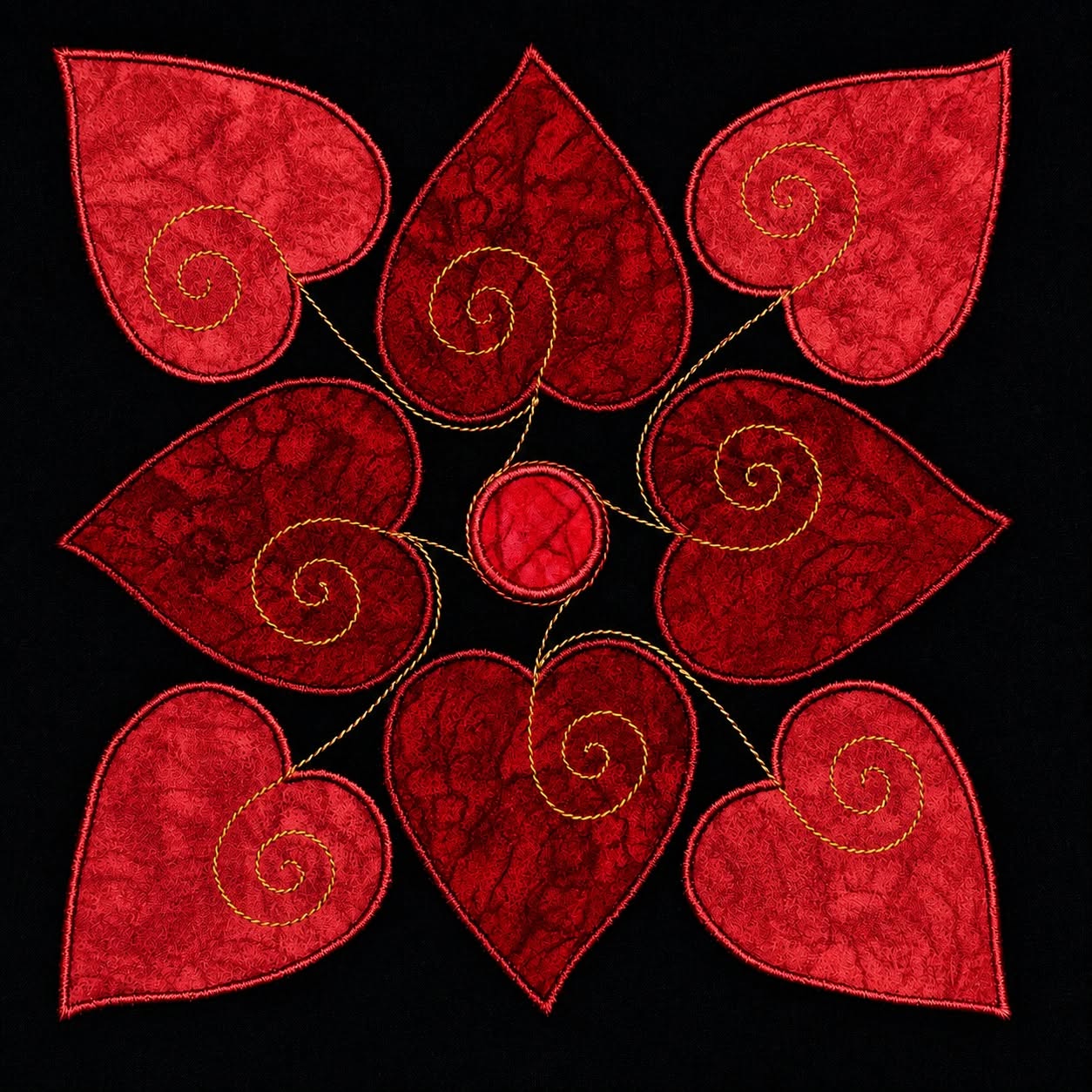
Quilt Block with Heart and Leaf Appliqué Pattern is a charming textile project that combines the softness of heart shapes with the natural elegance of pointed leaves. Inspired by the photographed design, this block features a balanced arrangement of light and dark green appliqué pieces placed over a deep black background. Decorative golden spirals, contrasting stitched outlines, and a small circular center add movement and personality to the composition. The result can be used as an individual wall hanging, incorporated into a larger quilt, transformed into a cushion cover, or adapted into a decorative table mat. Although the finished design looks detailed, it can be completed successfully by beginners who work carefully through each stage.
The main technique used in this appliqué quilt block is fabric appliqué, which means attaching smaller fabric shapes to a larger background fabric. In this project, heart and leaf templates are cut from different shades of green fabric before being arranged symmetrically. The raw edges can be secured with a satin stitch, blanket stitch, zigzag stitch, or another decorative machine stitch. The golden spiral embroidery inside each shape is not only decorative; it also helps unify all the pieces and creates a handmade finish. By combining fabric color, shape, texture, and thread, the block becomes visually interesting without requiring an overly complicated construction method.
Before beginning the Quilt Block with Heart and Leaf Appliqué Pattern, take time to study the layout and decide how large you want the finished block to be. A practical size for a decorative block is approximately 16 inches by 16 inches, but the pattern can be enlarged or reduced according to your project. When resizing the templates, keep every shape proportional so the composition remains balanced. The photographed block uses repeated heart-like leaves around a central circle, with fine stitched lines connecting the pieces. This radial arrangement gives the impression of a flower, vine, or ornamental garden motif, making it suitable for modern, traditional, botanical, and seasonal quilting styles.
Materials and Tools for the Appliqué Quilt Block
Choose a strong black cotton fabric for the background of your heart and leaf quilt block. Quilting cotton is an excellent option because it is stable, easy to press, and compatible with both hand and machine stitching. Cut the background slightly larger than the intended finished size. For a 16-inch finished block, begin with an 18-inch square so you have extra fabric for trimming and squaring after the appliqué is complete.
DISCOVER MORE FREE PATTERNS HERE!
Select at least two contrasting shades of green quilting cotton for the heart and leaf pieces. One light green and one dark green will recreate the visual contrast seen in the reference image, but you may add a medium green for greater variety. Fabrics with subtle tonal prints work especially well because they create texture while allowing the shapes and decorative stitching to remain clearly visible. Avoid extremely busy prints that could compete with the golden spiral details.
You will also need fusible web, which is a thin adhesive material used to temporarily or permanently bond appliqué pieces to the background. Fusible web keeps the shapes from moving while they are stitched and makes the assembly process more manageable. Some products have a paper backing that allows you to trace each template directly onto the adhesive. Always follow the pressing temperature recommended by the manufacturer so the fabric does not scorch or become stiff.
Prepare threads that coordinate with the appliqué fabrics and the decorative details. Light green thread can outline the pale shapes, while dark green thread can secure the darker leaves. A warm yellow, mustard, or antique gold embroidery thread is ideal for the spiral designs. For the fine connecting lines, use pale green or yellow thread. Good-quality thread helps prevent excessive lint, broken stitches, and uneven tension during construction.
Basic sewing supplies include sharp fabric scissors, small appliqué scissors, a fabric marking pen, a ruler, a cutting mat, a rotary cutter, pins, an iron, and a pressing surface. A sewing machine with an adjustable zigzag or satin stitch will speed up the finishing process. However, the entire Quilt Block with Heart and Leaf Appliqué Pattern can also be stitched by hand using blanket stitches, whipstitches, stem stitches, and backstitches.
For added structure, prepare lightweight stabilizer or embroidery backing. Stabilizer supports the background fabric while dense satin stitching and decorative spirals are sewn. Without support, the black fabric may pucker around the appliqué edges. A tear-away stabilizer is convenient for machine work, while a lightweight fusible stabilizer can remain inside the finished project. Test the combination of fabric, thread, needle, and stabilizer on a scrap before sewing the actual block.
Preparing the Heart and Leaf Appliqué Pattern
Begin by drawing or printing the shapes needed for the arrangement. The design uses large pointed heart shapes, smaller rounded hearts, broad leaves, a large center-bottom heart, and a small center circle. The repeated pieces do not need to be perfectly identical, but they should share similar proportions. Fold paper in half before drawing each heart to create balanced sides. For the leaves, draw a gentle point at one end and a curved base at the other.
Trace each template onto the paper side of the fusible web. Remember that fusible appliqué templates are usually traced in reverse, especially when direction matters. In this design, most shapes are symmetrical, so reversal will not significantly change their appearance. Leave approximately half an inch between traced pieces to make cutting easier. Label each template according to its color and position, such as “top light heart,” “side dark leaf,” or “bottom center heart.”
Roughly cut around the traced templates, leaving a small margin outside each line. Place the adhesive side against the wrong side of the selected green fabric and press it according to the fusible web instructions. Do not slide the iron back and forth, because this may distort the fabric or move the adhesive. Instead, lower the iron onto one area, hold it briefly, lift it, and continue until the entire template is attached.
After the fabric has cooled, cut directly on the traced lines with sharp scissors. Smooth, accurate cutting is important because the finished appliqué edge will follow these shapes. For tight inner curves on the heart pieces, use small scissors and make controlled cuts. Do not clip too deeply into the center indentation. Peel away the paper backing only after all pieces have been cut and checked for size and shape.
Place the black background fabric on a flat work surface and mark its horizontal and vertical center lines with a removable fabric marker. These guidelines will help you build a symmetrical botanical appliqué pattern. Position the small circle near the center of the block first. Arrange one large dark green heart above it and another large dark green heart below it. These elements create the strong vertical foundation of the composition.
Continue adding the remaining shapes around the center. Place two light green hearts near the upper corners and two light green hearts near the lower corners. Position the dark green leaves on the middle left and middle right. Adjust the spacing until the arrangement feels balanced. Leave enough black background visible between the shapes so the connecting stitched lines can be added later. Take a photograph of the layout before pressing to preserve your preferred arrangement.
Fusing, Stitching, and Decorating the Appliqué Shapes
Once you are satisfied with the placement, fuse the pieces to the background. Work from the central elements outward so nearby shapes are not accidentally moved. Cover the fabric with a pressing cloth to protect the appliqué and thread area. Press each piece without shifting the iron. Allow the block to cool completely before lifting or moving it, because warm fusible adhesive may not have reached its full holding strength.
Place stabilizer behind the entire background square. Set your sewing machine to a narrow satin stitch, zigzag stitch, or decorative appliqué stitch. Test the stitch width and length on scrap fabric first. The goal is to cover the raw edge without creating an excessively thick ridge. Use a slightly shorter stitch around curves and inner heart points, turning the fabric gradually to maintain a smooth outline.
Start stitching around the larger pieces. Keep the raw edge positioned beneath the center of the presser foot so one side of the stitch falls on the appliqué and the other side enters the black background. Stop with the needle down whenever you need to rotate the block. This method prevents gaps and uneven corners. At the top indentation of each heart, reduce the stitch width slightly or pivot carefully to create a neat V-shaped finish.
Outline the small center circle with a close satin stitch. Because this piece is small and curved, sew slowly and rotate the block frequently. The circle may be made from light green fabric to provide contrast against the black background and dark surrounding shapes. Add a second stitched outline if you want the center to appear more prominent. Trim loose threads from the front and secure thread tails on the back.
Draw a loose spiral inside every heart and leaf using a removable fabric marker. The spirals should begin near the center and expand outward without touching the appliqué edge. Stitch over each drawn line with golden thread. A straight stitch, triple straight stitch, stem stitch, or narrow chain stitch can be used. Keep the spirals relaxed and organic rather than perfectly geometric, as slight variation adds handmade character to the leaf appliqué quilt pattern.
Finally, mark curved connecting lines from the center circle toward the surrounding pieces. Stitch these lines with pale green, yellow, or variegated thread. The lines can be created with a straight stitch or a narrow decorative stitch. They should suggest delicate stems or vines while visually linking the appliqué units. Remove any visible marking lines, tear away excess stabilizer carefully, and press the completed block from the back.
Finishing and Using the Completed Quilt Block
After all stitching is finished, lay the block on a flat surface and check for puckering. Minor ripples can often be corrected with gentle pressing. Place the block face down on a soft towel, cover it with a pressing cloth, and press from the back. Avoid crushing raised embroidery stitches. Do not apply excessive steam unless you have already confirmed that the fabric and thread are colorfast.
Square the block by aligning the ruler with the marked center lines and trimming equal amounts from every side. A symmetrical border is especially important for this Quilt Block with Heart and Leaf Appliqué Pattern, because the design is based on a radial arrangement. For a 16-inch finished block, trim the piece to 16½ inches if it will be joined to other blocks with a quarter-inch seam allowance.
The completed block can become the focal point of a larger botanical quilt. Surround it with plain black blocks, green patchwork squares, or simple leaf-themed blocks. Repeating the appliqué in different color combinations can create a dramatic garden-inspired quilt. Consider using autumn shades, spring pastels, jewel tones, or monochromatic fabrics while keeping the same heart-and-leaf arrangement.
To create a cushion cover, add batting and backing behind the block, then quilt around the appliqué shapes. Echo quilting, in which lines follow the shape of each heart and leaf, will emphasize the design. Finish the back with an envelope closure or zipper. A cushion made from this pattern can add a handcrafted accent to a living room, sewing studio, guest room, or reading corner.
For a wall hanging, layer the block with batting and backing fabric, then quilt the black negative space. Simple meandering stitches, parallel lines, or additional leaf motifs can provide texture without distracting from the central design. Add binding around the outer edges and sew a hanging sleeve to the back. A narrow black binding produces a clean finish, while green or gold binding coordinates with the appliqué.
Proper care will help protect the decorative stitching. Wash the finished item gently in cool water with a mild detergent, especially when metallic or decorative threads are used. Avoid harsh bleach and aggressive agitation. Air drying is preferable for wall hangings and embroidered projects. Store the block flat or loosely rolled to prevent permanent creases across the appliqué shapes.
Frequently Asked Questions
What is appliqué in quilting?
Appliqué is a sewing technique in which smaller fabric shapes are attached to a larger background. The shapes may be secured with fusible adhesive, hand stitches, machine stitches, or a combination of these methods. In this project, appliqué creates the heart, leaf, and circular motifs.
Is the Quilt Block with Heart and Leaf Appliqué Pattern suitable for beginners?
Yes. A patient beginner can complete the project by using fusible web and a basic zigzag stitch. The most challenging areas are the heart indentations, pointed leaf tips, and small center circle. Practicing these shapes on scrap fabric will make the final sewing easier.
What is the best fabric for this quilt block?
Quilting cotton is the most practical choice because it is stable, easy to cut, and available in many colors and prints. Batik fabric is another excellent option because its tight weave and rich tonal patterns work beautifully for raw-edge appliqué.
Can the appliqué be sewn entirely by hand?
Yes. Use a small blanket stitch or whipstitch to secure the shapes and a stem stitch or backstitch for the spirals. Hand sewing takes longer but gives the block a soft, traditional appearance. A lightweight fusible web can still be used to hold each piece in place.
How can I prevent puckering around the appliqué?
Use stabilizer behind the background, reduce excessive thread tension, and avoid pulling the fabric while sewing. Dense satin stitches can cause distortion when the background is unsupported. Testing the settings on a fabric scrap is one of the best ways to prevent problems.
Can I change the colors of the pattern?
Absolutely. The heart and leaf design works in many palettes. Red and pink fabrics can create a romantic block, while orange and brown fabrics produce an autumn theme. Blue and turquoise offer a modern look, and scraps of multiple colors can turn the design into a cheerful rainbow project.
Do I need to add the golden spirals?
The spirals are optional, but they are an important decorative feature of the photographed design. They create movement, connect the repeated shapes, and contrast beautifully with green fabric. You may replace them with veins, flowers, dots, echo lines, or another decorative embroidery motif.
How large should the seam allowance be?
The appliqué pieces do not require a traditional seam allowance when using the raw-edge fusible method. Cut them directly on the template lines. The outer quilt block should include a quarter-inch seam allowance if it will be joined to other blocks.
How can I make an accurate circular center?
Trace around a small round object or use a circle template. Fuse the circle before stitching and sew slowly around its edge. Rotating the block in small increments with the needle lowered will produce a smoother outline.
What projects can be made from this block?
The finished heart and leaf appliqué block can be used for a quilt, pillow, tote bag panel, table mat, wall hanging, fabric book cover, or framed textile artwork. Its size can be adjusted to suit both small decorative accessories and large quilting projects.
Conclusion
The Quilt Block with Heart and Leaf Appliqué Pattern brings together symmetrical placement, contrasting green fabrics, decorative spirals, raw-edge appliqué, and careful finishing. You learned how to select materials, prepare templates, fuse the heart and leaf shapes, stitch the edges, embroider the golden details, add connecting lines, and transform the completed block into a useful handmade item.
EASILY FIND THE PDF FOR THIS PATTERN HERE!
With thoughtful preparation and steady stitching, this botanical design can become a distinctive feature in many sewing and quilting projects. Please leave your sincere opinion about the pattern and share suggestions for colors, finishes, or creative variations that could make the design even more inspiring.